 Slashdot Mirror
12-volt Plexiglass Computer
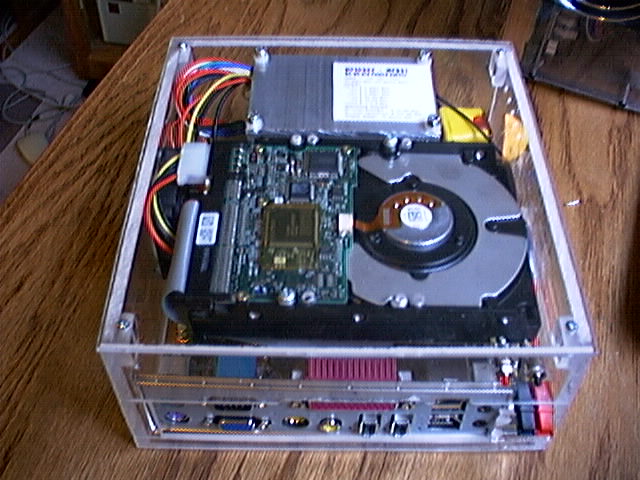
zootjeff writes: "I am in the process of designing and redesigning a computer for my car. This machine is based on the Shuttle FV24 motherboard. I built a box that is 8 inches by 7.5 inches by 3 inches. I also designed and built my own custom power supply. This could be useful to people who want to take linux into their car. It is also useful for solar powered battery operations." He sent some pictures, too, of what the 2nd case looks like, an
overview, including (!) police report number (the 2nd revision was stolen), more on
the power supply,
and the third iteration.
It's already been done...
I don't use a DC powersupply though.
One potential concern I see, especially with a car-bound computer, is impact resistance (potholes shake the unit around) and short-circuit fire safety. If you try using Lexan or Calibre sheet (polycarbonate) you'll improve the impact resistance of your case dramatically, and, the fire-resistance.
Plexiglass is notorious for getting brittle with heat and light exposure, both of which will happen if they sit in your car every day under the hot sun. One good summer could really do a number to the unit.
-When going for broke, go for Ithaca!
Conceptual Art like this is a fine way of improving the drudgery of the commute, where millions in their identikit Fords and Fiestas wander soulessly to and fro' employment in cubicles, some of us are free, free to make our wild imaginations reality.
Is playing with an in car computer really the same tho? I'm all a-quiver at the talents of these techy types, but what actual difference does this in car computer make? None, really, it won't inflame the mind or create beauty, and this is the problem with modern tinkering. 1950's mobiles had flaming jet burners on the back, and we are adding little bits of silicon? Yuk.
Thankfully, when I moved to America I noticed that there is an even bigger car scene, and I would go to my local car improvement rally were it not for all the guns held by the police and contestants at such events, quite barbarous, in many respects.
I urge the modifiers of the utilitarian not to invent even more utility, but to improve and create an original aesthetic. Art is what is missing from our lives, in the modern age, not linux computers.
Thumbnails won't work, but you didn't need to see them.
Could you please pass the word to the rest of your auto-sculpture friends that you need to use a better water-resistant glue in attaching all that crap? Our first good rain happened a couple weeks ago and I ended up following one of those trash-heaps on wheels. The freaking doll heads were tumbling off of the top of that POS car that they were once attached to and hitting my windshield.
Talk about disturbing.
Looking at the specs on my 1992 GM car - there is an onboard computer that controls the ignition timing - basically the timing is done by an almost analog circuit with the computer telling the circuit add or remove fuel from the mixture. Given how fast a piston moves in and out of the optimum range for firing the spark, it would be rather difficult to get a general computer and operating system to reliably send the signal to spark. There is a data bus that is available on most GM cars that will tell you all sorts of information - RPM, Fuel Mix Ratio, Governor speed and wheel speed etc. I'd rather have a computer that monitored the bus than have one that tried to replace the computers and circuits already in existence.
Moneyed corporations, non-working 'poor' and criminal prisoners are turning productive citizens into tax-slaves.
Most of us have seen nifty hardware setups with nice looking cases. However, I am much more interested in custom software to make a car computer more customized.
/., of a Macintosh based system like that - pretty darned cool. Combined with a wireless access card (too bad Ricochet went under) of some sort, it could be somewhat useful for an internet connection. GPS would be simple. Add a wireless ethernet card so when you park in your garage you can access your wireless hub/network (if you have the money to put a computer in your car you can afford a wireless hub). This would make transferring mp3s and other files nice. Perhaps download some web pages for offline reading, a bunch of cool games (and emulated games), and a few joysticks and you'd have a pretty cool entertainment center for the car.
Anyone who has owned or used a power inverter or more demanding electronics in a car knows that you really can't run it (for long) when the engine is off. An inverter will automatically shut itself off and turn itself on when the input voltage fluctuates (a sign that the engine has been turned off).
Since the input voltage is only 12 volts, a easy battery backup could be implemented to allow the computer to run while the car is off. When the battery gets low, the computer automatically suspends or hibernates.
Obviously, these things are already present in every laptop. If I were to construct such a device for my car, I would probably use the laptop as the CPU and connect an LCD screen and monitor/mouse combo (wireless, probably) to it externally. Since laptops have one input voltage, you only need to build a single car adapter (or buy one).
In addition, plexiglass isn't shielded like the average metal case - you'll get more interference, especially noticable in a sound system.
I'd like to see setups of a small LCD touch screen that allows the user (preferably the passenger - drivers shouldn't be messing with computers while driving) to easily navigate through things. I think I have seen one such example, perhaps from
So, in conclusion, a laptop is an easier (if less creative) choice that is superior to most home-built CPUs, and the peripherals and software is the real place to be creative and innovative.
"The universe seems neither benign nor hostile, merely indifferent." --Carl Sagan
CAN!
Most automobiles use a standard called CAN (Controller Area Network) to report things such as ABS status, mileage, etc. All of these things are thrown out onto a two wire differential bus. I actually did my senior project using an 8051 microcontroller to interface with a CAN controller and display data from different engine parameters on an LCD. We used a dummy ECM (Engine Control Module) to spit out random data for testing. I'm sure it would be just as easy to design something for X86 architecture as well. The problem would be getting ahold of the development tools for the CAN controller, and a spare ECM to do testing. Also, the ECM takes an unheard of amount of power because there is a power spike when it turns on so you need a very large power supply to supply that spike.