Slashdot Mirror


Space Pictures From Near and Far

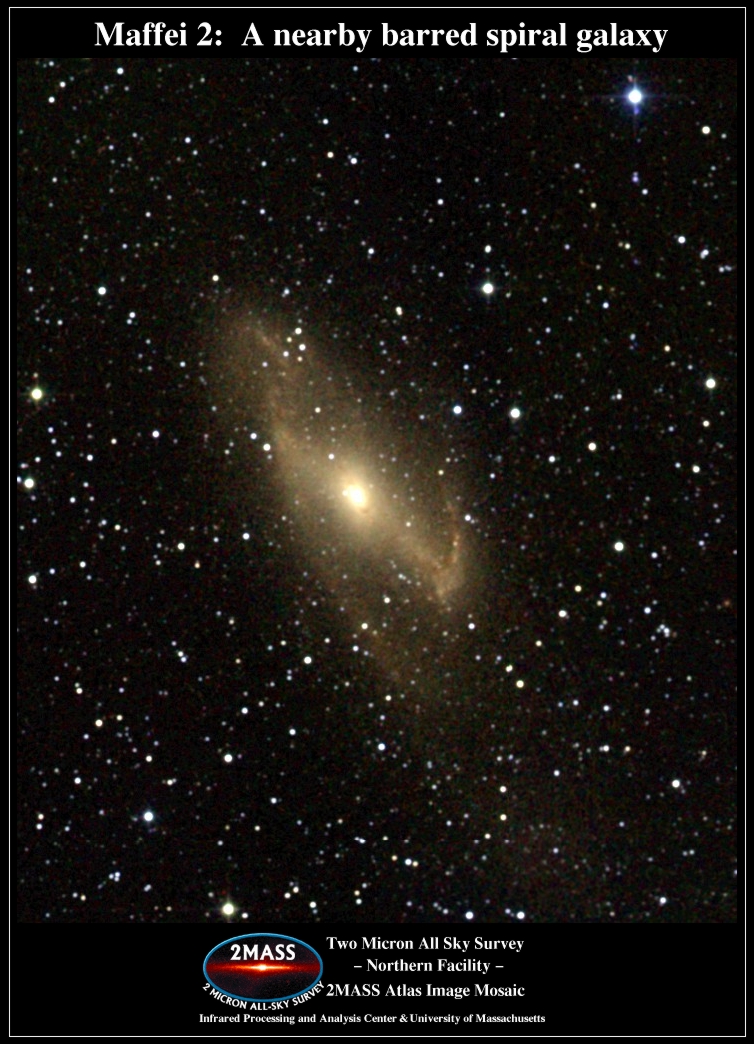
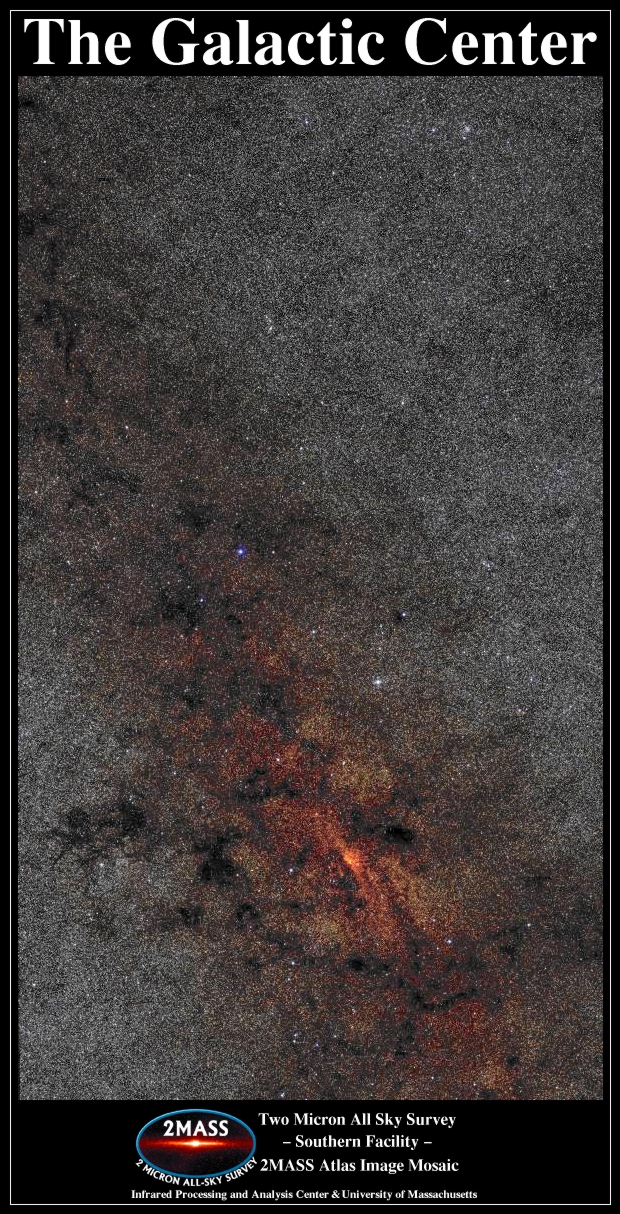
Buran writes: "The BBC News has a fine story about the how our galaxy looks from the outside according to the 2-Micron All-Sky Survey (2MASS). The article describes the shape of our galaxy (a barred spiral; all those books showing concept paintings of a regular spiral galaxy will be out of date now) and how the survey was done (near-infrared measurements of 500 million carbon stars). For the first time, we can see the center of our own Milky Way. All our worldly troubles seem so small..." That takes care of the big picture; Chris McKinstry has submitted news of much closer but just as exciting shots of Saturn -- read below for more on those.
mindpixel writes: "I was very excited when I saw this amazing shot of Saturn come up on the control room monitors of the VLT in November, and I'm even more excited that as of today the image is finally public. It is possibly the sharpest view of Saturn's ring system ever achieved from a ground-based observatory. All of us here at the observatory are quite proud of it, especially the NAOS-CONICA team."

9 of 185 comments (clear)

  1. I always thought barred spirals were cool... by Lendrick · · Score: 2, Interesting

    To be honest, I was always a bit dissappointed that I wasn't living in a barred spiral. Turns out I am. Nifty. :)

  2. Great pictures! by FrostedWheat · · Score: 5, Interesting

    I can't wait until Cassini gets within range of Saturn, it is definitly one of the most amazing things in the sky. Unfornatually it's largly been ignored by many high-power telescopes and space probes.

    What NASA/ESA and all the other agencies in the world need to do is send out a swam of probes to *every* planet - a little science is better than no science!

    1. Re:Great pictures! by FrostedWheat · · Score: 4, Interesting

      True, but the various space agencies could spread the cost like they did with the International Space Station. I doubt if any one single country would/could have done that.

      USA/Russia could prove valuable help with there long experience in space. Europe could provide the launch vehicle. There are many other countries that could provide valuable help with the design and building of the actual probes. Help make them smaller and tougher than before.

      Missions like Cassini/Galelio are very expensive, but they are designed to stay in orbit for years. Look how much great data the Voyagers returned on there quick passes of each planet.

      Imagine the images Galelio could have given us if it had been in orbit when the string of comets hit! With small, replacable, probes constantly in orbit of the various planets we'd be much better placed to observe these extremly rare events. Then they send in the big missions, when they know it's worth it.

    2. Re:Great pictures! by Witchblade · · Score: 5, Interesting
      What NASA/ESA and all the other agencies in the world need to do is send out a swam of probes to *every* planet - a little science is better than no science!

      Yes, and I'm sure they'd love to do it. The problem, as always, is funding. In the early days of the Space Race Soviet and American taxpayers gladly ponied up the cash for spaceprobes, just for the bragging rights to be 'first'. After that was accomplished we've entered phase 2: probes can only get funding by exploiting the 'search for possible life' angle. We're throwing probe after probe at Mars (and consequently billions and billions of dollars) yet we haven't even seen Pluto.

      Quick and dirty Pluto flybys keep getting canceled almost as soon as any funding is approved, even though most of us working in the space sciences would gladly relocate funding from projects we're involved in just to get something simple like Pluto-Kuiper Express of the ground.

      The public won't have it, though. Now to explain why we should send a 'swarm' of spacecraft to places they've never heard of. We astronomers have the advantage of the huge amount of unknown in searching for planets. We can, in mostly good conscience, play the Lifecard in proposals to study any stellar phenomena. Geologists are stuck with just two at his point: Mars and Europa.

      Just think of all we don't know about our own moon. Where is the swarm of really cost-effective probes we could be sending there? The only time anyone took notice was when a military craft found very shaky evidence for a possible tiny bit of water in a shadow of a small crater near the pole. The only return visits under any serious consideration are desgined soley to test that finding.

      If any exobiologists are reading, all you need to do is come up with a convincing argument for micro-organism in Saturn's atmosphere and I have the suspicion that Slashdot readers will get all the pretty ring pictures their hearts' could desire. ;)

  3. Wait... by xfs · · Score: 4, Interesting

    Isn't micron symbolized by a "" ?
    It would be 2ASS then... looks like something someone would say in an AOL chat room...
    please flame me if I'm wrong.

  4. newest Galactic Center release, in color by ghostlibrary · · Score: 4, Interesting

    At the AAS meeting a few weeks ago, a Chandra (X-Ray observatory) team produced this stunning mosiac of the Galactic Center.
    It's amazing. Also, apparently the supposed massive black hole in our galaxy's center is 'off', so there's not a lot of emission from it, instead we see remnants of earlier activity (such as Sagittarius A).

    --
    A.
    1. Re:newest Galactic Center release, in color by ghostlibrary · · Score: 4, Interesting

      I know your post was funny (+1) and rhetorical (+1), but I thought I'd answer it anyway because, hey, I'm pedantic (-1).

      Central black holes only are bright if they are sucking in matter. When they suck in matter and generate radiation, the radiation tends to blow away the surrounding gas a bit. Also, just sucking in the matter of course depletes the region.

      So after a bit, the space around the central black hole gets kinda sparse and there's not much for it it eat, so things cool down. This lets the gas further out get dragged in a bit (since there's not as much radiation blowing it away) and eventually enough accumulates that the emission from the black hole increases again.

      A lot of astrophysical stuff has cycles of basically 'eat and blow, thus clearing out the area, then sit there empty until more food gets drawn to you by your superior mass'.

      If you imagine a fat friend with a PS2 who requires chips and soda, you get the picture-- people get sucked in by the cool PS2 games but when the chips are gone and the farting has cleared out the area, he sits there alone until things have time to settle and friends begin to get drawn back to the PS2 again. [Yeah, I know, I'm now a Contendor for Worst Analogy of 2002].

      --
      A.
  5. Re:hmmm by Wombat · · Score: 2, Interesting

    Your post actually is actually more culturally relevant than you might think. Gustave Courbet painted in 1866 a work entitled 'L'Origine du monde' (The origin of the world), which was a detailed painting of the nether parts of a human female. It was a private comission (some rich business guy wanted it), but raises the stakes on the old pornography or art question at a far earlier date than many might realize, besides the interesting commentary of the work's title. For the curious and over 18, you can view the painting at the Artchive here.

    Oh the things you learn in art history class.
    -Wombat

  6. To Those in the Know by Alpha+State · · Score: 5, Interesting

    Why isn't there a big blind spot on the opposite side of the calactic center? Can the MASS see through the center, or are they just filling in what they assume is there?

    Furthermore, can we see objects farther away on the opposite side of the galactic center? If not, how big is the blind spot?