 Slashdot Mirror
April 1, 1972: Write Only Memory
Embedded Geek writes "While digging around Jack Ganssle's site, I came across an amusing prank from days gone by. In 1972 Signetics recognized April Fools day by printing a full color datasheet (scanned sheet 1 and sheet 2 here) for a Write-Only Memory (which accepts data but never reads it back), a considerable effort when documents were made via literal "cut and paste". Packed with jokes both obvious (a graph of "number of pins left versus number of insertions") and subtle ("Vdd = 0V +/- 2%") it's worth a chuckle."
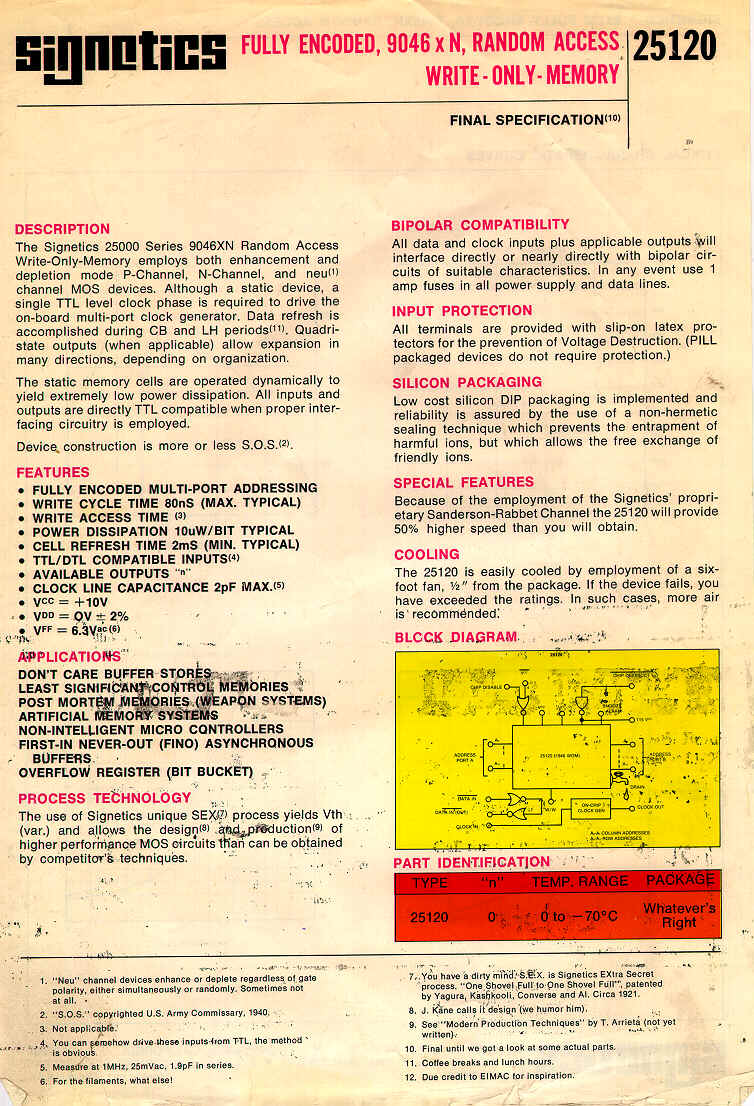
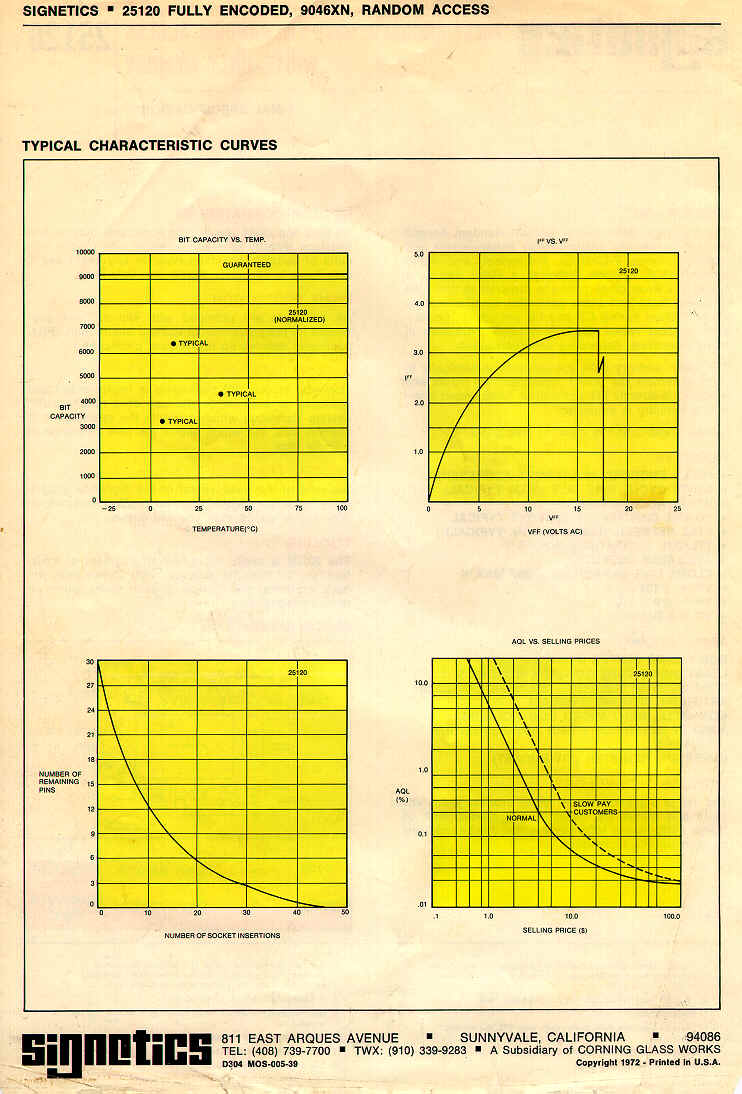
There are circuits in use that are essentially a write-only memory like this (but without the need for a 6 foot fan!), combined with a comparator and possibly a one-way encrypter. You can store an encrypted password in there, which then can never be read back in its encrypted form. Plaintext phrases can be encrypted and compared against the stored password.
One existing application is on debit cards (cards that are charged with a cash amount on the card itself).
If construction was anything like programming, an incorrectly fitted lock would bring down the entire building...
Many years ago, I used to go to DEC Users Group meetings. In the evenings, we'd have "sessions" where the operating system developers would come around and tell war stories. I remember one time that one of the RSX-11 (one of the PDP-11 operating systems) developers was telling us that writes to the Null device (NUL:) was found to be considerable slower than writes to real hardware. Therefore, they had begun development of a null hardware device to be plugged into the system. It was to be called the NUL-11 board, and they had developed quite a bit of specification material for it, unfortunately lost (this was in the early '80s). Very fun stuff.
...phil
"For a list of the ways which technology has failed to improve our quality of life, press 3."
OTOH, I've never encounterd a write-only memory before. The Amiga had a write-once memory (kind-of silly really) but that's not the same.
BTW: Great post C.T., it sure brought back a lot of memories digging through hardware specs. from my embedded days! : )
And that led to a bunch of weird (to the uninitiated) code like:
for i=49152 to 51200: poke i, peek(i):next i
But if you wanted to turn of the ROMs to use the underlying stuff in RAM, this is what you had to do, if you wanted access to some of that ROMs code. Weird, but interesting.
Ah the creativity of limited resources.
Complexity is Easy. Simplicity is Hard.
Not truly write-only memory (in the sense that you could get a value, albeit a painfully useless one), but it seems to come close to the spirit.