 Slashdot Mirror
Today's Solar Flare
An anonymous reader writes "X1-class solar flare today (13:30 Universal Time). Still the SOHO spacecraft offers some of the all-time greatest snapshots anywhere on the web. The flare's residual activity would be shown white and at around 9 o'clock position here. There are 3 major categories, each 10 times stronger than the next: X-class flares are big; they are major events that can trigger planet-wide radio blackouts and long-lasting radiation storms. M-class flares are medium-sized; they generally cause brief radio blackouts that affect Earth's polar regions. C-class flares are small with few noticeable consequences here on Earth. If it were headed towards Earth, arrival is usually 48-72 hrs later (this is not coming this way). Future Mars astronauts should take a lead umbrella because one radiation day on Mars is like living at 70,000 feet on Earth." Nature is pretty.
It -always- rains on holiday weekends!
Isn't that what Intel said caused Pentium 4's to underperform? Must have been.
Calm down, it's *only* ones and zeroes.
An X1 class solar flare, huh? No wonder I've gotten so many popup ads of provocatively dressed women staring longingly into webcams today.
I'm generally "Interesting," "Insightful," and even "Funny" here. What the hell happens to me at parties?
X class flares happen quite often, especially around the peak of the solar cycle (which we are currently moving away from). Often, they are not earth directed and do not cause anything so nice as aurora (even if they do cause blackouts on some frequencies). Keep an eye on spaceweather.com and notice how often these things occur. The flare referenced in the article was probably the one that occured on Friday from sunspot 95 and did not appear to be earth directed (it occured while SS95 was just comming into vision). I'm surprised that this flare got on the front page, since there have been larger ones recently (I can't recall exactly when - obviously, its effects were small enough).
See http://www.eaaa.net/ut_conversion.htm for translation in the US. Those mathematically inclined should be able to use the table and common sense to translate to any time zone. So 13:30 UT = 09:30 EDT.
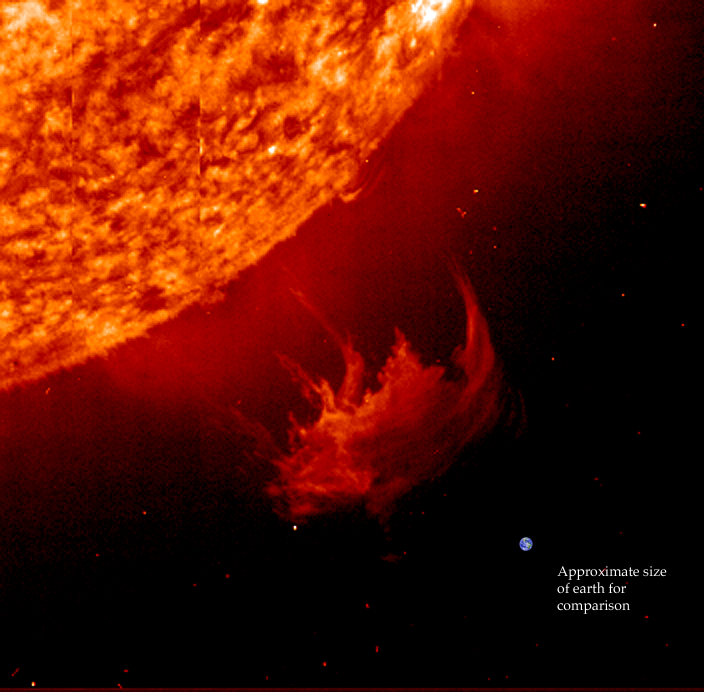
http://umbra.nascom.nasa.gov/eit/images/Sun_and_ea rth.jpg
Just a heads up to anyone, that the size may be to scale, but not the earth's distance from the sun. I still would like to see a to-scale model of the solar system. I guess a to-scal model of the galaxy, would be a "leetle deeficult" to make ;-)
Saskboy's blog is good. 9 out of 10 dentists agree.
Strange how all the "plasma" looks somehow connected together.
It does not look like a solar flare, but rather like Mr. Sun sneezed and blew his tupee off.
Table-ized A.I.
(* that the size may be to scale, but not the earth's distance from the sun. *)
I should certainly hope that the Earth is not anywhere near that close. 2/3 of the daytime sky would be pure sun. However, before our Sun goes nova, it will swell up so that about 2/3 of the sky will be sun according to current theories. (Not that any humans would live through the process to watch, barring special environ suits/houses.)
Some museums and campuses have scale models of the solar system including distances. In the cheezier ones, the sun is represented as a painted circle instead of a physical sphere. But even with painted stuff, you can still get a better feel for the scale. The problem is that the outer planets are often way off campus. You have to go hiking around to find them. Some students get pissed when they go hiking for miles only find a little B-B for pluto. (Now that I think about it, maybe it *was* a B-B that some kid shot into the wooden marker. Nobody would know the difference.)
Table-ized A.I.
M-class flares are medium-sized
That could make for some confusion in the Trek world:
"You idiot human! I said find and land on an M-class *planet*, not an M-class flare! [sizzle sizzle]"
Table-ized A.I.
Man is the wife going to give me shit when my wireless connection between be office and the apartment goes out.
"Learning is not compulsory... neither is survival."
--Dr.W.Edwards Deming
Fortunately, astronauts can find the protection they need indoors (from solar storms) ; shelter walls made of lightweight materials provide adequate shielding.
For those needing more on this, go find what you need here or, for something a little more cautious and "NASA" here.
Now only if we can get people to stop running about waving their arms and shouting "The Radiation! The Radiation!" we might get something productive done... Heh! No chance of that I guess, might as well join them...
*waves hands over head, runs about, starts screaming "The Radiation!" and giggling*
SOHO Spacecraft eh? Where can I accquire one of these for my small office/home office?
My other sig is funny!
I am curious what all those red star-like dots are.
I doubt they are stars or distant X-ray sources, because those are usually overwhelmed by the Sun's local radiation. In other words, they often have to turn *down* the sensativity when looking at the Sun (strong filters), but you normally have to turn *up* the sensativity to look at stars or take long exposures. I don't know what wavelength that image is in. It does not look like X-ray nor visible light. I guess infrared or ultraviolet.
Those "star spots" are signal noise I guess, not really actual objects.
Table-ized A.I.
You can actually see sunspots (it'll look kinda like this, but in grayscale) any time you want by projecting the sun onto paper. Binoculars work well, a telescope works even better.
Aim your binoculars at the sun, without looking into them. If you look into them, you'll only see the steam rise from your eyes as they cook. Put a piece of white paper about 2m away from your binoculars. Cover a lense so only 1 circle shows on the paper. Finally, focus your binoculars to make the remaining circle as crisp as possible. This is easiest when you mount your binoculars on a tripod, but still works by hand.
If you look closely, you'll see the sunspots.
It all goes downhill from first post
This is the information from SEC (NOAA): Only a few C class events are listed:
0221 UTC C2.8
0955 UTC C8.8
0930 UTC C6.7
You can easily see all the recent events from this plot of solar X-ray flux: (updated in real-time)
There was a minor X class flare last friday (as you can see from the plot!). This is what the poster may be refereing to:
8/30/02 1329 UTC X1.5 Sunspot 95
It was a limb event and isn't headed our way. The plot shows there were no X-ray flares today!
X class flares are fairly common (once every 2-3 weeks these days...) Usually they are near the limb or backside events and don't effect us other than a little radio interference. We might see an earth directed one from region 95 in the next few days. (But don't count on it!) If there is an X-ray event indicated by www.spaceweather.com, then check this alert page at Solar Terestrial Dispatch. These impact predictions are often very accurate! (Only updated if there is a strong earth directed event!)
The comparison shot got me thinking. Suppose there was a flare, say 100 times larger then one of the common X class ones. Would the radiation be enough to whipe out life on earth?
:P
Anyone have any idea. I suppose there really isn't much point in worrying about it though
autopr0n is like, down and stuff.
"Nature is pretty" -- CmdrTaco
According to the directory listing, that photo is from March 15,1999. I know it takes a while until submitted articles are posted, but this seems a little excessive.
Can You Say Linux? I Knew That You Could.
When I was looking for that "skull" image on Google, I had "Chandra" (the X-ray telescope) and "skull" in the search terms. Here is the summary of one of the matches:
... the skeletal remains of missing intern Chandra Levy. On a remote hill of a heavily ... "
"Chicago Tribune | Chandra Levy found dead
wooded park, a man walking his dog early Wednesday discovered a skull, human
The oddest coincidences you find using search words on the web. Let's make a cult out of it. Even El Ron didn't use coincidences to their full advantage.
Table-ized A.I.
http://sohowww.nascom.nasa.gov/data/realtime/mp
In particular this:
http://sohowww.nascom.nasa.gov/data/LATEST/curr
is a reasonably small (3Mb) mpeg of the last 48 hours... the flare is right at the end of the sequence. Notice that although it appears on the right limb of the sun first, it's also pretty symetrical - indictating that the thing's coming straight for us.
Incidentally, if you've ever fancies getting your name on a comet, there are people who sit in front of those pages pressing ^r constantly in order to be the first to identify a new sungrazer. No, there's no software sitting processing the images in realtime for comet-like objects, and they (or rather, their ion tails) show up nicely.
Enjoy!
"None are more hopelessly enslaved than those who falsely believe they are free." -- Goethe
What does "CCD Bakeout" mean? Does it mean NASA is suffering the /. effect, or does it mean a flare physically cooked the CCD elements, or something simpler, related to maintenance?
Just because you can mod me down, doesn't mean you're right. Shoes for industry!