 Slashdot Mirror
The 25th Anniversary of the BBS
Jason Scott writes "25 years ago today, Ward Christensen and Randy Suess officially announced the creation of a little project they threw together with a 300 baud Hayes modem, a Z-80 based S-100 computer, and a phone line. They called it "Chicago Bulletin Board System" (CBBS) and it was the first dial-up BBS. From this beginning, BBSes grew into the many thousands and became an entire industry, and when the Internet started to mature with the World Wide Web, the users who had cut their teeth on BBSes moved over to it. So raise a toast to these two fellows for a quarter century of great online times."
And don't forget to register at BBSmates to keep up with days gone by.
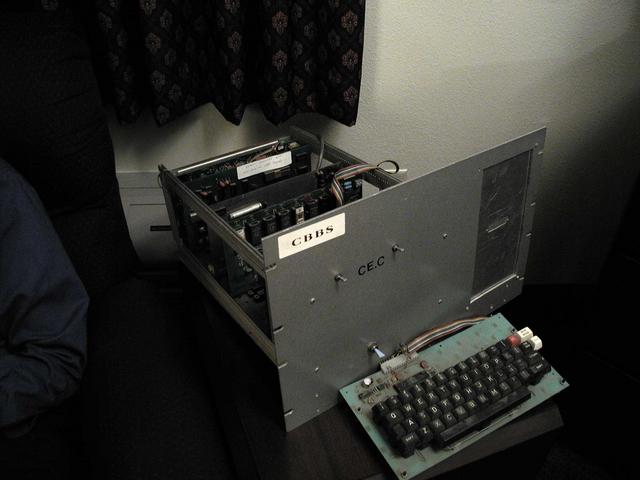
We were working on a campaign to get into the Smithsonian. I'm pretty sure that I know who owns it, Roy Lipscomb. He bought it from Randy for $20 (? maybe less). Randy was using it to hold up a table. Hes not known for sentiment.
Like was common for hobbiests in those days, Randy built it from chips they salvaged from old mainframe boards. They would heat the back of the boards with a blowtorch to melt the solder and then slam it against a table to pop out the chips.
It didn't even have an OS in the beginning. There was not even CP/M in those days. The first versions of CBBS talked directly to the hardware. Later Ward rewote CBBS to run over CP/M.
Ever dream you could fly? Get up from the Flight Sim. I Fly
Yes, QWK was originally designed for offline messaging by regular users, but it eventually became used for echomail by some networks as well. The way it worked was crude compared to FidoNet technology, though. If I wanted my BBS to exchange mail with yours, I'd have a special account on your board (or vice-versa). My BBS would then call up yours, and using scripts would navigate through your offline mail system as a regular user would. The offline mail system would know, of course, that it's another BBS calling. But basically it was a hack on top of the typical QWK offline mail system.
There were several networks that were QWK based, mostly in North America (Zone 1), and mostly based on commercial BBS software like PCBoard. Since you were in Zone 3, this might explain why you never saw this used. As far as I know, the mechanism more or less relied on the fact that all PCBoard systems were effectively identical, perhaps with just different text for the prompts. PCBoard was pretty popular in North America. It was basically the software to run if you wanted to have a "professional" looking BBS, and many of the large commercial BBS's ran it (some others like Wildcat and MajorBBS were also popular among commercial boards).
Anyway, to get other BBS software to work as a hub on a QWK network wouldn't really be feasible since you'd basically have to emulate PCBoard. But it was possible with some hacking to join a QWK network even if you ran other software. I ran Telegard as my BBS software and ended up hacking up some terminal scripts that allowed me to join a QWK network as a node. The QWK technology was technically inferior to FidoNet technology in just about every way. It probably originated as a kludge when the developers of certain BBS packages wanted built-in echomail but were too lazy to bother implementing all of FidoNet's technical specs. This then became the most convenient option for sysops who were too lazy or stupid to figure out how to set-up a 3rd party echomail front end and "tossing" software.
Eventually some of the QWK networks began distributing their mail using FidoNet technology via gateways.