 Slashdot Mirror
Halley's Comet Imaged As Transneptunian Object
An anonymous reader writes "The European Space Observatory has imaged Halley's Comet at the farthest point (past Neptune) in which such a 10-kilometer diameter iceball has ever been observed. To image a comet as a raven-black object, without its bright dust tail (coma), is equivalent to seeing a lump of coal at the distance between the Earth's poles and to do so in the evening twilight. The last gasp seen from Halley's Comet was 1991, when a gigantic explosion happened, providing it with an expanding, extensive cloud of dust for several months. It is not known whether this event was caused by a collision with an unknown piece of rock or by internal processes (a last 'sigh' on the way out). Halley has an orbital period just over 76 years and will return in 2062."

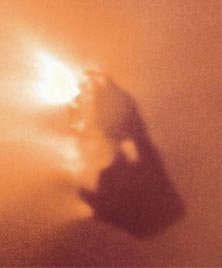
It is not known whether this event was caused by a collision with an unknown piece of rock or by internal processes (a last 'sigh' on the way out).
If they were able to image it, it seems they knew where it was, by mapping where it was going. If it had collided with something, it's trajectory would have changed.
So does this give us new insight as to how comets die? And if they die, how are they still comets? How does the solar system replenish its comet supply?
Everything seemed to be going so nice
'till the end of all beings punched right through the ice
Here's the image, in case it gets /.'ed:
.
. . . . .
. , . . . . (the 2nd one)
. . . . . .
True. Halley's Comet is ideal for this kind of observation because it has one of the most accurately known orbits of all comets of this kind of orbital period.
But you shouldn't see this as just a comet finding exercise (though it does prove the capabilities of the VLT rather well).
By analysing the image further it will be possible to determine whether there is any activity at this distance, or a residual dust cloud. Depending on what filters they used for the observation, they might be able to compare the "colour" of the nucleus with that observed by the spacecraft back in 1986 and look for changes. This might indicate a change in surface conditions at large distances form the sun.
-- "Sponges grow in the ocean. I wonder how much deeper the ocean would be if that didn't happen."