 Slashdot Mirror
Halley's Comet Imaged As Transneptunian Object
An anonymous reader writes "The European Space Observatory has imaged Halley's Comet at the farthest point (past Neptune) in which such a 10-kilometer diameter iceball has ever been observed. To image a comet as a raven-black object, without its bright dust tail (coma), is equivalent to seeing a lump of coal at the distance between the Earth's poles and to do so in the evening twilight. The last gasp seen from Halley's Comet was 1991, when a gigantic explosion happened, providing it with an expanding, extensive cloud of dust for several months. It is not known whether this event was caused by a collision with an unknown piece of rock or by internal processes (a last 'sigh' on the way out). Halley has an orbital period just over 76 years and will return in 2062."

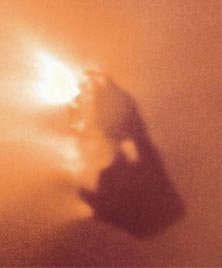
Reading this made me think of the comet rendevous in 2061. I doubt that I'll live to see something like that actualy accomplished.
What we need is another space race, some incentive to get there. My guess is that the next space race will be for resources, metals, chemicals, etc.
stuff
It is not known whether this event was caused by a collision with an unknown piece of rock or by internal processes (a last 'sigh' on the way out).
If they were able to image it, it seems they knew where it was, by mapping where it was going. If it had collided with something, it's trajectory would have changed.
So does this give us new insight as to how comets die? And if they die, how are they still comets? How does the solar system replenish its comet supply?
Everything seemed to be going so nice
'till the end of all beings punched right through the ice
Here's the image, in case it gets /.'ed:
.
. . . . .
. , . . . . (the 2nd one)
. . . . . .
The spot was discovered by Robert Hooke in 1664. The spot is HUGE (large enough to hold to Earths) and back in the 15'th centurty it was much brighter. The red spot in the southern hemisphere has been there for about 400 years and is starting for fade.
and see if he is any more impressed than me. Perhaps he'll be more concerned about a 1 in 909,000 chance of an impact than he was about his odds of winning a frog jumping contest.
That's human curiosity, what allowed us to survive and evolve through ages. Give us some knowledge buried under a giant rock and we'll put huge efforts in removing that rock.
The same applies to the comet's tail: there's a chance to learn something by making observations without the comet tail hiding things.
Almost 1000 years ago, Halley's Comet was overhead during the Battle of Hastings in the year 1066. That long ago, the comet was said to have virtually filled the sky it was so bright. It must have been perceived as a powerful omen.
They can pick out such a small dark object at that distance. Makes me hope that maybe one day the Star Trek scenes where Picard asks Data for range to object and then has it on screen in living colour at 50 million Kilometres may one day become a reality.
Do not try to read the dupe, thats impossible. Instead, only try to realize the truth
What truth?
There is no dupe
ESA's sekret plan is to point that baby at the Apollo landing site and prove once and for all, those lying Amerikanischer Schweinhund never made it to the moon!
The spot was discovered by Robert Hooke in 1664. The spot is HUGE (large enough to hold to Earths) and back in the 15'th centurty it was much brighter.
Really? You have some idea of of how the GRS appeared 200 years before Hooke (in the mid seventeenth century) inferred the rotational period of Jupiter? The earliest definitive observations of the GRS, btw, are those of Heinrich Schwabe (1831)
It's a remarkable achievement, and shows what can be done with Earth-based telescopes, but it seems to be more proof of concept than practical.
Panurge has posted for the last time. Thanks for the positive moderations.
That should be European Southern Observatory (www.eso.org).
-- "Sponges grow in the ocean. I wonder how much deeper the ocean would be if that didn't happen."
Hmmm, we didn't have "human curiosity" before we "evolved through [the] ages".
e s curiosity."
We had "ape curiosity", or as some scientists call it, "wow-that-ground-sure-looks-better-than-these-tre
codegolf.com - smaller *is* better.
Considering the fact that Aricebo is a radio telescope, i don't think you'll get much of a view. (well, aside from the fact that the telescope itself is quite a view...)
Hmmm, I read that as a 'gigantic explosion' involving Halley's Comet, however it seems to involve Comet 57P/du Toit-Neujmin-Delporte according to one of the linked articles. Did I miss something?
The link that is described as referring to an event involving Halley's Comet is talking about a different comet. I should poke around for events actually involving Halley's, but I'll just settle for saying that I don't recall hearing anything unusual as it wandered away, and I'm actually rather skeptical we could see so much of it at that time (though the latest imaging is an impressive accomplishment).
Freedom = (Meaningful - Coerced) Choice != (Speech | Beer^2), and sad sock puppets' bad mods avail them naught.
In other news: Aricebo is a radio telescope.
"Learning is not compulsory... neither is survival."
--Dr.W.Edwards Deming
Did you have a look at Mars last week? I did, but only through this tiny collapsable telescope a friend gave me. It was very difficult to find Mars in the first place as fully extending the telescope focuses it at somewhere past infinity so the deal was:
a) try and find something in the distance to focus on (not easy at nighttime - luckily the sillhouette of the trees against the bright yellow London night sky sufficed)
b) try for ages to get the damn thing pointing in the right direction
c) Try not to look too suspicious as you're doing it - standing in the street at night looking around with a telescope pointed at a 30degree angle looks rather pervy to the casual observer...
In the end, I got a look at Mars, it looked like this:
.
except it was pink.
In other words, It was big enough to just about tell it was circular in shape, but that was about it. I wished I'd had my Dad's telescope with me, it wasn't the greatest thing on earth, but it had 60x magnification, rather than the 15x - odd that my little telescope has...
I'd put money on it in fact being impossible to view a lump of coal at that distance. In fact, I propose someone do a lump of coal viewing test. These people can get away with all sorts of silly analogies to make themselves seem impressive and nobody calls their bluff.
Doesn't it make you feel good to know that our freedoms are protected by politicans, lawyers and journalists.
Not even the editors RTFA.
Yes, I realised after I'd posted that I'd just made a fool of myself. I did see Hailey's comet though - must have been winter 86? I remember showing to the gf, who was distinctly unimpressed.
here's a stoopid question:
How long is halley's comet going to last? If its a little 10km diameter object thats not only melting on each pass, but breaking up as well, how many times can it survive its lap of the sun?
Inquiring Minds want to Know!
In the end, I got a look at Mars, it looked like this:
.
except it was pink.
I'm happy to report that I was able to run your image through a high-tech image-enhancement system. To further aid in visualization, the edge definition has been increased as well.
Here is the new image:
o
Hope this helps!
Stressed? Me? Of course not. Stress is what a rubber band feels before it breaks, silly.