 Slashdot Mirror
Goodbye, Galileo
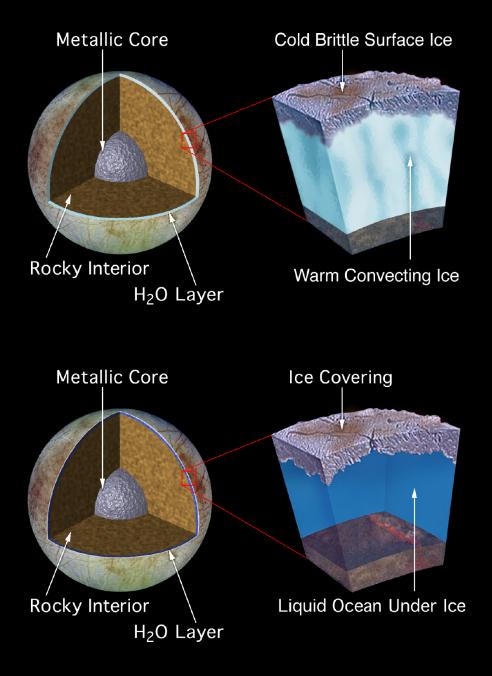
deglr6328 writes "On the 21st of this month the Galileo Space Probe, which has been orbiting Jupiter for nearly eight years, will plummet fatefully into the crushing pressures and searing heat of that planet's interior. The spacecraft's 14 year journey has brought the discovery of, among other things, the first moon orbiting an asteroid, the first remote detection of life on earth when Carl Sagan used data from an onboard infrared spectrometer to observe the spectral signature of Oxygen in our atmosphere, it has caught snowflakes of Sulfur Dioxide as it flew through the plume of an erupting volcano on Io, snapped pictures of comet Shoemaker-Levy 9 as it smashed into Jupiter's atmosphere and most importantly, provided proof a >60 Km deep ocean on Europa with hints of oceans on Callisto and Ganymede(listen to Ganymede's eerie sounding plasma wind). And all this with scarcely more computing power than a late '70s video game and a maximum data transfer rate of ~120 bits/s over a distance of more than 600 million Km. In a mission spanning three decades, the Galileo space probe has answered many of humanity's questions about space and presented us with the knowledge to ask many more which will be answered by the next generation of Jovian explorer. Goodnight Galileo."


but I would rather have a replica of this space probe in schools/colleges than any number of sports trophies. The amount of hard work and dedication required to do things like this should inspire our youths, instead of their current role models (kobe bryant, et al.)
later,
epic
"Im drowning here, and you're describing the water!"
all this with scarcely more computing power than a late '70s video game
When it comes to real engineering, the fewer resources you need to meet your goals, the better of a job you did. Throwing in larger processors just to you can brag about the power of a Beowulf cluster of those is just a poor job.
Less is more.
Galileo was not cheap. Neither were the Pioneers or the Voyagers. Look at the return on the investment, though.
NASA has not made a good argument for cheaper = better. The Hubble Space Telescope was flawed when it went up and spent the first three years of its lifespan doing very little compared to its design. We have lost several probes headed Mars. Quality has not been top priority at NASA, and until it is, we're going to continue to see failure after failure, I'm afraid. Galileo wasn't perfect, with deployment problems of its high-gain antenna, but it did not fail entirely, and it did not require humans in suits to go play with it for it to work right. We need that kind of engineering again.
We need to build them like we used to.
Do not look into laser with remaining eye.
Also, engineers are trained to downplay risks. They consider a risk of one in a million insignificant. But to a layperson who has seen the results of thousands of environmental accidents where the risk was supposedly very low, one in a million seems quite possible.
That is the one the stupidest views on 'risk' I've heard. Risk is risk. One in a million IS low! 'results of thousands of environmental accidents' What the hell is he talking about it? It doesn't matter how many accidents you've seen, it matters how many accidents you seen compared to the number of things you've tried. *That* is an esitmation of risk. I don't understand the point this guy is trying to make.
Even worse:
Of course, how can we get anyone to be concerned about the possible harmful effects of dumping our radioactive waste on other worlds when modern science condones illness, cancer, and even deaths if they advance a technology or turn a profit. Our culture has made it OK to release a drug if the side effects "only" kill two percent of the users under certain circumstances.
(idealist alarm rings) There is no such thing as a world without risk. If your risk of dying in a car accident is WAY more than one in a million, but does that mean we should outlaw driving?? Does this person not get in their car? You trade some level of risk to _actually_ do something.
On top of this, what does the guy advocate we do? The plutonium has to go somewhere. Do you store enough fuel to launch it out of the solar system? Isn't that still 'pollution?' I'm sorry but the basis for the argument is a *little* weak.
Cool link from an insurance company that shows different levels of risk.