 Slashdot Mirror
Goodbye, Galileo
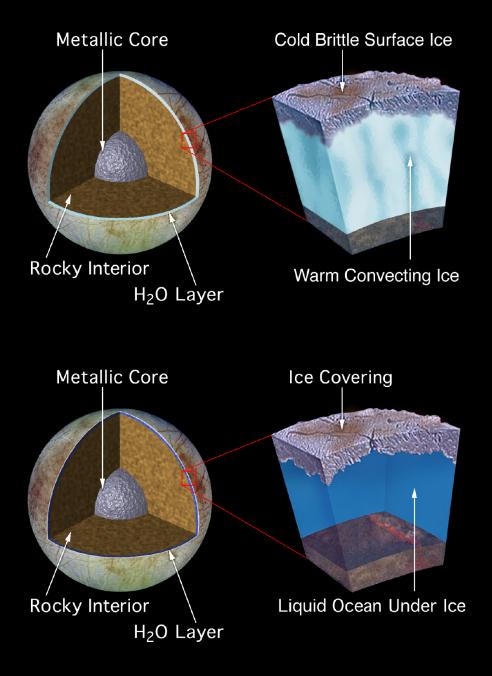
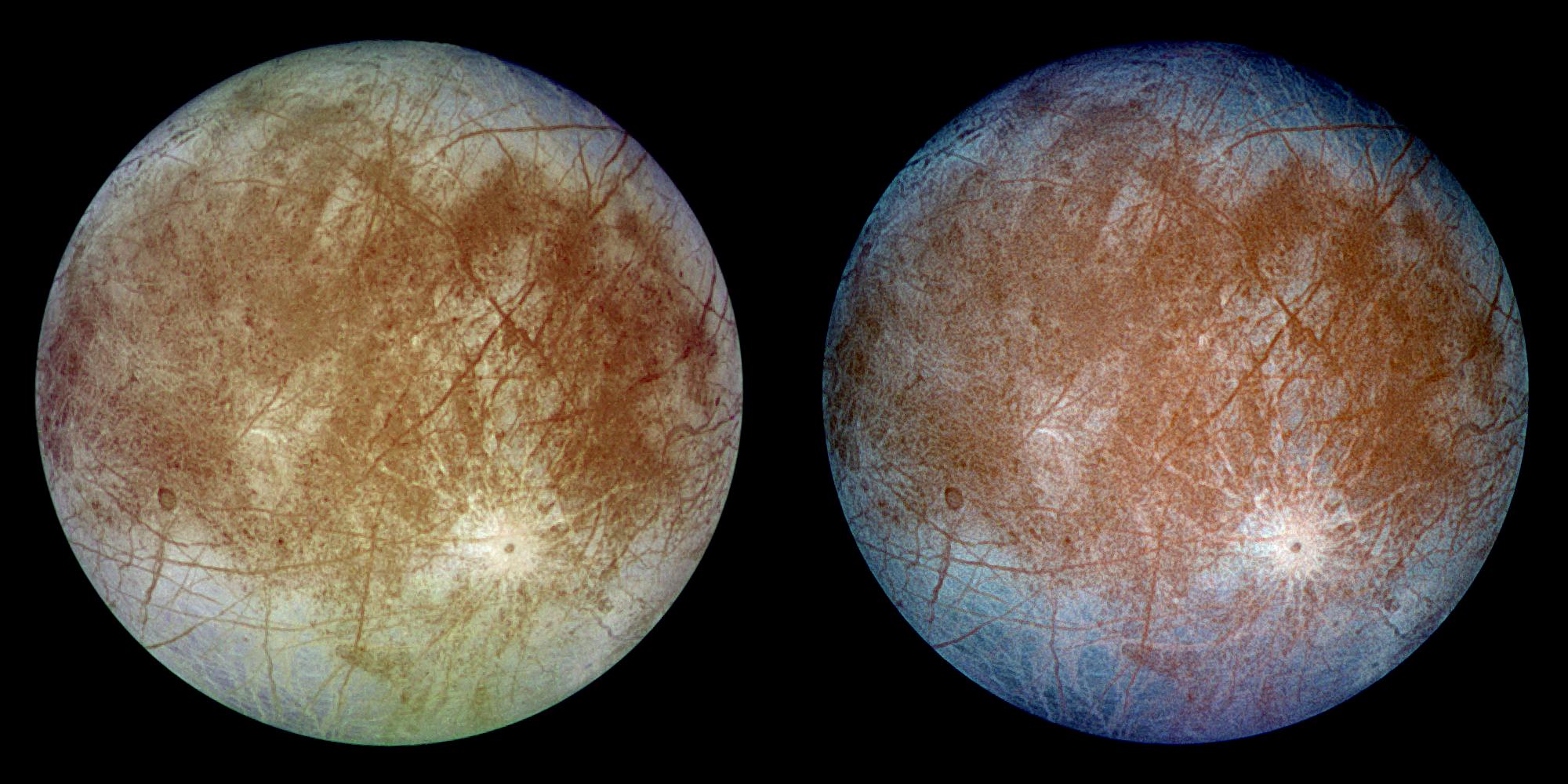
deglr6328 writes "On the 21st of this month the Galileo Space Probe, which has been orbiting Jupiter for nearly eight years, will plummet fatefully into the crushing pressures and searing heat of that planet's interior. The spacecraft's 14 year journey has brought the discovery of, among other things, the first moon orbiting an asteroid, the first remote detection of life on earth when Carl Sagan used data from an onboard infrared spectrometer to observe the spectral signature of Oxygen in our atmosphere, it has caught snowflakes of Sulfur Dioxide as it flew through the plume of an erupting volcano on Io, snapped pictures of comet Shoemaker-Levy 9 as it smashed into Jupiter's atmosphere and most importantly, provided proof a >60 Km deep ocean on Europa with hints of oceans on Callisto and Ganymede(listen to Ganymede's eerie sounding plasma wind). And all this with scarcely more computing power than a late '70s video game and a maximum data transfer rate of ~120 bits/s over a distance of more than 600 million Km. In a mission spanning three decades, the Galileo space probe has answered many of humanity's questions about space and presented us with the knowledge to ask many more which will be answered by the next generation of Jovian explorer. Goodnight Galileo."

The reason that it sounds so "eerie" is because it is recorded with a receiver whose channels are harmonically related. A true wideband recording would sound quite different. This is true of the similar Voyager plasma recordings as well.
It promised a lot, then with the failure of the high-gain antenna, it delivered a lot less than expected.
Both Voyagers sent us a lot less data but the data was publicised much more energetically.
Since the probe has been plauged by malfunctions for some time I agree it is time to let it go. Bye bye...
There's also a bit of dissention currently about the decision to crash the probe. Apparently, there's enough plutonium on board (34 pounds!) that we'll be donating to the Jovian depths.
I'm not sure I like that idea.
The cure for cancer is coming: Reovirus
From the article: "Obliteration is precisely what nasa intends for the spacecraft. The reason is that Galileo may still harbor some signs of life on Earth: microorganisms that have survived since its launch from the Kennedy Space Center, in Florida, in 1989. If the orbiter were left to circle Jupiter after running out of propellant (barring an intervention, this would likely happen within a year), it might eventually crash into Europa, one of Jupiter's large moons. In 1996, Galileo conducted the first of eight close flybys of Europa, producing breathtaking pictures of its surface, which suggested that the moon has an immense ocean hidden beneath its frozen crust. These images have led to vociferous scientific debate about the prospects for life there; as a result, nasa officials decided that it was necessary to avoid the possibility of seeding Europa with alien life-forms." But I always thought it would be great to colonize another planet with earth's bacteria. :)
But really, wouldn't doing something like that possibly help to set the stage (a ways off) in the future, when we can send a manned crew out towards Jupiter. Just think if we sent hundreds of probes containing simple life like bacteria, maybe we could help to create a more hospitable place. Of course, then you have to worry about the pesky part about it being mostly ocean(frozen nonetheless).
Ironically, Galileo Galilei spent his own last eight years under close house arrest. To pile on the irony, he spent the last five of them blind, in part because he was prevented from consulting a doctor. Maybe these past eight years of clear vision can help make up for that in a small way. But I doubt it.
In other similar stories, they always mention the small trickle of data that these crafts can return. I always wonder if this represents some physical limitations, or just the state of technology at the time of the probe. If they had more communications potential, they could return all kinds of data, images, even video. Anyone know of background info on space communications?
How do the new probes compare to these old ones in terms of communications capabilties? What sort of xfer rates can new ones support?
What are the limiting factors in space communications? Is it the power of the transmission, under the power limitations of the craft?
Here's a thought. ...Send it back to Earth, send a Shuttle up there, grab it, return it to Earth, and analyze it for signs of life.
Having spent 10+ years floating around, it might have picked up a thing or two, and might lend some creedence to the panspermia thoery of how life started on Earth. If space is "dirty" with life, surely some of it would have clung to Galileo...?
Other than being massively radioactive, and something that would piss alot of hippies off if we actually DID bring it home, it would make for good science.
Bowie J. Poag
Even if it did go up as an A-bomb, it'd be a little teeny firecracker at best for Jupiter. This is a planet that has storms bigger than the Earth and hundreds or thousands of years old.
The real danger to Europa isn't from the plutonium, but from any stray extremophile microbes that might survive on or in Galileo. Funny that a bacterium can be more dangerous than a wad of plutonium. Well until you consider malaria, plague, dengue...ok it's not that funny.
I think it's a wonderful idea, but instead of just saying, how about doing?
Beware blue cats moving at
"maximum data transfer rate of ~120 bits/s"
Let see. 120 bits/sec for 8 years... thats about 28 gigabytes of data. Not that bad.
-larsch
http://www.cyberspaceorbit.com/JUPFULLx.htmc le summary- galileo may cause jupiter to ignite into second sun.
arti
granted, some scientists thought the first nuke test might ignite the earth's atmosphere at the time and this led to some heated (no pun intended) internal debate according to richard feynman. of course our atmosphere isn't made from hydrogen and helium, or contain seas of liquid or metallic hydrogen. a little 2010 anyone?
It's interesting to note that Galileo's successor (the Jupiter Icy Moons Orbiter) will use Ion propulsion powered by a nuclear reactor. I believe that this is a first time a spacecraft has been nuclear powered. The Deep Space 1 mission proved that Ion thusters (which operated off of electricity provided by solar panels) were a faster and more efficient method of propulsion, especially over very long distances such as for exploration outside of our solar system.
See the pdf on the fission technology
Err, no. There is a lot of nitrogen, but there's a lot more oxygen. The 78% figure for nitrogen is in the gaseous atmospheric form of N2 (whereas oxygen (O2) has 21%).
On the other hand, apart from the masses and masses of oxides present in the earth's makeup, there's a fair amount of water (H20) around on the planet, which is far denser than the atmosphere... There's a fair amount of nitrogen around too, lots of organic compounds have N in them, but lots also have O in them, so that probably roughly balances...
I'd say there was probably more iron than oxygen though - AFAIR(emember), most of the Earth's core is iron, hence the magnetic field...
Simon
Physicists get Hadrons!
Galileo will be Europe's own global navigation satellite system, providing a highly accurate, guaranteed global positioning service under civilian control. It will be inter-operable with GPS and GLONASS, the two other global satellite navigation systems. A user will be able to take a position with the same receiver from any of the satellites in any combination. By offering dual frequencies as standard, however, Galileo will deliver real-time positioning accuracy down to the metre range, which is unprecedented for a publicly available system. It will guarantee availability of the service under all but the most extreme circumstances and will inform users within seconds of a failure of any satellite. This will make it suitable for applications where safety is crucial, such as running trains, guiding cars and landing aircraft. The first experimental satellite, part of the so-called Galileo System Test Bed (GSTB) will be launched in late 2004. The objective of this experimental satellite is to characterize the critical technologies, which are already under development under ESA contracts. Thereafter up to four operational satellites will be launched in the timeframe 2005-2006 to validate the basic Galileo space and related ground segment. Once this In-Orbit Validation (IOV) phase has been completed, the remaining satellites will be installed to reach the Full Operational Capability (FOC) in 2008. The fully deployed Galileo system consists of 30 satellites (27 operational + 3 active spares), positioned in three circular Medium Earth Orbit (MEO) planes in 23616 km altitude above the Earth, and at an inclination of the orbital planes of 56 degrees with reference to the equatorial plane. Once this is achieved, the Galileo navigation signals will provide a good coverage even at latitudes up to 75 degrees north, which corresponds to the North Cape, and beyond. The large number of satellites together with the optimisation of the constellation, and the availability of the three active spare satellites, will ensure that the loss of one satellite has no discernible effect on the user.
I was under the assumption that radio waves traveled near but not the same as light. As for the repeaters, they would need some type of orbit, they cannot just float around out there. I too have thought about the possibility. But I would imagine that they would need to orbit another planet, as they wouldn't be able to orbit the sun.