 Slashdot Mirror
Heavy Metal Frost on Highlands of Venus?
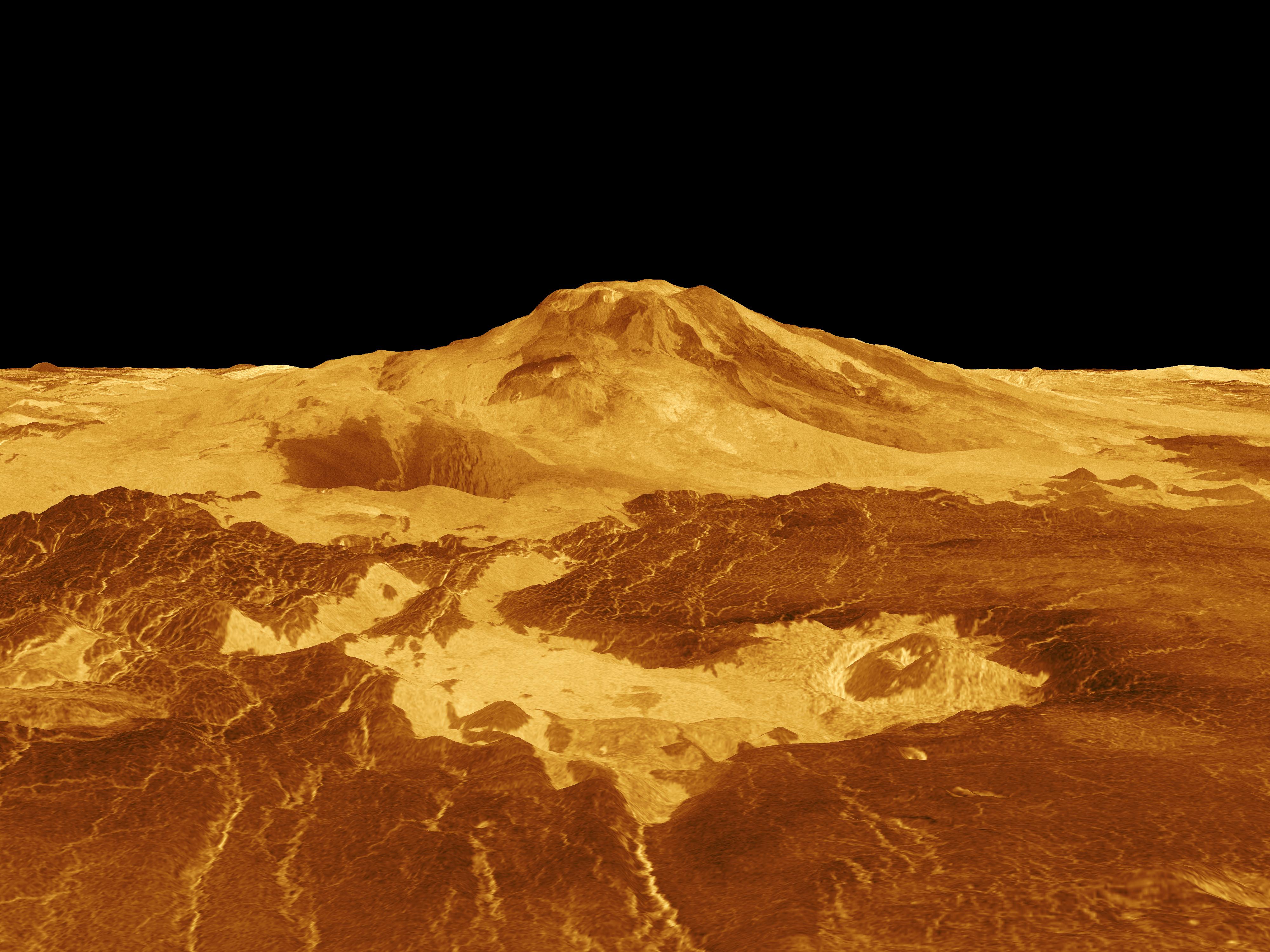
deglr6328 writes "The BBC is reporting that a paper published in the journal Icarus, suggests that the highlands of Venus are covered by a layer of Lead and Bismuth frost. The authors of the paper were looking for a way to explain the anomalous high reflectivity (and corresponding low emissivity) shown at high altitudes in synthetic aperture radar images sent back by the Magellan probe in the early 90's. The study concludes that Venus's lowlands are hot enough (~850F) to partially vaporize these metals into a mist which then condenses back out of the atmosphere to a solid on the surface of the cooler Venusian highlands."
Anyway, the active color ingredient in Pepto Bismol and its generic equivalents is, if I'm not mistaken, red food coloring - that, and the active ingredient is bismuth subsalycilate, not pure bismuth, whereas the theory here is that it's bismuth and lead.
This sig no verb.
I wonder what other yummy metals (arsenic, gallium, indium, etc.) might be found on the surface?
.pdf paper:
I spent a day Googling on that idea a couple of years ago, but didn't come up with much. But you've got to figure that even "trace" amounts of particularly valuable metals would be worth gigabucks -- if there were only a way to get to them.
Here are the specific elements I found mentioned in the
This line is talking about what happens on Earth, but it's probably fair to assume that at least some similar chemistry is going on on Venus:
Halides and/or chalcogenides of several volatile metals (e.g., Cu, As, Pb, Sb, Bi) occur around terrestrial volcanic vents and fumaroles or are present in volcanic gases (Brackett et al. 1995).
They're definitely looking for interesting minerals (for those not familiar, Au is gold and Ag is silver):
The calculations shown in Figures 1 included the elements O, C, N, S, H, Cu, Cl, As, Pb, Tl, Se, Br, F, In, Ag, Sb, I, Bi, and Te. We also considered Zn, Ge, Sn, Cd, Hg, and Au. Approximately 660 compounds of the trace metals were considered.
Tellurium (Te) isn't considered a major player:
We therefore conclude tellurium frost cannot be the high dielectric material found in the highlands because of its low abundance and thermodynamic instability.
Next, they look at Copper (Cu), Lead (Pb), and Bismuth (Bi). I think they're saying that Cu could be found, but the Pb and Bi are what's causing the interesting radar readings:
Copper condenses over Venus' entire surface as Cu2S (chalcocite) and converts to CuS (covellite) at an altitude of ~19 km. Other condensates that are stable at all elevations (i.e., above ~2.6 km) include Ag2S (acanthite), In2O3 and PbS (galena). Bismuthite (Bi2S3) condenses at an altitude of ~1.6 km and stibnite (Sb2S3) condenses at ~16.6 km. Of these compounds, only galena and bismuthite have both dielectric constants high enough to be interesting (see Table 2) and reasonable abundances.
Now for the good news! If terrestial volcanoes provide a workable model, some of the really interesting elements (Au, Ag, & co) could be present in trace amounts -- but likely much higher concentrations than found in Earth rocks:
Near terrestrial fumaroles, lead and bismuth often condense together to form lead, bismuth sulfosalts such as galenobismutite (PbBiS4), lillianite (Pb3BiS6), cannizarite (Pb4Bi5S11), and cosalite (Pb2Bi2S5) (Borodaev et al. 2000, 2001). If present on Venus, these compounds may contain large amounts of Cu, Ag, and Cd, which also form stable condensates at Venusian surface conditions. Several other sulfosalts of the elements Pb, Bi, Cu, Ag, As, and Sb also form as volcanic condensates and cannot be ruled out as the heavy metal frost on Venus.
And wouldn't the aerospace industry be pleased to find some bonus Titanium (Ti)?
One of the most puzzling aspects of the highland radar data is that at the highest elevations the dielectric constant drops back to values consistent with bare rock. Some of these summit areas, such as Ovda, Atla, and Beta Regiones, also seem to have a porous surficial deposit with a low dielectric constant (Campbell et al. 1999). The perovskite model for the high dielectric material explains these regions by weathering of perovskite (CaTiO3) to fluorite (CaF2) plus rutile (TiO2) through reaction with HF (g). This reaction produces a significant decrease in volume, leading to an increase in the porosity of the rock (Fegley et al. 1992).
And just in case all this profit has you shaking your head, here's some pure science:
We propose that lead condensed in the Venusian highlands is a representative sample of Venusian lead, just as Pb in oceanic sediments is apparently a representative sample for terrestrial lead (Patterson 1956). Therefore, it should be possible to determine the age of Venus by measuring the Pb207/Pb204 and Pb206/Pb204 lead isotopic ratios in the heavy metal frost.
Cool possibilities, for such a hot planet!
Stressed? Me? Of course not. Stress is what a rubber band feels before it breaks, silly.