 Slashdot Mirror
Heavy Metal Frost on Highlands of Venus?
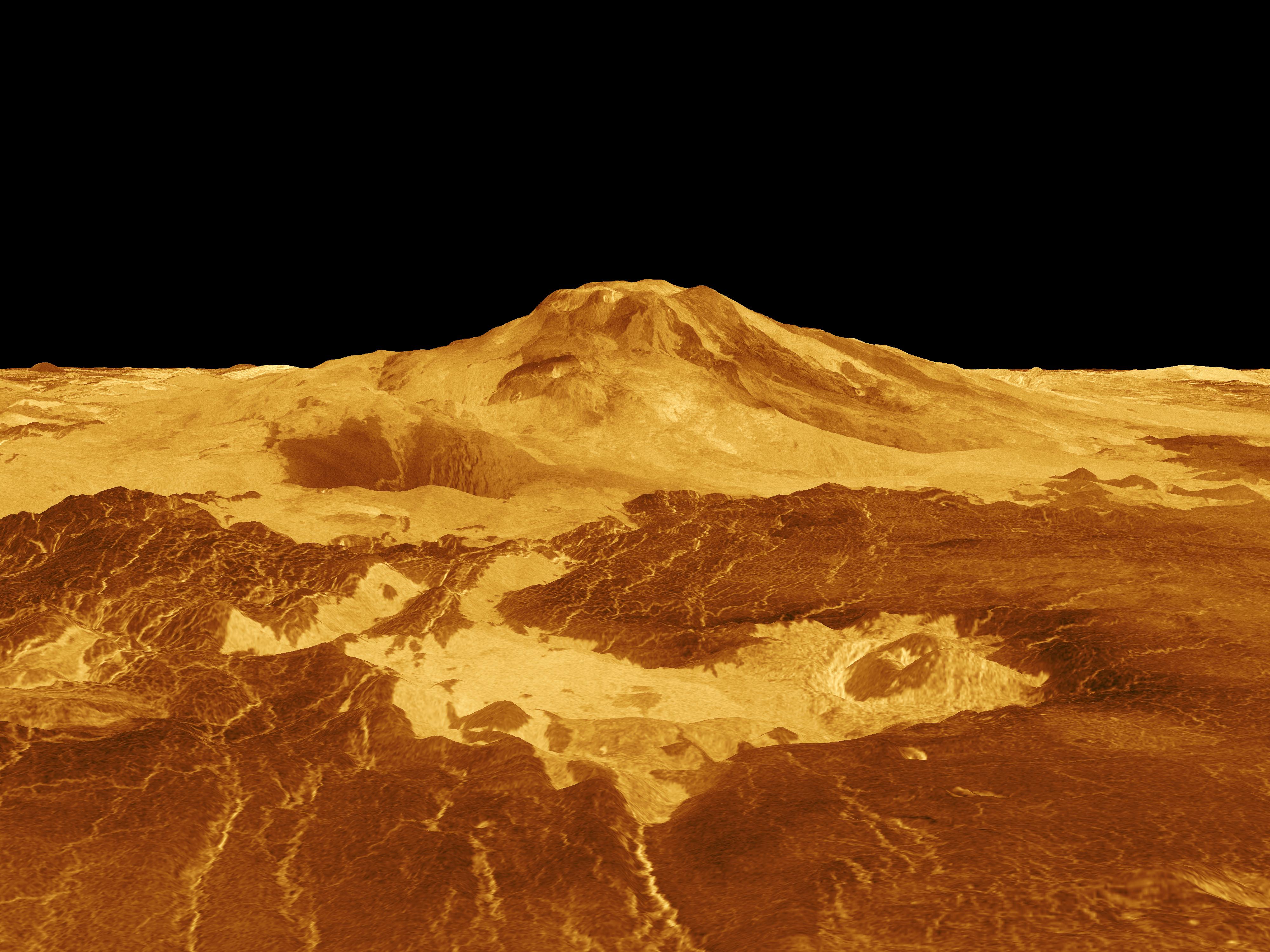
deglr6328 writes "The BBC is reporting that a paper published in the journal Icarus, suggests that the highlands of Venus are covered by a layer of Lead and Bismuth frost. The authors of the paper were looking for a way to explain the anomalous high reflectivity (and corresponding low emissivity) shown at high altitudes in synthetic aperture radar images sent back by the Magellan probe in the early 90's. The study concludes that Venus's lowlands are hot enough (~850F) to partially vaporize these metals into a mist which then condenses back out of the atmosphere to a solid on the surface of the cooler Venusian highlands."
Add a cheap means of hoisting the goodies from the surface and we have the first interplanetary mining operation. The lead might be especially valuable in space for radiation sheilding. I wonder what other yummy metals (arsenic, gallium, indium, etc.) might be found on the surface? Perhaps an orbital station around Venus might be a good for manufacturing semiconductors or superconductors from freely available materials from the surface.
....creating an elevator cable that can handle the high temperatures.
Only minor detail
Two wrongs don't make a right, but three lefts do.
Bismuth is pretty.
That's a picture of Bismuth that we can grow in labs. I wonder if the atmosphere of Venus produces samples that are even more interesting.
There are no trails. There are no trees out here.
Elevators make it easier but still not dirt cheap to move stuff up. Venus is comparable to earth in mass, rotation period, and size, and probably would be about as cost-effective as the earth elevator ($100/lb at best). Also, the extreme climate. Mining light bodies like asteroids, comets, and moons makes more sense - you don't have to spend anything because they're already "up", and sending them down is free, provided you don't destroy anything.
---If you can't trust a nerd, who can you trust?
Venus has a rotational period of over 200 DAYS. By my calculations, Geostationary orbit is effectively non-existant at around 1.7 billion miles. No elevators for Venus!
---If you can't trust a nerd, who can you trust?
Space elevators are cool for places you need to send stuff up without blowing up where it came from, but in the case of uninhabitable venus.. Who cares??
Just attatch some nuke to the nearest large rock floating in space, calculate the direction it needs to go in to enter the planets gravity, and BAM! The explosion sends the rock careening towards Venus.
After the big mushroom cloud sends the microscopic sediment into the upper atmosphere, you could swoop it up in giant whale shaped spaceships (since the air density is greater, you need less wing area for atmospheric lift, it would look like a whale) for delivery and processing in an orbital space station.
Sort of like dynamite fishing on a planetary scale.