 Slashdot Mirror
GNOME/KDE Integration Gets A Few Boosts
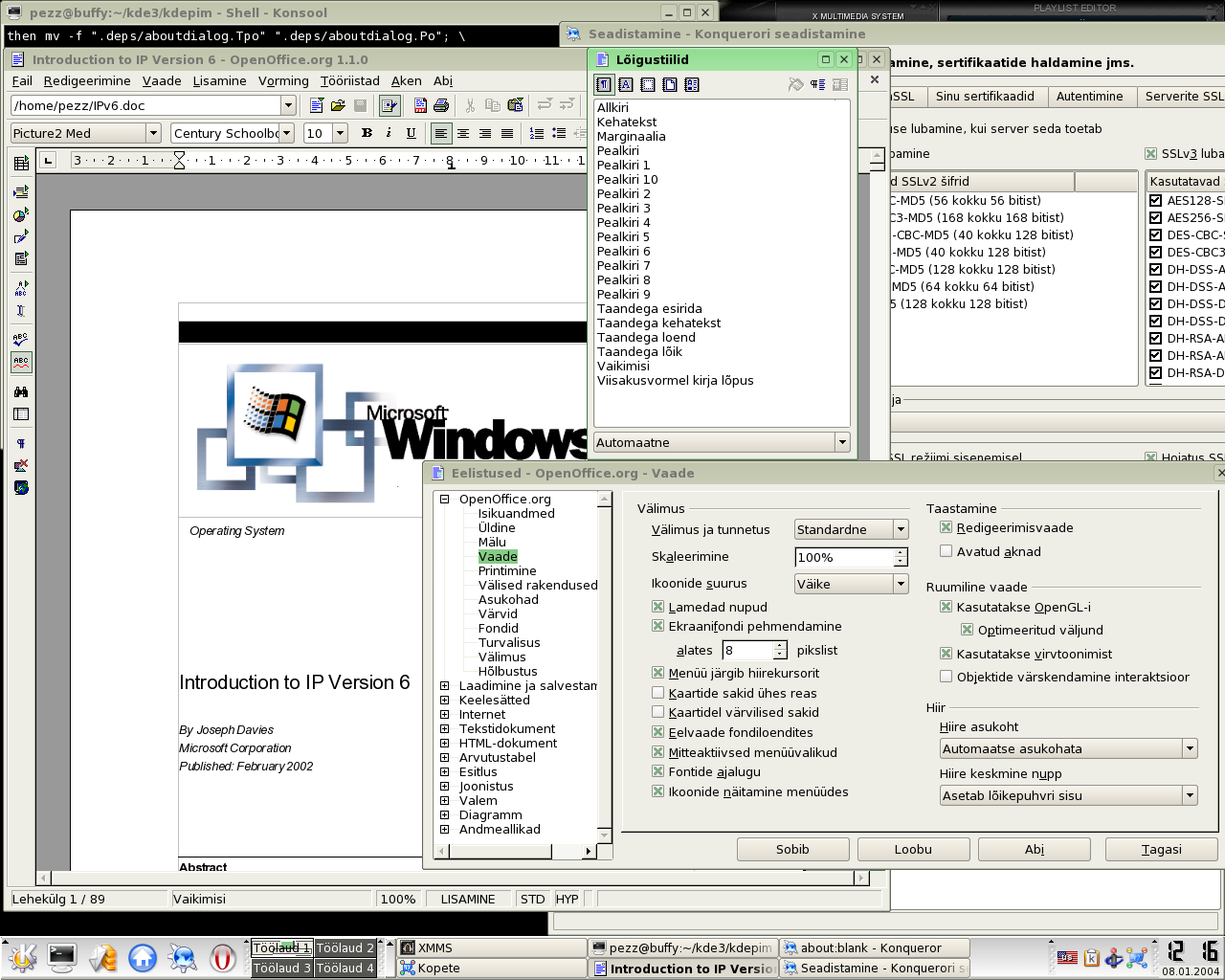
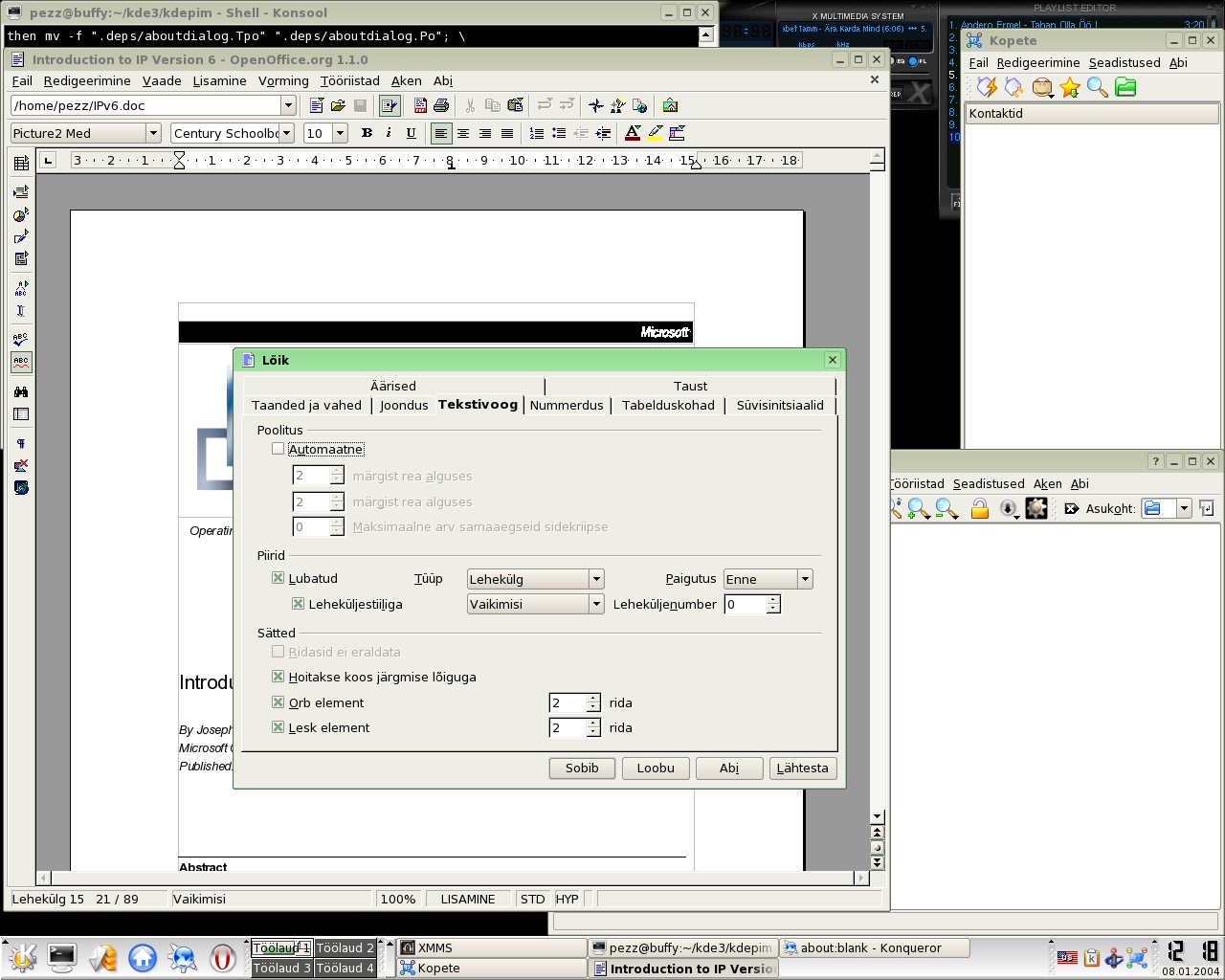
Balinares writes "Great bunch of news on the Linux desktop unification front. After the unification of GTK and Qt themes that Slashdot already reported on, it is OpenOffice's turn to get the unified look treatment (screenshot 1, screenshot 2, screenshot 3).
In related news, the recently released QtGTK library allows to merge the Qt event loop with that of GTK. In other words, this means you can now easily use KDE's DCOP, IOslaves, and, last but not least, file dialogs, from inside your GTK apps. (Screenshot of this feature used in XMMS2: 1 2). It comes with a tutorial that explains the basics.
Finally, the new fuse_kio tool now makes it possible to use KDE's IOslaves directly at the filesystem level, from any Linux app. 2004 is really beginning well for all those of us who use Linux as their primary desktop!"


So what are we going to call this, KNOME? Or maybe GDE...
This is exactly what should be happening I think. We've seen some pretty good strides as far as interopability goes between KDE and GNOME. This brings us the unified desktop without having to sacrifice either one of these projects. It's good that KDE and GNOME can both go their own directions while still increasing interoperability.
This should satisfy the people who just want a consistent look on the desktop and then people who want choice.
That reasoning makes no sense.
"But the truth is, people don't want to choose, they want you to choose for them."
Well, just because there IS choice doesn't mean you HAVE to choose. If those people don't want to choose then why don't they just let their distributor/geek friend/vendor/whatever choose for them?
And you forgot why there is choice in the first place: one size does not fit all! The only way to satisfy as many people as possible is to provide choice. The people who don't like that their distributor/vendor/whatever chose for them will choose, and the people who don't want to choose will let their distributor/vendor/whatever chooce for them. What's wrong with that?
That depends on what license you pick for Qt. Qt is available under a number of different licenses. For Free Software, you need to follow either the GPL or the QPL.
I don't see it that way. I use about 95% KDE applications on my desktop, and about 5% GTK/GNOME applications. The GTK/GNOME applications always bug me because of things like the file selector (which, for example, can't load files using the KDE IOSlaves).
Given that I find this kind of thing useful, and that I use 95% KDE applications, I can't agree that it's a sign of GNOME's success. It's just dragging the GTK/GNOME applications along where the original developers have failed to take them.
That argument's been done to death. The basic points:
When I first installed Linux I flipped a coin to decide between the two :) Yes, I didn't want to make a choice, as Redhat gave no background to base my decision.
GTK apps using KDE file dialogs
GTK apps using the QT event loop and DCOP, etc.
All Linux apps able to use KIO Slaves
How come no KDE apps want to use the GLib event loop or the GTK file dialogs or Gnome VFS I wonder? (*wink wink*)
"Not true. It was sometimes,"
It still is. We're talkling about people writing applications. Trolltech has a large list of customers, which includes many major companies. More importantly, not a single company has come forth and said they used GNOME for licensing reasons. Sun's choice of GNOME had much more to do with the fact that:
a) Since GNOME 2.x was a total rewrite, they got to play a huge role in shaping it. Much of the HIG and the usability and accessibility work on GNOME was thanks to Sun.
b) KDE wouldn't compile with Forte C++ (Sun's C++ compiler), which meant that no KDE apps would be developed with Forte C++, and Sun's engineers were much more comfortable with C.
c) Sun's engineers were much more comfortable with existing standard technologies like CORBA, as opposed to KDE's new ones like DCOP. CORBA turned out to be more or less a failure on GNOME, but Sun didn't know that at the time.
"Sun-Gnome, IBM-Gnome(at least based on assumption that Suse and RH are it's distros), RH-Gnome, Novell-Gnome, Suse the major KDE player - Gnome"
Whoa. Neither SuSE nor Novell have comitted to GNOME. And neither has IBM. Its just Sun and RedHat. IBM is a mix of GNOME and KDE (because of RH and SuSE). And to this day, most of the major Linux desktop rollouts that have actually happend (the China rollout hasn't, yet) have been KDE.
"KDE is loosing ground in this field. Not gaining."
This is probably true. But its *very* early in the game, and it is these sorts of initiatives that could stem the tide.
"Phoenix and Thunderbird - GTK"
Neither are GTK+ apps. They use GDK to handle drawing and do fonts. They don't use any GTK+ dialogs, widgets, or any GNOME technologies.
"OpenOffice.org - Now native GTK planned for next release"
No, a GUI-independent framework is planned for next release.
"KDE release, well project is open but no one want's to do it"
I have yet to see any indication that "no one want's to do it." Hell, KDE's already ahead on this front. There is already a release that adopts OpenOffice to the native KDE theme. That's one step, anyway, ahead of OpenOffice's GTK+ support.
"Evolution - I can't remember any serious KDE mail client sorry (please no kmail)"
Kontact? KMail is a very seriousl mail client, and you provide no evidence to the contrary.
"Gimp - not Gnome but GTK it is"
This is probably the standard one. However, 2.0 has the GUI and core seperated, and a Kimp would not be out of the question.
"xmms - GTK"
XMMS is a GTK-1 app! It looks and feels nothing like a GNOME app! And KDE has many excellent media players, notably JuK and AmaroK.
"Time to smell the future, distro maybe but commercial apps are poping up"
And so far, very few of them have been based on either GTK+ *or* Qt. Most are Motif ports. And of the commercial apps that do use a modern toolkit, most of them have chosen Qt.
"btw. all this **look** hacks KDE producess, GTK look, OpenOffice look, KDE dialogs in GTK are just dust in your eyes."
Well, apparently dust works. Because GNOME has managed to convience a whole bunch of people that Mozilla and OpenOffice are GNOME apps! KDE should have done these hacks a long time ago. And note, Windows is entirely based on such **look** hacks, to make the many Windows toolkits look cohesive. Its a crappy solution, technically, but the market doesn't seem to care.
A deep unwavering belief is a sure sign you're missing something...