 Slashdot Mirror
GNOME/KDE Integration Gets A Few Boosts
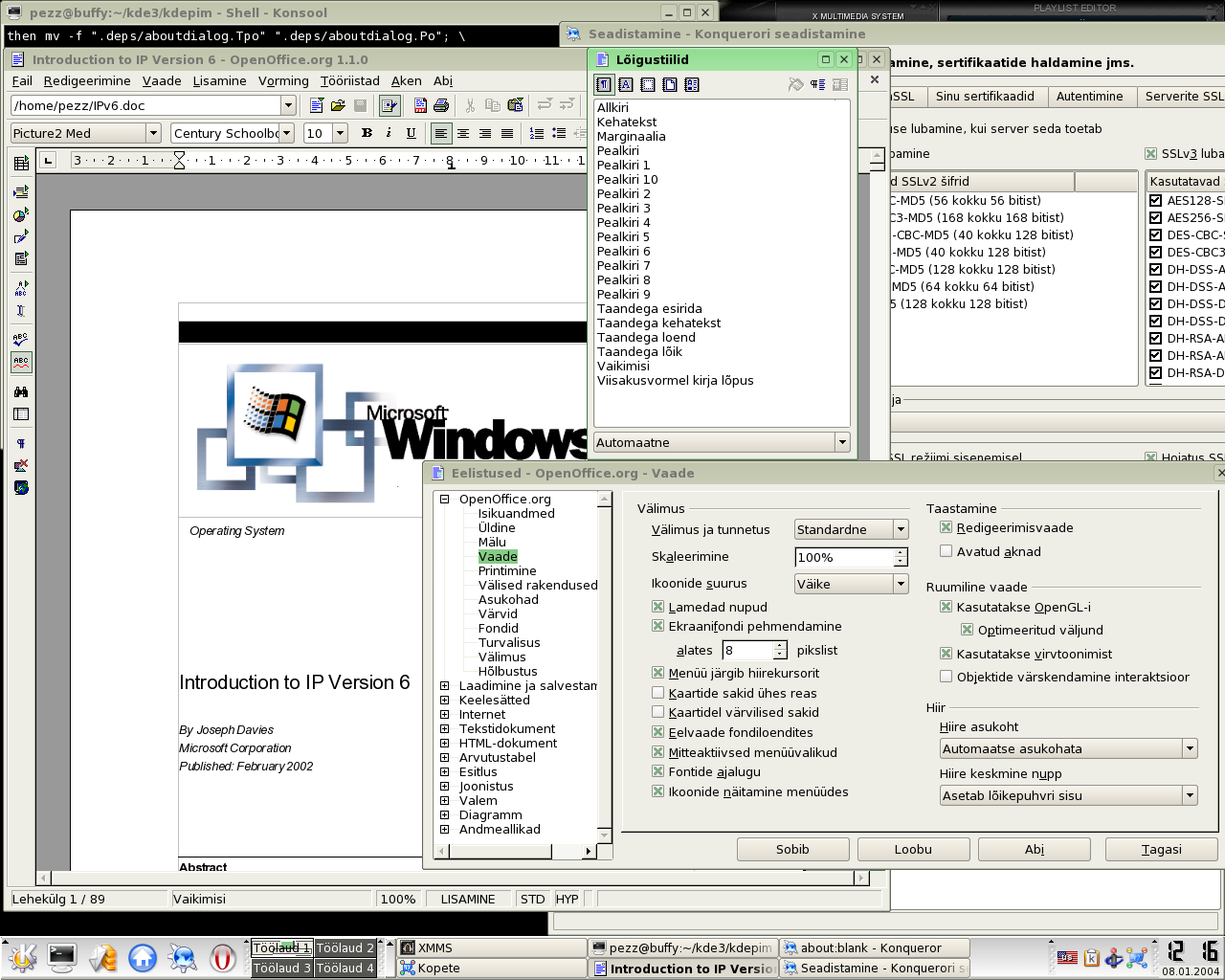
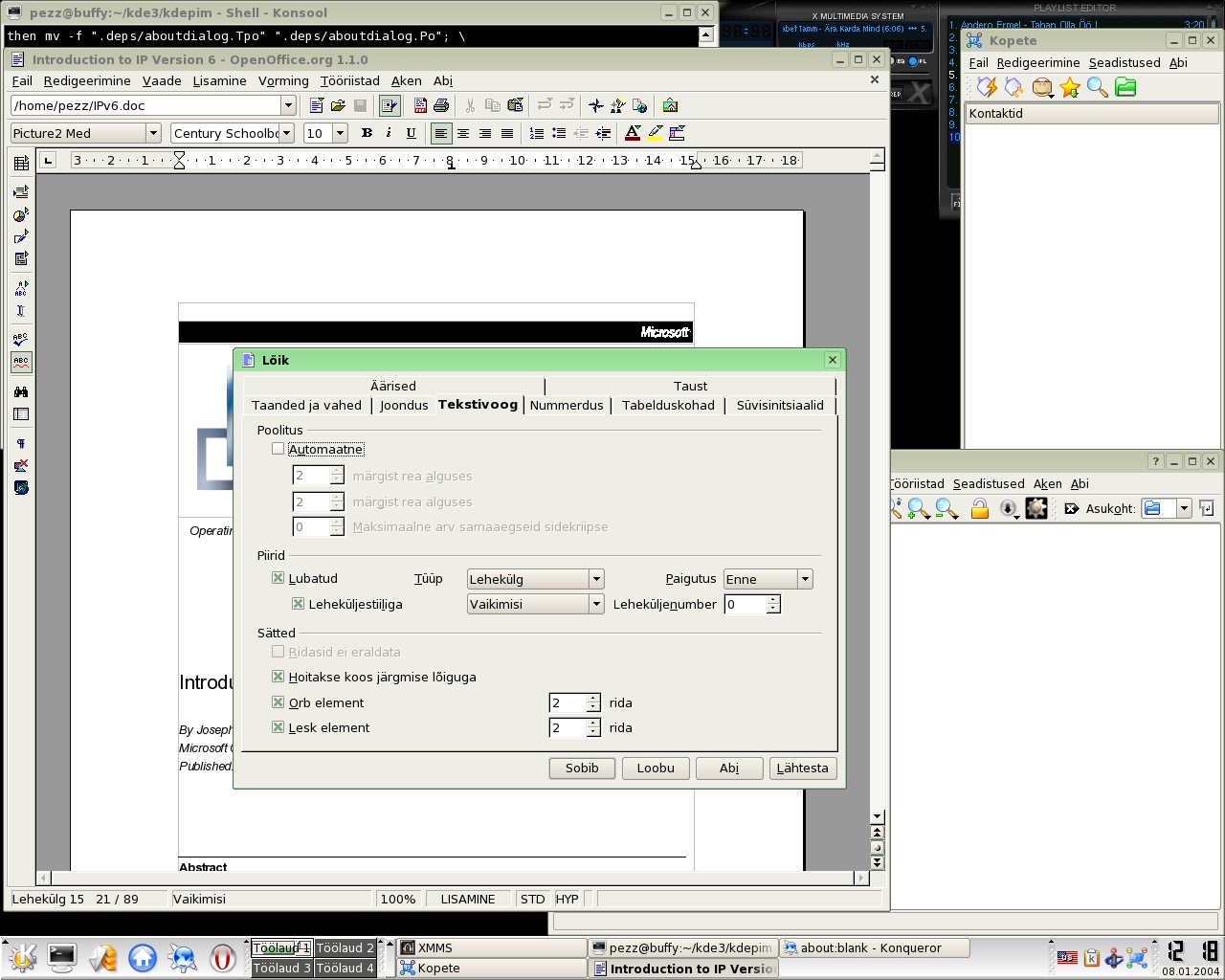
Balinares writes "Great bunch of news on the Linux desktop unification front. After the unification of GTK and Qt themes that Slashdot already reported on, it is OpenOffice's turn to get the unified look treatment (screenshot 1, screenshot 2, screenshot 3).
In related news, the recently released QtGTK library allows to merge the Qt event loop with that of GTK. In other words, this means you can now easily use KDE's DCOP, IOslaves, and, last but not least, file dialogs, from inside your GTK apps. (Screenshot of this feature used in XMMS2: 1 2). It comes with a tutorial that explains the basics.
Finally, the new fuse_kio tool now makes it possible to use KDE's IOslaves directly at the filesystem level, from any Linux app. 2004 is really beginning well for all those of us who use Linux as their primary desktop!"


I can't wait for this to happen, I'm tired of there being so many desktops in linux. You can argue all you want about "it offers better choices for people." But the truth is, people don't want to choose, they want you to choose for them. Once they learn your system, then they can go in and tweak it for themselves.....I've always seen this as a drawback for Desktop Linux, some programs work in one window maker, others work in another. It's too hard for the average user.
What effect will the QT/GTK event loop intergration tech have on licensing? In other words, does your app have to be GPL to use this tech?
This is not wanted, because XMMS has always been the bastion of UI consistency. Also, while I am telling the truth, Mozilla makes any desktop look professional with its native menus and widgets. While I am still telling the truth, I am not always looking for functional replacements for Mozilla and XMMS that don't scream UGLY and awkward every time you see them.
~Darl
So what are we going to call this, KNOME? Or maybe GDE...
One of the screenshots look like a print dialog box. I wonder what the state of that is. Or is this a moot point, when cups has it all solved?
What time is it/will be over there? Check with my iPhone app!
This is exactly what should be happening I think. We've seen some pretty good strides as far as interopability goes between KDE and GNOME. This brings us the unified desktop without having to sacrifice either one of these projects. It's good that KDE and GNOME can both go their own directions while still increasing interoperability.
This should satisfy the people who just want a consistent look on the desktop and then people who want choice.
It's projects like these that show how much more productive Open Source is.
Proprietary companies may try to run other company's formats, but probably wouldn't be willing to say "oh here's how we do it, let's make it easier for people and merge the two for greater compatibility." Open Source companies can't (and I'd like to think wouldn't if they could) restrict compatibility for their own benefit.
For example: Microsoft comes out with special new features like "plug n' play" or some new way to install programs "faster" and "more easily," but RedHat releases an open source program, RPM, and allows anyone who will to use it.
Hooray for Open Source!
Esoteric reference.
OO.org has apparently been translated to Bork!
Great job to all those who worked on the integration! I have been worried that Gnome might overtake KDE as the popular desktop and KDE might then be subject to a smaller niche for the desktop. I'm glad that all the work that the KDE teams have done will continue to be used alongside Gnome.
http://github.com/gbook/nidb
That's not xmms in the screenshot, it's beep, an XMMS fork ported to GTK2 and Pango/Freetype font rendering.
It's hard to be religious when certain people are never incinerated by bolts of lightning.
For you KDE users who aren't on Konqueror 24/7: don't forget to say thank-you.
I thought we can't use such intrusive naming anymore??
I don't see it that way. I use about 95% KDE applications on my desktop, and about 5% GTK/GNOME applications. The GTK/GNOME applications always bug me because of things like the file selector (which, for example, can't load files using the KDE IOSlaves).
Given that I find this kind of thing useful, and that I use 95% KDE applications, I can't agree that it's a sign of GNOME's success. It's just dragging the GTK/GNOME applications along where the original developers have failed to take them.
That argument's been done to death. The basic points:
that now companys who don't want to fork over a licence fee to trolltech can build apps that integrate with KDE using gtk and no one would have to know or care? Or is there some kind of GPL conflict that I'm not seeing?
Why is it so hot? Where am I going? What am I doing in this handbasket?
> Someday one of Gnome and KDE will be obsolete.
You had some good points, but I strongly disagree with that statement, unless by "someday" you mean far, far in the future.
Open Source is not a monoculture. There does not have to, nor should there be, "one true path". Should we have one file system type as well? Make "more" and "less" battle to the death?
People use the desktop they do because they WANT TO and can MAKE THE CHOICE. Why should we think that choice and preference will go away? Do we want to be like Microsoft as a community and force people to conform? Sorry, that's just not possible. Give the penguin a hug for that.
While I see the united themes and integration as a step forward to a somewhat consistant Linux desktop expierence, God (tm) help us if we limit the diversity that brings true innovation.
I'm dying to have my gnome/kde apps respond to WM_PAINT. Really. I want them to paint and paint and paint, all day long, then I will WM_DESTROY them!!!
Won't this create some undesired mess? I'd rather like to have at least some visual diversity between them. After all, concurrent development inspires progress.
Visual diversity may indeed inspire progress because there would be more competition, but it's not very desirable. Developpers may like it, but if you want to show a desktop with 2 different themes, people who are used to see a consistent interface will be scared (or at least not be impressed) by it.
Not only will most people think it's ugly, but also requires extra configuration: with two independant themes, changing the KDE theme doesn't change the theme for GTK applications, resulting in confusion. And confusion isn't good when trying to impress people with Linux.
Why Gnome/KDE insist in non-fs integrated virtual filesystems? Although their solution is platform independent, it is too 'opaque'. LUFS and similar stuff is the win :-b
The same OO.o integration work has been done with GTK+.
It's hard to be religious when certain people are never incinerated by bolts of lightning.
Oh well. To quote someone here (Sorry I don't remember your name)
"Why are we so worried about the fact that publishers of closed source proprietary software who are used to paying for software development tools are going to have to continue that exact same practice in the OSS wordl?"
On the topic at hand, all I can say is sweet. Gimp, Evolution, Beep etc all fitting in KDE and where possible even getting to use the excellant KDE fileselector.
If you wanna get rich, you know that payback is a bitch
Now the wide variety of commercial applications for Linux et al can play nice with KDE!.
That remains true. Commercial applications written in other developement platforms will work inside KDE (they will behave differently, though). Oh, wait... doesn't KDE require a license for commercial applications... oh, never mind...they can't play nice together.
Well, now that integration is possible, instead of coding in QT you can write Gnome/GTK commercial applications and run them inside KDE, with the looks and behavior of KDE. As far as I can tell, you are not violating any license by doing this.
I really like that idea. I'm a C coder rather than a C++ coder, so coding in GTK feels more natural to me. But... I prefer KDE over Gnome for my desktop (*), and I'd like the programs I create to have the behavior of KDE. So I was in a point of desperation trying to decide whether to use C-based GTK or C++ KDE/Qt.
Now, I can happily code in C/GTK, knowing that my apps will look great in both Gnome and KDE!
(*) No trolling or flamebait intended. If you prefer Gnome and say KDE sucks, that's fine by me, it's a free world.
GTK apps using KDE file dialogs
GTK apps using the QT event loop and DCOP, etc.
All Linux apps able to use KIO Slaves
How come no KDE apps want to use the GLib event loop or the GTK file dialogs or Gnome VFS I wonder? (*wink wink*)
Estonian isn't a part of Indo-European, or the so called "Baltic" languages. It's actually a part of the finno-ugric language family, which also includes Finnish.
While I appreciate the humor, all this has a reasonable explanation. This integration work in question is being done by KDE people, as part of a recent initiative to do something about KDE's reputation for only doing their own stuff, seemingly "starting over" (their own office suite, their own browser etc) where GNOME is adapting to existing technology. Basically, KDE is starting to show that it, too, can adapt existing technology.
This work is NOT being done by people who simply want more integration, but by people who want a more consistent KDE desktop. If the GNOME people want to integrate KDE apps so that they'll feel more like GNOME apps, they're free to do so.
"Oppression and harassment is a small price to pay to live in the land of the free." -- Montgomery Burns.
Look, they have MS Word running natively on Linux. It even has the "Fail" option in the menu! ;)
Fail > Now
Fail > When file not saved
etc.
You wild guess was close but not enough. It's Estonian.
GIMP isn't really a GNOME-app AFAIK. Yes, it uses GTK+, no that does not make it in to a GNOME-app. And there are LOTS and LOTS of kick-ass KDE-apps (for example Konqueror, Kmail, Kdevelop, Quanta, K3B etc. etc.), so your claim that "GNOME-apps rule, KDE-apps suck!" is just plain ignorant.
Lesbian Nazi Hookers Abducted by UFOs and Forced Into Weight Loss Programs - -all next week on Town Talk.
There seems to be ALOT more commercial Qt-apps than there are commercial GTK+-apps. I honestly can't remember even one commercial GTK+-app, but I can remember lots of commercial Qt-apps.
What makes email-client "serious"? What makes Evolution "serious", whereas Kmail is not? And of course, there is Kontact.
To my knowledge, serious progress has already been made there. I saw an announcement about it in dot.kde.org.
Lesbian Nazi Hookers Abducted by UFOs and Forced Into Weight Loss Programs - -all next week on Town Talk.
"Not true. It was sometimes,"
It still is. We're talkling about people writing applications. Trolltech has a large list of customers, which includes many major companies. More importantly, not a single company has come forth and said they used GNOME for licensing reasons. Sun's choice of GNOME had much more to do with the fact that:
a) Since GNOME 2.x was a total rewrite, they got to play a huge role in shaping it. Much of the HIG and the usability and accessibility work on GNOME was thanks to Sun.
b) KDE wouldn't compile with Forte C++ (Sun's C++ compiler), which meant that no KDE apps would be developed with Forte C++, and Sun's engineers were much more comfortable with C.
c) Sun's engineers were much more comfortable with existing standard technologies like CORBA, as opposed to KDE's new ones like DCOP. CORBA turned out to be more or less a failure on GNOME, but Sun didn't know that at the time.
"Sun-Gnome, IBM-Gnome(at least based on assumption that Suse and RH are it's distros), RH-Gnome, Novell-Gnome, Suse the major KDE player - Gnome"
Whoa. Neither SuSE nor Novell have comitted to GNOME. And neither has IBM. Its just Sun and RedHat. IBM is a mix of GNOME and KDE (because of RH and SuSE). And to this day, most of the major Linux desktop rollouts that have actually happend (the China rollout hasn't, yet) have been KDE.
"KDE is loosing ground in this field. Not gaining."
This is probably true. But its *very* early in the game, and it is these sorts of initiatives that could stem the tide.
"Phoenix and Thunderbird - GTK"
Neither are GTK+ apps. They use GDK to handle drawing and do fonts. They don't use any GTK+ dialogs, widgets, or any GNOME technologies.
"OpenOffice.org - Now native GTK planned for next release"
No, a GUI-independent framework is planned for next release.
"KDE release, well project is open but no one want's to do it"
I have yet to see any indication that "no one want's to do it." Hell, KDE's already ahead on this front. There is already a release that adopts OpenOffice to the native KDE theme. That's one step, anyway, ahead of OpenOffice's GTK+ support.
"Evolution - I can't remember any serious KDE mail client sorry (please no kmail)"
Kontact? KMail is a very seriousl mail client, and you provide no evidence to the contrary.
"Gimp - not Gnome but GTK it is"
This is probably the standard one. However, 2.0 has the GUI and core seperated, and a Kimp would not be out of the question.
"xmms - GTK"
XMMS is a GTK-1 app! It looks and feels nothing like a GNOME app! And KDE has many excellent media players, notably JuK and AmaroK.
"Time to smell the future, distro maybe but commercial apps are poping up"
And so far, very few of them have been based on either GTK+ *or* Qt. Most are Motif ports. And of the commercial apps that do use a modern toolkit, most of them have chosen Qt.
"btw. all this **look** hacks KDE producess, GTK look, OpenOffice look, KDE dialogs in GTK are just dust in your eyes."
Well, apparently dust works. Because GNOME has managed to convience a whole bunch of people that Mozilla and OpenOffice are GNOME apps! KDE should have done these hacks a long time ago. And note, Windows is entirely based on such **look** hacks, to make the many Windows toolkits look cohesive. Its a crappy solution, technically, but the market doesn't seem to care.
A deep unwavering belief is a sure sign you're missing something...
Its not a sign of GNOME's success, but an indication that GNOME has some great apps that KDE doesn't. Its actually an indication of GNOME's weaknesses as a platform. If GNOME was really comparable to KDE, the GNOME application base would have pulled them over long ago. But the sheer technical advantages of KDE make it worth it to build projects like these, to access GNOME's apps from within KDE.
A deep unwavering belief is a sure sign you're missing something...
as part of a recent initiative to do something about KDE's reputation for only doing their own stuff, seemingly "starting over" (their own office suite, their own browser etc)
KOffice and Konqueror were started long before OpenOffice and Mozilla became open source.
-- Repeat with me: "There is no right to profits".
So, why are more apps written using GTK/Gnome? I don't know. FWIW I feel the KDE framework is better too, but ultimately they are both pretty good. In particular GTK stands on its own more than Qt does on the Linux desktop - for apps that wish to remain desktop neutral it seems a more natural choice (and to be honest GTK vs Qt is a pretty even match, you can argue about the corner cases all day but I'd say they're just as good as each other).
Whenever I read the KDE API docs I can't help thinking what a shame it is - if the original developers had cared more about licensing we'd probably only have one desktop, and everybody would use these great frameworks. There'd be no problems with desktop neutrality, no need to slowly reinvent everything in order to make it desktop neutral and so on.
A lesson learned hard, and one I hope future developers will respect..... those who don't take community concerns over platforms seriously can seriously damage things.
> 2004 is really beginning well for all those of
> us who use Linux as their primary desktop!"
Yes. Because GNOME and KDE only run on Linux, don't they?
Please, a little credit to the folk who right proper, portable code, and to those who port it.
I think that all the Translate-o-matics should be merged. But KDE isn't hated enough to have one, so behold the Gnome-translate-o-matic 2004!
:Gnome has a new web browser
Gnome is a rival to KDE, the popular collection
of programs for Linux and freinds. Unfortunatley, ever since Gnome 2.4 (and the BETA 2.5) was released, I have found more and more Zealots who MUST advocate it at every possible moment. Here are some of their most common claims and what they REALLY MEAN.
Claim : Unlike KDE, Gnome is free
Translation : GPL is freerer than LGPL. LGPL allows corporations like Novell
and Sun to have propeitry forks and lock away their changes from the user. Now
that Novell has taken over Ximian you can expect Gnome to get put under
corpirate lock. With KDE you have the choice, you either PAY UP or pay with
your source code. Most companies agree, the majority of commerical software for Linux is written in Motif and Qt, and NOT GTK. Apart from Ximian's desktop, there is no major product using GTK.
Claim : Nautilus is much better than konqueror.
Wrong, if your using nautilus for anything more than a simple finder clone you
can forget it. No split screen, no ioslaves (gnome-vfs can't compare, sorry) and forget about being able to
have a decent file dialog, not to forget that it is as unstable as hell and is
STILL slow on >3 Ghz machines. The latest version decided to copy Windows 95, complete with a my computer icon on the desktop.
Claim : Gnome is easier to use than KDE
Yep, nothing like using gconf-editor to edit all except the most trivial of
settings. Want tear off menus? Want a useable file dialog? You won't find it
here. Gnome was a lot more usable back in the 1.4 series, before sun came along with their usabillity "study".
Claim : Gnome has eye candy
Yes, my pirated Win32 fonts with the patent infringing font renderer. Bit
stream vera sans looks like Tahoma put through a shreadder! Of course I still
reboot into windows to print using "Comic Sans MS. Gnome themes don't even let you change the colour scheme. Looking at sites like art.gnome.org you will see that the majority of themes are the same one in different colours!
Claim : Gnome is not ugly like KDE
I am too stupid to realise that the look of KDE can be changed by going to the Appearence and themes section in KDE, not to mention that KDE has more themes wrote for it. Popular themes such as Keramik, Liquid, dotNET, Plastik and Alloy were wrote for KDE first, but somebody wrote a crappy port of it on art.gnome.org, so Gnome must be good.
Claim
Yawb! Along with Galeon, mozilla, thunderbird, konqueror, atlantis, lynx,
netscape and w3m. Yes I need another browser! Not to mention that its got a
religiously offensive name and it dosen't allow bookmark folders. It also
crashes like a crazy! Apple chose khtml for a REASON! its stable and light! Epiphany is also a faliure, it has gone through 6 major bug fixes and none of the major distrobutions use it because they stick with decent browsers.
Claim : Gnome is more popular than KDE
Despite the fact that the only mainstream Gnome based distro has been EOL'd,
and all the newbie distros such as Mangadrake, Lindoze, $u$E, Lycoris,
Xandroze, Gentoo use kde default, bruce perens decided to make a gnome based distro and everybody hated it because KDE wasn't in it.
Klaim : You KDE guys must be sick of the K
Our G's and monkeys are SO MUCH better, gedit, glib, gconf, bobono, ghex,
gless, same-gnome, gstreamer.
Claim : Gnome has multimedia framework
Its a kludge of esd combined with broken xine libraries. No wonder it crashes
all the time and dosen't work on 95% of video files. But we have Rhythmbox, a cheesy Itune clone using it, so it rules!
Zealot : My Gnome work station.....
My 2Ghz G5 box my mum bought for me from PC w
He's attempting to be even-handed, but, instead, is just stupid. Granted -- I'm not taking the time to actually read his unbalanced whine, but right off the bat, I see one out-and-out lie: "Apart from Ximian's desktop, there is no major product using GTK."
Ummm... would the GIMP count as a major product? How 'bout GNUCash?
Let's face it: this guy's a bozo. And, yeah, a coward -- which is the reason he sits there, makes all these amazing, bizarre claims, with nothing to back them up, and posts as an AC. Granted: I think Miguel's ego could drop a notch or two, and I definitely think the KDE developer community is more interested in harmony than... well, Miguel is. [Most of the GTK/Gnome developers are pretty reasonable folk, from what I've seen.]
Do I like GTK/Gnome more? Slightly -- or, perhaps I should say that I don't like being tied to a WM, and I like a panel, and Gnome's does a fine job. Does either "Suck"? Ummm... no. Stupid people who write stupid, long-winded rants "suck." People who attempt, instead, to inform, in an objective, open manner, OTOH, can actually help the OSS community AS A WHOLE, instead of picking sides, and sniping at those who disagree. Frankly, I'm -glad- there are two main competing libraries/environments: competition is good. Just look at Windows if you don't believe me. If either were the clear winner, stagnation would be the result. As it is, the developers are kept on their toes, and -- welcome to OSS -- can freely pilfer ideas from each other without fear of (say) patent reprisals.
Well, 'nuff for now: I'd hate to become as long-winded as the schmuck I'm criticizing...
------
Does anyone know if a closed-software maker is violating the GPL if it has originally linked to an LGPL library (legal), which has an independently created GPL analogue?
If not, then isn't it a matter of a LD_PRELOAD to transfer all or many GTK calls into QT calls, where the preloaded library is fully GPL, and gtk+ software was originally linked to the LGPL original gtk?
I really don't understand that logic. In fact, for system facilities, libraries, etc, I think the LGPL makes more sense. If a programmer wants to write a proprietary GTK or QT app it should be able to access all the system level facilities that the respective GNOME and KDE environments offer. Now it shouldn't be able to pull the code of a competing free software project into it with out having to give back. In short, if you are providing an open service/API or other applications to use, I personally dont' think it's right to discriminate as to what apps can use the service. Them actually rolling your code into their package though is a different matter. Kernel = GPL libraries = LGPL apps = GPL (or proprietary if you really want to) The app writer should be able to make that choice.
----- Question authority, but not ours. Hate the man, but we're not him.
KMail is(er.. was) possibly the worst core KDE application, IMO. I have used it pleny of times, and it always does something unexpected(deleting mail, crashes, etc.).
:) Its included in 3.2
:) The OOo situation is a bit complex. What Ximian is working on is a GTK+ version of OpenOffice's Native Widget Framework (NWF). Contrary to the name, the NWF is not a port of OOo to the native toolkit. Rather, it is a way to use the native toolkit to draw widgets for OOo. Its a cosmetic layer on top of the OOo VCL toolkit. KDE has an NWF implementation that's pretty far along as well. Of course, all of this is completely different from the new toolkit abstraction outlined in the Q Concept, which will have native ports for GTK+, Windows, Qt, and OS X.
---------
I've been using KMail since the 2.x days, and I've never had it lose email.
I also find the interface to be rather buggy and quirky.
----------
How so? KMail's interface is pretty straightforward. Folders on left, mail on top right, current message on bottom right. Toolbar buttons to compose, save, and print emails, as well as download new emails, reply and forward emails, iterate through unchecked mail, delete email, and search for emails. A lot of KDE apps are cluttered and have overly complex interfaces, but KMail is not one of them.
But what I think the other guy was getting at is that it lacks the huge number of features of most "modern" email clients.
-------------
Like? Kmail has made enormous strides over the past year, because of the Kolab/Kontact work. By the time Kontact is mature (when the Kolab work gets integrated in a few months time), Kontact will most likely be more feature-complete than Evolution.
Personally, I use mutt these days, with vim as my pager and editor(you just can't beat that).
-------------
Heh. Thanks to KParts, you can use vim in KMail too
False. Both use many GTK widgets now. Look at the buttons, text entry boxes, etc. Still not GTK menus though...
---------
You're right, I hadn't looked at a recent Firebird release. Although, its really not a GTK app. It still uses XUL as its toolkit. You can get OpenOffice to use Qt to draw its buttons/menus/etc too, but that doesn't really make it a Qt app, does it?
No, he was correct. Ximian has been working with OO.o, and they have implemented GTK for nearly the entire app(using the GUI-independent framework? I don't know... but it is there).
--------
No, I was correct
A deep unwavering belief is a sure sign you're missing something...
Yes, they did. When you distribute under the BSD license, only your code is under the BSD license. When you combine the two, the GPL supercedes the GPL so the entire distribution (your BSD program + GPL program foo) is distributed under the GPL license.
That means, if I so choose, I could sever the GPL parts from the BSD parts and close your software, but not the GPL parts, because I wasn't given permission to.
Black and grey are both shades of white.
More realistic comparison would be Kontact - Evolution.
I guess you mean Kword - Abiword?
I prefer Konqueror. How well does Epiphany handle filemanagament? Now very well eh? That's what I thought...
I think Kcontrol is superior. It lets me tweak the desktop EXACTLY the way I want to.
Maye GNOME is more gung-ho when it comes to simplicity of use. But they do that at the expense of configurability. Sorry, but I prefer KDE's approach. And I have exactly ZERO problems with KDE and it's ease of use. Just because you can tweak it as much as you want does not mean that it's hard to use.
Lesbian Nazi Hookers Abducted by UFOs and Forced Into Weight Loss Programs - -all next week on Town Talk.