 Slashdot Mirror
3D Display, No Glasses Required
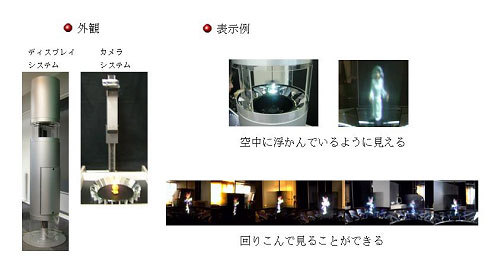
Shibatch writes "Hitachi, Ltd has developed a 3D display called Transpost which can be viewed from
any direction without wearing special glasses. 3D movies can be seen as floating in
the display. Also, 3D movies captured at other places can be shown on the display
in realtime. The principle of the device is that 2D images of an object taken from
24 different directions are projected to a special rotating screen. They also
developed a camera which can capture images from 24 directions simultaneously." The pictures are interesting, but ... translations, anyone?
I remember this earlier Slashdot article discussing a similar technology. How long before these things are commodity hardware?
the artist Dali played with lasers and 3d holograms in the eighties, of note was a woman in a rocking chair that just floated in thin air (about 6in tall) (red)
Old news, but the best article I've read on this yet is the New Scientistarticle from a couple of years ago in which they first (for me) described realtime rendering using existing games. Interesting stuff.
Basically its just layers of projected images, spinning around to give the impression of volume. Still really neat though.
From the article description and pics, this seems to be a relatively simple concept, but nicely implemented. Although I can't read the article, I'm guessing that the "3d" effect is a much better version of those "holograms" that appear to move when you tilt at different angles (e.g. Ken Griffey player appears to swing when you tilt his baseball card). But instead of 2-3 images on a flat card, you have 24 images on a cylinder. Needless to say, it's not "real 3D" as none of 24 images themselves have depth.
Some people mentioned a strobing projector around a rotating screen as being the method used here. I wonder if also some sort of projector facing upward from below could be reflected laterally in 24 directions by a 24 sided mirror.
The porn industry seems to jump on new technology a lot faster than "mainstream" industries, proving the effectiveness of new tech so the big boys don't have to take any inwanted risks. Look at multi-angle DVD's, they are only just starting to show up in genres outside of porn, and how long has the technology been around?
Making the moon less necessary since 1998.
Either your images have to be very simple, or you need extremely powerful hardware, or the resolution sucks, or you're going to have to accept low frame rates.
I wonder how frame rate relates to the rotational speed of the projection surface.
Slashdot quality declines as the number of hot grits posts decreases. - Provolt's Law, Apr-09-2005
"Why is is called a BACK-slash?"
"Well, cause it's leaning backwards"
"Then why isn't the other one a FORWARD-slash?"
And don't even get me started on bang and hash.
This'll bring back one of the weirder architectural designs from the 70's..the conversation pit...
Instead of sitting in front of the TV...people will sit around it...
Probably wouldn't work for sports though...at least not until they have a few crays laying around processing the every second of play to track an morph the images from 24 cameras all having to run at different levels of zoom...
Nice for soaps and sitcoms...Boxing matches...But football would be a little tougher...
"Helping to keep you two steps ahead of the Thought Police!"
Back at Cambridge University in England twelve years ago I saw a demonstration of a 3-D screen which did similar things.
Basically what they had was a high speed CRT, and in front of it they put an LCD-based filter and a lens system. The CRT showed consecutive images for multiple viewing angles, and the LCD filter worked in conjunction to ensure that only the correct images would be seen at the correct viewing angles. I can't remember the full details now (it was 12 years ago!) but the display did really seem to have depth and the images really did seem to jump out of it. They tried to ensure that when viewing the screen at a reasonable distance you would get different images for each eye. No glasses required.
The refresh rate wasn't astonishing, and the screen was only monochrome, but it was very effective. They were talking about making a colour version based on LCDs, but the big problem with using LCD screens back then was the switching time for the pixels.
I was seriously impressed by the demo I saw and have been waiting ever since for this to become a real product. I'm not holding my breath though - the amount of data required for 3D TV (or 3D movies) for these kind of screens is immense. Whilst modern digital satellite TV can carry hundreds of channels from a single satellite the same satellite would only be able to carry a handful of 3D broadcasts (if you want to ensure a decent 3D picture). I think you'd probably need something faster than Internet 2 for cable-based transmission.
One day though....
Heh. And you thought you were kidding.
-Hentai [in vita non pacem est]