Slashdot Mirror


3D Display, No Glasses Required

Shibatch writes "Hitachi, Ltd has developed a 3D display called Transpost which can be viewed from any direction without wearing special glasses. 3D movies can be seen as floating in the display. Also, 3D movies captured at other places can be shown on the display in realtime. The principle of the device is that 2D images of an object taken from 24 different directions are projected to a special rotating screen. They also developed a camera which can capture images from 24 directions simultaneously." The pictures are interesting, but ... translations, anyone?
79 of 285 comments (clear)

  1. that's easy... by glowfish · · Score: 5, Funny

    Help me Obi Wan Kenobi, you're my only hope.

    1. Re:that's easy... by JPelorat · · Score: 2, Funny

      Only difference is, in their holographic message the princess would look like she's about 12. Possibly with fur and a tail.

      --
      Hokey statistics and ancient misconceptions are no match for a good thought in your head, kid!
    2. Re:that's easy... by Hentai · · Score: 3, Interesting

      Heh. And you thought you were kidding.

      --
      -Hentai [in vita non pacem est]
    3. Re:that's easy... by Lord_Dweomer · · Score: 2, Funny
      Crap! And here I am just getting to Slashdot today when there are already 50 some +3 and up posts on this. That's ok I thought, I'll just say something clever and funny. Then I looked at the pics. I noticed the princess leia thing, and I thought hmmm.....it would be so witty of me to say "Help me Obi Wan Kenobi, you're my only hope."

      Then I get to the posts, and the first post I see on my screen is YOURS you goddamned insensitive clod.

      Ah well,

      "Perhaps I can find new ways of motivating them"(/vader)

      --
      Buy Steampunk Clothing Online!
  2. It's rotating? by AllenChristopher · · Score: 4, Funny
    Perhaps a system like this explains how the Old Republic, despite being a spacefaring civilisation, could have such flickering fuzzy 3-D communicators.

    It's just strobe interference with the cameras!

  3. How many companies are making these now? by ikewillis · · Score: 3, Interesting

    I remember this earlier Slashdot article discussing a similar technology. How long before these things are commodity hardware?

    1. Re:How many companies are making these now? by plams · · Score: 5, Informative

      Looks like two wholly different technologies to me. This article looks like StarWars-style holographic projection, while the article you link to is about LCD displays that has two different pictures depending on your viewing angle (that is, two different pictures for each eye, when it works).

    2. Re:How many companies are making these now? by timbloid · · Score: 5, Informative

      It looks more like the system from Actuality Systems. I am guessing it works by spinning a 180 degree screw shaped structure really quickly, and getting the timing right so you can project onto any point in space...

    3. Re:How many companies are making these now? by timbloid · · Score: 5, Informative

      Actually, the Hitachi one seems to be spinning a flat plane, rather than a screw... The screw based method is described here

  4. Translation by scribblej · · Score: 5, Funny

    I can't read japanese as well as I once could but I think it says, "Here is our video-capture of the opening scenes from Star Wars Episode IV"

    The caption on the second link says, "Help us, Obi-Wan."

    That's about all I can make out.

    1. Re:Translation by benjymous · · Score: 3, Insightful

      Just about readable, but a few untranslated gaps:

      --

      Developing the stereoscopic vision display technology which can see from with 360 degree anywhere
      - Photograph taken on the spot image in real time appreciation possibly -
      Hitachi, Ltd. (President execution part: Manor mountain Etuhiko, below: Hitachi), this each time, turning from with 360 degree anywhere, it developed the new model stereoscopic vision display technology which can look at image. With this technology, as for the viewer like wearing and hologram image of the special glasses, it is possible to enjoy the kind of stereoscopic vision which just floats in the sky without processing specially. In addition, jointly using the private photographing system, stereoscopic vision of photograph taken on the spot discrimination/reference also it is possible in real time to praise. Through network, if photograph taken on the spot image is sent, the presentation of the completely new shape that is actualized stereoscopic vision is appreciated simultaneously at the place where it is far. Application in wide field is expected as the new information offer system where this technology used image.

      [untranslated] *1)Is known widely. But, with holography, because the process which draws up the interference fringes (hologram) in order to play back stereoscopic vision is necessary, it is not possible to indicate photograph taken on the spot image in real time.
      It becomes possible to actualize the scene that, in the actual world if in real time, as stereoscopic vision it becomes possible to indicate for example, in order to appear in the world of the SF movie, stereoscopic vision of the person and the object is projected photograph taken on the spot image in the sky. In addition, it just drew up in Japan even in the foreign country simultaneously appreciating mock-up (prototype), such that the presentation is done it can actualize the form of new business to argument and the customer of the commodity design.

      [untranslated]

      (1) indication of the stereoscopic vision with simple mechanism
      As for basic principle, projecting the image of the subject which is projected from plural directions, simultaneously to the rotary screen which administers uniqueness processing, it is something which indicates three-dimensional image. With trial manufacture display "Transpost", it projects to the mirror of the top board with the liquid crystal projector which first installs image of the subject which is projected from 24 directions, in the pedestal. It is the mechanism that the image which is reflected with the mirror of the top board is projected by 24 mirrors which are arranged around the rotary screen, furthermore, reflects with this mirror and is projected to the rotary screen.
      (2) indicating stereoscopic vision of photograph taken on the spot in real time
      [untranslated]

      As for the stereoscopic vision display technology which this time was developed, both the still picture and animated picture indication of full color is possible from [untranslated] to photograph taken on the spot image. Until recently it is expected to the field of business and entertainment, as a stereoscopic vision expression of the [untranslated] times which are not and a display of information transmission, that it is utilized widely.

      --
      Help me! I'm turning into a grapefruit!
    2. Re:Translation by chendo · · Score: 4, Informative

      The first [untranslated] tag refer to "hologram". And the bottom bit just explains what holograms are and what the Hitachi Human Interaction Labs are.

      --
      Founder of Mirror Moon - Tsukihime Game Trans
    3. Re:Translation by datan · · Score: 2, Funny

      this guy psycho-analyses his own joke and he gets modded up???

    4. Re:Translation by Spyffe · · Score: 4, Informative

      Human-generated translation (mine)

      360-degree viewable volumetric display developed
      Enabling appreciation of real subjects in real time

      The Japanese Product Development Team (Pro tempore executive ATSUYAMA Etsuhiko, below "Hitachi") has recently developed a new volumetric display technology that allows viewing of images from 360 degrees. Using this technology, without using specialized lenses or holograms, a viewer can enjoy images as if floating in space. Furthermore, combined with specialized visualization systems, these images may be viewed in real-time. If the images are transmitted across a network, this allows a completely new style of presentation, with volumetric objects displayed at a remote location. This technology, as a new projection-based information transmission system, is poised for use in a broad range of applications.

      Among past techniques for projecting a volumetric object in space, holography is widely known. However, in holography, a specialized process is required to record the image, making realtime display impossible.

      If it were to become possible to display actual objects in real time, then the transmission of messages delivered by physical images of people and objects would become possible, as in the world of SF movies. Furthermore, it would become possible to change the face of business, enabling Japanese-developed mockups to be viewed synchronously overseas for review or presentation to clients.

      Now, Hitachi's Foundational Technologies Research Group's Hitachi Human Interaction Laboratory has developed a volumetric display technology allowing viewers to see realtime volumetric objects from all 360 degrees. Also, as a testbed, a cylindrical volumetric display unit called "Transpost" has been developed. In this case, the developed display technology has the following salient features.

      (1) Volumetric Image Display Using Simple Mechanisms

      The fundamental principle is that of displaying multiple shots of the object on a rotating screen, and thus displaying a volumetric object. In the testbed display "Transpost," images shot from twenty-four angles are projected onto the ceiling mirror using an LCD projector. The images reflected off of the mirror are projected onto twenty-four mirrors surrounding the rotating screen, and from there are projected onto the screen itself.

      (2) Realtime Display of the Volumetric Image

      A camera system was developed which automatically generates the twenty-four views of the object. If we transmit the views produced by this system, it is possible to change the viewed object in real time. Furthermore, connecting the system to the "Transpost" using a network, it is possible to send the images over long distances.

      The volumetric display developed in this instance is capable of reproducing everything from computer graphics to recorded images, from still images to movies in full color. In an unprecedented era of ubiquitous computing, we anticipate its use in a wide range of fields, including information distribution, business and entertainment.

      --
      Sigmentation fault - core dumped
  5. Translation by Anonymous Coward · · Score: 4, Informative

    http://www.worldlingo.com/products_services/worldl ingo_translator.html

    Of course not perfect translation, but should able to give some draft idea what it is talking about.

  6. More pictures by Anonymous Coward · · Score: 5, Informative
  7. 360degree shots by 6pak · · Score: 2, Funny

    now thats great: i am finally going to be in EVERY single picture i take with that camera. hooo, my folks are gonna like those slideshows big time!

  8. Think of the possibilities... by qkw · · Score: 4, Funny

    just imagine, tele-surgery becoming standard, video calls to loved ones being more and more special, blind people missing out on something else and won't sombody think of the pr0no industry???

    --
    ---- Design. Invent. Cheese.
    1. Re:Think of the possibilities... by Alapan · · Score: 4, Funny

      It won't be commercially successful unless the Porn industry uses it.

    2. Re:Think of the possibilities... by trezor · · Score: 3, Funny

      Why not \.? Because that would be back-slash-dot.

      --
      Not Buzzword 2.0 compliant. Please speak english.
    3. Re:Think of the possibilities... by Fred+IV · · Score: 2, Insightful

      I'm sure cam-whores would love it. They could be the first group to use it commercially as well.

      FIV
    4. Re:Think of the possibilities... by trentblase · · Score: 2, Interesting
      Sometimes my non-techie friends get confused about this.

      "Why is is called a BACK-slash?"
      "Well, cause it's leaning backwards"
      "Then why isn't the other one a FORWARD-slash?"

      And don't even get me started on bang and hash.

    5. Re:Think of the possibilities... by mark-t · · Score: 3, Informative
      This is modded as Funny, but I think it's actually very insightful.

      It is an irrefutable fact that pornography sells -- more to the point, there will always be people who are willing to pay for it.

      What happens then with new technology is that those who pay for porn end up subsidizing the rest of us -- as they pay top dollar for the latest tech, leading to further advances in those technologies which ultimately cause a reduction in price enough that these latest and greatest technologies start getting widely used in the mainstream.

      The technology is always actually available to the general public, but is usually priced out of that market (at least in terms of what it would take to be considered a mainstream technology) -- and the only ones that will pay for it initially are the ones that use it for pornography.

      I've had occasion to observe this specific phenomenon in the past, and although it's always impossible to predict which technologies become successful, it pretty much always follows that unless some government has allocated virtually unlimited funds in that direction (which doesn't happen too often), new technologies don't in general become successful without being subsidized first by people who are willing to pay for porn. Weird, huh?

  9. New ? by Anonymous Coward · · Score: 4, Interesting


    the artist Dali played with lasers and 3d holograms in the eighties, of note was a woman in a rocking chair that just floated in thin air (about 6in tall) (red)

  10. Old News by jakoz · · Score: 5, Interesting

    Old news, but the best article I've read on this yet is the New Scientistarticle from a couple of years ago in which they first (for me) described realtime rendering using existing games. Interesting stuff.

  11. Seems like technology similar... by Anonymous Coward · · Score: 5, Interesting
    to the one developed by Actuality. It was reported here on Slashdot like a year ago (I'm too lazy to find a link). Actuality's technology is described on their homepage, and since the visual appearance is similar I guess the technology is too. Plus I can't really imagine another way of making this work.

    Basically its just layers of projected images, spinning around to give the impression of volume. Still really neat though.

    1. Re:Seems like technology similar... by baxissimo · · Score: 3, Informative

      It does look similar to Actuality's system. But it seems to have much lower resolution. Take a look at the video someone posted in this message.
      It's really really smeary, almost to the point that the subject is unrecognizable.

      From the spec sheet you can see Actuality's display does 198 slices of the volume compared to Hitachi's 24, and each slice is 768x768 resolution, compared to whatever Hitachi does. Just guessing, but assuming they Hitachi splits one projector frame up into 24 subframes (which it looks like they do because the schematics seem to indicate fixed optics), and generously assuming no wasted pixels, that comes to something like 213x256 resoultion per view, assuming they start with a 1280x1024 projector. So the frame resoulution is also a good bit lower than Actuality's.

      Also looking at the vid of the Hitachi, and how smeary the images are, it almost makes me think they are projecting ALL 24 images ALL the time rather than blanking all but the two projecting most perpendicular to the screen. Or maybe it's smeary because they're using the same image for 15 degree chunks (360/24), compared to Actuality's 1.8 degrees (360/198). Or it could just be an artifact introduced by the video camera.

      The other big difference is you can actually buy a display from Actuality today -- if you have $39,995. :-)

  12. Informative +5 by News+for+nerds · · Score: 2, Funny
    1. Re:Informative +5 by chendo · · Score: 2, Funny

      ... If I had mod points I'd mod you down for having your subject as "Informative +5". That's like, false advertising. It's like saying "Windows is bug-free!"

      And today I discovered my school's library runs on SCO *shrudder*

      --
      Founder of Mirror Moon - Tsukihime Game Trans
  13. 3D *movies*? by JessLeah · · Score: 5, Insightful

    It seems to me like a system such as this would be rather inappropriate for watching movies. For one thing, making a device any much larger than a normal-sized tube TV would start to get really impractical, as the spinny elements would start to generate a lot of noise (and you WOULD NOT want to be there if a large, high-speed spinning element broke off of its axis and started ricocheting about the room...).

    Also, unlike conventional holograms, you would not be able to "touch" the image. Reach out to touch these images, and the rotate-o-thingy will lop your hand off.

    I shudder to think of the safety (and power consumption, and noise) issues that would be involved in making a movie-screen-sized version of one of these...

    Something like this is probably more useful for scientific and military visualization. I know it's corny, but think of the Star Wars-like 3D display in South Park, in the scene where Bill Gates gets shot by the army guy. Something like that display machine...

    1. Re:3D *movies*? by Anonymous Coward · · Score: 4, Insightful

      Man, can't you see beyhond?! Rembember ENIAC? It was the first digital computer. Let me just copy-paste a little:

      By today's standards for electronic computers the ENIAC was a grotesque monster. Its thirty separate units, plus power supply and forced-air cooling, weighed over thirty tons. Its 19,000 vacuum tubes, 1,500 relays, and hundreds of thousands of resistors, capacitors, and inductors consumed almost 200 kilowatts of electrical power.

      By your logic computers would never be PERSONAL computers, for gamming, watching videos, etc...

      This is awsome, and in 10/20/30 years they can probably build one small enough to put in the livving room.

  14. No glasses? WTF? by Anonymous Coward · · Score: 3, Funny

    What kind of geek doesn't wear glasses

  15. Translation by chendo · · Score: 5, Informative

    Used Babelfish and then paraphrased it so it wasn't as engrish:

    The stereoscopic video display that can been seen from all 360 degrees is in development. Video can be displayed on the fly. - Hitachi, Ltd.

    This time, Hitachi has developed a new stereoscopic video display that allows viewers to view it from all 360 degrees. With this technology, viewers can see a 3D picture as if the viewer was using special glasses. It is possible to enjoy this stereoscopic image which just floats in the air without special processing. In addition, using a special video recording system, it is possible to display the images in real-time. Through the network, the photograph is sent (along with positional vector details), and the image is displayed. Various applications in the field are expected as the new technology matures.

    Only bothered to do the first paragraph, as what babelfish produces is really really bad engrish :/ But from what I can read, I can tell you this:

    # It's called 'Transpost'

    # It uses LCDs and mirrors

    It'll be much better if a native speaker translates for us.

    --
    Founder of Mirror Moon - Tsukihime Game Trans
  16. Translations by tiled_rainbows · · Score: 4, Funny

    Please, please, please, for the love of all that's intelligible, can people refrain from posting babelfish "translations".

    It's okay for the odd word or phrase, but for a whole article, it's just wrong. Or, as babelfish would put it:

    Please, for those the love for all the those that is understandable, can satisfy please of refrain of babelfish of the writing of the "translations" of the peoples. It is for the odd word or the approval of the sentence, but for a complete article, he is necessarily false. Or, babelfish that it puts...

  17. No glasses? by Bazman · · Score: 4, Funny

    So you dont need glasses to see it, but I can imagine after squinting at 24 rotating mirrors projecting a fuzzy blob into a vague space just in front of your nose you soon *will* need glasses!

    Baz

    1. Re:No glasses? by Eivind · · Score: 3, Insightful
      Where does this common, but confused, idea come from ? I mean, the idea that straining your eyes, like trying to look at a fast-moving object, or looking in poor ligth or whatever will damage your eyes ?

      It's not like people commonly claim that straining your ears, trying to hear a very very soft noise is damaging to your hearing. Or that trying to taste something that's present in very very low concentration will damage your sense of taste

      Now, staring at something very brigth, or hearing a very loud noise can indeed be damaging, but that's sorta in the oposite direction, overload if you like.

      Still, people persist in this "trying to see in poor ligth will kill your eyes" thing. I've honestly got no idea where that comes from.

    2. Re:No glasses? by evilviper · · Score: 3, Insightful
      Where does this common, but confused, idea come from ? I mean, the idea that straining your eyes, like trying to look at a fast-moving object, or looking in poor ligth or whatever will damage your eyes ?

      Reality maybe?

      Okay, maybe some people misunderstand how the eye works, and use the analogy to apply to things that won't actally damage your eyes. However, your eyes most certainly can be damaged by some activities...

      It was recently discovered that the muscles in your ears will atrophy if they are in a completely noiseless environment (but normal, quiet, background noise prevents it) so eyes aren't the only sense that can be damaged due to extra-low conditions.

      Your eyes are different entirely. The real problem is that your eyes focus, and different envirnments will influence your eyes to focus differently... For example, if you wear a pair of perscription glasses designed for someone else, your eyes will gradually try to adjust their focus to accomodate. Wear those glasses for several weeks, and when you finally take them off, your eyes won't be able to focus normally again.

      Another issue is moisture. When trying to focus on things like a computer screen, you will subconsciously begin to blink less. If you don't blink often enough, this will both cause pain to you, and can cause scratches on your eye's lense, which will damage your vision.

      So, yes, there are a number of things that you can do that will damage your eyesight..
      --
      Slashdot gets worse every day... Pipedot: News for nerds, without the corporate slant
  18. Insert obligatory porn comment here by m_dob · · Score: 2, Insightful

    This won't be big until its actually useful for something other than technical visualisation. But it's still cool...

  19. Product homepage by News+for+nerds · · Score: 5, Informative

    Transpost product homepage (Japanese w/ pictures) at Hitachi Human Interaction Lab.

    Other products from this laboratory include Waterscape (English).

  20. How are these images projected/created in the tube by huha · · Score: 3, Insightful

    I really wonder how these images you can see in the tube are created.
    I could imagine it's a kind of fog where the image is projected by the help of lasers or other strong light sources.
    I don't think this technique is very helpful because it requires really bulky "Displays", returning a relatively small picture.
    If this does ever want to become generally accepted, the viewing appliances have to shrink and return bigger pictures, perhaps by sacrificing quality over price and bigger pictures.

    -huha

  21. 3D Catnip and warm Soda... by Geburah · · Score: 4, Funny

    Holy crap. My cat already goes bonkers with the mouse pointer in 2D mode. 3D?! She's gonna friggin explode!

    I can see it now...

    She crouches down, eyes fixed on the Mecca that is my cursor, while time and space come to a stand still...

    Eyes fixed, heart beating swiftly, she tactfully wiggles her butt, to confirm her primal instinct. This... this is her moment... her destiny...

    ..........

    ... SLAM!!! Kitty head goes face first into hard cold monitor, while simultaneously knocking over a half can of warm Dr. Pepper all over my keyboard.

    She twitches her noes and squints her eyes, and runs off feeling sheepish, as I make a half ass attempt to clean off my keyboard with a dirty laundry, cause im to lazy to find paper towels.

    1. Re:3D Catnip and warm Soda... by CmdrGravy · · Score: 2, Funny

      Except in this case Kitty goes head first into a high speed spinning mechanism similar to that used to create the "mechanically seperated chicken pieces" you can buy in KFC.

  22. 3D in a way by nuffle · · Score: 4, Interesting

    From the article description and pics, this seems to be a relatively simple concept, but nicely implemented. Although I can't read the article, I'm guessing that the "3d" effect is a much better version of those "holograms" that appear to move when you tilt at different angles (e.g. Ken Griffey player appears to swing when you tilt his baseball card). But instead of 2-3 images on a flat card, you have 24 images on a cylinder. Needless to say, it's not "real 3D" as none of 24 images themselves have depth.

    Some people mentioned a strobing projector around a rotating screen as being the method used here. I wonder if also some sort of projector facing upward from below could be reflected laterally in 24 directions by a 24 sided mirror.

  23. rough translation by offpath3 · · Score: 5, Informative
    The basic point of this article is that this technology is interesting because it can be done in realtime, unlike holography. Holograms have to be prepared in advance, while with a good connection, this can be streamed over the network so that the viewer of the projector can see what is going on where the remote camera is at the same time as it happens.

    They then go on to explain a little more about the technology. They take video feed from 24 different angles and then feed that into their projection system which I think is a number of projectors inside a single machine. They then project it upwards onto some sort of rotating screen/plate.

    They then talk some more about how it's automatic and works in realtime over a network.

    Lastly they just talk about how a color projector like this is possible and what some of the uses might be (business, entertainment). Then at the bottom, they define the terms "holography" and "hitachi human iteraction lab".

  24. Bah! by SinaSa · · Score: 3, Funny

    I am totally against this technology. Totally 100% vehemently abhorrent of it. If every 3d image requires 24 2d shots to create, this is going to make my porn image collection only one twenty-fourth of the size!

    And now porn is going to take 24 times as long to deliver! For every 1 shot they want to get to the end user, the photographer has to do 24 times the work. Every second spent in the studio is a second that porn hasn't spent on my hard drive! BOYCOTT I SAY! BOYCOTT!

    --
    --
    The last digit of pi is four.
  25. s/unless/until by King_of_Prussia · · Score: 5, Interesting

    The porn industry seems to jump on new technology a lot faster than "mainstream" industries, proving the effectiveness of new tech so the big boys don't have to take any inwanted risks. Look at multi-angle DVD's, they are only just starting to show up in genres outside of porn, and how long has the technology been around?

    --

    Making the moon less necessary since 1998.

  26. Re:Not 3D, 2.5D stereoscopic by jamesbulman · · Score: 3, Informative

    Its a rotating screen which has a projector projecting a different image for each of the 24 rotations. Hence you can view an object from 24 different angles. You should be able to increase the number of viewing angles by increasing the frame rate.

    Number of Angles * Desired Frame Rate = Required Frame Rate

    So I suppose the projectors already doing 576 (24 * 24) frames per second! You could reduce the impact on the projector by having multiple projectors with some sort of high speed blanking plate to ensure they only project on their associated angles.

    Sorry for rambling nature of post, just thinking of the top of my head...

  27. Immersive Karaokes? by dtio · · Score: 3, Funny

    One of the firs applications of this new tech could be immersive karaokes, where you can sing your favourite song among a living 3D projection of the real band (without the singer of course)...

    Just imagine, the *huge* market that there is in Japan for this kind of stuff: all those japanesse business men impersontating Freddie Mercury after work ;)

  28. Re:Not 3D, 2.5D stereoscopic by Alan+Partridge · · Score: 4, Informative

    Informative? How can 24 discrete views POSSIBLY be called stereoscopic? This is an interesting technique that could allow for 3D video conferencing if scaled up sufficiently, though I doubt it would ever make sense for dramatic enetertainment.

    --
    That was classic intercourse!
  29. Porn is the killer app. by kiwioddBall · · Score: 5, Insightful

    You may be moderating this as funny but that is the most serious/insightful comment you will see here.

    If you think about it, it is going to be really hard to show scenery ie mountain landscapes on this screen - you can only show objects standing in a void - the demo piccies here show a man standing in the middle of nowhere. Think about Star Wars and Princess Leia standing in the middle of nowhere in R2's projection - there are no walls around her...

    So if you think about it, the only real use for this are artificial landscapes like Air Traffic Control displays, and people.

    Porn is _the_ killer app for this one.

    1. Re:Porn is the killer app. by Anonymous Coward · · Score: 2, Funny

      THIS from someone using the handle of "Alan Partridge" . . . . .

  30. Re:Not 3D, 2.5D stereoscopic by packeteer · · Score: 2, Insightful

    The number of angles is dependant on the number of projectors since that is all that changes when you see something different. Your simply looking into a different projector.

    --
    unzip; strip; touch; finger; mount; fsck; more; yes; unmount; sleep
  31. Re:Not 3D, 2.5D stereoscopic by Hufo · · Score: 3, Informative

    In this image you can see that only 1 projector is used. The 24 views are encoded in a single image which is reflected by 24 mirrors around the central rotating one. So to have a 24fps animation you only need a 24fps projector. The drawback of course if that the resolution is divided by 24. As the final display is quite small, it's better to have lower resolution but not dividing the framerate by 24!

  32. Actuality Systems has had this for years by Eponymous+Cowboy · · Score: 3, Informative

    http://www.computerworld.com/hardwaretopics/hardwa re/story/0,10801,69675,00.html

    --
    It's hard for thee to kick against the pricks.
  33. You're out of luck.. by Channard · · Score: 2, Funny

    .. if you've only got one eye, though.

    1. Re:You're out of luck.. by JaredOfEuropa · · Score: 2, Informative
      .. if you've only got one eye, though.
      Not really, since you'll still be able to walk around the display and view the object from all sides. It'll not be stereoscopic but it'll still be 3d.
      --
      If construction was anything like programming, an incorrectly fitted lock would bring down the entire building...
  34. 3D Control? by cheesethegreat · · Score: 3, Insightful

    If 3D ever become mainstream for computing environments, my big question is how we'll navigate it. You can't exactly move your mouse up and down through the table as it tends to leave big holes. Maybe an orientation-based thing a la Twiddler 1, or a POV button for vertical movement and rotation. It's something I haven't seen addressed at all, and if we want to get support for 3D computing then I think we need to start with some interesting ideas on how we'll use it.

    1. Re:3D Control? by jeff+munkyfaces · · Score: 2, Insightful

      firstly, i can't imagine (true) 3d interfaces being used for "general" use - that is any kind of text-based work, including the majority of internet browsing - i think that while 3d navigation might be useful for some situations (very large quantities of information might benefit), for the most part 2d will be the easiest, and importantly quickest to use (a 3d slashdot would not be a success..)

      Of course there could be uses for 3d - the equivilent of flash at present (although i suspect a system designed for low-bandwidth will not continue for too much longer) or games, not to mention 3d modelling software and similar.

      Again, while it could be useful for a lot of circumstances, i think the majority of users would get annoyed pretty quickly with their 3d navigation system, and long for their 2d mouse system - the actual process of finding stuff in a 3d world can be slow ("walking", turning, selecting an object over another), especially when compared to a 2d system.

      So i personally don't believe we will be using 3d navigation in every-day computing. I can see it being very useful for specific applications - some desk-top but more around the home, where the emphasis is on "coolness" and the navigation/options a lot simpler.

      As for the control system, (at last) i think the final-fantasy movie managed to deal with the issue quite well!
      The idea of having a holographic spherical control unit (hovering in front of you and controlled with both hands) would offer very accurate/detailed control and could be adapted for many navigation/gaming/creative situations based around the same system - you can twist, stretch, rotate, squash etc.
      If it was possible, of course. Presumably the projection system would not allow you to "stick your hands in" without ruining the projection, and how you could tell when you were touching something are problems.. A physical desk-mounted system along the same lines (both hands, "3d" movement) might work..

      As for keyboard systems, i liked the idea that the control panel could adapt to the current situation, but again i suspect a physical keyboard would be the best solution (well it seems to have worked fine for this!)

      So having spewed my mind and read it back, i agree, i have no idea and we need some ideas ;)

  35. No Glasses: What if you are short sighted? by dwalsh · · Score: 2, Funny

    And if you are not myopic, you will think you are when you are looking at Casper the Friendly Ghost bustin' a move...

    --
    ${YEAR+1} is going to be the year of Linux on the desktop!
  36. flickering by aapold · · Score: 4, Informative

    All the cameras involved would need to synchronize their frames ala time-based correctors we used to use for video editing, else you'd probably get some disconcerting flicker as you moved around it...

    --
    "Waste not one watt!" - CZ
  37. 3D or stereopsis ? by Anonymous Coward · · Score: 5, Informative

    Many people are dubious about 3D screens. This is understandable as there have been doezens of them and none has "made the grade"

    The reason for this is simple: stereopsis is, while whiz-bang, is not "interesting". After the initial gee-whiz the grim reality of the lack of value added benefits for the cost always come into play.

    Today the tag "3D" has a fuzzy meaning, but it is usually interpreted to mean mere stereopsis: artificial illusion created by presenting each eye a differing perspective of am in image.

    The reason stereopsis fails is that it only provides a fractional increase in information, where as "holographic" (a misnomer) provides a full dimensions worth of information.

    To explain it simplest: stereoptic images have one depth of focus, whereas a "holographic" image has thousands of "planes" of focus. A holographic image allows you to focus your eyes at different depths whereas a mere stereoscopic image keeps your eyes focused at one depth.

    When it comes down to it, its about information density; fake stereroptic effects add no information. So we can conclude that "3D" technology won't ever become mainstream until true depth "holographic" imaging is available.

    Bottom line: this screen is not worth its cost. Give us depth of field.

  38. Heavy processing workload by zero_offset · · Score: 4, Interesting
    Unless I'm missing something, this approach (as others have noted, this is Hitachi's take on a relatively old idea) means you have to constantly generate an image for EVERY viewing angle. In this case, you're cranking out 24 3D images for every frame.

    Either your images have to be very simple, or you need extremely powerful hardware, or the resolution sucks, or you're going to have to accept low frame rates.

    I wonder how frame rate relates to the rotational speed of the projection surface.

    --

    Slashdot quality declines as the number of hot grits posts decreases. - Provolt's Law, Apr-09-2005

    1. Re:Heavy processing workload by DrWhizBang · · Score: 2, Insightful

      Either your images have to be very simple, or you need extremely powerful hardware, or the resolution sucks, or you're going to have to accept low frame rates.

      Well, duh! 24x3d images, given that we can do one image now, Moores law would say that the tech should be mainstream in about 7 years. Not that I think Moore's law is correct, but the point is, of course it's computational expensive, if it weren't it wouldn't be innovative. Eventually, processing power will catch up.

      --
      Schrodinger's cat is either dead or really pissed off...
    2. Re:Heavy processing workload by asadsalm · · Score: 2, Interesting

      Yes you are right. It is a relatively old technology, also used in Arcade games. More than 15 years ago, here at an arcade center called "Sindbad's" in Dubai, U.A.E, Middle East, there was a game which you could play and control, seeing everything in 3D. If you pased your hand through it you could not touch anything. I think, I am not sure, it was a StarWars game.

  39. Re:Already Been Done? by DZign · · Score: 2, Informative

    You probably mean Sega Time Traveller
    http://www.klov.com/game_detail.php?let ter=T&game_ id=10124

    which according to the klov entry uses a parabolic mirror to display a hologram image

    I remember this game too, and yes it looked very cool

  40. happy reading by Anonymous Coward · · Score: 2, Informative

    http://www.lemminginvestor.com/DDDpresentation.htm l

  41. Coversation Pits?! by killfixx · · Score: 3, Interesting

    This'll bring back one of the weirder architectural designs from the 70's..the conversation pit...

    Instead of sitting in front of the TV...people will sit around it...

    Probably wouldn't work for sports though...at least not until they have a few crays laying around processing the every second of play to track an morph the images from 24 cameras all having to run at different levels of zoom...

    Nice for soaps and sitcoms...Boxing matches...But football would be a little tougher...

    --
    "Helping to keep you two steps ahead of the Thought Police!"
  42. Re:Not 3D, 2.5D stereoscopic by sakusha · · Score: 2, Informative

    I read the article (yes I read Japanese) and it's mostly a bunch of marketingspeak about their new method of capturing and transmitting images in realtime, which are displayed on LCDs screens in the imaging chamber. It isn't clear to me after just a quick read whether this is something they can do NOW, it sounds more like they think they CAN do this in the future. It also describes the process as stereographic, they make several comparisons to holograms but they don't say it IS a hologram.

  43. Here is what is happening by Anonymous Coward · · Score: 5, Informative
    I posted this same news notice which appeared on the front page of Mainichi Daily News but obviously the /. editors didn't post it.

    For those wondering how this system works here is the actual article:

    Viewers gaze at a live three-dimensional image produced with groundbreaking technology unveiled by electronics giant Hitachi Ltd. on Tuesday. Hitachi's device is the first in the world that can record and instantly display three-dimensional images from 360 degrees.

    Up until now two steps were required: special filming using lasers and the intermediate process of physically recording the image, meaning that the image could not be seen at the same time as filming.

    The circular viewing device stands about 2 meters high and is 40 centimeters in diameter. The image of the person being filmed is portrayed onto a high-speed spinning screen from angled mirrors.

    When viewed from the side, the person's face can be seen and their back is visible when viewing the object from the opposite direction.

    The person or object being filmed is surrounded by 24 mirrors and recorded with a camera. This recorded image is instantly transmitted to a projector in the viewing device. (Mainichi Shimbun, Japan, Feb. 24, 2004)

    To see the picture, which is larger than the ones on the Hitachi site, go to Mainichi Daily News and in the lower right corner of the current picturce click 'More'. When the pop-up occurs click 'Next' to see the single picture and the text I just posted.

  44. Translation by takasuz · · Score: 4, Informative

    I hope this helps.

    Hitachi Co. Ltd. (CEO: Etsuhiko Shouyama) has developed a novel 3D image display technology, which allows a 360 degrees view from any direction. The technology allows a viewer to enjoy a 3D image that appears to be floating in the middle of the air. With the proprietary camera system, one can take and view a captured real-time 3D image. The taken image can be sent over a network and played in distant places simultaneously --- this makes a totally new presentation style possible. The technology is expected to be use as a new image-based information system in various fields.

    Holography has been a well-known method for playing floating 3D images to date. However, playing a 3D image requires preparation of an interference pattern (hologram), and this make real-time playing of a captured 3D image impossible.

    Real-time playing of a captured 3D image will bring, for example, projection of 3D images of a person or an object in the air, which has appeared in SF movies, to the real world. As a new style in oversea business, discussion of a product design or a presentation to a customer can be made based on the image of a sample freshly made here in Japan.

    The Hitachi Human Interaction Laboratory in the Hitachi Fundamental Research Center has developed the 3D image display technology that allows one to view a real-time 3D image floating in the air from any direction. This comes with a demonstration system, cylindrical 3D image display "Transport." The developed display technology has the following features.

    (1) 3D image display by a simple mechanism

    The system is based on simultaneous projection of the images of a subject taken from multiple direction onto a proprietary prepared rotating screen. In the experimental display "Transport," the images of the subject taken from 24 different directions are projected to (a) mirror(s) at the top by (a) LCD projector(s) set in the base. The projected images are reflected by the mirror(s) to 24 mirrors placed around the rotating screen, and further directed on to the screen.

    (2) Real-time display of captured 3D image

    The Lab developed a proprietary camera system that automatically produces images of a subject from 24 different angles. Directly sending the images captured by the camera system to the LCD projector displays the captured 3D image in real time. The captured image can be sent to a distant place by connecting the camera system to "Transport."

    The developed 3D image display technology can handle both still and animated images with full colors and from computer-generated graphics to real image captures. The technology may find various applications in business and entertainment as a unconventional display system for 3D image presentation and information distribution in the ubiquitous era.

    (Notes about *1) holography and *2) Hitachi Human Interaction Lab)

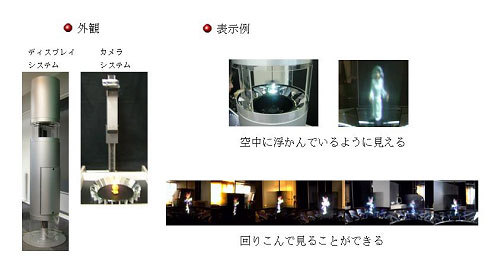
    Left: Overviews of the display system (left) and the camera system(right)

    Right: (top) "It appears to be floating in the air."

    (bottom) "One can move around and see."

  45. Re:Not 3D, 2.5D stereoscopic by arakis · · Score: 5, Informative

    You are correct in this assertion. The infinite limit of this approach is a hologram. True holograms play out the 3-dimensional wavefront of light as reflected by the 3-dimensional object. Frames taken with a 2-dimensional camera are just that 2-d.

    I interned at Holographic Studios with Jason Sapan in New York City. We would construct images like these using 16mm film frames and a cylinder of holographic film. This is similar to the technique in Logan's Run, but I don't think Jason did that one. This image type is called integral since it is an integral model of a 3-dimensional image kinda like sticking cheese wedges together to make a wheel of cheese. The wheel is round when you slap it together, but it is still an approximation and not a whole wheel. This design seems even worse than the cylinder hologram, because at least the cylinder can play out multiple angle truly at the same time.

    As an experiment you can use a stereo pair of 2-d images and a real object. When you look at one of the stereo pair images with one eye you will see that it is flat. This is due to the scanning of a single eye as it looks at the scene. When you look at the real object with one eye you will see the foeveoal (center) scan of depth from the real object. That is why stereoscopy != depth. Reference "Practical Holography" by Graham Saxby for a more eloquent explanation.

  46. 3D Display Technologies: Overview and Comparisons by Saltation · · Score: 5, Informative
    I was CEO of a 3D display startup before they did the dirty on me, so I can offer some insight here.

    This Hitachi display is not new technology and it has some problems, principally:
    • size, bulk, cost, noise
    • image can not be opaque (only translucent)
    • image is blurred towards its centre by internal "cloud" or "haze" effect created by the axis of the spinning plate
    • unusual/custom software and camera setups required to create image

    On the upside:

    • no special viewing position required, you can walk around it
    • works for people with only one eye

    It would be most useful for applications such as air traffic control, etc.

    It competes with the other autostereoscopic displays (the LCD shutter glasses will never break out of their nerd/medical/scientific-imaging market for social and multi-tasking reasons), of which there are only really 2 consumer-market viable architectures:

    • parallax barrier
    • holographic

    The other displays linked to in the comments, and various others not linked, are all variations on the parallax barrier approach. Again, not new. They have the benefits of:

    • being relatively cheap
    • having more or less the same physical form factor as a normal flat-screen
    • only needing special graphics drivers to display normal 3D images, which are pre-written for most current graphics cards

    They have the big downsides of:

    • requiring very close manufacturing tolerances
    • picket fence effect where black vertical bars appear to float in mid air between you and the image
    • inversion -- where moving left or right "flips" an image inside out, eg a nose will go backwards while ears come forwards, EXTREMELY disconcerting
    • very very narrow viewing angle and position -- move an inch in any direction from the sweet spot, e.g. lean back in your chair, and the image goes to pieces

    The limited viewing angle practically requires most parallax barrier systems to use active head tracking systems, where the display identifies where your eyes are and retargets the imaging accordingly. This exposes the practical usefulness of the 3D image to a further potential degradation if the headtracking system is not spot on.
    Sharp and Dresden both use parallax barrier. Dresden's is beautifully bright but its headtracking can unfortunately jump the image around very badly for some people -- speaking from experience, it is beyond unusable if you're one of the unlucky ones, the image is jumping inches in random directions on random sub-second intervals.
    Another major disadvantage is the extreme difficulty of presenting a 2D image via parallax barrier systems, thereby sharply restricting its desktop market. If you want to write or read something, such as a spreadsheet or some code or a word document, you're out of luck -- you need another monitor.

    The other approach has been developed by a single company comprising now 2 people (holographic artists) about 10-12 years ago. The Display:

    • is holographic
    • is at the theoretical maximum of all the optical angles etc.
    • has no picket fence effect, no inversion, and no intrinsic refresh rate (ie, instantaneous)
    • provides very large 3D image-depth of about one screen-width "height" towards you and 1.5 screen-widths "depth" away from you
    • degrades gracefullly to 2D should you lean too far away from the very broad sweet spot, so needs no head tracking
    • is about the same size as a normal flat panel screen, although deeper to allow for non-flat backlight
    • has no brightness issues as there is only a single additional layer to the LCD
    • astoundingly, it is extraordinarily cheap and simple to build using existing technology and manufacturing processes
    • requires NO special cameras or preprocessing required-- all standard. to create a 3D video-conferencing camera, just tape together two narrow cameras so the lenses are eye-width apart, interlace
  47. Re:projecting in thin air... by baxissimo · · Score: 3, Informative

    I think that only projects a 2D image into 3D space. It looks like they are basically doing the trick of projecting on a thin laminar stream of fog. Although they don't call it fog, they call it "transformed air" because that sounds a lot cooler and more mysterious.

    It does look pretty neat. But it's not 3D imagery.

  48. Literal Japanese Translation by khrustalicious · · Score: 3, Funny

    "Obi ran, all my hope are belong to you. EKEKEKEKEKEKEK"

  49. 2 short english articles by ShdwStkr · · Score: 2, Informative

    There's a few (very short) enlish news blurbs:

    Ananova
    Akiba live, which ananova mentions and links to.

  50. height by Jagaast · · Score: 2, Funny

    It's kind of cute how they set it up at just there right height for a japanese person to read - 172.6cm.

  51. And 12 years ago... by Archibald+Buttle · · Score: 2, Interesting

    Back at Cambridge University in England twelve years ago I saw a demonstration of a 3-D screen which did similar things.

    Basically what they had was a high speed CRT, and in front of it they put an LCD-based filter and a lens system. The CRT showed consecutive images for multiple viewing angles, and the LCD filter worked in conjunction to ensure that only the correct images would be seen at the correct viewing angles. I can't remember the full details now (it was 12 years ago!) but the display did really seem to have depth and the images really did seem to jump out of it. They tried to ensure that when viewing the screen at a reasonable distance you would get different images for each eye. No glasses required.

    The refresh rate wasn't astonishing, and the screen was only monochrome, but it was very effective. They were talking about making a colour version based on LCDs, but the big problem with using LCD screens back then was the switching time for the pixels.

    I was seriously impressed by the demo I saw and have been waiting ever since for this to become a real product. I'm not holding my breath though - the amount of data required for 3D TV (or 3D movies) for these kind of screens is immense. Whilst modern digital satellite TV can carry hundreds of channels from a single satellite the same satellite would only be able to carry a handful of 3D broadcasts (if you want to ensure a decent 3D picture). I think you'd probably need something faster than Internet 2 for cable-based transmission.

    One day though....

  52. Re:Not 3D, 2.5D stereoscopic by baxissimo · · Score: 2, Informative

    If you can walk around the thing and the steroscopic pairs change accordingly, how is that different from reality?

    The two main differences are latency and multi-viewer capability.

    When you move around a true 3D image there is ZERO latency. You move your head back and forth, you always see the right view and it's perfectly in sync with your viewpoint. Any system that has to track your head, and then generate a stereoscopic pair based on that tracking result is going to have some latency. The result is that the image seems to swim a little bit. And it doesn't take much latency to make many people get a form of motion sickness. (Consider with 60fps display you have generally at least 16 msec of latency, and trackers usually pile on at least another 10-30msec or so, at best. That's plenty to induce motion sickness in many people, and in those that don't feel sick, at least it is enough that the swimming of the image is obvious when you make quick movements of your head.

    Second, with stereo pairs, only one person can get the correct 3D view at a time. So it kind of cuts down on the potential for use in a group setting. Not to mention that you have to track the viewer and/or wear special eye gear. That cuts down on the potential uses also. You can't, say, have a 3D kiosk that people can just idly walk by and be wowed by if they have to line up one by one and put on some kind of tracking head gear to see the effect.

    So there are a number of real reasons why you'd want to have a real 3D image-generation device instead of a device that's merely stereoscopic. If you just want to sit in front of your monitor and appreciate 3D porn, then there's nothing wrong with stereoscopic images, and at $150 or so (compared to $50K) the price is certainly right.

  53. Re:3D Display Technologies: Overview and Compariso by lub · · Score: 2, Informative

    I guess those guys must be Jesse Eichenlaub and Arnie Lagergren from DTI. Their displays have been discussed before.