 Slashdot Mirror
Chandra Provides Support For Dark Energy
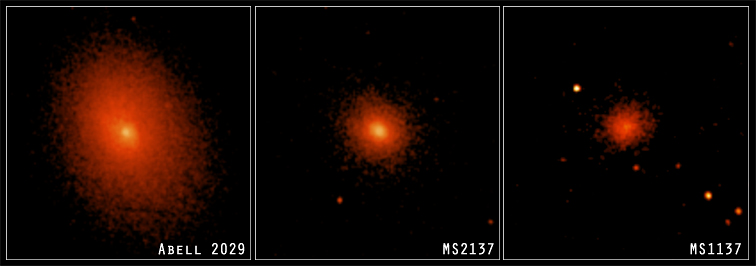
starannihilator writes "The Chandra X-Ray Observatory has provided new evidence supporting the existence of dark energy, the force causing the acceleration of universal expansion. The new findings support the theory that the universe will expand forever, provided there is enough dark matter. CNN and Newsday are running the story, originally reported by NASA. Chandra's site has some good images and information on the three galaxies clusters studied (Abell 2029, MS2137.3-2353, and MS1137.5+6625)."
Releativity states that the speed of light is as fast as it gets. ... for matter. Relativity makes no such claims as to the speed limit of space itself.
There are quite a number of valid GR metrics which describe space which expands faster than the speed of light, and in fact, it's thought that it did expand faster than the speed of light during the inflationary period.
Those same metrics are the basis of the Alcubierre metric, one of many ways to generate faster-than-light travel without multiply-connected spacetimes (wormholes). Like most "violate the speed of light" metrics, it requires negative energy density matter, though variations on the metric allow for very tiny amounts of negative energy matter to generate it.
No. The expansion of the universe refers to the fact that distant galaxies are moving away from us, and that the farther they are, the faster they are moving. This is expressed by the Hubble constant, which has a value of about 50 km/s/Mpc.
The acceleration of the expansion is reflected as this "constant" increasing with increasing distance.
The acceleration is caused by Dark Energy, not Dark Matter.
Dark Matter is either normal matter or subnuclear matter that makes its presence felt as increased gravity, but is not directly observable.
Dark Energy is not well understood at all.
HCG 50a = 2MASX J11170638+5455016
11h17m06.4s +54d55m02s
Yes. The universe is accelerating in its expansion. To say that the universe is expanding "at the speed of light" isn't quite right in a couple of ways. First off, if we look at objects nearby, they are moving away from us at some (quite reasonable) finite speed (i.e. the nearby Virgo Cluster is moving only at ~1000 km/s). Secondly, the somewhat more subtle point is that we generally talk about velocites not exceeding the speed of light; however, this is motion THROUGH space. The expansion of the universe (expansion OF space) doesn't necessarily need to follow this rule. . .
I should also point out that "Dark Matter" and "Dark Energy" are COMPLETELY DIFFERENT THINGS (as far as we know). Astronomers have just named them both "Dark" because they don't know what they are. They both also affect the expansion of the universe, but dark matter is slowing down the expansion of the universe (presumably via gravity) and dark energy is accelerating the expansion of the universe (by some yet-unknown force). Dark Matter is weird, but at least it seems to sortta obey the rules of the universe (i.e. gravity); dark energy is completely unlike anything we've seen before.
I couldn't tell if you were experimenting with poor-man's cryogenics or looking for the orange sherbet.
Uh, dark matter and dark energy aren't the same thing.
tasks(723) drafts(105) languages(484) examples(29106)
No offense, but that's not how relativity works. The thoery of Relativity posits that all measurements are taken from some frame of reference, and it is impossible for an object to go faster than light for any frame of reference.
So, if I'm on a spaceship going 99.9999999% the speed of light from the frame of reference of the earth. However, from the frame of reference of my spaceship, I'm stationary. Now, I can run as fast as I want in any direction, I can even sit in the back of my space ship with a super-powerful gun that shoots bullets at 99.9999999% the speed of light, and fire a couple rounds towards the front of the ship. From the frame of reference in the ship, the bullets will travel at 99.9999999% the speed of light, even when the ship is travelling at 99.9999999% the speed of light in reference to the earth.
But here is where it gets wierd: an observer on earth will not measure the speed of the bullets to be travelling 199.9999996% (99.9999999%x2) the speed of light, they will be measuring the bullet to be travelling just over 99.9999999% the speed of light.
This is because, from the viewpoint of someone on earth, the space ship will be very short, which means even if it still traverses the length of the ship in the same amount of time as it does from the viewpoint of me on the spaceship, it will not have travelled the same distance, which (since v=d/t) means the bullet didn't travel as fast relative to the spaceship (from the viewpoint of earth) as it did from the viewpoint of someone on the spaceship.
Additionally, from the viewpoint of Earth, time is travelling more slowly on the spaceship, which enhances the effect even more.
It's confusing if you don't have a handle on it, but none the less, this is how the theory of relativity works.
You are quite right.
Here is a synopsis of signs that things are due for a big shakeup:
The last two are probably not mandatory, but most people feel like any general theory should account for those two things.
HCG 50a = 2MASX J11170638+5455016
11h17m06.4s +54d55m02s
Just a quick reply to this. I'm a graduate student doing computational astrophysics - in particular, cosmological structure formation (galaxies and such). The law of conservation of energy is only valid in closed systems. If the universe isn't a closed system - if there's something 'outside the universe' which is adding/subtracting energy - then energy doesn't necessarily have to be conserved. Also, there are some cosmologists that believe that energy is not conserved on cosmological scales, so the law of conservation of energy is not valid on all scales. I suppose it's fair to say that as of right now, dark energy appears to result in the non-conservation of energy on very large scales, given our current understanding of particle physics. However, there is almost certainly a lot going on that we don't really understand, so it's an open problem.
I hope that helps!
Here's a quick summary of the technique:
[TMB]
I don't, but "Brief history of Time" by Hawking or "The Elegant Universe" by Green have pretty good explanations of relativity.
Actually, I'd recommend trying a book written by Einstein called "Relativity". I've also heard it referred to as "the short book" because apparently he wrote two, one in laymen's terms, and one filled with math/equations. If you really want to go hard-core, you can read his original papers, but takes a bit of work to get through, and it helps if you have a big physics background and are familiar with Maxwell. "Relativity" isn't too hard to understand, though. Plus, it's generally true that you'll never get such a dead-on explanation of a theory as when you get an explanation from the guy who came up with it. I've met a lot of modern physicists whose grasp on Relativity has been corrupted by hearing poor explanations. No risk of that if you go to the source (Einstein).
I am eagerly awaiting the next annoncement where someone again finds evidence to refute the dark matter claims. It seems like the science; "Dark Matter is like this" - "No, it can't be, actually it's like that".
The only articles I've seen that make statements like that are the commentaries on the commentaries on the dumbed-down press releases on the actual publications.
What's actually been happening is more along the lines of:
"There's a discrepency between galactic models and observations. What did we get wrong in the model/what needs to be added?"
"Maybe A? B? C? D?" "Let's try to test them and see."
"Not A, not D, but maybe B, maybe C." "What kind of B or C? B1? B2? B3?" "Let's try to test them and see."
"Our models only work if we have B _and_ C, and we've ruled out C1 and C2, but C3 still works."
"What kind of C3?"
"New observations show a new effect in addition to the old one. How do we explain it?"
"Maybe E? Maybe F?"
[Etc.]
This is a process of examining many possible explanations, and weeding out the ones that don't work until we have reasonable confidence that the ones left _do_ work.
We've gone from "galactic rotation doesn't match models based on stars alone, what could be causing this?" to "we know that there's about X amount of normal matter we aren't seeing, Y amount of abnormal matter that we aren't seeing, and that the properties of the abnormal matter fall somewhere in this range (that's wide but being narrowed)". There's surprisingly little backtracking. Tests that detect or fail to produce evidence for dark matter of various types all help to increase our understanding of what dark matter's actual properties are.
As for dark energy, if anything, it would be surprising if something like it _didn't_ exist. We already knew that a scalar field with similar properties was likely present in the early universe, and several models proposed universes where the _absence_ of the field was only a local effect. Even relativity contained a similar type of effect that was set to zero a priori as opposed to forced to zero through a mechanism inherent in the model.
We're still sifting through the myriad of possibilities, but we certainly are learning something each step of the way.