Slashdot Mirror


Chandra Provides Support For Dark Energy

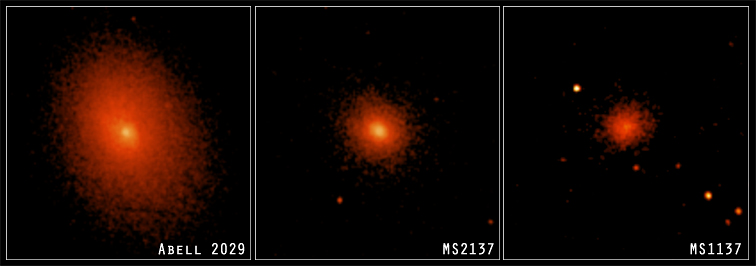
starannihilator writes "The Chandra X-Ray Observatory has provided new evidence supporting the existence of dark energy, the force causing the acceleration of universal expansion. The new findings support the theory that the universe will expand forever, provided there is enough dark matter. CNN and Newsday are running the story, originally reported by NASA. Chandra's site has some good images and information on the three galaxies clusters studied (Abell 2029, MS2137.3-2353, and MS1137.5+6625)."
37 of 350 comments (clear)

  1. Dark matters by Allen+Zadr · · Score: 5, Funny

    I am eagerly awaiting the next annoncement where someone again finds evidence to refute the dark matter claims. It seems like the science; "Dark Matter is like this" - "No, it can't be, actually it's like that". Is not going to end soon.

    Join me. Come to the dark side, and together, we will expand the universe.

    --
    Kinetic stupidity has a new brand leader: Allen Zadr.
    1. Re:Dark matters by Jim+Starx · · Score: 4, Funny

      God made the universes expansion a sine wave just to piss scientists off.....

      --
      The darkness... controls the music. The music... controls the soul.
    2. Re:Dark matters by Too+Much+Noise · · Score: 4, Insightful

      It's not that simple. Cosmology is now in a position pretty much similar to that of a butterfly trying to understand the passing of seasons. Moreover, as the name says, "dark" matter/energy is undetectable directly (at least, so far) - and it's quite challenging to figure out a 'simple' theory for something that not only you can't observe directly, but the indirect observations are difficult and not always very accurate.

      Anyway, since it's not very likely that the knowledge of dark matter will have a significant impact on the daily life anytime soon, relax and enjoy the (slow-moving) show.

    3. Re:Dark matters by hazem · · Score: 4, Insightful

      Why can't scientists just make up their minds already?

      Because if they did, they'd be theologians, not scientists.

    4. Re:Dark matters by ArsonSmith · · Score: 4, Insightful

      I think it is common for people to make up something that helps fill gaps in science. sometimes it turns out right many times it turns out wrong. many times this happens such as space ether.

      When we can't explain something we are sometimes better off makeing something up that fills the gap until we can find the more correct answer. There is no such thing as exact science. Only reproduceable observation which eventually becomes accepted fact. Although there is no reason for it to always stay fact if someone says, "Hey, I tried to do the experiment and used this method to test it and I got a diffrent observation!" Well, now it's time to re think that scientific fact.

      What happens typically is that the person is downplayed as doing something wrong, adding some new variable to the mix, or something that would throw off the observation in some way. Politics in science is as complicated and painful as anywhere.

      --
      Paying taxes to buy civilization is like paying a hooker to buy love.
    5. Re:Dark matters by Anonymous Coward · · Score: 4, Funny

      I knew this thread would end up at Hitler or Religion. Thanks for not picking Hitler.

    6. Re:Dark matters by Christopher+Thomas · · Score: 4, Informative

      I am eagerly awaiting the next annoncement where someone again finds evidence to refute the dark matter claims. It seems like the science; "Dark Matter is like this" - "No, it can't be, actually it's like that".

      The only articles I've seen that make statements like that are the commentaries on the commentaries on the dumbed-down press releases on the actual publications.

      What's actually been happening is more along the lines of:

      "There's a discrepency between galactic models and observations. What did we get wrong in the model/what needs to be added?"

      "Maybe A? B? C? D?" "Let's try to test them and see."

      "Not A, not D, but maybe B, maybe C." "What kind of B or C? B1? B2? B3?" "Let's try to test them and see."

      "Our models only work if we have B _and_ C, and we've ruled out C1 and C2, but C3 still works."

      "What kind of C3?"

      "New observations show a new effect in addition to the old one. How do we explain it?"

      "Maybe E? Maybe F?"

      [Etc.]

      This is a process of examining many possible explanations, and weeding out the ones that don't work until we have reasonable confidence that the ones left _do_ work.

      We've gone from "galactic rotation doesn't match models based on stars alone, what could be causing this?" to "we know that there's about X amount of normal matter we aren't seeing, Y amount of abnormal matter that we aren't seeing, and that the properties of the abnormal matter fall somewhere in this range (that's wide but being narrowed)". There's surprisingly little backtracking. Tests that detect or fail to produce evidence for dark matter of various types all help to increase our understanding of what dark matter's actual properties are.

      As for dark energy, if anything, it would be surprising if something like it _didn't_ exist. We already knew that a scalar field with similar properties was likely present in the early universe, and several models proposed universes where the _absence_ of the field was only a local effect. Even relativity contained a similar type of effect that was set to zero a priori as opposed to forced to zero through a mechanism inherent in the model.

      We're still sifting through the myriad of possibilities, but we certainly are learning something each step of the way.

  2. Hmm that name sounds familiar by Nuclear+Elephant · · Score: 4, Funny

    I dated a girl named Chanda once. Dark energy is a good way to describe her.

  3. Dakr Matter by Mz6 · · Score: 4, Interesting

    Maybe someone can explain... But when the CNN article states that the universe is "accelerating", does that mean it's really accelerating? I thought it was decided that the universe's expansion was expanding at the speed of light. So, I would assume that by accelerating they mean growing bigger and not actually accelerating faster than the speed of light. Unless, this Dark Matter is something that can bend the known laws of physics and travel faster than the speed of light?

    --
    Hmmm.
    1. Re:Dakr Matter by barawn · · Score: 4, Informative

      Releativity states that the speed of light is as fast as it gets. ... for matter. Relativity makes no such claims as to the speed limit of space itself.

      There are quite a number of valid GR metrics which describe space which expands faster than the speed of light, and in fact, it's thought that it did expand faster than the speed of light during the inflationary period.

      Those same metrics are the basis of the Alcubierre metric, one of many ways to generate faster-than-light travel without multiply-connected spacetimes (wormholes). Like most "violate the speed of light" metrics, it requires negative energy density matter, though variations on the metric allow for very tiny amounts of negative energy matter to generate it.

    2. Re:Dakr Matter by Betelgeuse · · Score: 4, Informative

      Yes. The universe is accelerating in its expansion. To say that the universe is expanding "at the speed of light" isn't quite right in a couple of ways. First off, if we look at objects nearby, they are moving away from us at some (quite reasonable) finite speed (i.e. the nearby Virgo Cluster is moving only at ~1000 km/s). Secondly, the somewhat more subtle point is that we generally talk about velocites not exceeding the speed of light; however, this is motion THROUGH space. The expansion of the universe (expansion OF space) doesn't necessarily need to follow this rule. . .

      I should also point out that "Dark Matter" and "Dark Energy" are COMPLETELY DIFFERENT THINGS (as far as we know). Astronomers have just named them both "Dark" because they don't know what they are. They both also affect the expansion of the universe, but dark matter is slowing down the expansion of the universe (presumably via gravity) and dark energy is accelerating the expansion of the universe (by some yet-unknown force). Dark Matter is weird, but at least it seems to sortta obey the rules of the universe (i.e. gravity); dark energy is completely unlike anything we've seen before.

      --
      I couldn't tell if you were experimenting with poor-man's cryogenics or looking for the orange sherbet.
    3. Re:Dakr Matter by barawn · · Score: 4, Interesting

      Speed of light is the acceleration barrier.

      This isn't even strictly true. You can violate global speed-of-light travel times without violating local speed-of-light travel times by making space itself move - see the inflationary period, or the Alcubierre metric for more info.

      You can imagine it as a speed limit placed on people walking, but there is no such speed limit on moving walkways (like in airports).

      And the problem with particles traveling faster than light (tachyonic) is the fact that as they *lose* energy, they go faster, which makes them lose more energy, so they spiral out to infinite speed. Tachyonic modes are unstable, so a theory containing them typically undergoes tachyonic condensation (spontaneous symmetry breaking) and the tachyons gain a positive mass squared.

    4. Re:Dakr Matter by nine-times · · Score: 5, Informative

      No offense, but that's not how relativity works. The thoery of Relativity posits that all measurements are taken from some frame of reference, and it is impossible for an object to go faster than light for any frame of reference.

      So, if I'm on a spaceship going 99.9999999% the speed of light from the frame of reference of the earth. However, from the frame of reference of my spaceship, I'm stationary. Now, I can run as fast as I want in any direction, I can even sit in the back of my space ship with a super-powerful gun that shoots bullets at 99.9999999% the speed of light, and fire a couple rounds towards the front of the ship. From the frame of reference in the ship, the bullets will travel at 99.9999999% the speed of light, even when the ship is travelling at 99.9999999% the speed of light in reference to the earth.

      But here is where it gets wierd: an observer on earth will not measure the speed of the bullets to be travelling 199.9999996% (99.9999999%x2) the speed of light, they will be measuring the bullet to be travelling just over 99.9999999% the speed of light.

      This is because, from the viewpoint of someone on earth, the space ship will be very short, which means even if it still traverses the length of the ship in the same amount of time as it does from the viewpoint of me on the spaceship, it will not have travelled the same distance, which (since v=d/t) means the bullet didn't travel as fast relative to the spaceship (from the viewpoint of earth) as it did from the viewpoint of someone on the spaceship.

      Additionally, from the viewpoint of Earth, time is travelling more slowly on the spaceship, which enhances the effect even more.

      It's confusing if you don't have a handle on it, but none the less, this is how the theory of relativity works.

    5. Re:Dakr Matter by nine-times · · Score: 4, Informative

      I don't, but "Brief history of Time" by Hawking or "The Elegant Universe" by Green have pretty good explanations of relativity.

      Actually, I'd recommend trying a book written by Einstein called "Relativity". I've also heard it referred to as "the short book" because apparently he wrote two, one in laymen's terms, and one filled with math/equations. If you really want to go hard-core, you can read his original papers, but takes a bit of work to get through, and it helps if you have a big physics background and are familiar with Maxwell. "Relativity" isn't too hard to understand, though. Plus, it's generally true that you'll never get such a dead-on explanation of a theory as when you get an explanation from the guy who came up with it. I've met a lot of modern physicists whose grasp on Relativity has been corrupted by hearing poor explanations. No risk of that if you go to the source (Einstein).

  4. perspective problem by WormholeFiend · · Score: 5, Funny

    how do we know if something outside the universe isnt affecting it.

    I'd like to think we live on an electron in orbit around the proton of a molecule as part of a giant coffee mug -- our universe is expanding due to some even bigger geek having just poured hot coffee in our universal mug.

    It's "dark" cuz that's how this geek likes his coffee.

  5. Goofy gravity by ka9dgx · · Score: 4, Interesting
    Dark Matter is a goofy, overly complicated theory to try to explain something obvious. Gravitons don't come from matter, gravitons, like any other particle... PUSH, they don't pull.

    Gravitation is a shadowing effect. (Yes, all the formulae still work, except when you get out towards the edges of space)

    --Mike--

  6. Expansion of universe by hcg50a · · Score: 5, Informative
    I thought it was decided that the universe's expansion was expanding at the speed of light.

    No. The expansion of the universe refers to the fact that distant galaxies are moving away from us, and that the farther they are, the faster they are moving. This is expressed by the Hubble constant, which has a value of about 50 km/s/Mpc.

    The acceleration of the expansion is reflected as this "constant" increasing with increasing distance.

    The acceleration is caused by Dark Energy, not Dark Matter.

    Dark Matter is either normal matter or subnuclear matter that makes its presence felt as increased gravity, but is not directly observable.

    Dark Energy is not well understood at all.

    --
    HCG 50a = 2MASX J11170638+5455016
    11h17m06.4s +54d55m02s
  7. Ptolemy's back! by ogma · · Score: 5, Interesting

    Does anyone else think that the cutting edge of physics is starting to resemble Ptolemy's system of astronomy? With all this 'dark' energy, and 'dark' matter, it's beginning to look like a lot of hand-waving.

    Increasingly complex adjustments (e.g. epicycles) were made to Ptolemy's system to explain the observed motions of the heavenly bodies. Then along comes Copernicus and tells us that we've been looking at it inside out all along, things are simple after all, we just have to adjust our viewpoint.

    I think physics is overdue another Copernicus.

    1. Re:Ptolemy's back! by hcg50a · · Score: 4, Informative
      Does anyone else think that the cutting edge of physics is starting to resemble Ptolemy's system of astronomy?

      You are quite right.

      Here is a synopsis of signs that things are due for a big shakeup:

      • "dark energy" comprises 70% of the matter-energy of the universe, yet we don't have theory for it, and we don't have a clue what it is.

      • The two fundamental theories of physics, General Relativity and the Standard Model of Quantum Mechanics, are fundamentally irreconcilable.

      • There is still no organizing principal for the zoo of fundamental particles.

      • There is still no organizing principal for the zoo of fundamental physical constants.

      The last two are probably not mandatory, but most people feel like any general theory should account for those two things.

      --
      HCG 50a = 2MASX J11170638+5455016
      11h17m06.4s +54d55m02s
  8. Headline is an Exaggeration by m1a1 · · Score: 4, Insightful

    The headline to this story is an exaggeration. Of course, you can't blame it on the author seeing as the headlines of the major news sources were exaggerations as well.

    So what, we have more evidence the universe is expanding at an accelerating rate. WE ALREADY KNEW THAT! This is just another indication that it's happening. This doesn't "prove" the existence of dark energy. It's still entirely possible (and I would suggest probable) that we just don't know the entire story about gravity. Physicists have gotten gravity wrong before after all.

  9. Dark Energy not Dark Matter by forand · · Score: 4, Interesting

    The original poster has it wrong, more dark matter decreases the expansion of the universe as one would expect, dark energy does the opposite changing the state function of the universe and thus allowing it to expand. IAA astro-physicist

  10. the universe was expanding at the speed of light by Allen+Zadr · · Score: 4, Funny
    Don't you get your science from Monty Python movies. It was explained quite succinctly, in the Meaning of Life.

    Whenever life get's you down, Mrs. Brown
    and things seem hard and tough,
    and people are stupid, obnoxious or daft,
    and it feels that you've had quite enough---

    Just remember that your standing on a planet that's evolving,
    revolving at 900 miles per hour.

    It's orbiting at 19 miles per second, so it's reckoned,
    a sun that is the source of all our power.

    The sun, and you and me and all the stars that we can see
    are moving at a million miles a day,
    in an outer spiral arm at 40,000 miles an hour,
    in this galaxy we call the milky way.

    The galaxy itself contains 100 million stars,
    it's 40 thousand light years side-to-side.
    It bulges in the middle 30 thousand light years thick,
    but out by us it's just 3000 light years wide.
    We're 30 thousand light years from galactic central point,
    we go round every two hundred million years
    And our galaxy is only one of millions and billions
    in this amazing and expanding universe.

    Musical interlude

    The Universe itself keeps on expanding and expanding
    in all of the directions it can whizz.
    As fast as it can go, the speed of light, you know
    A million miles a minute and that's the fastest speed there is.
    So remember when your feeling very small and in-secure,
    how amazingly unlikely is your birth.
    And prey that there's intelligent life, somewhere out in space,
    'cause there's bugger-all down here on Earth.

    Attribution for the above lyrics to Eric Idle.

    --
    Kinetic stupidity has a new brand leader: Allen Zadr.
  11. Dark Energy was proven before by RoderickMcDougall · · Score: 4, Funny

    That was proved to me years ago when I met my housemates girlfriend. She was positively festering with it. She radiated me with it so much of it that I now have a latent ability to detect dark energy within a 5m radius.

  12. Big Rip vs. Black Holes by ConversantShogun · · Score: 4, Interesting

    I've seen a few references to a theory of a final "big rip," in which everything (even atoms) are torn apart by the expansionistic force.

    Would this apply to black holes, as well? If black holes aren't ripped apart, would they continue to provide areas of gravity strong enough that particles in the vicinity don't undergo the rip?

    --

    --When you buy proprietary software, you don't get better software. What you get is the right to complain about it.
  13. "Dark matter" != "Dark energy" by Short+Circuit · · Score: 5, Informative

    Uh, dark matter and dark energy aren't the same thing.

    1. Re:"Dark matter" != "Dark energy" by rknop · · Score: 4, Informative

      Dark matter and dark energy are different.

      Dark matter is normal matter. "Cold dark matter" has a pressure of 0 (or very low in relativistic terms), just like all regular gas, stars, planets, etc.

      Dark energy is freaky. It has *negative* pressure.

      The two are extremely different things.

      -Rob

    2. Re:"Dark matter" != "Dark energy" by Mr.+Slippery · · Score: 5, Insightful
      Dark matter is normal matter.

      Depends on which theory of dark matter you subscribe to. I don't think WIMPs could be considered "normal" matter.

      --
      Tom Swiss | the infamous tms | my blog
      You cannot wash away blood with blood
    3. Re:"Dark matter" != "Dark energy" by Dashing+Leech · · Score: 4, Funny
      (dark)E=(dark)m*c^2

      That's not quite right, it should be:

      (dark)E = (dark)m * (dark)c^2

      where (dark)c is the "speed of dark", and we all know the speed of dark is faster than the speed of light. Therefore, (dark)c > (light)c and therefore dark matter holds more (dark) energy than normal matter hold in (light) energy.

    4. Re:"Dark matter" != "Dark energy" by wanerious · · Score: 5, Informative
      "dark energy" usually refers to that energy that seems to be driving the galaxies away from each other at an accelerating rate. Normally, we would think that due to the mass of the universe, the universal expansion would slow down, just as a baseball slows down if I toss it upwards. Strangely, we see a growing "anti-gravity" (I hesitate to use that phrase around here) or repulsive force that seems to be proportional to the volume of the universe. Almost as if each cubic centimeter of space itself carries a small repulsive force acting on all other cubic centimeters. This is also why the acceleration is dominant now --- earlier in the history of the universe, when it was smaller, the repulsive force was also smaller in magnitude. As the universe expands, the quantity of 'dark energy' also increases with the universe's volume and now overwhelms the attractive gravitational force of all the matter.

      Dark matter, on the other hand, is the name confusingly given to a number of unsolved phenomena. By looking at how the outer parts of galaxies rotate, we get a sense of how much matter is in a given galaxy, as well as its distribution. It seems that there is a great deal of matter in the outer regions of galaxies that does not 'glow' like stars do. In addition, by studying how galaxies move in clusters, we strengthen the case for lots of matter existing between galaxies that is invisible to us. The candidates for this dark matter are many and varied, from innumerable Jupiter-sized objects to cold white dwarfs to small black holes. Current observations are undertaken to rule in or out some of these. Even so, standard Big Bang theory predicts an upper limit to the amount of "ordinary" (baryonic) matter present, so it is possible that some of this dark matter might be weird stuff.

    5. Re:"Dark matter" != "Dark energy" by bobbozzo · · Score: 4, Funny

      And how does (Dark)Helmet factor into this?

      --
      Nothing to see here; Move along.
    6. Re:"Dark matter" != "Dark energy" by sean.peters · · Score: 5, Informative

      Some responses...

      Photons are normally considered to have zero mass, and to be the smallest possible unit of energy.

      Check... although photons can have almost any energy. Low-frequency photons (think IR) have low energy, and high-frequency photons (think gamma rays) have high energy.

      Yet, they are also "negative", are they not? That is, they move away from their source.

      I have no idea what you're saying here. Photons have no charge and no mass. They are not "negative" in any sense of the word I'm familiar with. One of the fundamental properties of photons is that they are always moving at the speed of light - that's why they move away from their source.

      Yet, if a photon will be absorbed by some types of objects, bounce off of others, and simply pass through others - it must have some sort of mass.

      Why must it? If you begin to study physics seriously, one of the first pre-conceptions you'll have to let go of is that your "common sense" can be trusted to tell you how things behave in the quantum world. Photons have no mass.

      Where does a photon go when it's energy is spent?

      A typical fate for a photon would be for it to be absorbed by an atom. In the process, the photon's energy is put into raising one of the atom's electrons from a lower energy state to a higher energy state.

      There must be a near infinate supply of photons that have no energy or are waiting to aquire it. It would seem that these photons - assuming they do have mass, in the same sense that electrons have a larger mass, could explain both, no?

      No. All photons have a non-zero energy which equals something like h * f, where h = Planck's constant and f = the photon's frequency. I may be off by a factor of 2 pi... it's been a long time since I took Modern Physics!

      Hope this helps.

      Sean

  14. Left over matter/energy from another dimmension by Anonymous Coward · · Score: 5, Interesting

    There was some PBS special a little while back that talked about "string theory" of reality and the possibility that the "Big Bang" was actually a big "collision" between this and another dimmension. The "collision" or interaction between the two different dimmensions not only created tremendous energy but also left some material from the other dimmesion in this one, dark matter. That is why the stuff is invisible with no known origin but somehow detectable. Kind of like the Old Ones.

  15. dark energy and energy conservation by Maimun · · Score: 4, Interesting
    several months ago I posted a question regarding dark energy
    Speaking of dark energy, I wonder whether [suppose it exists indeed] dark energy does not break the law of conservation of energy. Once I attended a public talk by someont from Fermi Lab [sorry, cannot recall the name] who said that dark energy is a constant quantity [a very small number in standard units] per volume of space. So, given that the Universe is expanding and is being pushed more and more this way by the dark energy, the quantity of dark energy goes up and up, right? So, if it has indeed the meaning of energy, there is more and more energy in the Universe, contrary to the law of conservation...

    Sadly, after the mention public talk only very few questions were allowed and I missed the opportunity to ask the expert in person.

    It got moddep up as Interesting +1, but nobody answered. Maybe this time...
    1. Re:dark energy and energy conservation by fnordboy · · Score: 4, Informative

      Just a quick reply to this. I'm a graduate student doing computational astrophysics - in particular, cosmological structure formation (galaxies and such). The law of conservation of energy is only valid in closed systems. If the universe isn't a closed system - if there's something 'outside the universe' which is adding/subtracting energy - then energy doesn't necessarily have to be conserved. Also, there are some cosmologists that believe that energy is not conserved on cosmological scales, so the law of conservation of energy is not valid on all scales. I suppose it's fair to say that as of right now, dark energy appears to result in the non-conservation of energy on very large scales, given our current understanding of particle physics. However, there is almost certainly a lot going on that we don't really understand, so it's an open problem.


      I hope that helps!

  16. Re:Why not oscillation rather than expansion? by hcg50a · · Score: 4, Interesting

    Why not? Because observations do not support it. Other than that, it's a fine idea!

    --
    HCG 50a = 2MASX J11170638+5455016
    11h17m06.4s +54d55m02s
  17. Summary of technique by TMB · · Score: 4, Informative
    I think this press release is the most informative one.

    Here's a quick summary of the technique:

    • clusters are filled with hot gas that emit X-rays with a spectrum indicative of their temperature (typically a million Kelvins or so)
    • the X-ray luminosity depends on the temperature and the gas mass
    • the temperature depends on the total (gas + dark) mass
    • Chandra measures the spectrum which gives you the temperature) and the flux (luminosity / distance^2)
    • therefore you can find the distance given the gas/dark mass ratio
    • because clusters are really big and sample a big fraction of the universe, the gas/dark mass ratio is typical of the universe as a whole... and more importantly, that means that all big clusters have the same gas/dark mass ratio
    • setting the gas/dark mass ratio of all 26 clusters equal gives you the ratio of all of their distances
    • measuring the redshift of the galaxies in the clusters gives you a relationship between the rate of expansion and distance (relative to the nearest cluster, say)
    • when you look at this diagram, you see that as things get farther away, the expansion rate increases... and then if you get really far away, it decreases again. this is exactly consistent with what you expect from the cosmological constant (or any form of dark energy with a similar equation of state)


    [TMB]
  18. Re:Dark Matter by Dashing+Leech · · Score: 5, Interesting
    Actually, this is an interesting problem, and seems possible. Take the example of two points on a balloon surface. They also follow this "Hubble" equation. To see this imagine three colinear points on the surface (P0, P1, P2) such that P0 and P1 are 10mm apart and P1 and P2 are 10mm apart. Since they are colinear, P0 and P2 are 20mm apart (following the curvature of the surface).

    Now blow the balloon up a little more such that P0 and P1 are 1mm further apart, and thus P1 and P2 are also 1mm further apart (P0 and P2 are 2mm further apart). Then (D=distance, dD=change in distance):

    dD01/D01 = 1mm/10mm=0.1
    dD12/D12 = 1mm/10mm=0.1
    dD02/D02 = 2mm/20mm=0.1

    i.e., dD/D = constant. Since the dD occured over the same time for the two distances, you can also write this as

    (dD/dt)/D = V/D = constant = K
    (This is the Hubble equation, where K=H.)

    So, in theory, you could blow up a balloon such that two points are moving faster than c relative to each other (V=c=D*K). Let's see how to do this. The distance between any two points on the surface is D = r*Q (r=balloon radius, Q = angle between the points in radians which stays constant as the balloon expands). The change in distance over time is

    dD/dt = V = dr/dt*Q.

    The furthest two points can get apart is Q=pi (opposite points on the balloon), hence the fastest relative velocity will be between these points. Let V = c and solve:

    dr/dt = V/Q = c/pi

    In other words, if the radius of the balloon was expanding at a rate of just under 1/3 the speed of light, two points on the balloon would be moving relative to each other at the speed of light. (This would not only take a lot of air, but the rate of air required would go up with the cube of the radius, so you'd want to do this when the radius is very small.)

    Applying this 2D analogy to the 3D universe, it doesn't have to be expanding at the speed of light for two distant points to be moving greater than c relative to each other. But it does have to be expanding above a certain rate to achieve this. If it's expanding slower than this critical rate, no two points can be moving faster than light relative to each other. If it's expanding faster, they can. Since the expansion seems to be accelerating, it seems inevitable that it will happen at some point if it hasn't already.

    We should also be able to figure out if it has already happened or when it will. We know the constant H (from the Hubble equation H = V/D). (It's easy to calculate anyway, given the distance to any star and it's measured relative velocity.) If we know the history of the expansion rate we know how big the universe is, i.e., this furthest distance Dmax between any two points. We can then solve the Hubble equation V = H*Dmax and see if it is less than or greater than c.

    By the way, I don't think this violates relativity, it doesn't say anything about the rate of expansion of the universe. I think this falls into the "warp" concept of traveling faster than the speed of light, i.e., if you can locally expand the universe fast enough, it appears you are moving away faster than the speed of light, and vice-versa if you can contract it fast enough locally it appears that you are approaching faster than the speed of light. I could be wrong about that though.