Slashdot Mirror


Chandra Provides Support For Dark Energy

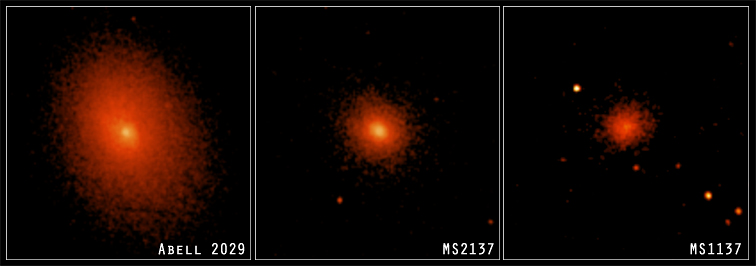
starannihilator writes "The Chandra X-Ray Observatory has provided new evidence supporting the existence of dark energy, the force causing the acceleration of universal expansion. The new findings support the theory that the universe will expand forever, provided there is enough dark matter. CNN and Newsday are running the story, originally reported by NASA. Chandra's site has some good images and information on the three galaxies clusters studied (Abell 2029, MS2137.3-2353, and MS1137.5+6625)."
5 of 350 comments (clear)

  1. Expansion of universe by hcg50a · · Score: 5, Informative
    I thought it was decided that the universe's expansion was expanding at the speed of light.

    No. The expansion of the universe refers to the fact that distant galaxies are moving away from us, and that the farther they are, the faster they are moving. This is expressed by the Hubble constant, which has a value of about 50 km/s/Mpc.

    The acceleration of the expansion is reflected as this "constant" increasing with increasing distance.

    The acceleration is caused by Dark Energy, not Dark Matter.

    Dark Matter is either normal matter or subnuclear matter that makes its presence felt as increased gravity, but is not directly observable.

    Dark Energy is not well understood at all.

    --
    HCG 50a = 2MASX J11170638+5455016
    11h17m06.4s +54d55m02s
  2. "Dark matter" != "Dark energy" by Short+Circuit · · Score: 5, Informative

    Uh, dark matter and dark energy aren't the same thing.

    1. Re:"Dark matter" != "Dark energy" by wanerious · · Score: 5, Informative
      "dark energy" usually refers to that energy that seems to be driving the galaxies away from each other at an accelerating rate. Normally, we would think that due to the mass of the universe, the universal expansion would slow down, just as a baseball slows down if I toss it upwards. Strangely, we see a growing "anti-gravity" (I hesitate to use that phrase around here) or repulsive force that seems to be proportional to the volume of the universe. Almost as if each cubic centimeter of space itself carries a small repulsive force acting on all other cubic centimeters. This is also why the acceleration is dominant now --- earlier in the history of the universe, when it was smaller, the repulsive force was also smaller in magnitude. As the universe expands, the quantity of 'dark energy' also increases with the universe's volume and now overwhelms the attractive gravitational force of all the matter.

      Dark matter, on the other hand, is the name confusingly given to a number of unsolved phenomena. By looking at how the outer parts of galaxies rotate, we get a sense of how much matter is in a given galaxy, as well as its distribution. It seems that there is a great deal of matter in the outer regions of galaxies that does not 'glow' like stars do. In addition, by studying how galaxies move in clusters, we strengthen the case for lots of matter existing between galaxies that is invisible to us. The candidates for this dark matter are many and varied, from innumerable Jupiter-sized objects to cold white dwarfs to small black holes. Current observations are undertaken to rule in or out some of these. Even so, standard Big Bang theory predicts an upper limit to the amount of "ordinary" (baryonic) matter present, so it is possible that some of this dark matter might be weird stuff.

    2. Re:"Dark matter" != "Dark energy" by sean.peters · · Score: 5, Informative

      Some responses...

      Photons are normally considered to have zero mass, and to be the smallest possible unit of energy.

      Check... although photons can have almost any energy. Low-frequency photons (think IR) have low energy, and high-frequency photons (think gamma rays) have high energy.

      Yet, they are also "negative", are they not? That is, they move away from their source.

      I have no idea what you're saying here. Photons have no charge and no mass. They are not "negative" in any sense of the word I'm familiar with. One of the fundamental properties of photons is that they are always moving at the speed of light - that's why they move away from their source.

      Yet, if a photon will be absorbed by some types of objects, bounce off of others, and simply pass through others - it must have some sort of mass.

      Why must it? If you begin to study physics seriously, one of the first pre-conceptions you'll have to let go of is that your "common sense" can be trusted to tell you how things behave in the quantum world. Photons have no mass.

      Where does a photon go when it's energy is spent?

      A typical fate for a photon would be for it to be absorbed by an atom. In the process, the photon's energy is put into raising one of the atom's electrons from a lower energy state to a higher energy state.

      There must be a near infinate supply of photons that have no energy or are waiting to aquire it. It would seem that these photons - assuming they do have mass, in the same sense that electrons have a larger mass, could explain both, no?

      No. All photons have a non-zero energy which equals something like h * f, where h = Planck's constant and f = the photon's frequency. I may be off by a factor of 2 pi... it's been a long time since I took Modern Physics!

      Hope this helps.

      Sean

  3. Re:Dakr Matter by nine-times · · Score: 5, Informative

    No offense, but that's not how relativity works. The thoery of Relativity posits that all measurements are taken from some frame of reference, and it is impossible for an object to go faster than light for any frame of reference.

    So, if I'm on a spaceship going 99.9999999% the speed of light from the frame of reference of the earth. However, from the frame of reference of my spaceship, I'm stationary. Now, I can run as fast as I want in any direction, I can even sit in the back of my space ship with a super-powerful gun that shoots bullets at 99.9999999% the speed of light, and fire a couple rounds towards the front of the ship. From the frame of reference in the ship, the bullets will travel at 99.9999999% the speed of light, even when the ship is travelling at 99.9999999% the speed of light in reference to the earth.

    But here is where it gets wierd: an observer on earth will not measure the speed of the bullets to be travelling 199.9999996% (99.9999999%x2) the speed of light, they will be measuring the bullet to be travelling just over 99.9999999% the speed of light.

    This is because, from the viewpoint of someone on earth, the space ship will be very short, which means even if it still traverses the length of the ship in the same amount of time as it does from the viewpoint of me on the spaceship, it will not have travelled the same distance, which (since v=d/t) means the bullet didn't travel as fast relative to the spaceship (from the viewpoint of earth) as it did from the viewpoint of someone on the spaceship.

    Additionally, from the viewpoint of Earth, time is travelling more slowly on the spaceship, which enhances the effect even more.

    It's confusing if you don't have a handle on it, but none the less, this is how the theory of relativity works.