 Slashdot Mirror
Chandra Provides Support For Dark Energy
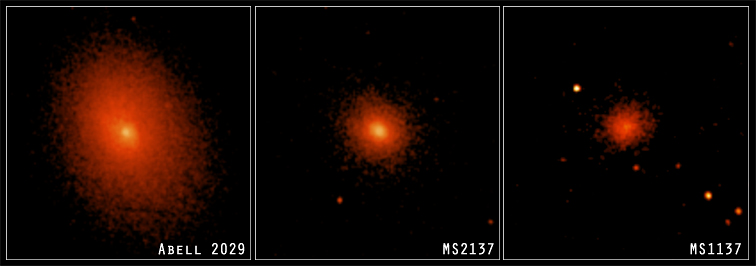
starannihilator writes "The Chandra X-Ray Observatory has provided new evidence supporting the existence of dark energy, the force causing the acceleration of universal expansion. The new findings support the theory that the universe will expand forever, provided there is enough dark matter. CNN and Newsday are running the story, originally reported by NASA. Chandra's site has some good images and information on the three galaxies clusters studied (Abell 2029, MS2137.3-2353, and MS1137.5+6625)."
I am eagerly awaiting the next annoncement where someone again finds evidence to refute the dark matter claims. It seems like the science; "Dark Matter is like this" - "No, it can't be, actually it's like that". Is not going to end soon.
Join me. Come to the dark side, and together, we will expand the universe.
Kinetic stupidity has a new brand leader: Allen Zadr.
how do we know if something outside the universe isnt affecting it.
I'd like to think we live on an electron in orbit around the proton of a molecule as part of a giant coffee mug -- our universe is expanding due to some even bigger geek having just poured hot coffee in our universal mug.
It's "dark" cuz that's how this geek likes his coffee.
No. The expansion of the universe refers to the fact that distant galaxies are moving away from us, and that the farther they are, the faster they are moving. This is expressed by the Hubble constant, which has a value of about 50 km/s/Mpc.
The acceleration of the expansion is reflected as this "constant" increasing with increasing distance.
The acceleration is caused by Dark Energy, not Dark Matter.
Dark Matter is either normal matter or subnuclear matter that makes its presence felt as increased gravity, but is not directly observable.
Dark Energy is not well understood at all.
HCG 50a = 2MASX J11170638+5455016
11h17m06.4s +54d55m02s
Does anyone else think that the cutting edge of physics is starting to resemble Ptolemy's system of astronomy? With all this 'dark' energy, and 'dark' matter, it's beginning to look like a lot of hand-waving.
Increasingly complex adjustments (e.g. epicycles) were made to Ptolemy's system to explain the observed motions of the heavenly bodies. Then along comes Copernicus and tells us that we've been looking at it inside out all along, things are simple after all, we just have to adjust our viewpoint.
I think physics is overdue another Copernicus.
Uh, dark matter and dark energy aren't the same thing.
tasks(723) drafts(105) languages(484) examples(29106)
There was some PBS special a little while back that talked about "string theory" of reality and the possibility that the "Big Bang" was actually a big "collision" between this and another dimmension. The "collision" or interaction between the two different dimmensions not only created tremendous energy but also left some material from the other dimmesion in this one, dark matter. That is why the stuff is invisible with no known origin but somehow detectable. Kind of like the Old Ones.
No offense, but that's not how relativity works. The thoery of Relativity posits that all measurements are taken from some frame of reference, and it is impossible for an object to go faster than light for any frame of reference.
So, if I'm on a spaceship going 99.9999999% the speed of light from the frame of reference of the earth. However, from the frame of reference of my spaceship, I'm stationary. Now, I can run as fast as I want in any direction, I can even sit in the back of my space ship with a super-powerful gun that shoots bullets at 99.9999999% the speed of light, and fire a couple rounds towards the front of the ship. From the frame of reference in the ship, the bullets will travel at 99.9999999% the speed of light, even when the ship is travelling at 99.9999999% the speed of light in reference to the earth.
But here is where it gets wierd: an observer on earth will not measure the speed of the bullets to be travelling 199.9999996% (99.9999999%x2) the speed of light, they will be measuring the bullet to be travelling just over 99.9999999% the speed of light.
This is because, from the viewpoint of someone on earth, the space ship will be very short, which means even if it still traverses the length of the ship in the same amount of time as it does from the viewpoint of me on the spaceship, it will not have travelled the same distance, which (since v=d/t) means the bullet didn't travel as fast relative to the spaceship (from the viewpoint of earth) as it did from the viewpoint of someone on the spaceship.
Additionally, from the viewpoint of Earth, time is travelling more slowly on the spaceship, which enhances the effect even more.
It's confusing if you don't have a handle on it, but none the less, this is how the theory of relativity works.
Now blow the balloon up a little more such that P0 and P1 are 1mm further apart, and thus P1 and P2 are also 1mm further apart (P0 and P2 are 2mm further apart). Then (D=distance, dD=change in distance):
dD01/D01 = 1mm/10mm=0.1
dD12/D12 = 1mm/10mm=0.1
dD02/D02 = 2mm/20mm=0.1
i.e., dD/D = constant. Since the dD occured over the same time for the two distances, you can also write this as
(dD/dt)/D = V/D = constant = K
(This is the Hubble equation, where K=H.)
So, in theory, you could blow up a balloon such that two points are moving faster than c relative to each other (V=c=D*K). Let's see how to do this. The distance between any two points on the surface is D = r*Q (r=balloon radius, Q = angle between the points in radians which stays constant as the balloon expands). The change in distance over time is
dD/dt = V = dr/dt*Q.
The furthest two points can get apart is Q=pi (opposite points on the balloon), hence the fastest relative velocity will be between these points. Let V = c and solve:
dr/dt = V/Q = c/pi
In other words, if the radius of the balloon was expanding at a rate of just under 1/3 the speed of light, two points on the balloon would be moving relative to each other at the speed of light. (This would not only take a lot of air, but the rate of air required would go up with the cube of the radius, so you'd want to do this when the radius is very small.)
Applying this 2D analogy to the 3D universe, it doesn't have to be expanding at the speed of light for two distant points to be moving greater than c relative to each other. But it does have to be expanding above a certain rate to achieve this. If it's expanding slower than this critical rate, no two points can be moving faster than light relative to each other. If it's expanding faster, they can. Since the expansion seems to be accelerating, it seems inevitable that it will happen at some point if it hasn't already.
We should also be able to figure out if it has already happened or when it will. We know the constant H (from the Hubble equation H = V/D). (It's easy to calculate anyway, given the distance to any star and it's measured relative velocity.) If we know the history of the expansion rate we know how big the universe is, i.e., this furthest distance Dmax between any two points. We can then solve the Hubble equation V = H*Dmax and see if it is less than or greater than c.
By the way, I don't think this violates relativity, it doesn't say anything about the rate of expansion of the universe. I think this falls into the "warp" concept of traveling faster than the speed of light, i.e., if you can locally expand the universe fast enough, it appears you are moving away faster than the speed of light, and vice-versa if you can contract it fast enough locally it appears that you are approaching faster than the speed of light. I could be wrong about that though.