 Slashdot Mirror
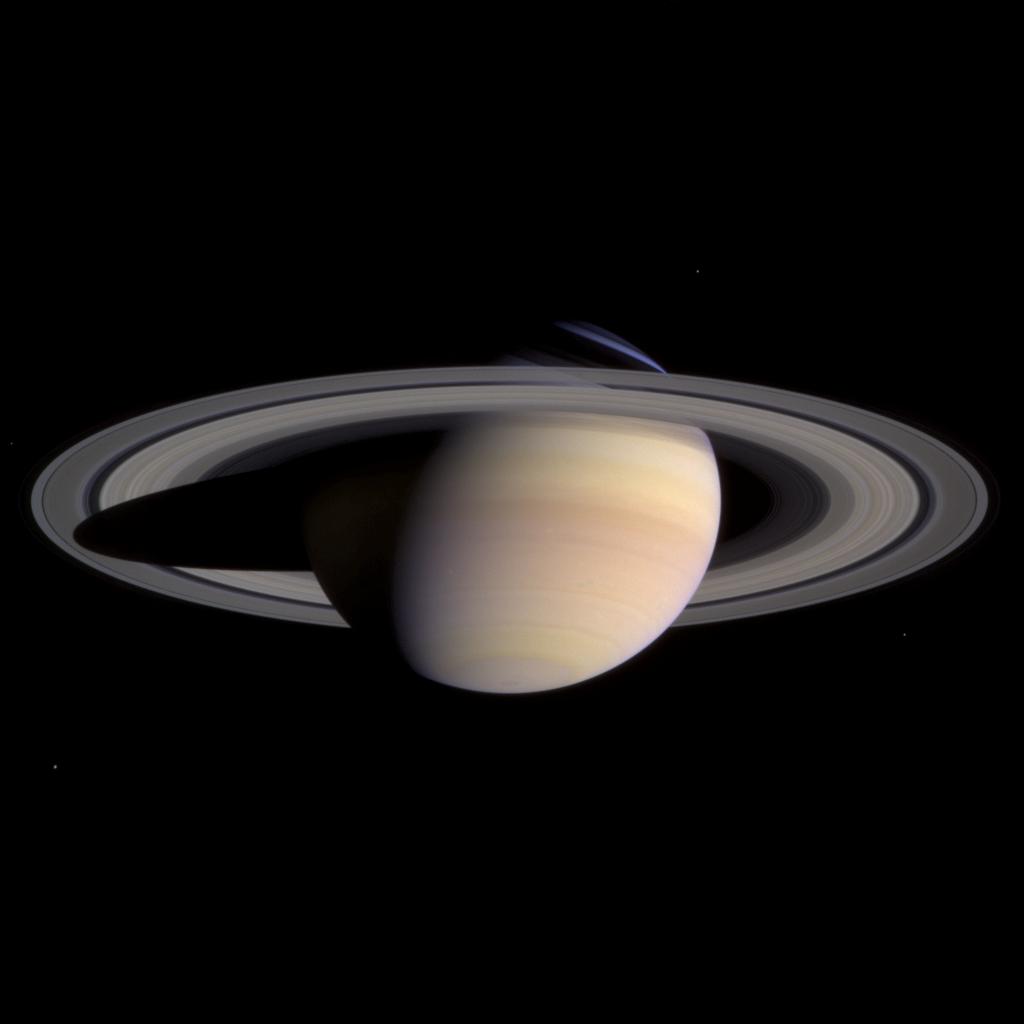
Cassini Alters Path. Phoebe Now In Sight!
Anonymous Explorer writes "This week the Cassini-Huygens
Spacecraft finally entered
the Saturn system and made its first
main-engine burn in five years in preparation of for the Phoebe flyby. This long
journey
has been one filled with much promise and peril. Launched in 1997,
Cassini is expected to have a rendezvous with
the moon Phoebe
on June 11. For those of us who are lazy, that's just a tad under two
weeks away. After the Phoebe flyby, it's on to the ringed planet, with an
anticipated July 1
ground orbit insertion. The ESA's
Huygens probe will descend into the atmosphere of Titan a few months
after Cassini is inserted into orbit. This mission
promises to be
one that brings a very psychedelic and beautiful area of our solar
system into clearer focus. This multinational
mission is one the
most ambitious scientific explorations yet undertaken and promises some
truly otherworldly images in the near future. With 31 moons/natural
satellites thus far discovered orbiting Saturn, there should be a lot
to keep us occupied. Anyone else excited about the journey
to a ringed world? Lets all enjoy this ride. It promises to
be a unique one as much as for the scenery as for the science. Informal
discussion regarding the Cassini-Huygens mission can be found at
#cassini on irc.freenode.net."


Map and Images of Titan from Hubble Space Telescope
Nasa Titan Photojournal
Saturnian Satellite Fact Sheet
Phoebe best image so far, from Voyager2 in 1981!
Do you need a website upgrade?
It's gonna be nice to see a photo-intensive orbiting mission to one of the big gas giants. The Galileo orbiter for Jupiter had an antenna problem that greatly reduced the imaging volume.
However, based on Voyager flybys, Saturn's moons are not quite as photogenic as Jupiter's. Titan is covered with a thick feature-poor haze and most of the other moons are too small to have many of the interesting tidally-caused features of the Jupiter moons. But there are still some interesting features on some of the moons.
And, Cassini will drop a probe into Titan's atmosphere that should return some interesting images and data. Titan may have a methane ocean and the Titan probe may possibly land in it and float for a few hours. The ocean may have giant waves because the gravity is so weak compared to Earth, similar to the way that sand-dunes are easier to make on Mars because of the lower gravity there. Things can get taller and weirder under low gravity. It would be the first time liquid could be seen from the surface of another world (aside from the Apollo Tang drippings).
Table-ized A.I.
Al Sharpton (2004 democratic presedential hopeful) led a protest in harlem at NASA's Goddard center.
I think astronomers realize the importance of beauty when trying to get public support. Check out the Hubble Heritage project. The main reason for this project is to take pretty astronomy pictures.
I AM an environmentalist, and I KNOW that there was more danger with the rocket (bomb) that was sitting under Cassini hurting people than the RTG becoming a problem. IF the RTG did somehow become a problem, the "probability * consequences" was still so low that it's more dangerous for you (and the rest of the world) to drive your car to work. The issue is that there are some rather uninformed emotional reactions to the word "radiation".
Do you drive a car? Do you use a computer? Do you smoke? All of these have very real and very bad risks to yourself and others. Nothing you do is 100% safe. You're still doing it.
The problem is not that you oppose nuclear power, it's that you seem to be uninformed about nuclear power (and the rest of technology). The "risk" associated with your using electrical energy to power your computer is more than the risk NASA generates by using an RTG to power a spacecraft. The environmental consequences of burning coal, damming rivers, or however else you produce your electricity are much worse than the use (or even (VERY unlikely) destruction within Earth's atmosphere) of an RTG.
This doesn't mean they're dangerous. They are all quite capable of surviving reentry and impact, and in one case (the NASA Nimbus B1 satellite in 1968) an RTG was recovered and actually reused in another spacecraft!
Furthermore even if one did break up in the atmosphere and somehow vapourise despite being made in a ceramic form that would stay in a few lumps, it would cause bugger all damage. Plutonium isn't especially radioactive, although it is moderately chemically toxic. The small amount in an RTG completely pales in comparison to the plutonium in the environment from all the nuclear tests, and those make up literally 0.5% of the radiation we receive each year. (The rest comes mostly from natural sources but a significant amount also from medical xrays.)
"Studies have shown that people who eat peanuts live longer than those who do not eat."
Oh, nonsense. All evidence says that RTGs are very safe. Therefore someone saying that they are not has the burden of proof. Whether or not a person _likes_ the truth (or our best estimation thereof) doesn't change it.
The greater damage was done by irrational fearmongering than any launch.
This silly thing where "my side need only be plausible, your side needs to be 100% concrete" is stupid. I think we're done.
"Faith: Belief without evidence in what is told by one who speaks without knowledge, of things without parallel." - A.B.
There is a preliminary plot of Cassini's possible orbital tour here . According to it, Cassini will make around 69 orbits during its planned mission. Note that one of Cassini's primary targets, Titan, orbits at around 40 Saturn radii, well outside the rings.
Oh, and, look for all the pretty pictures from Cassini to be posted over at CICLOPS (Cassini Imaging Central Laboratory for Operations).
Bush Lies On the Record.
They're also really damn expensive because you have to make the fuel in a nuclear reactor. Probably not suitable for home use. Also, there hasn't been much success making them really really tiny like you'd want for portable equipment.
"Studies have shown that people who eat peanuts live longer than those who do not eat."
Actually, Cassini will pass through Saturn's rings twice during orbital insertion. Although it will be "driving" through one of the gaps between rings, it will still be going directly through the ring plane.
For those of you interested in Saturn's larger roll in the formation of our solar system, check out this site. Lots to read, but pretty interesting:
http://www.jnocook.net/saturn/
The ring plane extends out to infinity, and so even the Earth passes through it occasionally. The ring plane is considerably tilted with respect to the ecliptic, so it would have been impossible for the Voyagers to not pass through the ring plane. Both went well outside the rings, not, as you imply, through the rings (In Saturn radii: closest approaches V1=3.09 & V2=2.67, outer ring lies at ~2.3) Someone has already pointed out your misinformation about the Cassini orbit. Your links are interesting, but none support your assertions.
"I'm so moist I'm sticking to the leather." -Kermit the Frog on The Late Late Show
We have a room on the irc.freenode.net servers called #cassini which is available to all who are interested in the Cassini project. Here you will find a wide range of interests discussed, from the informal to the most scientific details of the mission. Some of the Cassini staff have shown interest in participating to further support the project's public interest so don't be surprized to meet them there.
We also support the ' Maestro ' program which is the Public-Outreach software created for the Mars Exploration Rover Project from JPL . As a result, we helped maintain the #maestro room (also on freenode.net) which is still in operation today.
With such high interest building as Cassini-Huygens approaches orbital insertion and the Phoebe flyby, we expect a bigger rush in the next weeks. Join in and share the experience!
If you are not sure how to do 'IRC' there are many good primers online to help and you can visit http://freenode.net for details about connecting as well as links to assist you to set things up to chat online.
See all "/.'ers" there... ;^)
Pandelirium
http://www.pandelirium.net irc.freenode.net
#cassini
#maestro
#pandelirium
You never have a "certain probability".
Sure you do. The expression just means "some well-defined but unknown probability value" and suggests it is different from zero. It's common usage in statistics and stochastics. Search on Google for examples (about 19300 of them).