 Slashdot Mirror
Optimal 24 mark Golomb Ruler Proven
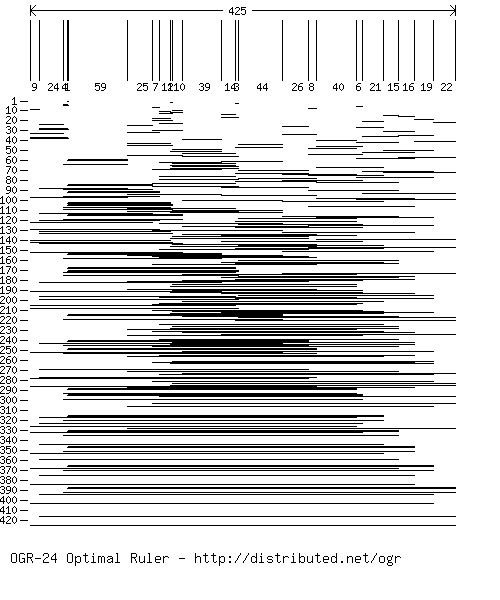
globring writes "Four years ago, distributed.net users undertook the search for the optimal 24 mark Golomb Ruler. This year sees the successful conclusion of that effort. The diagram of the optimal ruler can be seen here. If you have no idea what a Golomb Ruler is, you can read up on them. Work on finding the optimal 25 mark ruler is still in progress."
Slashdot beat the Amiga team in OGR-24, but the Amiga team is leading the Slashdot team in OGR-25: OGR-25 Team Listing
But the Dutch Power Cows leads in both efforts.
OGR-24 blocks have been scarce for the last few months, so the statistics have been rather erratic.
At least the OGR effort is more useful than the RC5-72 effort. We showed how quick DES and RC5-56 could be broken quickly with a bruce force attack with spare CPU cycles. But why do RC5-72? It's not that interesting.
I'm doing OGR-25 now, and when that's finished I might go on to something like folding @ home, if there's a client.
Irene KHAAAAAAN!
Actually, strictly speaking, both the travelling salesman problem and finding an efficient Gollumb ruler with n marks are not NP-complete. To be NP-complete, a problem must require a yes/no solution.
For instance "Is this particular Gollumb ruler optimal among all Gollumb rulers with n marks" asks a yes/no question, and could therefore be NP-complete. Also, the problem "Does there exist a way to visit the following cities without travelling more than n miles" is a decision problem. Note that we can usually phrase non-decision problems as decision problems, but going in the other direction can be trickier... you may in fact have to use the yes/no algorithm an exponentially growing number of times to solve the original problem!
It is true that NP-complete problems "map" to each other. In fact, this is part of their definition: an NP-complete problem is an NP problem that can map to any other NP problem. Essentially, NP-complete problems are the "hardest" problems of the NP problems. (And quickly, a problem is NP if given a solution and a "proof" to the problem, the "proof" can be verified in polynomial time. This loosely implies that if you can try all perspective solutions simultaneously, you can solve the problem in polynomial time, but if you have to try all possible solutions consecutively, it could take a while.)
The article does mention that this problem is "like" NP-complete problems, but does not suggest any reason for this except for the presumed requirement of exponential time (which by the way is not necessarily a requirement for NP-completeness... this is in fact one of the outstanding questions in computer science).
To get back to your original question (does an approximation algorithm for this approximate other NP-complete problems)... let's assume that the decision version of this problem is NP-complete. Then an approximation is more of a guess (with one-sided error) about the answer to the yes/no version. In this case, you have an approximator (with one-sided error) for all NP-complete problems. But this might not really provide an efficient or even correct solution for any corresponding non-decision problem.
Finally, approximators for the travelling salesman problem do already exist. Not surprisingly, the more reliable and accurate the approximation algorithm, the more time it requires.
I hope this clarifies things...
Thou shalt not begin a subject line or post with the word "Umm".
Briefly (probably too briefly) this and similar sounding challenges have real world applications in optimization, where you are trying to figure out how to get what you need without it costing any more than necessary.
For example, suppose you needed to do something that involved two things that had to be the right distance apart, which might mean physical distance, or two oscillators on different frequencies, or two voltages, or whatever. Just two things separated by some value.
You could get pairs separated by 1,2,3,4, etc. by just having one thing (telescope, oscillator, electrode, etc.) located at values 0,1,2,3,4, etc. But suppose each of those things cost you $10 million and you had a $50 million budget. You could still lay them out at 0,1,2,3, and 4, but is there another layout where your $50 million could buy you more bang for the buck?
How could you lay out 5 things to have the maximum number of different gaps between any pair? And this problem adds another constraint, which is to make the total distance from the least value to the greatest value as small as possible. There are real world problems where that's a constraint, too, such as buying the land on which to situate telescopes.
Once problems like this are tackled and optimal solutions found using just numbers, then somebody who later comes along with a practical problem who has heard about this work can take advantage of this work to optimize his system.
"Those who have never entered upon scientific pursuits know not a tithe of the poetry by which they are surrounded."