 Slashdot Mirror
Review: Jade Empire
- Title: Jade Empire
- Developer: Bioware
- Publisher: Microsoft Game Studios
- System: Xbox (only)
- Reviewer: Zonk
- Score: 9
Jade Empire begins with another day in the simple life of a martial arts student in the town of Two Rivers. You get to pick who that martial arts student is, and can choose from among several different characters with distinct styles and kung-fu names. Whether you pick Wu the Lotus Blossum or Furious Ming, you'll be introduced to Two Rivers and the Jade Empire combat system via sparring and talking with your fellow students. The idyllic scene is broken by the sneers of a bully and, more seriously, a pirate attack. The aftermath of the pirate attack thrusts you and a few followers onto a path to discover your destiny, rescue a friend, and unravel the truth behind the history of the Jade Empire.
The story-based gameplay, then, is very similar to the Xbox version of KOTOR. You move around the world through various maps people with NPCs, and talk (and talk, and talk) to them. What could have been a frustration is a joy in Jade Empire, as every character's lines are voice acted and the quality of the voice acting is almost universally high. Even minor NPCs get performers with heart assigned to them, and the result is very engaging. By default the entire game is subtitled, but I found that the subtitles were distracting me from the quality vocal performances and I switched them off. The Tho Fan language, made specifically for the game, is subtitled to allow you to follow along with the traditionalists who don't speak english. Without subtitles in most of the conversations Jade Empire is a cinematic experience with you as the protagonist.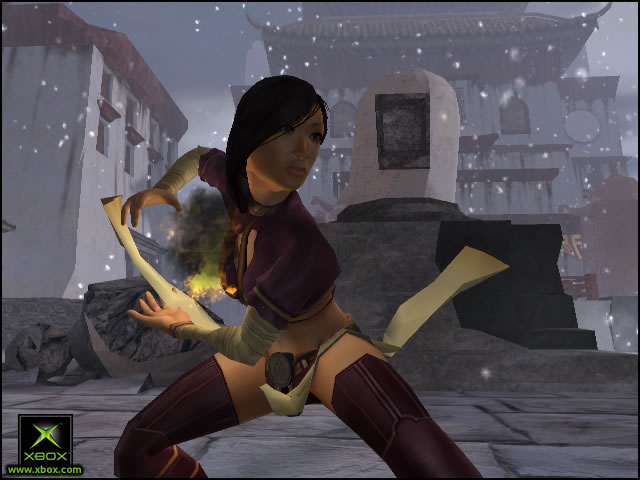
The cinema of the game is brought to the fore by the impressive graphical presentation Bioware wrings from the Xbox. The graphics are not groundbreaking or extraordinarily realistic, but evoke the world with soft tones, slightly exaggerated character designs, smooth looking animation, and beautiful effects. Much like KOTOR the beauty of the game is occasionally marred by slowdowns, but I found these technical hitches to be relatively rare. Given the story, cinema, and quality voice acting, Jade Empire evokes a well made wire-fu film.
Where there is wire-fu there is combat, and Jade Empire balances the preponderance of storytelling with a thoroughly enjoyable real-time combat system. Unlike Neverwinter Nights or Knights of the Old Republic, you actively control your protagonist character and your reflexes determine the success or failure of the Jade Empire saga. The basics of the combat gameplay, despite this innovation, remain firmly rooted in the d20-like systems of past games. Defeating enemies results in experience gains, and at certain intervals you gain levels. At each level gain you are given points to slot into your attributes to permanently increase them, and points to slot into your martial arts forms to improve their damage, speed, etc.
Your character has three attributes: Body, Mind, and Spirit. In turn, these attributes help determine your consumable personal resources. Body determines Health, Mind determines Chi, and Spirit determines Focus. You also have three social skills: Charm, Intuition, and Intimidate. Bonuses to your attributes affect these skills as well, with a higher Body resulting in more affective Intimidation and a higher Mind resulting in better Intuition. Your attributes, your resource pools, and your social skills can all be modified by amulet jewels. The amulet the protagonist possesses is given to her near the beginning of her quest, a powerful legacy from her mysterious past. By slotting jewels into the amulet you can customize your character beyond the levels you gain. Every jewel modifies one or more attribute or social skill in a specific way. The stones themselves are found at regular intervals throughout the game, and with only a limited number of slots you'll constantly be shifting the stones in your inventory looking for a good combination for combat and social situations. Every character starts with a pair of martial arts styles, and as you move through the game you acquire more through combat, purchasing them, and questing. Every form, in turn, has a specific purpose. Ghosts are unaffected by weapon forms, demons turn aside magic forms, and other forms have supporting roles, such as stunning or blinding opponents. Some forms are pure support, draining chi or focus from your opponents to refill your own bars. Combat itself uses the martial forms in several basic ways, and even small fights tend to be varied enough to keep you on your toes. The basic martial arts forms have three moves: hit, block, and power attack. In the classic rock/paper/scissors style basic hits disrupt power attacks, blocks deflect hits, and power attacks destroy blocks. Each form uses the same moves, with their own variations. Long Sword's power attacks is a sweeping slash, for example, while Spirit Thief (a support/draining form) uses a power attack that fills almost half of your chi bar in one blast. The most visually impressive forms are the shapechanger forms, which allow you to take on the appearance and attacks of a demon or monster. The combat drama unfolds, then, with you switching between four pre-chosen forms (on the D-pad) in such a way as to take advantage of the situation. The flexibility of the combat system makes it rewarding to use, and rarely a chore to work through a battle.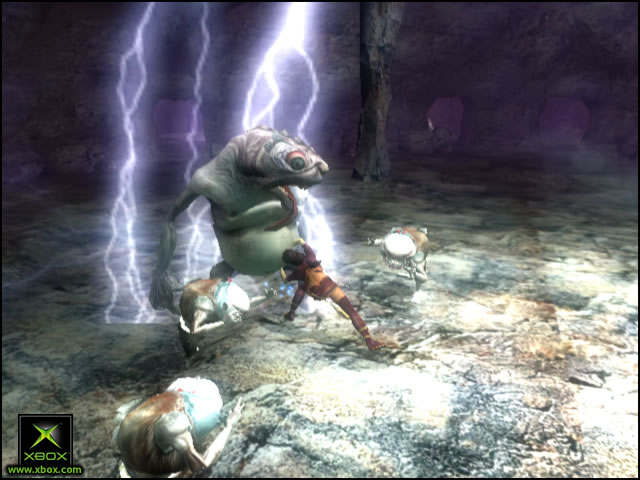
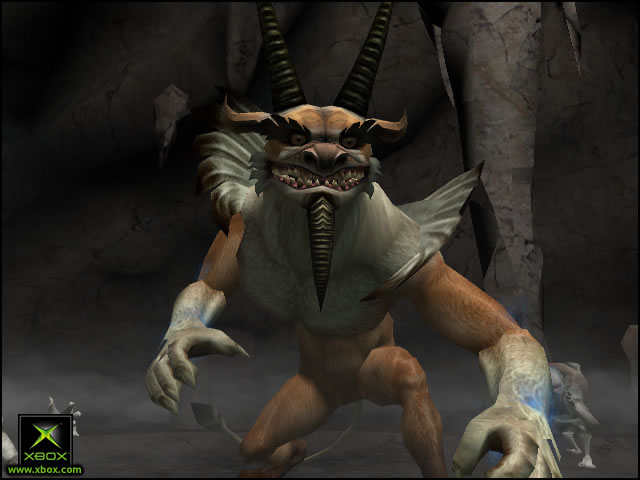
The other element that enters into combat, and ties the combat system into the fully realized story of the game, is your companion. As you move through the game (much like KOTOR) you pick up fellow travelers and miscreants who have something to add to your tale. These individuals range from a fellow student and friend from your days at the 2 rivers school to a little girl possessed by a demon to a mad inventor who maintains the airship you travel in. Each of them has a well fleshed out backstory and as events unfold you have the opportunity to delve into their pasts and fish out interesting information and personal insights. The characters are well written and in some cases downright funny. Kang the Mad, in particular, gets some choice lines.
Next time I hide something, I'm packing explosives around it. Explosives shaped like silver bananas! Stops thieves, monkeys and monkey thieves in one fell swoop. - Kang the MadBesides talking with them, you are allowed to choose one to travel with you as you explore, and when you enter combat your companion fights alongside you. The AI is usually effective in their tactical choices. The companion picks a target and stays with it until it's down, countering the baddies moves as best they can. While they do occasionally take out enemies, as is befitting of a game where you are the hero, for the most part they engage supporting characters while you move in on more important targets. If you don't want them mucking up your battlefield you can also choose to place them in support mode. In support mode your companion doesn't fight, but each individual aids you in some specific way over the course of a battle. One companion regenerates your focus as you fight, for example, while another does so with your chi. The added complexity a companion brings to a fight allows for even more options on the field of combat.
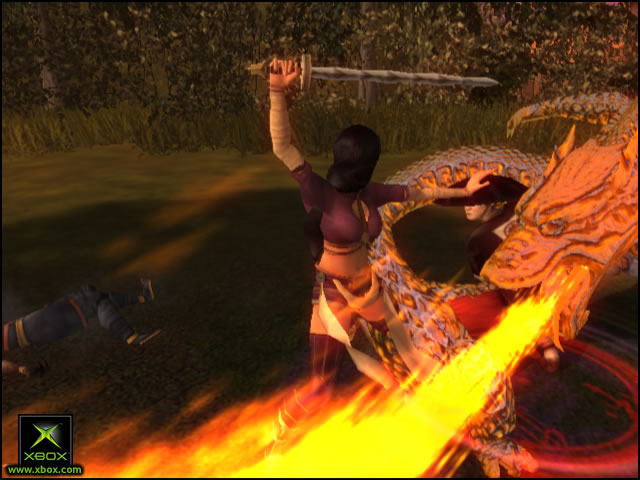
Each companion has their own outlook on life. Some tend more towards a gentle disposition, while others have a harder edge to them. These outlooks reflect the two opposing points of view that your character will choose between as you move through the game. The Way of the Open Palm and the Way of the Closed Fist correlate, roughly, to the light and dark sides of the force as explored in KOTOR. As in those titles, moral choices are presented to you in nearly every conversation and situation. The more you tend towards kindness and understanding, the more enlightened you become towards the way of the Open Palm. The more you tend towards cruelty and indifference, the more accepting you become towards the way of the Closed Fist. Your physical appearance begins to change as you reach a choice along either path, and different martial art forms open up to you as well. In the end, your choice along the two paths determines what your role in the Jade Empire becomes.
Jade Empire, then, is a complicated game. It's a long story (I'm well over 30 hours into it and no where near done), well written, with impressive graphics and memorable characters. The only two real complaints I can lay at the game's feet are occasional slowdowns during combat, and (as with all Xbox Bioware games) sometimes abominably long load times between map areas. Neither of these minor technical hurdles was annoying enough for me to become frustrated by my play experience. Jade Empire is a new high water line for console RPG titles, and in my opinion is Bioware's best work to date. If you enjoy an engaging story, have gotten into Bioware titles in the past, or have a love of well crafted martial arts tales don't let Jade Empire pass you by.
Jade Empire is the best game I've played in a long time; certainly over the last year, quite possibly a good bit longer.
I've got a bit of an erratic history with Bioware games. The first Baldur's Gate left me a bit cold... it felt like a good idea badly executed and hindered by a determination to be a bit nastier to the player than was strictly necessary. Baldur's Gate 2, on the other hand, felt a lot more polished and I must have played it through half a dozen times. Neverwinter Nights was a huge let-down for me; the toolkit demanded more time and effort to use properly than I was willing to put in and the campaign basically sucked. KOTOR, on the other hand, was awesome. Then KOTOR 2 came along (yes, I know it's not strictly Bioware) and it just felt flat. The writing in particular was pretty horrible and the total bugfest didn't help either.
To be blunt, though, Jade Empire beats anything else Bioware have done into the ground. I'm about 15 hours into my first playthrough of it now and it's an incredible experience. It feels odd at first to be controlling the combat so directly in a game which obviously shares such a strong technical base with KOTOR, but the controls and combat system are pretty much flawlessly implemented. There's a superb learning curve; you can button-mash the first few fights, but successive enemies need increasingly sophisticated tactics.
I must admit I wasn't enthusiastic when I heard Jade Empire would be an action RPG. In my experience, most of these tend to degenerate into either boring button-mashing fests like the Dark Alliance games or tedious movement-puzzle crawls like Zelda. Kingdom Hearts pulled the genre off reasonably well, but even that had some real annoyances. However, one of the most striking things about Jade Empire so far is the relative scarcity of combat. Rather than being attacked constantly as you move around the map, or having to get past the same group of infinitely-respawning monsters every time you pass through a particular area, the vast majority of fights in the game actually seem to be tied into a specific plot point. You don't get randomly attacked by bandits or monsters; there's actually a *reason* for almost every encounter. Moreover, as in earlier Bioware games, it's possible (and sometimes preferable) to talk your way out of fighting.
Graphics are generally excellent. You can occasonally detect that the game is based on a now-aging engine, but the quality of the character and location designs is more than good enough to mask this. Sounds are excellent, particularly voice-acting. John Cleese's cameo (as an "English" explorer, come to enlighten the oriental savages) actually had me laughing out loud. The dialogue is back up to the high-standard of that in KOTOR.
If I'd add one complaint to the two in the review, it would be that the in-game journal doesn't always do a very good job of recording quest objectives. A few times now I've come back to the game after a break and had to think quite hard about where I needed to meet a character in connection with a subquest. Overall, though, it's a stunning game. The X-Box may have had a crap first year or two, but it's got to be the strongest late-cycle performer of the current generation by quite a margin.
I just played through this twice and I only have 2 complaints. Both times doing most of the side quests, I beat it in around 15 hours. After KOTOR's 30+ hours I found it to be a bit of a let down. My other problem was the load times. They really chopped up the story in my opinion. Other than those 2 small complaints, this is my favorite RPG of the year...so far.
JE feels very linear, despite the effort spent by the development time devoted to the sidequests. Even if you were to complete every sidequest available, you would still wind up only clocking in at about 20 hours. For most harcore RPG gamers, this lack of gameplay hurts the title more than it helps.
Remember, the standard for RPGs have been set by games like the Final Fantasy series, the Star Oceans, and XenoGears/Sagas. Unfortunately short play RPGs like JE and Fable doesn't do anything but support the fact that American development houses still can't compete with Japanese ones.
I'm having an excellent time playing JE. I have finished quite a few of the side quests in the imperial city, just took the silver championship and am OMW to infilitrate the Lotus Blossom Assassins before I work my way up to the gold championship.
I think the game is a hell of a lot of fun, and quite a bit more engrossing than many I have played (although I did love the PC version of Morrowind and I'm also finally playing the xbox KOTR 1 and enjoying it as well). One thing that annoys me immensely about KOTR 1 is that I don't have Xbox live, and therefore can't get the bug fixes and game updates for it (why should I have to pay a subscription to get bug fixes?). Anyway, I digress...
The dialogue *is* excellently voice acted. The whole bit with the outlander (John Cleese) was hilarious. The combat is fun, but could be a bit more challenging. It's not completely dumbed down but it's also no Soul Caliber. Using the storm dragon style coupled with any other martial style (I'm using leaping tiger) pretty much leads to a "can't lose" versus anything that's stunnable. Like another poster I read, I almost never use blocks, and I don't think I've ever purposefully done a harmonic combo. Most of the time against normal opponents I can easily win just by tossing a few storm dragon strikes to stun them, then pummel them for 5 or 6 secs before stunning them again, rinse and repeat. During the silver championship, Soldier never touched me, he spent the entire time stunned/shocked/getting his ass handed to him. The final fight in the black leopard school was a bit more challenging, until I finally managed to stun Smiling Raven or whatever his name was and then it was all over.
I'm looking forward to playing it again from the beginning and doing a few things differently... number 1, going full closed fist instead of open palm and turning into a grade A bastard, number 2 not learning every single style I happen across and instead focusing on maxing out 3 or 4 bread and butter styles, and finally number 3 not even using Storm Dragon because it's almost like a cheat mode.
All in all, this game was WELL worth the cash, and I can't say that too often anymore. I've spent more money on a lot shitter games.
-- Gary F.