 Slashdot Mirror
European Students to Put Microsatellite Into Orbit
Astervitude writes "A Frankenstein's microsatellite made out of parts "donated" by university students across Europe will be launched on September 30 atop a Russian booster. Space.com reports that more than 400 students "spread across 23 universities and 12 countries" spent 18 months designing and building the SSETI Express. While its acronym sounds suspiciously similar to that of a project that seeks to uncover signs of intelligent life beyond Earth, the SSETI or Student Space Exploration Technology Initiative mission is actually part of an effort by the European Space Agency "to boost student interest in space technology and offer some hands-on experience." The satellite itself weighs a mere 136 pounds and is the "size of a small washing machine", as shown in this ESA photo. Visitors to the mission site may want to check out the contest page for ham radio operators to help collect data from the satellite."
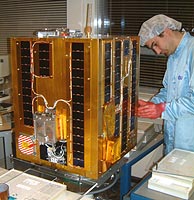
From the SSETI Express page:
Payload systems:
The Attitude Control and Determination System controls the attitude of the spacecraft using a pair of magnetorquers and a passive magnet and determines the attitude of the spacecraft using a magnetometer and a pair of sun-sensors.
The camera uses CMOS technology and is capable of taking full colour pictures in the visual range at a ground resolution of about 100m per pixel, with an image size of 1280x1024 pixels. It will be used to take images of the Earth.
The S-Band unit is the secondary communications system. It contains a microwave transmitter and TNC and is capable of 38400bps data downlink, or transponding audio from UHF via three patch antennas (S-Band ANT), acting as a voice repeater for radio amateurs.
T-PODS - These three pods contain the three Cubesat passengers during the launch and coasting phases. After injection they will act as launcher tubes, ejecting the Cubesats from SSETI Express so that they can pursue their own missions.
SSETI Express will carry three small nano-satellites into orbit as passengers. These will be ejected from SSETI Express shortly after the launch, and will then undergo their own, separate, missions.
The three cubesats are:
NCUBE-2 -Developed by the Andøya Rocket Range, Norway. This Cubesat will track boats around the Norwegian coastline (and one reindeer on land).
[I, for one, welcome our new reindeer-tracking overlords!]
UWE-1 - Developed by the University of Würzburg, Germany. This Cubesat will test new communications protocols.
XI-V Developed by the University of Tokyo, Japan. This Cubesat will test commercial off-the-shelf technology and has a camera to take pictures of the Earth.
SSETI Express has two 'radios' on-board.
On UHF 437.250MHz there is a FM transceiver that can transmit and receive the AX25 packet telemetry and payload data at the data rate of 9k6bps. The transceiver produces approx 3 watts of RF output that feeds a canted 1/4 wave whip, which is mounted on the top plate. It incorporates a standard TNC7-Multi to convert the data to and from the OBC. It also has an audio and RSSI feed to the S-Band Tx. It was constructed by Holger Eckardt DF2FQ and is based upon his T7F UHF packet transceiver.
Communications - On S-Band there is a transmitter on 2401.835MHz which can transmit packet data at a data rate of 38k4bps. It can also be configured to work in a voice transponder configuration. It produces approximately 2.5 watts of RF output which feed a three way splitter to the three patch antennas. The enclosure, power splitter and antennas were provided by the University of Wroclaw SSETI team and the electronics were produced by five members of AMSAT-UK. The unit comprises of a switch mode power supply, exciter board, amplifier board, controller board and a sensor board. The TNC is identical to the TNC7 Multi being used in the UHF transceiver except that it is set for a different baud rate.
Typical Groundstation:
To receive data from SSETI Express the requirements are similar to those for previous 9k6 Pacsats.
To receive UHF telemetry, a steerable circularly polarised yagi with 12dBic gain with, preferably, a masthead preamplifier, should be satisfactory for reception of the data . The receiver must have an IF bandwidth of at least 20kHz and an audio output that is taken from the discriminator before any 'shaping'. This audio is then fed into a suitable KISS-enabled TNC which itself is connected to a PC normally via a serial port. To transmit to the satellite (when 'friendly telecommands' have been enabled) an RF output power of 10 watts on UHF should be sufficient.
To receive S-Band data, the antenna gain will need to be more than 21dBic and in this case RHCP (right hand circular polarisation) is a must. Again a mast mounted preamplifier will be required. As the data rate is 38k4bps the IF bandwidth will need to be approx 80kHz together with a K
"Is life so dear, or peace so sweet, as to be purchased at the price of chains and slavery?" - Patrick Henry
hello? i thinnk you can count the communists in europe with both of your hands.
at lest the parties).
They are a small minority.
What makes you think we are communists?
I don't say the Americans are fascists!
By the way, a well known german ex-chancellor once said:
"Communists are red painted Nazi's"
(Willi Brandt)
Ummmm just how do you propose to get it to the ISS this decade? Payload mass on Soyuz is laughable and beyond spoken for. A washing machine sized payload, or even the smaller cube sats has NO chance. Shuttle isn't much better... starting with the simple fact it isn't flying. After that ISS payload space is also spoken for and very behind schedule so again getting these things up there would take a long time and a lot of money clearing NASA's manned certification issues for launching a payload with a crew.
Frankly if you want to actually get science payloads up and running I would suggest ISS as the LAST possibility till they get their act together.
I don't ask you to be me. I only ask you not expect me to be you.
For reference:
3 1/0451217&tid=160
... and some sattelites lauched before (from russia):
X 1Index.html
Previous story on SlashDot about micro satelites:
http://science.slashdot.org/article.pl?sid=05/08/
(30. June 2003)
http://dtusat.dtu.dk/
http://www.cubesat.auc.dk/
http://www.utias-sfl.net/nanosatellites/CanX1/Can
-:) Oh no - not again.
www.rednebula.com
Yeah, I wondered too about this 136 pound microsatellite
The first ARRL satellite, Oscar 1 was 10 pounds and the size of a shoe box. Mind you it could only say HI, and couldn't hear your reply, so I guess we've had some progress in 44 years...
Uh, I hate to break it to you, but there are already a bunch up there. And more on the way. In the US alone, Stanford has launched a couple of satellites (Sapphire being the only one I can remember off the top of my head), Utah State & Weber State have launched one (NUsat), the Air Force Academy has put up several (FalconSat), and the University of Colorado has launched at least one (SNOE) - I've probably missed a bunch because I'm doing this oof the top of my head. The Air Force and Naval Academies have several student-built satellites manifested already. There a bunch of schools building CubeSats. And around a dozen schools competing in the NASA/AFRL University Nanosat competition.
Outside the US, a number of European universities have worked on CubeSats, the University of Stellanbosch in South Africa has done one or two satellites, and, of course, the University of Surrey (and their spinoff Surrey Satellite Technologies Ltd) have launched around 25 satellites in the last 20 years. Again, I've probably missed a bunch that I can't remember right now - these are just the ones that immediately leap to mind.
That horse has left the barn already.
"Slaves" of a communist regime? I grew up in a communist country, and while there were many things horribly wrong with that, it could hardly be compared to slavery. As a matter of fact, it was sometimes pretty hard to even find somebody working. A popular saying was that "the main principle of communism is simple: people pretend to work and the state pretend to pay them for it".
If you refer to GULAG and other prison camps, I highly doubt that any of these prisoners contributed in any way to the boosters that are currently in use (or perhaps any boosters at all).
AccountKiller