 Slashdot Mirror
European Students to Put Microsatellite Into Orbit
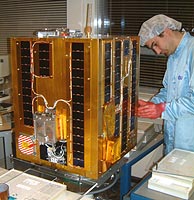
Astervitude writes "A Frankenstein's microsatellite made out of parts "donated" by university students across Europe will be launched on September 30 atop a Russian booster. Space.com reports that more than 400 students "spread across 23 universities and 12 countries" spent 18 months designing and building the SSETI Express. While its acronym sounds suspiciously similar to that of a project that seeks to uncover signs of intelligent life beyond Earth, the SSETI or Student Space Exploration Technology Initiative mission is actually part of an effort by the European Space Agency "to boost student interest in space technology and offer some hands-on experience." The satellite itself weighs a mere 136 pounds and is the "size of a small washing machine", as shown in this ESA photo. Visitors to the mission site may want to check out the contest page for ham radio operators to help collect data from the satellite."
It's not quite orbit (yet), but JP Aerospace has been running a PongSat program for the past few years which does something similar. Some of their past missions have gone above 100,000 feet, and would make great science fair projects for students. The description from their page:
A PongSat is an experiment that fits inside of a ping pong ball.
These ping pong ball 'satellites' are flown to the edge of space by balloon or launched in sounding rockets. The PongSats are then returned to the student.
It's an easy and inexpensive way to get students excited about science and engineering.
There are endless possibilities for experiments that can fit inside a ping pong ball. PongSat's can be as simple or complex as you want them to be. Experiments can be as simple as comparing how high a ball bounces before and after being exposed to vacuum. The PongSat can carry seeds to see if exposure to cosmic rays effect their growth. Several small inexpensive computers and other electronics can fit inside a PongSat. These can be used to create a wide range of experiments. Whether carrying a marshmallow to see if it puffs up in the vacuum of near space or an entire sophisticated satellite in miniature, PongSat can create motivation, drive
and passion in the classroom.
PongSats are flown at no cost to the student or school.
I agree that sending something to the ISS via NASA would soak up large sums of money. But the Russians send flights to the ISS too, don't they? I mean, couldn't they just stuff this thing into one of those unmanned supply capsules they send up?
Last I heard it was something like $20 mil to be sent up to the ISS via the Russian Space Agency. If it's that much for a person and their gear, surely it would be a lot cheaper to send an inanimate object?
Is that deserving of a slashdot story?
http://microsat.usc.edu/
Actually, given the dimensions and capability of the first artificial Earth satellite, Sputnik, it would be interesting to know how it compares. It would be amusing if the second space race - the race to be cheap, not to do things regardless of cost - was basically being led by a new generation of Sputniks on top of a new generation of Russian rockets.
Panurge has posted for the last time. Thanks for the positive moderations.
your just pissed you don't have the talent to do the same. besides the fact that the PROCESS of building and using the satellite is a great learning tool, by your logic we only need to ever build one of everything, since we already have ONE why build another. totally rediculous and i can't believe you got modded informative.
If you mod me down, I will become more powerful than you can imagine....
Moving along to funding the taxpayer in america it seems would prefer that his/her children learn how god created the earth in six days.
To the staff of Nasa - it seems most of them where inspired by the moon landings, or 'rockets'. The book 'October Sky' by ex nasa employee Homer H Hickman sort of implies that.
How about Burt Rutan and his spaceships. - Space tourism I mean wow is that it.
It seems that getting in the 'space club' - is very difficult to get into, Kids realise this, hey lets do a business mba instead.
How many of us are physically perfect? and uber inteligent, not many and quite why you need to have legs in zero g is just plain daft - i mean they dont really work there - so being 'perfect' goes out the window.
There probably are fun 'space jobs' Most kids probably think that space is not for them.
Send Peter Clifford Francis Macrae comdoms to 23 Bedford St, St.Neots, PE19 1AX, England
Funny that the OBDH (On-Board Data Handling System) Core for the ESEO is running Linux with 2.6.9 kernel. However all the decoding software I have found is all UI-View plugins for Windows. Is there (going to be) a Linux decoder out there? I can use Xastir to decode the AX.25 packets but I'd hate to hand decode the packets data.
No, I wasn't really referring to that. I was referring to the fact that even the democrats are more to the right than the right-wing politicials here in social-democratic Norway, for example.
Americans tend to refer to social-democracy as communism. While I was just stating that there are fundamental differences.
This is a reflection of different historical development, I believe. It is more about words than political programs.
Before WWII socialism and communism was considered evil by mainstream media everywhere -- hence the development of fascism as a reactionary force. After WWII the UK and US simply congratulated themselves while the formerly occupied countries generally reappreciated democratic socialism (which had been on the right side all along, and was a victim of the Nazis and therefore good).
Consequence is that European 'Liberal' parties permanently moved to the moderate right while social-democrats and socialists replaced them on the left side of the spectrum, while US and UK socialist all but disappeared. US Liberals and UK Labour are traditionally considered 'sister' parties by continental social-democrats, but these parties tend to shun the word 'socialism' because it has a negative connotation.
If the US/UK district system didn't exist we would probably see similar distinctions as in continental Europe. Liberals would split in for instance social liberals, social democrats, socialists, environmentalists, and Conservatives in christian-democrats, christian fundamentalists, conservative liberals, fascists. Since in a two party system both parties compete for the voters in the middle much of the diversity in opinions is nearly invisible from a distance.
'Neoliberalism' is a much newer thing, which tends to have less (but still too much) influence on continental social-democrats. It is neoliberal market-think that makes it seem nearly the whole US population is right wing.
Personally, I don't really mind paying taxes as long as I know it's used sensible.
I am also a happy European social-democratic taxpayer.
Funny but the CubeSat concept was by a Stanford professor and is coordinated by another California university, Cal Poly.
It's just that the international schools don't have the ITAR restrictions so they can actually get their satellites launched.
CubeSat has a bunch of American CubeSats ready to go, just waiting on the Russians to launch it now. http://www.cubesat.org/