 Slashdot Mirror
Cassini Returns Photos of Hyperion
imipak writes "The Cassini Saturn probe has captured the previously unseen northern polar region of Saturn's moon Hyperion. Its weirdly eroded surface looks like nothing else in the solar system seen so far, demonstrating once again that when it comes to planetary exploration, "expect the unexpected" is more than just glib advice from the Hitch-hiker's Guide!"
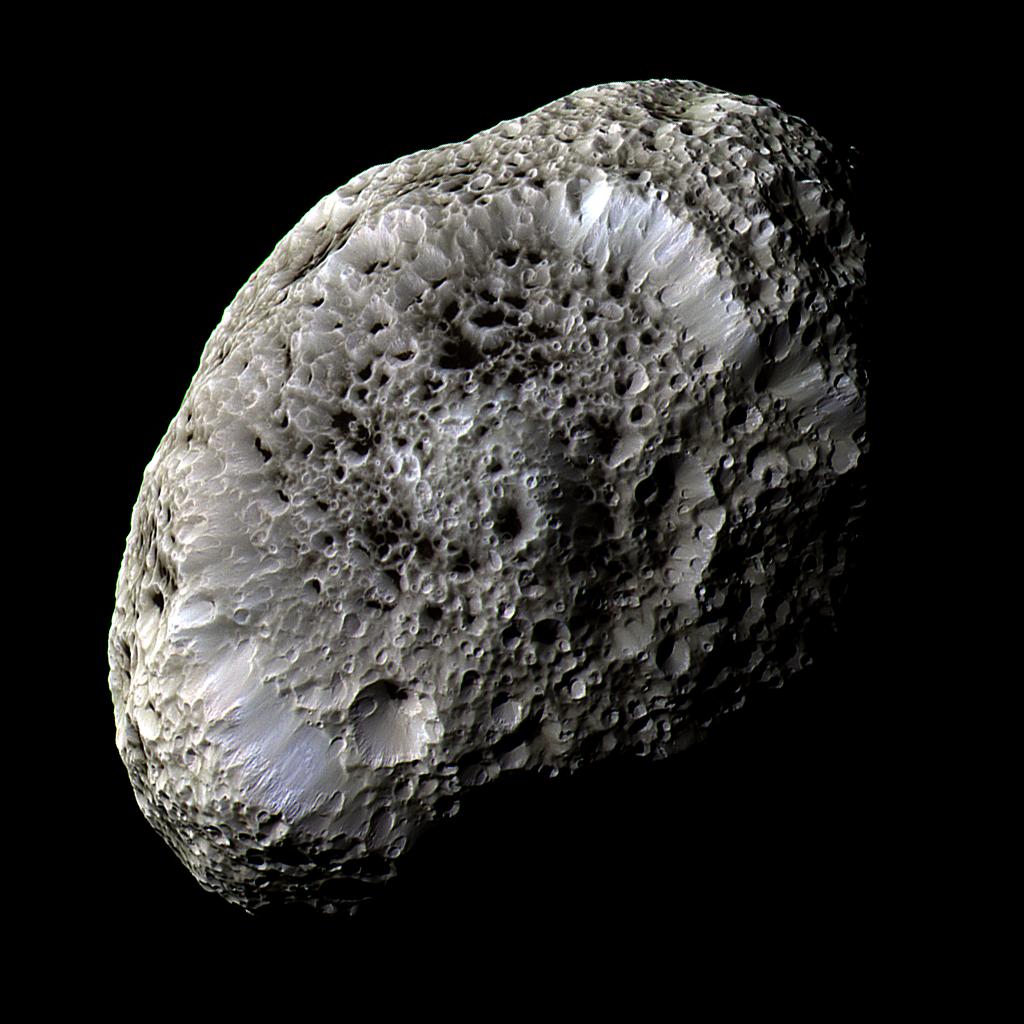

...it's a weirdly eroded space station.
My girlfriend has one of those in the shower, and yells at me when I leave it in the old water :(
Brent Jones
The image in the post http://saturn.jpl.nasa.gov/multimedia/images/moons /images/PIA07737-br500.jpg is of the moon Tethys and not Hyperion.
It was a double flyby, hence the confusion.
Imagine a beowolf cluster of "Thats no moon" jokes...
The two pictures are from different moons, Tethys (second link), Hyperion (first link). Perhaps reading a caption from the real article at http://www.jpl.nasa.gov/index.cfm would help
Everyone knows NASA faked the moon landings, and this is just a black and white close up of a rice crispy in Mike Griffin's morning cereal! ;-)
She's built like a steak house, but she handles like a bistro....
If it's a microscopic picture, I have to ask - what browser are you using to view it?
Bad jokes aside, this is what a magnified grain of salt looks like:
(it's pretty enough to make desktop wallpaper)
What's that thing in the top left hand corner of the second image? It doesn't fit with the rest of the landscape...
You mean the words that say, "DB_Session allocated the following problem: DB Error: connect failed"? Something tells me it is an earthy artifact.
Table-ized A.I.
I think there are two factors at work:
- In space, the lack of atmosphere gives things an "unreal" look in photographs. See if you can dig up the movie that was done by Messenger as it left Earth. It actually looks less "believable" than a modern Hollywood movie in some ways.
- The images are false colour. This is useful for conveying more information, but it does make them look a little "wrong."
For comparison, here's another version of the Tethys shot. It looks a lot less surreal, because it's greyscale.
"...always new atoms but always doing the same dance, remembering what the dance was yesterday." -Richard Feynman
Its a fish fossil. You see, when God created the earth 3,000 years ago he had some stuff left over, so he just thew it in orbit around other planets, figuring no one would ever find it.
Actually there are a ton of reasons for such a surface.
1) Its by Saturn which has a massive gravitational pull. This causes Saturn to pull in a lot of comets, asteroids, and dust. Thus Saturn gets hit with a lot more debris then the planets in the inner solar system. This would also increase the risk of the moons getting hit with this debris as well and therefore will have more impacts then that of the planets and moons in which we know.
2) Saturn has rings filled with debris. So if the moon ever happened to swing into these rings it would go through hundreds if not thousands of impacts. That could have very well created the surface that you see. This could have happened at any time in the moons history and so is a very likely cause.
3) The moon could have some sort geological processes that are responsible for such a surface, however thats very unlikely.
Personally I would put my bet on number 2 cause it makes the most sense. If the moon went through on of Saturns rings especially when the rings might have just formed there would have been a lot of collisions leaving the surface scarred like you see in the picture.
You can see the raised part in the centre, around which is part of the old crater wall.
Note the crater wall is significantly brighter than the surrounds - this is exposed materials, mainly water ice to judge from the brightness.
The other thing to note is that the crater is incomplete, and is itself riddled with craters, both the centre and the crater walls. This tells us that the large crater is very old. How old I would leave to an expert of the Saturnian system, who would no more about impact frequencies than me.
Hyperion is interesting in that it is the largest irregular body in the solar system. Anything larger (and many smaller objects) are pulled into a spherical shape by their own gravity. Hyperion is not that much smaller than Enceladus, and is of a similar make-up (frozen H2O) yet these object are very different.
I would hypothesise that a large impact has sheared off part of Hyperion- that's why the large crater is incomplete - the rest is gone, possibly to become part of the ring material but I don't know what the timing of that blast was.
The very strange not-really-craters next to the very large impact crater I would say were outgassing artefacts, not any type of impact crater. Basically the heat from the large impact caused volatiles to rocket out of Hyperion, leaving those sort of "exit valve" formations.