 Slashdot Mirror
Cassini Returns Photos of Hyperion
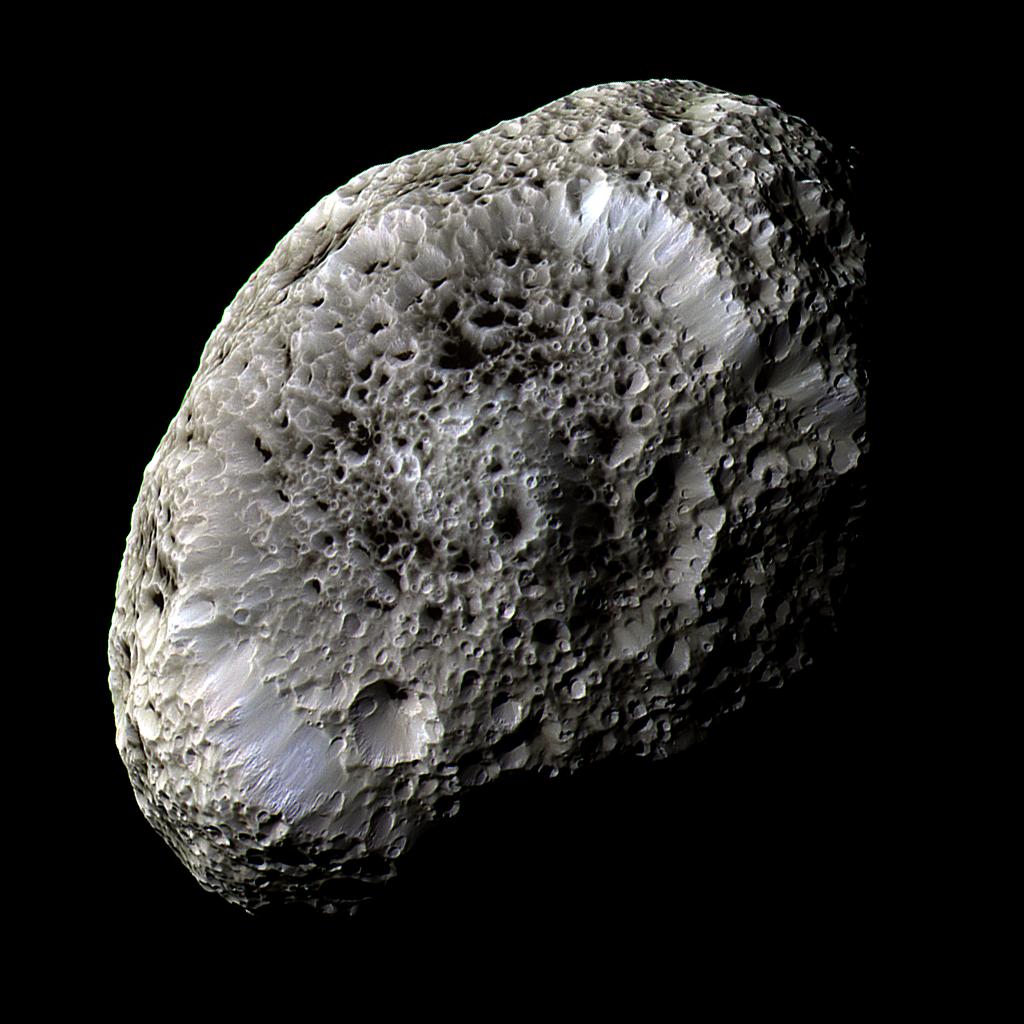
imipak writes "The Cassini Saturn probe has captured the previously unseen northern polar region of Saturn's moon Hyperion. Its weirdly eroded surface looks like nothing else in the solar system seen so far, demonstrating once again that when it comes to planetary exploration, "expect the unexpected" is more than just glib advice from the Hitch-hiker's Guide!"

What's that thing in the top left hand corner of the second image? It doesn't fit with the rest of the landscape...
Quid festinatio swallonis est aetherfuga inonusti?
Africus aut Europaeus?
And it's a good thing!
Cassini was helped to more funding because WE the geeks of Web/Net WANT TO KNOW. We want to see our world, our Universe. We join advocacy groups and science foundations.
Keep up the good work NASA. Let private groups continue as well.
I see a 2nd space renaissance soon!
If you "get" pointers add me as a friend (116)!
...it's a weirdly eroded space station.
I don't get that second image.
Is that what nothing else looks like, or is that what everything else looks like?
Either way, this article proves we shouldn't make general statements like that, doesn't it?
My girlfriend has one of those in the shower, and yells at me when I leave it in the old water :(
Brent Jones
The image in the post http://saturn.jpl.nasa.gov/multimedia/images/moons /images/PIA07737-br500.jpg is of the moon Tethys and not Hyperion.
It was a double flyby, hence the confusion.
it's a pumice stone!
I pretend to know more than I really do by mooching off google and wikipedia.
Imagine a beowolf cluster of "Thats no moon" jokes...
The two pictures are from different moons, Tethys (second link), Hyperion (first link). Perhaps reading a caption from the real article at http://www.jpl.nasa.gov/index.cfm would help
Travel pictures? Uh, yeah, that would be interesting. It is getting late though. Have a big meeting in the morning. Really, have to go. You have to download the pictures? It will take how long? Their from where?! How far out is that? No really, I have to leave. I can't wait that long to look at trip pictures. Really, big meeting, yes, really big meeting. Bye! [makes a break for the car....]
Having no formal education in planetology does not stop me to spout nonsense on slashdot:
:)
But the first picture looks like there was just big collision (old big crater) followed by lots of small collisions, without any erosion in between. I *think* I have seen similar features on the moon.
To have this picture is nonetheless an astonishing accomplishment.
I think that simply the lighting makes this view impressive
It looks like a microscopic picture of a grain of salt or something, wonder what it would look like if you were standing on the surface...
Everyone knows NASA faked the moon landings, and this is just a black and white close up of a rice crispy in Mike Griffin's morning cereal! ;-)
She's built like a steak house, but she handles like a bistro....
After viewing the pictures of the highly eroded surface, NASA scientists realized it bears a striking resemblance to EDWARD JAMES OLMOS and have renamed the moon in his honour. The moon will now be known as the "EDWARD JAMES OLMOS MOON" in honour of the Battlestar Galactica and Miami Vice star.
GoatPigSheep, the 3 most important food groups
This: shot-up "no shooting" sign
This issue is a bit more complicated than you think.
... the Shrike??
Disclosure: I'm stupid
http://saturn.jpl.nasa.gov/multimedia/images/moons /images/PIA07737-br500.jpg
Iv'e scene this in the toliet bowl after a hard night of drinking and Taco Bell.
This looks kind of like a wasps' nest. So THAT'S where all those big space wasps in my garden are coming from!
That's a patently false statement. Walk up to any person with a printout of this photo, and ask them, "Hey, does this look like anything you've seen in the solar system so far?" They'll probably say, "Yeah, it looks like a sponge" or "Yeah, it looks like pumice" or "Yeah, it looks like my mother-in-law's face".
Perhaps it doesn't look like any other celestial body we've seen so far.
The average density of particles in space is way too low to explain this. We're looking at at most a couple hundred particles per cubic centimeter.
One thing that I have never seen in discussions of cratering, is elastic collisions. Everybody seems to assume that collisions are necessarily plastic: A smaller body smashes into a larger body and the smaller body is pulverised in the process.
However, in the asteroid belt especially, many collisions may be elastic, with bodies bouncing off each other like billiard balls, leaving behind large indentations. This could happen, as these bodies are moving in essentially the same direction and therefore collisions may not always have much force.
Oh well, what the hell...
thats pretty much the most disgusting thing I have seen today.
Erosion? This thing has been beaten up badly by tons of impacts from Saturn's gravity pulling (or intelligently falling for you IDers) all sorts of cosmic debris down onto it.
It looks worse than Noriega's face
yeah i'm way off, i was looking at the wrong picture...
Thank you Dave Raggett
That means "It is weirdly eroded surface".
http://en.wikipedia.org/wiki/Its
It looks like the remains of sublimated ice/dirt from hoarfrost or something like that. Or the leftovers from a half-melted snowstorm on the side of the road. I've seen similar effects in the frost of my non-frost-free freezer. Definately not rocks/dirt like the moon or Mars.
Uhmm, the cheese looks definitely older than on our moon (set zoom to highest level).
Windows is like decaf - it tastes like the real thing, but it won't get you through the day.
I think there are two factors at work:
- In space, the lack of atmosphere gives things an "unreal" look in photographs. See if you can dig up the movie that was done by Messenger as it left Earth. It actually looks less "believable" than a modern Hollywood movie in some ways.
- The images are false colour. This is useful for conveying more information, but it does make them look a little "wrong."
For comparison, here's another version of the Tethys shot. It looks a lot less surreal, because it's greyscale.
"...always new atoms but always doing the same dance, remembering what the dance was yesterday." -Richard Feynman
I think that this was a bubble of magma that spun off of a world, bubble and seethed close to the sun, then cooled down to a pockmarked, gas bubble fulled rock. Then a asteroid hit opposite of the picture seen here, blasting a good sized chunk off of the surface, leaving that odd bump in the middle of that crater.
First rule of holes; When in one, stop digging.
You don't get craters with elastic collisions as they are a sure sign of absorbed energy. I doubt anything solid ever came out again from craters like these.
On se Internetz nobody noes your German.
While I think it is a good idea for a well regulated market economy to investigate mergers and acquisitions thoroughly, I think sending multi-billion dollar probes to scrutinise Hyperion's recent purchase of Brio to be a bit much...
// It had been Fat's delusion for years that he could help people. --Philip K. Dick, Valis
Does the second pic look like a Total Annihilation map to anyone other than me?
This is the work of Xeelee.
It looks like honey comb to me. It must have been
made by giant space bees.
In Soviet Russia, Hyperion watches you!
Ok, who had the bright idea of linking to a NASA server directly from the main page of slashdot--which is home, need I remind you, to a ravening hoard of space geeks? I mean, seriously, now they're going to have to blow their moon shot budget for the year on bandwidth, new servers, and cleaning up the slag that was once their servers!
Yeesh.
~UP
Eat the Path.
Man 1: So, what do you do for a crust?
Man 2: I don't shower for a few days.
'Thats they exact same thing a banana wrench monkey.'
What we are seeing, ladies and gents, is a galactic Surinam Toad.
...
Exactly what the spawn were, and what has become of them, is the subject of fierce debate. But we can be sure of two things: We have always been at war with Oceania, and these creatures don't like waffles.
Oh sure, my friends said, just try a little LSD. All that stuff about flashbacks and going psycho is bullshit
"City hall" in German is "Rathaus" Kinda explains a few things......
OK, the H2G2 Radio Scripts include "expect the unexpected". But I learned that advice from Arnold Horshack, on _Welcome Back, Kotter_: "when you least expect it, expect it."
--
make install -not war
Well you never know.. ;)
If you RTFA you'll note that the image posted here are not of visible Light. "Images taken using infrared, green and ultraviolet spectral filters were combined to create this view..." http://photojournal.jpl.nasa.gov/catalog/PIA07740 I wonder what it really looks like? Perhaps not enough light?
If they WEREN'T forced to replace all the servers we'd just melted, can you imagine what would have happened when they put the live streaming video feed from the NASA control center during the next moon landing? Dunno about you, but I'd rather they get themselves equipt to handle that kind of mass onslaught now.
It's a small world and it smells funny; I'd buy another if it wasn't for the money; Take back what I paid (SoM)
Actually there are a ton of reasons for such a surface.
1) Its by Saturn which has a massive gravitational pull. This causes Saturn to pull in a lot of comets, asteroids, and dust. Thus Saturn gets hit with a lot more debris then the planets in the inner solar system. This would also increase the risk of the moons getting hit with this debris as well and therefore will have more impacts then that of the planets and moons in which we know.
2) Saturn has rings filled with debris. So if the moon ever happened to swing into these rings it would go through hundreds if not thousands of impacts. That could have very well created the surface that you see. This could have happened at any time in the moons history and so is a very likely cause.
3) The moon could have some sort geological processes that are responsible for such a surface, however thats very unlikely.
Personally I would put my bet on number 2 cause it makes the most sense. If the moon went through on of Saturns rings especially when the rings might have just formed there would have been a lot of collisions leaving the surface scarred like you see in the picture.
Bah. First thing that came to mind:
o ral&btnG=Google+Search&sa=N&tab=wi
http://images.google.ca/images?hl=en&q=c
I took a close look at the high-res pictures they offer in TIFF (3MB) and JPEG (120K) format. Even though the jpg contains 1/25th as much information as the tiff, it still looked decent up close. When I tried turning the contrast way up (100) the tiff was far better up close (jpeg turned to gray mush), but at hi con both looked similar at 100%. The tif seemed to have more vibrant colors.
What I'm trying to ask is, does anyone else notice a major difference between the two without using the GIMP @ 7 or 8X zoom?
Yes, that would be the mistake I was pointing out...
Slashdot needs a "-1, Wrong" moderation option.
The Urban Hippie
Send in Sergeant Zim, we've found the Bug homeworld!
The Hyperion story is the most extreme example I know of Sci Fi's most common problem. The man wrote an incredibly rich story with fascinating charaters, incredible intrigue, sweeping creative vistas ... the most compelling page-turner I have read in a decade.
... the tombs and the shrike ... had very little to do with the ending, which was about a literal deux ex machina. I absolutely hate it when authors write a fascinating plot about one thing, and then end it by bringing in an entirely different issue ... which SF does frequently and of which Simmons is entirely guilty.
... all the writing, plot, characterization, setiing up until the end is so fantastically good that I would still recommend reading them, even with a bad ending. It's worth it for the rest of the story. Particularly the first book, which is entirely devoid of an ending.
With a sucky ending. Didn't make sense, and the merged resolution of the two most interesting particular characters was, I thought, both nonsensical and unsatisfying. The plot crux of the series
(Note - I only read the Hyperion books, not the Endymion books. I was too disappointed in the ending of The Fall to be inspired to read on.)
That said
I stole this sig from someone cleverer than me.
In Korea, only old people use those any more...
That means "It is weirdly eroded surface". Aren't we all?
You can see the raised part in the centre, around which is part of the old crater wall.
Note the crater wall is significantly brighter than the surrounds - this is exposed materials, mainly water ice to judge from the brightness.
The other thing to note is that the crater is incomplete, and is itself riddled with craters, both the centre and the crater walls. This tells us that the large crater is very old. How old I would leave to an expert of the Saturnian system, who would no more about impact frequencies than me.
Hyperion is interesting in that it is the largest irregular body in the solar system. Anything larger (and many smaller objects) are pulled into a spherical shape by their own gravity. Hyperion is not that much smaller than Enceladus, and is of a similar make-up (frozen H2O) yet these object are very different.
I would hypothesise that a large impact has sheared off part of Hyperion- that's why the large crater is incomplete - the rest is gone, possibly to become part of the ring material but I don't know what the timing of that blast was.
The very strange not-really-craters next to the very large impact crater I would say were outgassing artefacts, not any type of impact crater. Basically the heat from the large impact caused volatiles to rocket out of Hyperion, leaving those sort of "exit valve" formations.
You know, in space no one hear your screams (specially the ones about misspelling)
Ah, but you see the end of the Hyperion pair... isn't the end. You do have to read Endymion and (the rise of?) Endymion to get the full flavour...
it's worth it because, as you say, hugely rich and entertaining.
Go on. Give it a go. What else are you gonna do - watch more re-runs of Lost? hehehe
I am a leaf on the wind
yep, they really got the ways to light those scenarios nowadays. They really Learned the lessons from the mistakes of that old fake moon land, i must reckon.
This stuff looks a great deal like features found all over Mars, just enormously more concentrated, and steeper. (Notice particularly the flat-bottomed craters on hillsides and on the right side of the image.) Of course the mechanisms normally proposed for the Martian features ("collapse pits") are inconceivable applied to identical features on Hyperion. That doesn't reduce the objective similarity, of course, but it makes those mechanisms much less plausible for the Martian features.
The notion that the straight lines on Tethys are fault lines is nothing short of ludicrous. Any fractures it has (a) would have no reason to be straight, and (b) wouldn't selectively attract meteorite craters centered along them. Carving by oblique impacts is even worse; butter would not slice out that cleanly, they wouldn't follow up and down hills with occasional wide/deep spots, and there's still the problem of round craters preferentially centered on them.
The only plausible source of geometrically straight lines on a body like this is geometric: rotation past an external reference.
The electromagnetic environment around Saturn is certainly busy enough to make electric arcing a mechanism worth investigating. That would explain the craters along the lines -- each records a spike of current flow -- and the oddly-shaped excavation at the end. The length of each line, coupled with the (approximate) rotation rate, reveals the duration of the arcing, the rate of excavation, and (thereby) the approximate current involved.
your own link has the same usage too
the possessive form of "it" -- used to show that something belongs to a generic "it" -- e.g., "This computer comes with its own mouse and keyboard."
Like it had moved through a part of the ring system and was eroded through the numerous collisions that resulted.
http://www.livejournal.com/users/cixel
Thanks for the warning. Same problem with the 4-book "Neutronium Alchemist" series by Hamilton. Huge, rich, interesting universe, gripping plot, great characters... And it ends with a contrived deus ex machina. I wanted to kill the author. I plodded through four freepin' enormous books, for that ending! Screw Hamilton, I'll never buy another of his books again.
--
Mad science! Robots! Underwear! Cute girls! Full comic online! http://www.girlgeniusonline.com/
Except that there's no sensible way to take Hyperion (which is just beyond the orbit of Titan) and swing it into the rings, the latter being much closer to the planet. Orbiting bodies don't just change their orbits. Moving them around takes a lot of torque. To move Hyperion back *out* to its present orbit and then to circularize the orbit would be extremely difficult and very, very unlikely. We can rule your second option out.
But it is wierdly eroded surface!
And could they not spell "hitchhiker" correctly as well?
Furthermore, the expression "expect the unexpected" goes back at least to Wilde's play "An Ideal Husband" (1895): "To expect the unexpected shows a thoroughly modern intellect." (Act 3).
The message of The Hitchhiker's Guide to the Galaxy is more like "the unexpected is stranger than you might expect".
Erosion doesn't require a fluid. Cratering by impacts or sandblasting or whatever can cause erosion.
Karma police, I've given all I can, it's not enough, I've given all I can, but we're still on the payroll.
so they finally found his lost pumice rock, damnd those pesky calluses
What if the moon had a cavity, or sponge structure, (or sponge-structured cavity) when it formed, and then one or more impacts caused it to collapse?
https://www.eff.org/https-everywhere
Well, that wouldn't preserve the impact craters on the surface, I don't think. Also, it's difficult to imaging a lot of serious collapsing occurring after formation since formation is essentially a bunch of impacts to begin with.