 Slashdot Mirror
Review: Dragonshard
- Title: Dragonshard
- Developer: Liquid Entertainment
- Publisher: Atari
- System: PC
- Reviewer: Zonk
- Score: 8/10
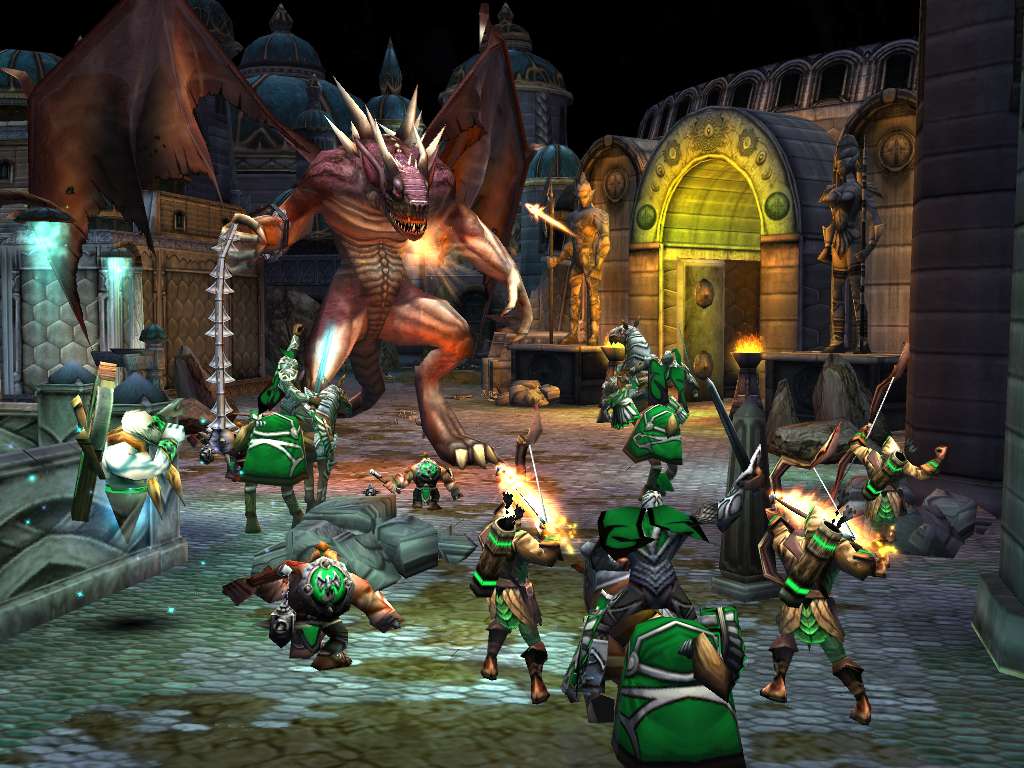
In addition to the setting, Liquid also broke new ground with gameplay elements. While most RTS titles pit you against other factions in titanic battles, Dragonshard offers more than one way to play the game. On the surface of Xen'drik you build a fortress settlement and train up characters referred to as captains. These captains fill different character templates from the Eberron setting (artificers, rogues, ranged warriors, warforged soldiers, etc). Powerful captains attract soldiers which bolster your numbers while campaigning aboveground. There are several unique hero characters you can choose from as well, and these lead your captains in battle against opposing forces. The problem is that the only resource you can gather aboveground are the semi-ubiquitous dragonshards. Like every good adventuring party, you need gold to fund your conquests. In the grand tradition of D&D there is just as much gameplay to be had belowground as above. In the dungeon realm of Khyber, which runs beneath every level's map, monstrous creatures with hordes of loot await your blade's ministrations. By taking your captains belowground you leave the common soldiery behind, reducing the game to a much more traditional dungeoncrawling experience. Defeating these creatures nets you experience, which you can apply to captain types in order to level them up. In a nice circular fashion, leveled captains gain more followers. These soldiers don't count against the maximum number of followers you can control, and above ground your captains lead huge armies against your opponents. As you conquer more of the map above, you'll find new entrances to the Underdark and new opportunities for loot.
The result is a fun combination of traditional Warcraft-like combat and something more akin to Neverwinter Nights. The focus of game's storyline is very RPG, as well. A group of good-aligned warriors united in their worship of the Holy Flame seek three mystic seals which will allow them access to a giant hunk of Dragonshard. The powerful relic has affected the local lizardfolk population, changing them in substantial ways and providing the primary adversary for the Holy Flame's army. Aside from the goals you'll attempt to fulfill in acquiring the seals, quests you receive from characters scattered throughout the map give you opportunities to gain additional power and treasure. Items can affect your Hero's stats, and some quests can even open up new captain types in your base. The experience taken as a whole is very different than your standard cookie-cutter RTS, and the variety of gameplay ensures that if you get bored with one aspect of the game you can indulge in another activity to switch things up.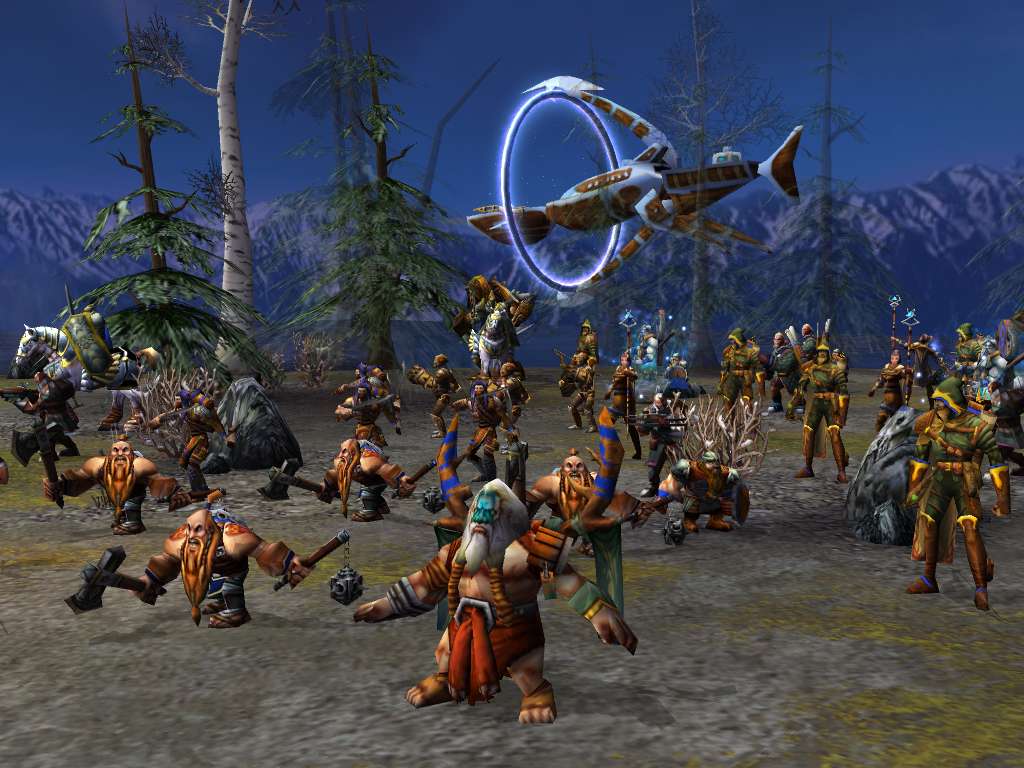
Base building in Dragonshard is fairly unique as well. Bases are laid out into blocks of four squares, with a central citadel and a stout wall surrounding the buildings. Unit-building structures are built on each square. Once their training facility is constructed, captains can be trained and (if you have enough experience) upgraded to level 2. By building another of the same structure type adjacent to the original, you can train units more quickly and upgrade the captain type further. Beyond simply upgrading the captains, there are structures you can build in the square arrangement that will improve the statistics of adjacent unit structures. Placing a mana increase obelisk in an arrangement with priest and sorcerer producing buildings will allow your spellcasters to be more effective in combat. It takes some getting used to, but once you get the hang of putting together a base it's easy to throw one together fairly quickly. After you've ventured into the Underdark enough times to gain some sizeable wealth you'll have a base that resembles a small city, with monuments and buildings nicely blending together.
The visual look of the game is distinct, and quite attractive. Units are highly detailed, with lots of nice touches given to the captains and heroes you'll be leading. One hero has a cross hanging from their armor that swings as she runs, while the angelic Archons wield inner-lit lightning bolts. The lizardfolk are especially intricately designed, with spines and scale flaps all over the place. The world is equally beautifully rendered, with environmental effects aplenty and a deformable terrain adding to the experience of combat in a substantial way. The most dramatic way to see the terrain deformation is the infrequent impacts of dragonshards from above. The first time it happens, it's quite startling to see. The explosions of crystalline shards are heavy enough to knock your troops off of their feet if they hit nearby, and leave collectible shards nestled in impact craters in their wake. The downside to all this pretty is a drag on your rig. While I don't have a cutting edge setup, I can play Half-Life 2 with most of the shinies turned up. Just the same, a screen full of warring armies caused me slowdowns on a couple of occasions. Despite the slowdowns, Dragonshard is a dramatic game. The auditory environment is dramatic as well, with angry cries and clashing blades adding emphasis to the visual devastation. Heroes and captains have unique vocalizations and catch phrases. As with every RTS they get old after the hundredth time you've heard them, but until you get fed up and turn them off you'll enjoy their gusto. There are precious few cinematics in the game, with most plot elements being explored via cutscenes acted out within the engine. While this is a good way to show off the game's graphical power, it can make for some odd moments. Up-close, the running animations of the heroes looks decidedly awkward. Additionally, there are no animations for characters to turn in place. When a hero turns to address one of his fellows, he rotates in place like a cardboard cutout. It's distracting, but the cut-scenes move the plot forward effectively. While some of them skirt the line of hokey gaming patter, for the most part they do a good job of keeping you informed about your goals in the single-player campaign.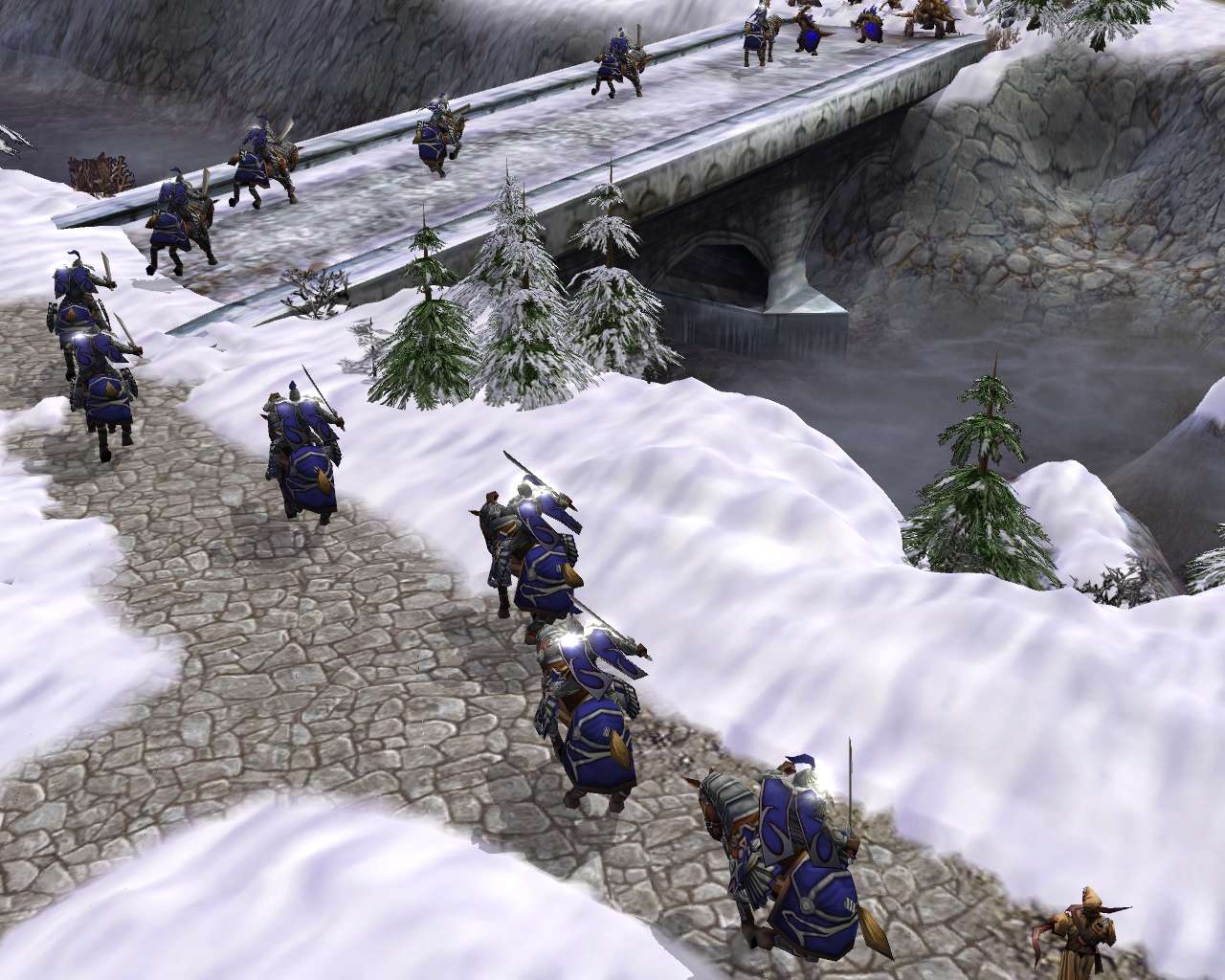
The single-player mission is enjoyable, but re-playability is fairly low due to brevity. Multiplayer is where the game gets an extended life. Whatever reservations I have about the single-player are easily ignored when it comes to online play. The aboveground/Underdark gameplay makes for an even more interesting experience when other adventuring parties are thrown into the mix. In addition to probing the dungeons for treasure and experience, you have to fend off the opposing forces as well. This can be a tricky prospect if you've just put your party through a difficult boss battle. Beyond the basic gameplay, there are additional objectives that you can attempt to gain dominance. A capture-the-flag-like mode has you collecting artifacts before your opponent does, while another gametype requires you to take and hold places of power for a given span of time. Good gameplay is nothing without opponents, and I was very happy to have little problem finding folks to play against via the browser. The only catch is that you have to download a patch straight off in order to get online. A small price to play for the most entertaining way to play the game.
I didn't like this game at first. My knee-jerk reaction to this version of Eberron set me back, and the gameplay didn't jump out at me the way many other games have in the past. It's been a slow year for Real-Time Strategy, but after some time working with Dragonshard it began to grow on me. The base-building has a very different feel to it than your standard model, and the Underdark dungeoncrawling component is the perfect contrast to combat between massive armies. There are still elements that weaken the end result. The single-player game is very short, and confusingly while there are three races in the game there are only two campaigns. The game has occasional slowdowns, and the random Underdark spawn tables can make for overly interesting forays in the Multiplayer game. Overall, though, Dragonshard is well worth taking in if you're a fan of strategy games or the Dungeons and Dragons brand. Eberron is a fascinating setting, and I'm looking forward to seeing it realized more fully in future titles.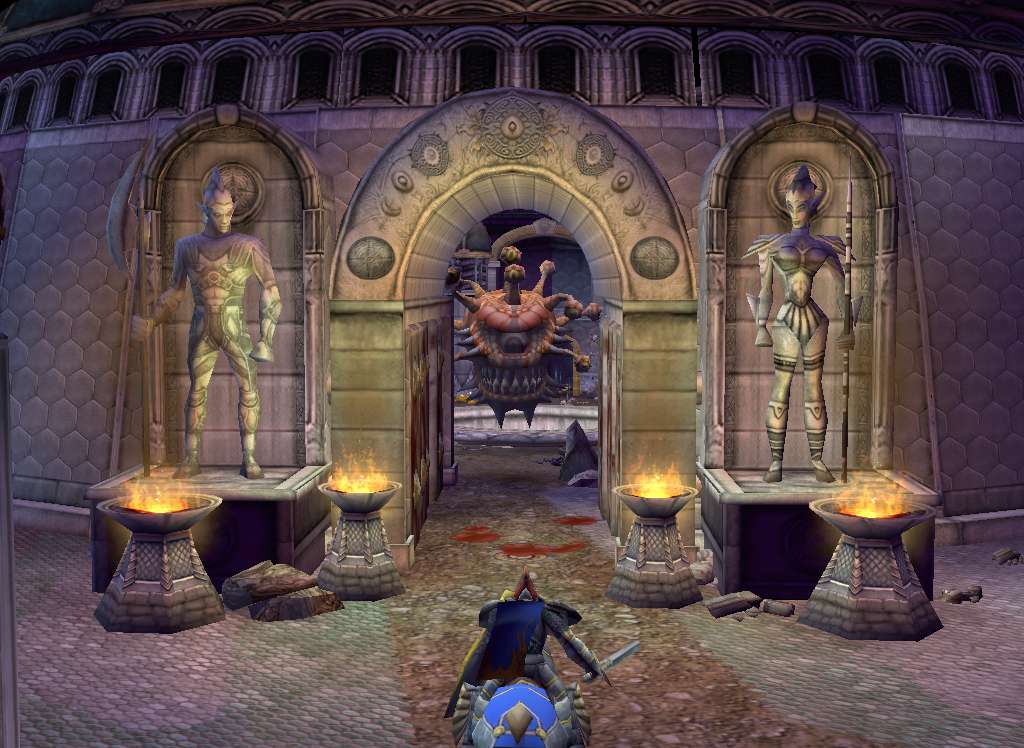
is an engine that can help a DM design thier own world for others to play in. Heck that is what D&D is all about. D&D gave you the books and you developed the world. Sure you could buy a world that the D&D creators fleshed out but I always enjoyed creating my own. If I could just get an AI engine for NPCs and monsters, graphics, and whatever building blocks I need to create my own world. THAT would be cool. Then I could host my world on a dedicated PC off of my high speed internet and control the number of users that come in....
"If you are on fire you can just stop, drop, and roll. If you fall into Lava you are just dead." - my 5yr old daughter
Planescape: Torment and the Baldur's Gate sagas are some of the finest gaming experiences RPG fans can cite.
I haven't played all that many of these games, because I became disenchanted with the whole genre long ago, but I have to ask... do any of these games actually provide any opportunities for role playing? That is, do you as a player have any control over your character's actions beyond those of a "choose your own adventure" book? Oh, sure, you can choose to go on or not go on side-quests, but beyond that the only results of your actions are whether you make it through to the ending, or at the most get one of a couple of different variations to the end.
For a canned game, where the only person involved is yourself, this kind of interactive fiction approach is probably the best you can manage... but even the "massively multiplayer" games seem to give you awfully limited opportunities for developing your own character with his or her own motivations and goals. And, after all, that's what distinguishes the role-playing campaign from the canned dungeon crawl whete the DM may as well BE a computer...
Eberron ain't that great a setting. It's not particularly inspired, and the rules for it don't help it reach its stated goal, which is to create "Cinematic Roleplaying". Wow, ok, I have these "Action Points" that can be used as die bumps. Thats crazy. Wow, the "Extreme Adventurer" gets more of these die bumps. So very cinematic. =P
I think their core concept is that if you publish modules with one or two film noir-esque illustrations in each one, that somehow will make a roleplaying experience cinematic. (And no, it doesn't work.)
For a roleplaying system that actually, really, creates a cinematic feel to it, try out Feng Shui some time. There's a D20 adaptation for it (Google "Burning Shaolin"), but their core system is better. No dis on D&D, I play it a lot, it's just that they really missed the mark on this one.
Inflated reviews? Metacritic.com lists the average rating by the gaming media for this title as 82/100, which is pretty damn close to Zonk's 8/10. If this score is inflated, so are pretty much everyone else's.
Most of the time games like that just make me wish I could delegate more responsability to the AI. Frankly, it should be pretty obvious when you need to cast a power like that, it's unacceptable that I have to do it manually. That's the biggest reason I'm still a fan of Kohan, the AI did all of that stuff for you and let you control the battles from a higher level.
Who wants to be a general when you have to call up each man individually and tell him to throw that grenade already?
I read the internet for the articles.
You are correct. Most games are overrated. If you release a CD in a box, it earns a minimum score of 6 for most sites, regardless of the quality.
82 is an insane score for this game. I was in the beta, and I hated it. I wouldn't have done any further than I went, but I wanted to see the process through. Warcraft 3 is still better, even though it is somewhat dated, now.
Look at some of the real stinker games that came out, and what their metas are.
Then look at who pays most of those websites/magazines whose scores go into the metas, and you have your answer. Most of those websites/magazines are so far in bed with the game developers that they don't give you a reliable review on anything. And the previews are even worse. Every game is a blockbuster "best ever" game until it is released and everyone thinks it sucks. Then it gets shifted to a score of the mid 70s.
Lastly, those metas do not reflect user votes. That is purely magazine reviews. And with only 19 user votes when I checked, most of them didn't have much to say other than "I liked it" and a 10. Typical of most voting areas, it is either all or nothing, with little thought put into a score.
I've played it ... its fun, but nothing greatly different from other RTSes. A few peculiarities to make it interesting for a while, but if you play it a lot I'm sure it boils down to just as much micro as Warcraft III (and similar strategies etc as well). For a few weeks entertainment (depending on how intensively you play - for me with a full-time job a few weeks at least) for someone who likes RTS games in general its worthwhile.
I would ignore the 'first D&D RTS' claims - once you get past appearances its not much closer to D&D than Warcraft. And unfortunately the more magic etc you throw into such a game, the more micro-ing is required (personally I always find games with lots of magic + heroes etc initially attractive, but due to the inevitable micro-ing required for such games I tend to end up playing the more strategic games like Kohan longer). And the dungeons are just an excuse to lean the games towards creeping which inevitably makes the games more of a race.
But I would also ignore the 'another C&C clone' trolls. If its your kind of thing, its worth a play as long as you don't expect too much over existing RTSes. It is definately different, but its not D&D, and if you play any of these RTSes too much they inevitably all boil down to the same thing. Its inherent in the name _real-time_ strategy that time is of the essence, and thus micro etc becomes ever more important once the basic strategy+tricks are understood.
Pause? Hmmm. Homeworld2 (at least) let you do exactly that in single-player missions. In fact, it was suggested in strategy guides. You could still issue commands while paused, which made it much easier to get your fleet(s) into position, then pause every minute or so and re-arrange units as you saw fit, or quickly switch back and forth between targets. However, if you got used to doing this, you were in for a sharp surprise in multiplayer. At least the AI seemed fairly smart. I've played Empire Earth since then, and have been nothing but annoyed at the AI (on my side). They seem incapable of actually just holding their ground, defending each other. My options seem to be: either they take a hit, then chaotically run at the enemy (and get themselves killed), or they hold their ground, but forget to use ranged weapons at approaching enemies and won't defend each other even if close enough to do so, or I can micromanage -- but without the ability to pause, that's pretty much moot.
Delegating to smart AI seems important. These games like to give you both strategic and tactical responsibilities, but with only tactical commands, and only enough time to do strategic things. You can't give broad commands, and you don't have time to use specific ones.