 Slashdot Mirror
"Bookshelf" Computer Wins Design Contest
aibrahim writes "Industrial designers at Purdue University win a competition for next generation computer design sponsored by Microsoft. The design emulates a bookshelf, with hardware components that are "stacked" horizontally around a cube shaped CPU. The design attempts to address hardware issues from a user perspective and is pretty cool despite a focus on DRM."
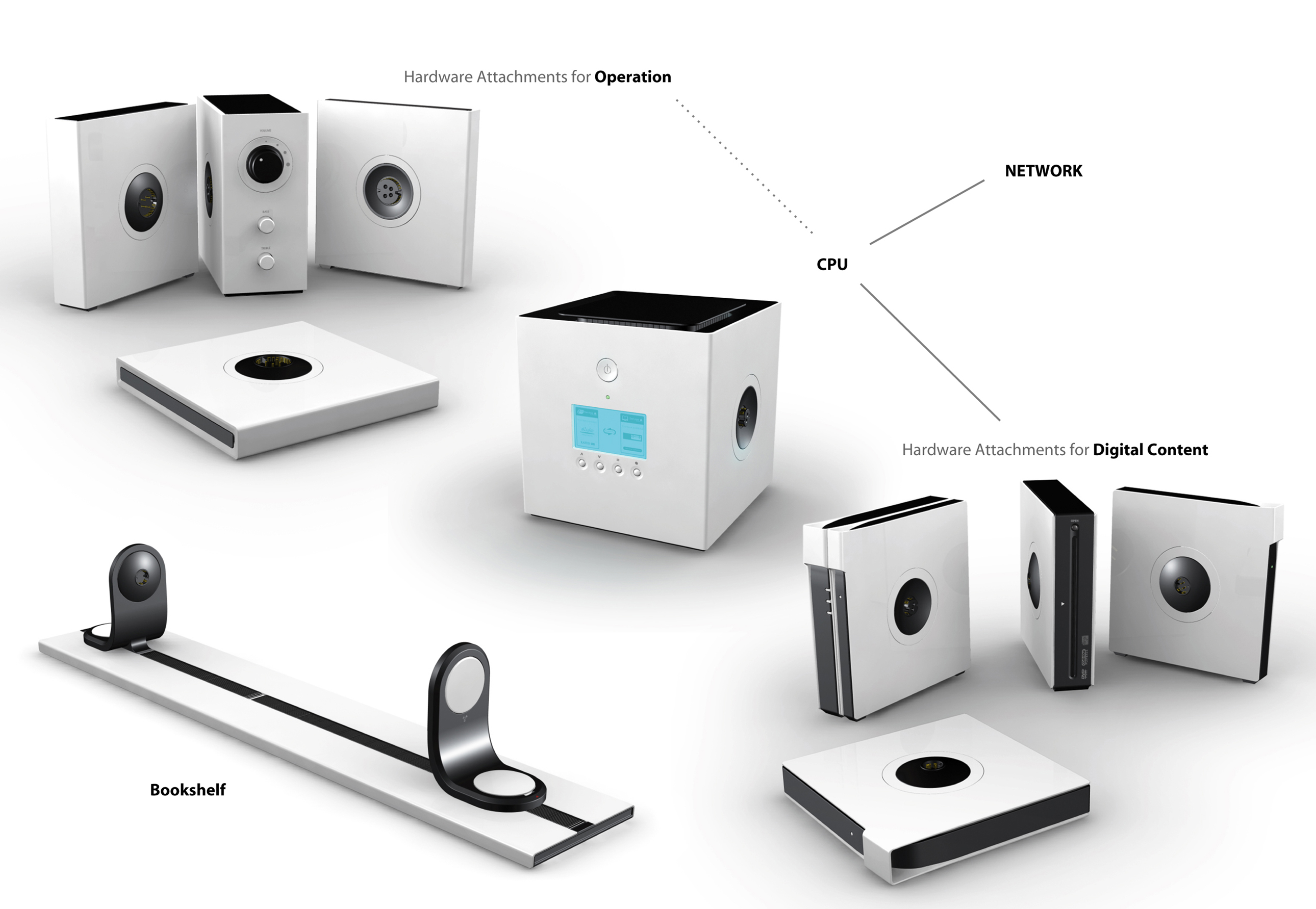
First of all, I'm always curious and a little suspicious when anything is a winner of a competition, "next generation computer design sponsored by Microsoft." My gut reaction to MS sponsored design is that the winner is going to be more about something Microsoft will leverage and much less about what is good for the consumer. Here's why:
Interesting design, but even more constrained in some ways than traditional computers. For my personal taste I much more prefer to put my computer somewhere completely out of sight and not taking up any desktop real estate. I'm not adding and modding so much that I need the "bookshelf metaphor" to accommodate my computing needs.
I'm not even sure I'm convinced this modular design will stem the constant support I give to friends of family when things don't work. Visually it looks simpler for managing a computer, I wonder that vendors would do any better creating truly modular and plug 'n play components for this design.
As for the DRM, from the article:
This new look is essentially a Bang and Olufsen computer -- lots of sizzle, but compared to what really could be done advancing computer design, not much new. If you're into eye-candy, this is for you.
Does function drive design, or should design drive function?? The 'modern' PC appears to be made the way it is for functionality purposes. The internal bus structure is faster than the external buses, so fast stuff goes there such as memory, video cards and disk drives. The external stuff aren't as fast, so long runs of cables are allowed.
I don't want my memory or video card sitting a couple of feet away from the CPU, with signals bouncing across several interconnects. The amount of noise in the system that will have to be overcome will surely result in decreased performance from current designs.
I don't want a computer that is designed around DRM instead of speed. DRM is not being requested by the masses, and results in pissed off customers. I want faster and better, not slower and less function. I want to be able to copy any DVD/CD to my hard drive so I can put my media on a shelf and never touch it again because the media is too fragile. I want to be able to copy it to my car/phone/media player so I can listen to it anywhere without buying more than one copy. Just like being able to carry a book anywhere and read it, I want to be able to take my music or video anywhere and enjoy it.
Any computer or system that doesn't provide the above, and CDs/DVDs that won't run unless used on an approved DRM device will not be purchased by me. Or if accidentally purchased, will be returned.
If they have come up with a fiber interconnect that the average Joe User can manage. Now that would be a great design idea.
I rarely read replies, it's my opinion and if you thought about your opinion a little more, I'm OK with that.
And that's the problem with this kind of design. Signal paths need to be as short as possible and with as few intermediate connections as possible. The design with the smallest possible CPU, short memory and GPU paths, and everything else on point connections using the highest possible serial clock speeds to minimise the actual number of signal lines and so reduce cross channel noise - that's the most efficient design, and with the rise of Firewire, Sata, USB-2, Gigabit Ethernet and optical connections, that's exactly where the industry is going.
Interestingly, this was forecast by Ivor Catt in the 1970s - though he failed to spot that the CPU itself needed to be as integrated as possible, and it is the peripherals that need the high speed serial links. Not surprisingly, given the state of the industry at the time.
Conclusion: looks nice but design actually sucks technically. Too many connectors, enforces a form factor that will often be inconvenient, and the issue is going away for other reasons (USB-2, Firewire, hardware miniaturisation)
Pining for the fjords
wirelss keyboard+"mouse" (or input devices to suit) large screen on wall(or on end of desk), sound output (using purely digital entirely drm compliant connectivity of course) via speakers that are tastfully integrated with the screen/room decor/where they sound best.
The actual computer? with those too difficult to understand cpu's and hard drives and magical wires, net connection? power?
Out of sight out of mind. So who cares what it looks like as long as it fits into the space it got put into.
I like artistry and artistic expression, but for something that needs to be used I chose utility over form, and this is just a set of boxes in "a style" no more or less valid than any other idea of what the correct way to make a personal computer is.
To see a real personal computer of tomorrow look what random folk are doing with mini-itx boards, putting them into all kinds of crazy stuff and making enclosures from scratch or recycling the cases from older devices and achieving something special that suits their needs and tastes. In some of these it really looks like the "out of sight, out of mind" mentality is making the aesthetics of the magic box of wires take second place to something that is simply there to be used, and it's neither pro nor anti drm.
"... eliminates the most common problems - digital copyrights and inconvenient accessibility ..."
How does changing the physical design of the player eliminate the problem of digital copyright?
Oh wait, is it because once the content is downloaded via subscription to those 7" square, 2" thick modules, you can't move the content off of the modules - you have to take the physical thing itself? That'll be real convenient in all the places we already use CDs, DVDs, flash drives and MP3 players.
Besides that, I don't see this as a "personal computer" design. Looks to me more like an audio/video player design.
Web 2.0 == Giant Blogspam Circle Jerk