 Slashdot Mirror
"Bookshelf" Computer Wins Design Contest
aibrahim writes "Industrial designers at Purdue University win a competition for next generation computer design sponsored by Microsoft. The design emulates a bookshelf, with hardware components that are "stacked" horizontally around a cube shaped CPU. The design attempts to address hardware issues from a user perspective and is pretty cool despite a focus on DRM."
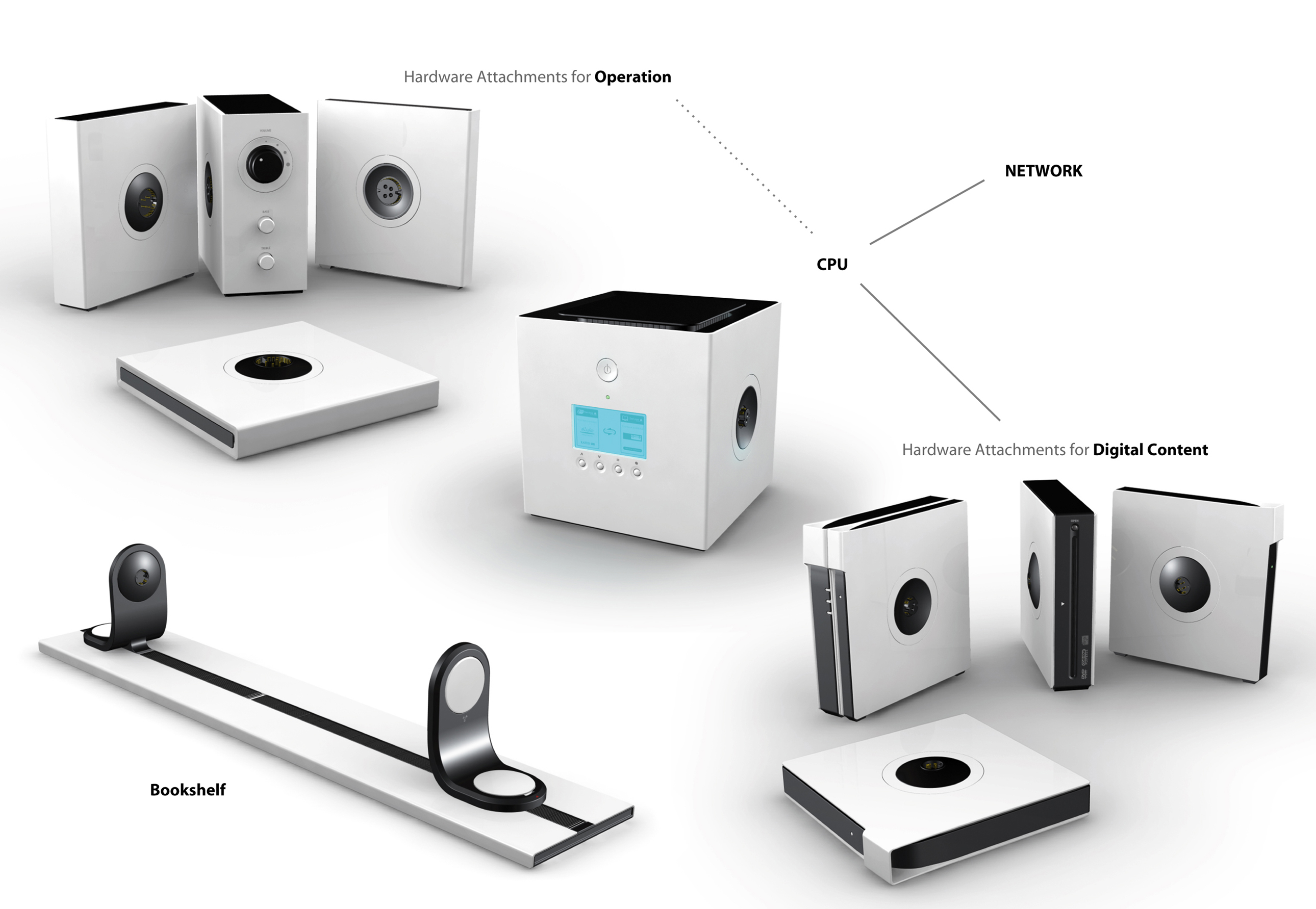
With present machines if you want to add a USB drive, just plug it in. But then where does it physically sit around. On your desk, I guess. If there are many such add-ons it becomes messy. So this design sorta addresses the mess issue.
I'd like to see a standard spec for stacking (verically) components. They can be connected at the back with USB.
What is the greatest issue facing computing today? For the users, it is security, for some vendors, it is the security of their hold on some part of some market. DRM answers the second interest to the detriment of the first. The jury who awarded this prize don't understand this, or they do, and have themselves some interest, therefore are not impartial.
Aside from the chicklet keyboard, it's claim to fame was expansion by stacking cartridges on the side.A little memory here, a printer port there, and you had a few feet sticking off the side.
http://www.oldskool.org/shrines/pcjr_tandy
Sounds like the same thing with a new paint job.
Was done back in the 80s.. I cant remember what company t was now, but i thought it was cool at the time.. Not practical, but a cool idea.
You started wtih a 'CPU block' and added 'extras' like a 'ram block', video, ports..
Now the DRM 'block;, can we not purchase that 'block' ? Id prefer my comptuer to be fully functional and under MY control.
---- Booth was a patriot ----
A guy at work has been talking about how nice a small, non-laptop cube would be which essentially had the equivalent of a docking station. He wanted to easily have one computer at a couple of locations, but doesn't want to be constricted by laptop shortcomings. If they left the CPU completely port free, and relied on those book-things to get a monitor/keyboard/mouse hookup - it'd be pretty cool.
You know what we be cool to put on that bookshelf? An Encyclomedia PC! This is by far the nicest form-following function I've seen home-brewed in a long time. I couldn't resist the chance to plug it.
-- I have fans? Wow.
It looks like a horizontal version of the vertical "Amiga Walker" http://www.blachford.info/computer/walker/walker.h tml
It was never functional as intended, but the top and bottom halves were meant to be separated and expansion modules placed in the middle. Which would make the top and bottom the equivalent to the bookends...
The book The Design of Everyday Things discusses horrible design decisions in appliances, doors, locks, gadgets, computers, and basically anything with a user interface. The book shows how the same mistakes are made over and over by each new designer, issues of user interfaces as simple as buttons and levers, which many engineers know little to nothing about.
In this book, the author repeatedly criticizes designs with the phrase "It probably won an award." He attacks design awards as being given out to aesthetically pleasing or structurally innovative designs, but without sufficient consideration and testing by people who actually have to use the device.
xkcd.com - a webcomic of mathematics, love, and language.
The TI-99 http://oldcomputers.net/ti994a.html was heavily stackable.
No, Apple actually did design the bookshelf computer back in the 80's, and it was an ingenious design (separate processor, drive, graphics, etc modules). Read AppleDesign; it's hard to get but can be found in some libraries. Practically pornography, and will make you weep at the wonderful designs that never made it out of their design shop.
Lies about crimes
I don't disagree on any particular point, but what I found interesting is the notion that people were thinking, or at least trying to think, in a new way about we use our actual PC's.
Not the software- the actual machine. Aside from some of the Mac Mini and Media Center windows machines meant to integrate with the home entertainment centers, this is the most different design I've seen for decades. That is intrinsically interesting.
That says a great deal about the industry, and its lack of innovation. Remember how dumbstruck folk were by the Mac Mini ? Its a laptop without a monitor, keyboard or mouse. That is what is passing for "innovative."
I don't think the Bookshelf concept is a good design though... it seems far too susceptible to failure. The parts have to be snapped together properly and you need that bookshelf to restrain the system. Also, you still have a computer core, the cube, without which the entire system is nonfunctional- and it is undoubtedly the most complex part of the system. The parent is right- its too much looks and too little computer design.
I agree with the parent that we could have much more interesting things done with "advanced computer design." The only "advanced" idea I have right now is a return to passive backplanes, but for consumers. I also want to see more happen with Plan 9, and with computers that are explicitly designed to take advantage of its paradigms.
Don't post innacurate information
If you do, I swear by my pretty floral bonnet I will end you.
There have been numerous designs like that before. The Mac Mini is the lastest example, with stackable components being increasingly available.
They look clean and nice, but they don't catch on. Why? Because they don't make economic sense. A lot of the case material is between components, where it actually impedes heat flow and ventilation. Each of the boxes needs its own fan and power components. And the connector design is tricky and costly, too, compared to internal connectors. Finally, the vendors that the customer can choose from is restricted by such designs; what good is an easily expandable system if my vendor only offers a tiny set of the possible expansions?
Their Shifttricycle is similarly stupid: learning to ride a bicycle is a fairly quick affair, and training wheels already ease the transition; spending a lot of money on a weird, mechanically complex bicycle just doesn't make sense.
I think these people are entirely missing the point of good design: good design combines form with function; they seem to forget about the "function" part.
If you thought the DRM on the grand prize was scary, take a look at this
From the article:
Touchtron is a window to the future of Personal Computers, attuned to innovation at the component level. The Data Storage Unit shall either be located away from the user location or would be on the servers of Application Service Providers (ASP) to which the user shall have subscribed.