 Slashdot Mirror
Review: Animal Crossing and Electroplankton
- Title: Animal Crossing: Wild World
- Developer/Publisher: Nintendo
- System:DS
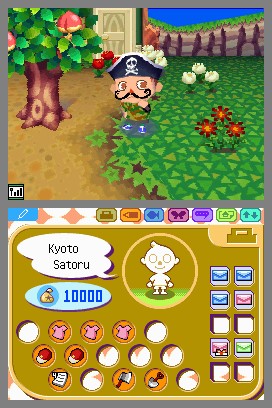
Every player who starts a game of Animal Crossing is actually creating a miniature world. By answering some simple questions on a cab ride into town, you establish your identity and your little avatar's personality. Dropped into the town in front of the establishment of one Tom Nook, you're immersed into a reality that exists just for you. If you asked me to describe to you what you 'do' in Animal Crossing the answer would be something like this: "The player works to get out of debt to real estate tycoon (and raccoon) Tom Nook by performing odd jobs for the town's citizenry." Jobs include fossil hunting, bug catching, and fishing; All of them are accomplished through simple mini-games.
That's what you do, but that simple description belies the reason you'll want to play Animal Crossing. The mortgage hanging over your head is a very kind one. No one will break your kneecaps if you don't spend your every minute working towards a debt-free life. As such, you're free to explore the world you've created. Complete with a 24-hour clock that matches day and night cycles to the real world, Animal Crossing is a place you'll want to visit for a number of reasons.
In my town (Madison), the humorous animal citizenry were a huge draw. Besides the owl running the museum, Polly the Postmaster, and anti-RIAA music-dog K.K. Slider, my neighbors included a big jovial bear, a scatterbrained kitty, and a surly penguin. Each of them had very different personalities, with their own tastes and hobbies. The penguin liked to go bug collecting at night, for example, while the kitty was always camped out by my house with a fishing pole. Even while you consciously understand these are just figments of your handheld console's imagination, you can't help to connect with their goofy avatars. I honestly found myself wanting to make sure they were cared for. We'd send letters back and forth, often giving each other little presents that would help us personalize our homes.
The customization element in Animal Crossing is another draw. You can design T-shirts for your little avatar to wear, collect furniture and ornamental pieces to spruce up your home, and make deals with Tom Nook to expand your floorspace once you''re completely out of room. Shops only sell a given selection of items every day, and so you'll find yourself coming back to the game for short sessions every day. A typical play session will see you hopping on to check Nook's for a piece of furniture, running a quick fossil digging sweep for Blathers the museum owl, and returning some correspondence to a well-wishing neighbor.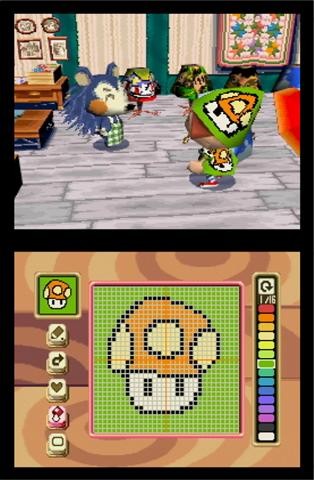
Therein lies the fun. Instead of boxing you in with quests or time tests, Nintendo gives you the chance to live in a fully realized place. The longer you're in a town, the bigger impact you'll make. Fossil turn-ins will improve the museum, chores done for neighbors lead to civic improvements; Play long enough and you'll see some friendly faces move on to other towns and new animal-folks move in to take their place. Via an online component you can even visit the towns of friends, meeting their animal buddies and checking out what they've done for their community. Overall the online element is underwhelming, though. The joy of this game lies in being a member of a tiny, cute, furry community.
Animal Crossing is not for everyone. Even folks who played the original title on the Gamecube may not appreciate the re-envisioned Crossing; the collectable NES games are missing here, for example. If you can get past the seemingly absurd nature of the game, you'll find a kind of calm warmth can be had from participating in this goofy little neighborhood simulation. The portability of the DS makes interacting with your town during a spare twenty minutes an ideal way to play. That bus trip or waiting room interval is just long enough to make a few bells, file a mortgage payment, and send a dirty letter to your next-door neighbor. I loved it. It has everything that the usual gaming experience doesn't offer. Animal Crossing is all about community as a reflection, and in the commitment you make to some tiny animal buddies you may just find out something new about yourself.
- Title: Electroplankton
- Developer/Publisher: Nintendo
- System:DS
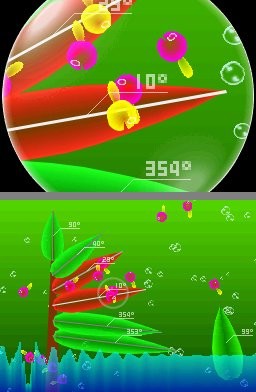
This unique offering from Nintendo is a new way to experience music. There are several different types of music-making tools, referred to as plankton. Each plankton is a type of tiny 'living' creature that makes sounds as it moves about the world. The sounds are greatly varied in nature, and travel the gamut from remarkable recreations of instrument noises to digitized version of sounds that the players makes into the DS microphone. Making music is a matter of manipulating the plankton in new and different ways. The Hanenbow creatures are probably my favorite. They're launched from a small leaf-tube at a plant. The plant itself can be in various shapes, and each of the leaves on the plant can be oriented in 360 degrees of movement. When a Hanenbow plankton strikes a leaf, the chord is not unlike a harp being plucked. When it strikes a leaf, it ricochets off of the surface and (if other leaves are oriented to catch it) can continue to sound notes as it bounces from surface to surface. By orienting leaves appropriately beautiful melodies can be created. The Electroplankton site (flash) has flash movies of the Hanenbow and other planktons, and can give you a better idea of what the experience is like.
Some plankton are more one-trick ponies, but most of them have enough variability that you'll enjoy seeing what sort of musical experience you can get out of them. Playing with the plankton is an oddly soothing experience, as you watch the little guys moving about the DS screen while your musical arrangement echoes from the tiny system. There's something very Zen about the act of composing via plankton, a simple quiet that you don't get with more typical games like Mario Kart or Kirby.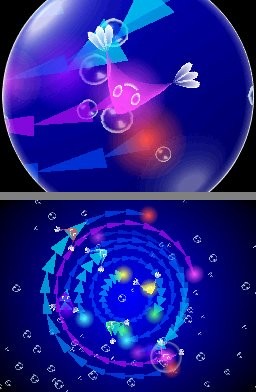
The actual experience of play is something that should be experienced at least once. Younger people, who many never have been able to create their own music before, will be awed by the power the simple tools offer. Older players will appreciate the quality of design and the calm the experience exudes. Frustratingly, that moment of peace will not last forever. As sublime a design as Electroplankton offers, the lack of practicality it shows is infuriating. When you wish to return to real life, plankton-less, you'll be disappointed by an inability to save your compositions. There are no goals, no unlockables, nothing to goad a buyer into playing more of the game. It's absolutely nothing like a game at all, and in the United States that tactic is going to lead to lackluster sales. Without the power to save your work, working with Electroplankton is an entirely transitory act.
For me, my time with Electroplankton was introspective and enjoyable. I enjoyed the opportunity to make music, to experience something on a gaming system that wasn't reward-driven or fast-paced. In truth, I hope we see more experiences like Electroplankton in the future. Burnout is a wonderful game series, but gaming for the quiet moments is a worthwhile endeavor as well. That said, this is not a title I'd want to take on the bus and will not be something I'll be glued to months from now. As therapy or Zen-inducing music experience, Electroplankton is without equal. As a game, the title just goes beyond what I'm looking for in a software purchase.
Probably should also be mentioned that animal crossing supports wi-fi. While the game is great without it, it's really nice to be able to pop and see your friend's towns, and trade items with them. If you have a few friends who play the game, it adds a lot, and makes you keep your town super-tidy :)
Combination - fun iPhone puzzling
ElectroPlankton was by the same guy who wrote "Musical Insects" at the San Franscisco Exploratorium, which got redone by Maxis, called "SimTunes"...
here's a Wired article about the artist and here's a review of the software.
SimTunes was a paintprogram of sorts, except the canvas was transversed by 4 bugs, each could be mapped to a different instrument. Each color then would make the bug play a different note or sound effect, and there were also square modifiers to change the direction or motion of the bug.
It still had a sense of playfulness, you could just focus on making pretty pictures, but could be used as a semi-serious sequencing tool...unlike ElectroPlankton, pretty much any tune could be ported to it, plus there were some interesting tools like limiting the color pallete to a certain scale...
anyway, SimTunes only "kind of" installs these days and runs poorly. I'd love to see a port of it to a game console or better yet as some kind of web app (with a way of SAVING results, unlike Electroplankton...)
SO YOU'RE GOING TO DIE: The Comic for Dealing with Death
For a very simplistic way of saving your compositions to your computer, get a male-male 1/8" audio cable ($3-$4 at your local electronics store). Plug one end into the DS headphone jack and the other into your PC's mic input. Then use a program such as Sound Recorder to capture the audio.
If you connect your headphone jack (stereo) to your mic input (mono, most likely) you'll short out one of your sound channels and possibly blow the DS's audio amplifier. Plus the mic. input is attenuated for microphones, not line-level input, so it'll sound like crap. What you want is the line-in.
Besides which, this method of "saving" compositions doesn't allow things a true save feature would, like re-editing later.
I've only played the WMB download demo of Electroplankton (Beatnes) so I don't know if the full game is also like this - but in that demo any music you input only gets looped like 3-4 times, then it stops. So to create a continuous, full tune you pretty much have to keep inputting more notes. This goes beyond "no save function"/"no later editing" into the realm of the experience being completely momentary.
---GEC
I'm but the humble pupil, seeking to snatch the scratchbuilt pebble from the master's fully articulated hand