 Slashdot Mirror
Dungeons and Dragons Online Impressions
- Title: Dungeons and Dragons Online
- Developer: Turbine Entertainment
- Publisher: Atari
- System:PC

One aspect of the title I know I have a firm grasp on is the setting. Eberron was developed by Keith Baker for a contest held by Wizards of the Coast a few years ago. Since then the pulp action setting for the D&D system has become the company's premier IP. Novels, sourcebooks, comics, and miniatures are all being created with the Eberron world in mind, and Dungeons and Dragons Online is the second work of electronic entertainment to use the setting. You may recall Dragonshard, the D&D RTS title. That too is based in Eberron, but with an (understandably) less immersive look at the setting. DDO delves deep into the backstory of the gameworld. Set in the settlement of Stormreach on the continent of Xen'drik, the game allows you to explore some of the elements that make Eberron unique. The powerful merchant and political factions known as Dragonmarked Houses make an appearance in the game, as benefactors and opponents. Dragons are rare, powerful, and mysterious. While I would have liked to get more of the backstory from the setting's main continent of Khorvaire, there is a definite sense of place in DDO. It's thin, but it's there.
Creating a character is the first of many DDO aspects that reinforce a D&D feel. Attributes are created using the 'point buy' system, allowing a player to build a character to fit a class without relying on random die rolls. If you're uninterested in tweaking a character's skills and attributes, you can simply select a class/race combo and accept the pre-built character the game will provide you. Prebuilt characters all have fairly sane choices made as regards attributes and skills, and if you're not interested in learning the particulars of D&D character creation it's a safe choice to make. All of the D&D iconic classes are available (even poncy bards), along with the typical player races. The Warforged are the stand-out race for the game, living constructs that resemble animated statues. In the game's lore, Warforged were construct troops created for a titanic century-long war. With the war at an end Warforged are emancipated creatures and can fill any role the fleshy races do. While I find them intriguing plot elements, I've heard a lot of player commentary about their inhumanity. It's a fact that the race most often played in a MMOG is 'human', and the unliving nature of the Warforged may make them an unpopular race. Just the same, their inclusion is a powerful reminder of the setting's background. The classes available are typical to what you'd find in most MMOGs; With good reason, as most MMOGs stole their class concepts from D&D in the first place. One class element that might surprise some folks who haven't done table-top gaming before is the role of the cleric. D&D clerics are almost as powerful front-line fighters as your fighter or paladin. They wear heavy armor, kick ass, and take names in the pursuit of their god's goals. Rogues are also fundamentally more useful than in many typical MMOGs. There are plenty of traps in D&D dungeons, and rogues are the only ones who can disable them. Making your character 'feels' very D&D, and sets the stage for your integration into the Eberron setting.
Once you're in the game, you'll find that the D&D setting is the least of the elements setting DDO apart from other MMOGs. Combat is a very different animal than almost any other title in the genre. In a word, DDO combat is realtime. Instead of hitting fight and using abilities as they become available, or simply watching as your avatar filets a bunny, DDO is a click-fest worthy of either Diablo game. Each click is a swing of the sword, and whether you 'hit' or not is determined by your stats. In the corner of the screen you're shown your to-hit roll, which is a random number between 1 and 20 modified by your Strength score. To score a hit, you have to get higher than your opponent's AC, and on a natural 20 you do more damage (a critical hit). In other words, you're going to do a lot of missing. This gets frustrating very very quickly. In fact, it's gets just boring after a while. Tabletop D&D combat is fun because it's abstract, with the blows landing on the screen in your mind. Actually having to sit there and watch the swords swing over and over is more than a little tedious. D&D monsters aren't like the villains of Diablo; They jump around, move out of range, and generally do their best not to get killed. That means that in addition to repeatedly clicking on your opponent you're going to be trying to follow their movements. It's all too dang chaotic to be truly fun.
Besides just poking the baddies, there is actually a good deal of depth to DDO combat. All characters have the option of using some tactics in their fighting. Skills actually play a large part in combat if used correctly. Diplomacy attempts to throw off aggro, making a monster attack someone else. Intimidate is the opposite, encouraging foes to attack your character. Rogues can use the Hide and Move Silently skills to avoid notice, and bypass monsters if need be. If they don't, they can strike from hiding and possible score a sneak attack for massive damage. Rogues can even do sneak attacks in combat by using the Bluff skill to throw an opponent off balance. Magic is more your typical MMOG fare. Wizards, Clerics, etc, have mana points which are used up by spellcasting. Even with that as the base mechanic, the system is very D&D. Spellcasting classes have only a few spell slots, and can only swap out what they have online when resting. Further, arcane spellcasters only know a subset of their available spells and must find or purchase additional spells before they can use them. These elements are all laudable additions to the game, but in reality many combats feel more like a group of individuals doing their own thing than a party effort. Because of the frenetic nature of real-time clicky combat fights are fast and hard to manage. A group comfortable with each other, with voice chat in use, will have a good deal of success. Pick-up groups, though, are at even more of a disadvantage than in most games simply because things happen so fast.
That's what you do in combat. What you're actually *doing* when you play DDO is almost entirely dungeon-crawling. You receive quests from the people of Stormreach, all of whom need help with this or that. Like City of Heroes/Villains, your missions are instanced, meaning that you and your party get to play around with your own copy of the dank basement/decaying sewer/giant ruin that you have to explore. With the missions instanced, DDO dungeons are allowed to do some really interesting stuff. Traps, for example, are deadly challenges that affect the world in real-time. More than just kicking open a chest and being set on fire, razor-sharp blades swing from the ceiling. Splashes of acid fly from spigots in the walls. If you don't have a rogue with you, some traps can be avoided by using your platforming skills to time the gap in a trap's movement. If you do have a rogue handy, the trap mechanisms can be searched out and disabled. The traps are a very cool addition to the genre, but the quests are unfortunately laughable. The thin layer of Eberron that I mentioned above is mostly related through quest text, and what is offered through NPC interaction is cookie cutter and boring. Quests usually have a voice-over, from an intangible Dungeon Master, to spice up your understanding of the situation and evoke the table-top setting. In my opinion, the voice-over doesn't add much. In truth, the storytelling that Everquest 2 and World of Warcraft manage through questing makes the story attempts of DDO look like a student project MOO in comparison.
Besides traps, dungeons are populated with all manner of gross and icky critters. While you start off fighting skeletons, slimes, and kobolds, you eventually graduate to some of the archetypal monsters of the Dungeons and Dragons product line. They're smart, too, with even the dim-witted kobolds doing their best to dance outside the range of your swordarm. You get real satisfaction from slaying enemies in DDO, both because they're a real challenge and because you can stop clicking for a little while. What you don't get is XP. Experience points are only handed out at the end of the mission, when quest objectives are completed. While some missions may have a subquest asking you to slay x number of monsters in the dungeon, each individual kill nets you nothing more than a clear hallway. I'm pretty ambivalent about this design decision. On the one hand, I like that they're emphasizing the quest instead of bashing in a kobold's brains. On the other, I don't feel quite the surge of success for whacking the baddie I might get in another game. Additionally, since the quests are so blah the XP I receive for completing them seems ill-gotten somehow. It's a toss-up, but it mostly feels like they made this decision just to be different.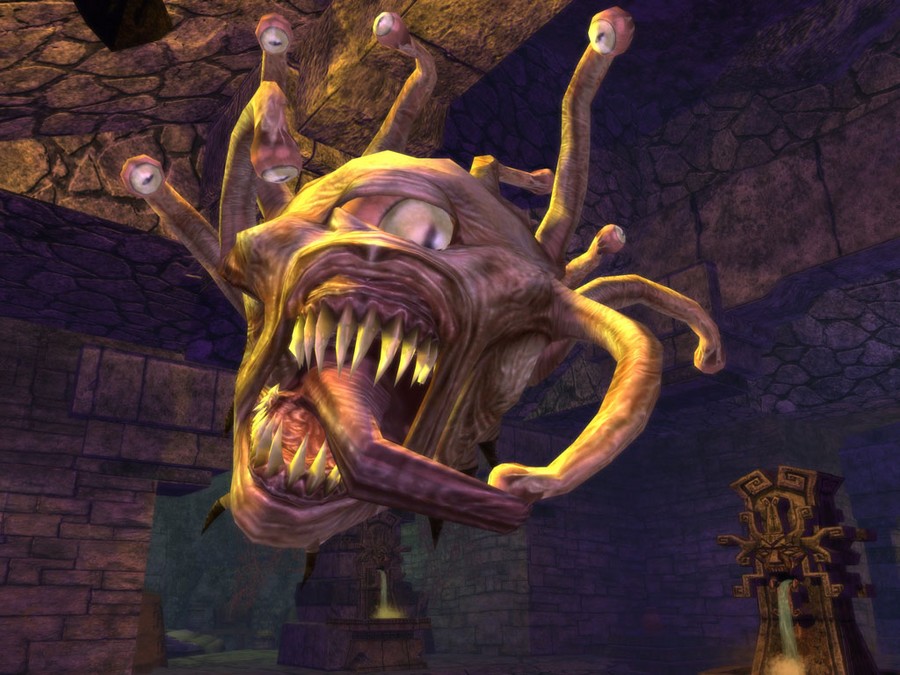
That XP is put towards your next level, as with all MMOGs. There is a difference here, though, in that each level is a very long time coming. You do gain in power on a semi-regular basis, but instead of gaining a level you gain a rank. Each level is broken down into four ranks, waypoints along the road to your next level. Each rank nets you an action point, which can be spent on a character enhancement. Every race/class combo has different enhancements available to it, and all of them increase specific aspects of your character abilities. (+3 to Search, for example.) With every level being a major milestone, it won't come as a surprise that there aren't that many to gain. At the moment DDO only allows you to achieve level 10, rank 4. You can go no higher than that, but there are plans in the works to add level 11-20 content at a future date. For most normal players this will take a while; the much loved experience penalty is enacted if and when you wipe. If you die and other folks are still alive, they can take you to a resurrection shrine in the dungeon to revive you. Rest shrines are usually nearby these areas, allowing characters to regain hit points and mana mid-dungeon. Besides these rest shrines, the only way to heal HP in-dungeon is with a potion or clerical spell. I hate hate hate almost everything about these design decisions. In reverse order: Long downtimes suck. HP and MP not regenning sucks. It is not fun to sit in an inn after a mission is over watching my hp bar creep upwards. You can buy food and drink to improve this rate of regen, but it's nothing like the regeneration you'd see in other modern MMOGs. Experience penalties are evil. Taking away accomplishment from a player is the worst thing you can possibly do. It's not as harsh an experience as you'll get in FFXI, but it's still frustrating to have XP taken away because of something you may not have even had control over. Finally, their decision to ship with only ten levels is a very bad one. I'll expand on why that is below.
You'll note I've usually said 'you' when talking about gameplay, but that's misleading. I should be saying 'you and your party', because in order to play DDO you'll have to be grouped. I'll say that again so you can be clear on this: It is not possible to play Dungeons and Dragons Online solo. The intention, of course, is to evoke the flavour of a table-top session. The publisher has even included voice chat as a built-in feature to the game client to facilitate team communication. The result is a title that you cannot play alone. Some classes, like spellcasters and rogues, will have trouble soloing even the introductory quest when you first get off the boat. Clerics are probably the best soloing class, as they can heal themselves most effectively, but after the first few 'figure out the game' dungeons they're outmatched by the strength of most monsters. I can't really fault them for deciding to go this route, but it's a very harsh line. Even Vanguard, the upcoming hardcore MMO being designed very specifically with grouping in mind, is said to have something like 15% of its content geared for solo players. There isn't even that much for the individual in DDO.
The one thing I can say without prevarication is that Dungeons and Dragons Online looks good. The streets of Stormreach are beautifully laid out, with a style of architecture that really gets across the character of Eberron. A floating inn out over the water is just the tip of the iceberg; DDO has a truly unique look. Character and monster animations are well done, and the soft lighting that pervades the game gives an otherworldly charm to the title. The visual look does more than anything else to establish the character of the dungeons and city streets you'll be exploring. The sound situation has likewise gotten a good deal of attention, but the results there seem merely adequate. Sound effects are competently accomplished, and the musical track highlights game moments without being offensive. There is 'combat music', though, which I'm already tired of. Combat music is fine in a single-player RPG, but FFXI is the only MMOG in which I find that acceptable.
Another website is quoted in a DDO television commercial as offering "A Genuine Online D&D Experience". Whoever it was that came up with that piece of pabulum has never actually played Dungeons and Dragons. Table-top D&D is about storytelling, camaraderie, and having fun with your friends. Somehow in the brave new electronic frontier, these qualities are translated into meaningless grind quests, chaotic click-fest combat, and swearing over voicechat. I'm enormously frustrated by DDO because there is just so much new and interesting going on here. The skill use and traps are real firsts for the genre, providing meaningful player choice in how to navigate a dungeon and how to do combat. These awesome mechanics are sandwiched side by side with other elements that seem more appropriate for launch-day Ultima Online. There are so many contradictions within this game that it's hard to know which is most confusing, but I have a top pick. For those who will like this game, they're going to just eat this thing up. And when I mean eat it up I mean "grind through the game in about a month or two". There were already characters at max level before the game's headstart event had finished out. Whoever did that payed about fifty bucks for ten days or so worth of play. They undoubtedly started a new character, but because of the simple questing structure there's almost no replay value currently in the game. Thankfully not all is doom and gloom. Turbine just announced that they're already planning to add 15 new dungeons and a raid on a dragon's lair in April. That commitment to new content is the going to be the only thing keeping the hardcore around because there is nothing at all available for you once you hit level 10. There is nothing to the endgame yet; It's all still in production.
So, let's review: The game isn't for the hardcore because they'll eat the content too quickly. It's not for the casual gamer because it's impossible to play on your own. Dungeons and Dragons Online is very specifically crafted for folks playing with other people at a non-hardcore pace. And in a way I think that's a good thing. It's good they have a target audience in mind, and if I were planning on adopting DDO as my game of choice that would probably be a good description of me. Just the same, it's a very bold decision to make. Only time will tell for sure, but I have a feeling it's a decision that will come back to haunt them. In the meantime: If you've got a group of regular online gamers you play with, you and your crew should consider giving DDO a try. It's got some interesting new elements that make it stand quite apart from most other Massive games. Don't be surprised if you get bored of it sooner rather than later, but if you and your group are tired of raiding Molten Core for the hundredth time this should keep you out out of Azeroth for a month or two. Hardcore gamers should stick to whatever they're playing now. They'll eat this title for lunch and find themselves frustrated with the lack of endgame content. Casual players should just keep on moving. If you're not willing to commit the time and energy to the constant search for a group, you won't find anything to do here. At the end of the day, DDO is a game with a great deal of promise squandered by some very confusing design decisions. Now go find your DM and give him a hug.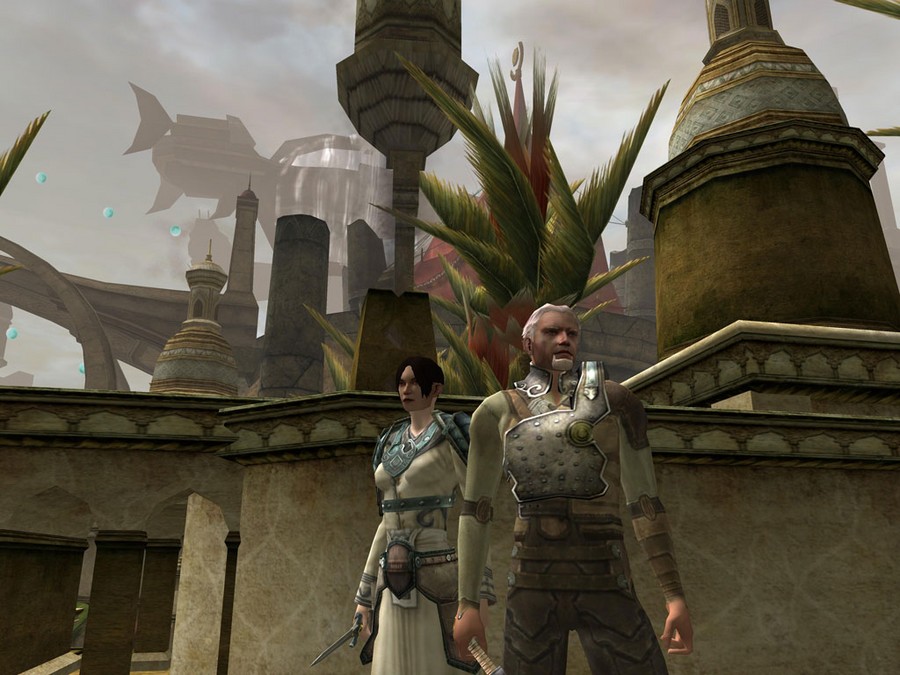
I still play every second week, with the same bunch of people (including a female) that I've been gaming with for about 20 years. Not that it might not be a good game on its own, but I think I'd miss seeing the mischievous look on the DM's face just before he pulls something nasty.
It's also nice having your own mental picture of what's going on, be it accurate or not.
This is the main point IMO that causes this game to fail. Hundreds of people brought it up during beta, and bring it up now, about instanced gaming. The game is fun. But to have to pay monthly for a game with similarities to how Guild Wars is run(with no monthly fee mind you), it is hard to convince myself to get this game. If it was stand alone and didnt have a charge i would probably jump all over it. But this instanced gaming and lack of traveling that is supposed to be "convenient" for gamers ends up making it less of an mmorpg that it already is. If you read the DDO forums you will see this issue brought up time and time again. And the responses are the same flames. But i think its obvious that this is one of the root problems of this title and why it will ultimately be a huge loss for Turbine.
It is not possible to play Dungeons and Dragons Online solo.
Anyone else out there really disappointed by this?
Slashdot Burying Stories About Slashdot Media Owned
So, writing as an "over the hill geek" - my first roleplaying experience was in late 1983, I have a suggestion: put in the effort to find people who want to play!
I started playing D&D 3rd edition again a few years ago with a few friends. At that point, we were all in grad school. Now, I'm a consultant, and most of the rest are lawyers. The game improves as you age. We haven't been in a dungeon in a year, but we've had fantastic debates over deposing the current ruler of an autocratic city-state ("Who will rule when we leave?" "Do we really have the right?"), the morality of killing the few to save the many (or killing the many to save the even more), and the banter between characters and between characters and NPCs is better than that in most fantasy novels. ('Cause, you know, we're older and more mature than we were when we were in high school.)
So: go check out your local gaming store. Or the local grad school. Or ask around among friends and say you're running a D&D game. Get people to come for just one day of gaming. Some of them will turn out to be hardcore and play every week. Our current group of 4-6 people meets every Sunday for about 5 hours. (I haven't missed a week since January, in spite of working 60+ hour weeks).
Some people will drop out, other will try to join, but it's worth the effort to making it work.
Disclaimer: Children will probably kill the whole thing. But until then... swords high!
---sheath
Let's talk about how sissified these new MMOs are compared to the first worthwhile 3d MMO, i.e. EQ. Specifically, let's talk about how these sissified MMOs are less immersive, less social, and less interesting than the grandfathers of the genre (UO,EQ). I'll be addressing EQ in the context of "classic" EQ, i.e. Kunark, Velious, and maybe Luclin.
We'll start with the death penalty. In EQ, when you die, you've just sacrificed somewhere between 10 minutes and 8 hours of your life. You have run back to your corpse to get back your things, and you have to do it *naked*. Sometimes this can take hours-- especially since the place you pop back up is determined by your "bind point", something that can only be set by casting classes and used in specific places. This, according to modern MMO players, sucks. I beg to differ. This kind of pain creates a real attachment to your character-- and to the people around you. To your character because his losses are yours. Your character loses his life, you lose a non negligible amount of time. To other people, because when you get *really* fucked, you need help from others to get your corpse back. Maybe it's not enjoyable by itself, but wheeling and dealing with a shady Necromancer, trying to get him to summon your corpse to a reasonable location at 3:00 AM is undoubtedly immersive experience.
Transportation as well, is a big thing that I loved in EQ and hated in most other MMOs. The goal of transportation isn't *really* to get you from point A to point B-- it's to give you an idea of how big the in game world really is. To that end. In EQ, a ship ride from one continent to another could take the better part of an hour (much of the travel space was populated by crazy content, too). In WoW, the trips are woefully abbreviated. Step on a ship and... Whoop! You're there.
For many people, the hardships of EQ may seem slightly insane-- but consider that in an easy game like WoW, you're getting something for nothing. Accomplishment without a challenge behind it is meaningless, and the feeling of accomplishment in a world populated by your peers is one of the big draws of MMOs. Hardship was *rampant* in EQ-- and you know what? It did kind of suck. It wasn't always enjoyable. But it made feats of daring all the more impressive and thrilling. The lows were lower, yes-- but the highs were much higher. In the end, WoW got my attention for maybe 5 months, as opposed to the 2 years and countless memories EQ gave me. I *know* WoW is more accessable. That's why so many damn people are playing it. But in my opinion, it isn't more *enjoyable*. The illusion of meaningful accomplishment is to central to the way I play MMOs, and WoW has never been able to make my accomplishments feel non-trivial (and please don't tell me about the PvP. I know it's the biggest draw WoW has, and there's some real potential there, but it's a completely different game when viewed from that angle, and I'm talking about PvE content).
To ward off the Off-Topic police, please note the D&D Online appears to be another of these easy, quick-to-beat, unsatisfying games. Most likely it won't be successful for these reasons.