 Slashdot Mirror
Living In Oblivion
The Elder Scrolls series is well known among PC gamers as the high water mark for an open-ended RPG experience. The series, set in the world of Tamriel, has a staggering breadth and depth thanks to the exacting standards of the team at Bethesda Softworks. The newest title in the line brings Tamriel to life in a manner that is renewing the faith of even the most jaded CRPG player. Elder Scrolls IV: Oblivion may not be the perfect game for everyone. For those willing to give it a shot, Oblivion treats gamers with a level of respect that is unique, uplifting, and (hopefully) inspirational for game developers in all genres. Read on for my impressions of a truly unique game.
This latter category of CRPG is, regrettably, on the wane. The type of gamer who enjoys this genre has been drawn away by the promise of multiplayer interaction, either in MUDS or MOOs or in their more graphically advanced MMORPG offspring. Since the days of Baldur's Gate and Planescape: Torment fewer and fewer of these non-linear titles, with an emphasis on creating an actual role to play, have been lining shelves. The grandaddy of this genre is the previous chapter in the Elder Scrolls saga. Morrowind let you loose on an island nation with little more than a race, astrological symbol, and some skills. Once you were in the game there wasn't a single constraint on your actions. An advanced world editor ensured that a player who tired of the hundreds of hours of potential gameplay in the shipped title could download content from his fellow gamers. From the smallest item all the way to entire additional continents, this content has kept dedicated players busy since the game's launch in 2002.
These players can move on, finally, as Oblivion steps ably into its older brother's very big shoes. The level of polish this game displays is such that it is hard not to wander into hyperbole when describing what they got right. In point of fact, it's hard to nail down something they got wrong when keeping the genre as a whole in mind. There are, however, some big obstacles to enjoying the game. The most daunting can be a simple question of technology. A lot of game impressions seem to be based on the Xbox 360 version of the title, and for good reason. The 'recommended specs' on the side of the PC box could make anyone pause. A three gig processor, at least a gig of memory, and (if you're using Nvidia as your yardstick) a 6800 or better graphics card are what they suggest. I'll be honest, I don't reach the recommended specs. I've got a 2 gig processor and a 6600 card. Anticipating the game, I did upgrade to 2 gigs of memory as a stopgap measure, and I really noticed that purchase in the lightning-fast load times. Graphically, though, I know I'm not seeing the full experience. Unless you have a high-end rig, you're probably going to want to go with the 360 version. I'm told it has noticeable load times and some occasional control frustrations, but if your computer can't handle the title at least you can play the game.
The second roadblock potential players might encounter is one of the game's biggest strengths: the open-ended gameplay. Once you've finished the tutorial dungeon you're let loose with absolutely no strings attached. Tamriel is your world to explore, and you can do it however you wish. There is about 100x more direction in Oblivion than there was in Morrowind, and various gameplay elements make it much easier to get where you're going and know what you're doing. Just the same, if you like having a clear goal the freedom of Oblivon may throw you. The entrants in the Final Fantasy series look like barely interactive movies in comparison.
Finally, an aspect of the title that's throwing even dedicated players may prove to be the final straw for folks new to the series. There's no other way to say it: Oblivion is harsh. With freedom comes consequences, and for a certain kind of player Elder Scrolls IV may be a very frustrating experience. The best example of this philosophy is in character creation. It's entirely possible to create a useless character if you make the wrong choices. They give you an array of pre-generated character roles to choose from, and it's hard to go completely wrong if you pick one of those. If you so choose, however, you can roll your own class. If you really want to, you can set off into Tamriel with little or no experience in wielding a weapon. Oblivion is far more than your usual hack-and-slash, but there is still a lot of combat in the game, and such a character will probably have a very hard time of it. That combat, too, can be brutally unforgiving. Enemies throughout the land scale as you gain in strength, so the hope is that you won't ever come up against an opponent that's completely out of your league. Within your 'league', though, you can come up against enemies that are almost impossible to defeat. That can depend on the character just as much as the enemies involved, and either way the game isn't going to sit there and hold your hand.
With those caveats out of the way, I'll engage in just a little bit of hyperbole. Oblivion is the most engaging RPG I have ever played. It captures the essence of what makes tabletop roleplaying so enjoyable, and allows you as the player access to a sprawling and beautifully realized world of possibilities.
From the first moment you enter the world, the occupant of a dank jail cell, you'll be struck by the depth of the experience. A fellow prisoner makes rude comments to you from across the hallway, and the guards which appear at your door make no bones about their willingness to kill you. They're there guarding the emperor, who is fleeing an assassination attempt. Your tutorial for the game has you following the emperor (voiced by Patrick Stewart), and exploring a small cave system beneath the Imperial prison. Game elements are well explained, with numerous opportunities to practice combat tactics, stealth, and spellcasting. By the time you leave the cavern, you'll have chosen your race and class and borne witness to the death of the empire's leader. Blinking in the sudden light, on a grass-covered hill outside the Prison walls, you have a quest in your journal and a million options open before you.
This sense of freedom is Oblivion's most engaging quality. While the emperor asked with his dying breath that you travel to a Priory in the north and find his illegitimate son, you are under no obligation to do so. Ever. There is enough to do in the world of Tamriel that if you so choose you can spend the rest of your play experience happily ignoring the looming threat implied by the main quest. The main quest is well-written, and if you follow through with the line's goals you'll be rewarded through fame and fortune. Unlike other titles with the implication of 'freedom', Oblivion really does offer far more than just the central script. Just walking down a street in one of the many cities of the empire will allow you to overhear the possibility of adventure. The Non-Player Characters (NPCs) of Oblivion are wonderfully written, and all have their own very specific needs. Their AI puts them through a normal routine every in-game day, and causes the characters to interact in very realistic ways. While a peasant's normal day might involve working in a farm outside the city, stopping at a tavern for a meal, and then heading home for bed, it's possible that could be disrupted by the actions of another character. If it is, you can bet that there's a quest waiting for you.
This level of depth is supported by the game's many conveniences. The number of quests the citizens of Tamriel will throw your way would make it impossible to handle if you didn't have a good level of support. The game offers a featureful quest journal, which not only shows what quests you're on, but quests that you've completed and prior steps to ongoing quests. Quest goals are clearly marked on your world map, ensuring that even if you are unsure of what exactly to do you can always know where you're supposed to go. The game features a 'fast travel' system that can take some of the tedium of overland riding out of the game. If you do choose to travel overland, you'll encounter new adventure locales and opportunities for questing, but the option of moving quickly from place to place is really nice.
What you actually do on quest is extremely varied. While there are some quests that fit into the usual 'kill the x for me' or 'deliver this to so-and-so', a surprising number of them substantially differ from the norm. There are diplomatic missions, like the request from the invisible people of Aleswell. An entire village turned translucent by a thoughtless wizard wants you to go talk him into turning them back. The Thieves Guild quests primarily revolve around entering private areas and coming away clean with an item or items. One involved quest line I explored had me following around a merchant, who turned out to be purchasing his wares from a graverobber. While the quest line did end in a confrontation with the scoundrel, there was far more to the quest than simply 'go here and kill the bad guy'. Quests in Oblivion are deeply satisfying in a way that many RPGs (especially MMOGs) can't even approach.
All that said, if you're not in the mood for considered action there's always monster hunting to lighten the mood. Ruins are scattered liberally across the empire, and exploring them will lead you into numerous combat situations. Combat in Oblivion shares the same first-person melee setup that Morrowind used. You hack and slash at your foes from behind your character's eyes, resulting in an immediacy to combat that raises the blood pressure quite effectively. There are several ways to fight, each with its own distinct 'feel'. Melee combat has a great kinesthetic feel, with your character swaying and moving in time to the action. Slashing your weapon across your field of view is enormously satisfying, and creatures bleed profusely when poked. Melee skills have been simplified a great deal, with 'Blade', 'Blunt', and 'Hand-to-Hand' constituting the three main options you have in this field. If ranged combat is your preference, 'Marksman' is the skill you'll want. Drawing an arrow on a bow conveys a real sense of power, and the whistling sound that accompanies a flying projectile imparts your shots with a deadly beauty. Ranged combat is most useful, I've found, to use when stealthing. Entering 'stealth' mode allows you to move quietly and unseen through the halls of the dungeon. If you can get off a shot with your bow or blade while remaining undetected, your initial blow will do far more damage. You'll be doing a lot of combat throughout your adventuring career, so the fact that they just nailed the feel of chaotic encounters makes it hard to get bored while exploring the depths.
Every system, in fact, has the mark of quality stamped upon it. Magic is just as engaging as the combat elements, with different schools covering a wide variety of spell effects. Spells are broken out into separate schools, which don't directly tie together. You can choose, for example, to improve your ability to cast healing spells and ignore other spellcasting elements. If you want to broaden your scope, the different schools can be used in synergy to create excellent effects. Magic schools, sneaking, bladework, and shield blocking are all covered by skills which improve as you use them. 'Leveling up' occurs when you've crossed a certain threshold of skills points acquired. Your increase in power (both via level and skill increase) is visible and enjoyable, with benefits to your prowess in battle immediately apparent during gameplay. There are also non-combat skills, which are just as well thought out as the more violent sort. Lockpicking and Speechcraft are mini-games, and both allow access to secrets you might not otherwise ever see. You can repair your armor or brew potions, as you'd like. You can leap from rooftop to rooftop to improve your Acrobatics, and haggle with merchants to improve Mercantile. The tapestry of skills works so well because not only do they hang well separately, they mesh together into a cohesive whole. Your character, as your window into Tamriel, manages to be just as interesting as the NPCs around you. You can actually find that you surprise yourself with what you can do, a truly rare treat for any game.
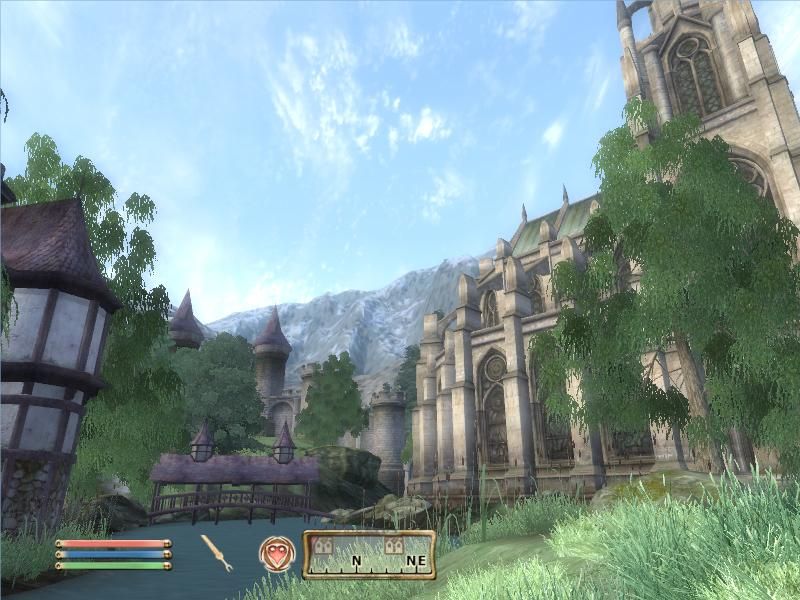
All of these well-crafted systems would be fun even if the game only looked 'okay.' What makes Oblivion so easy to lose yourself in, though, is the visual quality and audio presence the designers have lovingly applied to the entire experience. NPCs look at you with expressive eyes and delicate features. Enemy creatures attack with movement appropriate to their style of combat, and light winds stir the grasses around you while you sit and stare up at the beautiful sky. Tamriel is a gorgeous world, and the visual experience completes the powerful force pulling you into the gameworld. There are a lot of 'wow' moments, but what I enjoyed most about the graphical presentation is that after a time you just stop noticing it. Everything looks just right, and makes it easy to slip into your alternate persona.
There's just so much right about this game, it makes me actually a little sad. The strong statements made by the developers are entirely admirable: a harsh and open world where the player is empowered. Those same statements will put off a lot of gamers because we are just not taught to expect much of ourselves when we game. The power, beauty, and depth of this gameworld should be experienced by as many people as possible, and because of the bad lessons taught by other games there are a lot of people that are going to say 'that's not for me'. Oblivion is a game that forces you to make decisions with real consequences, a game that plays out those consequences on the world, and teaches you as the player to think fast and play for keeps. It's real life, packaged into a fantasy format and with a handy quest journal that I constantly find myself missing as I do chores around the house. It does what other games are afraid to do: it respects you. The finest compliment for a game that allows you to fill a role is to find yourself actually believing the role, and Bethesda has given you every tool you need to go off and be your very own hero. In an escapist niche of an escapist hobby, there's not much more you can ask for than that.
- Title: Elder Scrolls IV: Oblivion
- Developer: Bethesda Softworks
- Publisher: 2K
- System:PC (360)
This latter category of CRPG is, regrettably, on the wane. The type of gamer who enjoys this genre has been drawn away by the promise of multiplayer interaction, either in MUDS or MOOs or in their more graphically advanced MMORPG offspring. Since the days of Baldur's Gate and Planescape: Torment fewer and fewer of these non-linear titles, with an emphasis on creating an actual role to play, have been lining shelves. The grandaddy of this genre is the previous chapter in the Elder Scrolls saga. Morrowind let you loose on an island nation with little more than a race, astrological symbol, and some skills. Once you were in the game there wasn't a single constraint on your actions. An advanced world editor ensured that a player who tired of the hundreds of hours of potential gameplay in the shipped title could download content from his fellow gamers. From the smallest item all the way to entire additional continents, this content has kept dedicated players busy since the game's launch in 2002.
These players can move on, finally, as Oblivion steps ably into its older brother's very big shoes. The level of polish this game displays is such that it is hard not to wander into hyperbole when describing what they got right. In point of fact, it's hard to nail down something they got wrong when keeping the genre as a whole in mind. There are, however, some big obstacles to enjoying the game. The most daunting can be a simple question of technology. A lot of game impressions seem to be based on the Xbox 360 version of the title, and for good reason. The 'recommended specs' on the side of the PC box could make anyone pause. A three gig processor, at least a gig of memory, and (if you're using Nvidia as your yardstick) a 6800 or better graphics card are what they suggest. I'll be honest, I don't reach the recommended specs. I've got a 2 gig processor and a 6600 card. Anticipating the game, I did upgrade to 2 gigs of memory as a stopgap measure, and I really noticed that purchase in the lightning-fast load times. Graphically, though, I know I'm not seeing the full experience. Unless you have a high-end rig, you're probably going to want to go with the 360 version. I'm told it has noticeable load times and some occasional control frustrations, but if your computer can't handle the title at least you can play the game.
The second roadblock potential players might encounter is one of the game's biggest strengths: the open-ended gameplay. Once you've finished the tutorial dungeon you're let loose with absolutely no strings attached. Tamriel is your world to explore, and you can do it however you wish. There is about 100x more direction in Oblivion than there was in Morrowind, and various gameplay elements make it much easier to get where you're going and know what you're doing. Just the same, if you like having a clear goal the freedom of Oblivon may throw you. The entrants in the Final Fantasy series look like barely interactive movies in comparison.
Finally, an aspect of the title that's throwing even dedicated players may prove to be the final straw for folks new to the series. There's no other way to say it: Oblivion is harsh. With freedom comes consequences, and for a certain kind of player Elder Scrolls IV may be a very frustrating experience. The best example of this philosophy is in character creation. It's entirely possible to create a useless character if you make the wrong choices. They give you an array of pre-generated character roles to choose from, and it's hard to go completely wrong if you pick one of those. If you so choose, however, you can roll your own class. If you really want to, you can set off into Tamriel with little or no experience in wielding a weapon. Oblivion is far more than your usual hack-and-slash, but there is still a lot of combat in the game, and such a character will probably have a very hard time of it. That combat, too, can be brutally unforgiving. Enemies throughout the land scale as you gain in strength, so the hope is that you won't ever come up against an opponent that's completely out of your league. Within your 'league', though, you can come up against enemies that are almost impossible to defeat. That can depend on the character just as much as the enemies involved, and either way the game isn't going to sit there and hold your hand.
With those caveats out of the way, I'll engage in just a little bit of hyperbole. Oblivion is the most engaging RPG I have ever played. It captures the essence of what makes tabletop roleplaying so enjoyable, and allows you as the player access to a sprawling and beautifully realized world of possibilities.
From the first moment you enter the world, the occupant of a dank jail cell, you'll be struck by the depth of the experience. A fellow prisoner makes rude comments to you from across the hallway, and the guards which appear at your door make no bones about their willingness to kill you. They're there guarding the emperor, who is fleeing an assassination attempt. Your tutorial for the game has you following the emperor (voiced by Patrick Stewart), and exploring a small cave system beneath the Imperial prison. Game elements are well explained, with numerous opportunities to practice combat tactics, stealth, and spellcasting. By the time you leave the cavern, you'll have chosen your race and class and borne witness to the death of the empire's leader. Blinking in the sudden light, on a grass-covered hill outside the Prison walls, you have a quest in your journal and a million options open before you.

This sense of freedom is Oblivion's most engaging quality. While the emperor asked with his dying breath that you travel to a Priory in the north and find his illegitimate son, you are under no obligation to do so. Ever. There is enough to do in the world of Tamriel that if you so choose you can spend the rest of your play experience happily ignoring the looming threat implied by the main quest. The main quest is well-written, and if you follow through with the line's goals you'll be rewarded through fame and fortune. Unlike other titles with the implication of 'freedom', Oblivion really does offer far more than just the central script. Just walking down a street in one of the many cities of the empire will allow you to overhear the possibility of adventure. The Non-Player Characters (NPCs) of Oblivion are wonderfully written, and all have their own very specific needs. Their AI puts them through a normal routine every in-game day, and causes the characters to interact in very realistic ways. While a peasant's normal day might involve working in a farm outside the city, stopping at a tavern for a meal, and then heading home for bed, it's possible that could be disrupted by the actions of another character. If it is, you can bet that there's a quest waiting for you.
This level of depth is supported by the game's many conveniences. The number of quests the citizens of Tamriel will throw your way would make it impossible to handle if you didn't have a good level of support. The game offers a featureful quest journal, which not only shows what quests you're on, but quests that you've completed and prior steps to ongoing quests. Quest goals are clearly marked on your world map, ensuring that even if you are unsure of what exactly to do you can always know where you're supposed to go. The game features a 'fast travel' system that can take some of the tedium of overland riding out of the game. If you do choose to travel overland, you'll encounter new adventure locales and opportunities for questing, but the option of moving quickly from place to place is really nice.
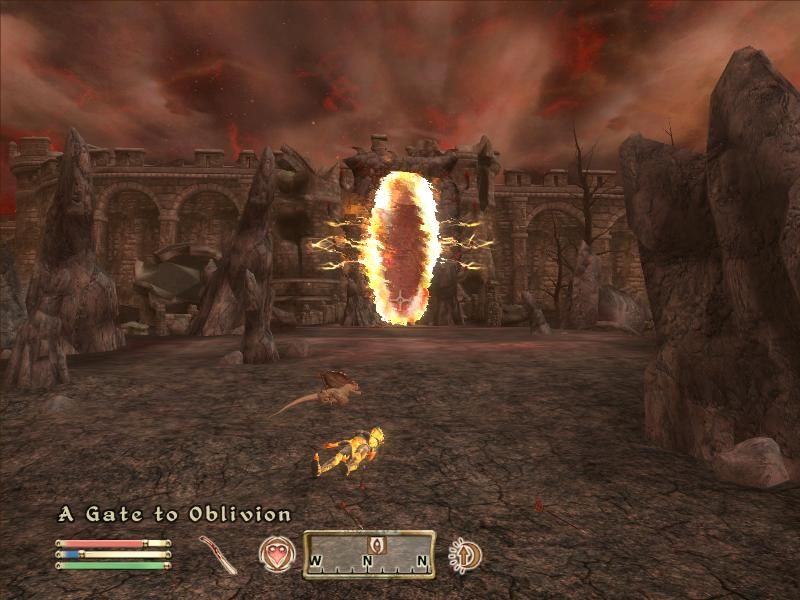
What you actually do on quest is extremely varied. While there are some quests that fit into the usual 'kill the x for me' or 'deliver this to so-and-so', a surprising number of them substantially differ from the norm. There are diplomatic missions, like the request from the invisible people of Aleswell. An entire village turned translucent by a thoughtless wizard wants you to go talk him into turning them back. The Thieves Guild quests primarily revolve around entering private areas and coming away clean with an item or items. One involved quest line I explored had me following around a merchant, who turned out to be purchasing his wares from a graverobber. While the quest line did end in a confrontation with the scoundrel, there was far more to the quest than simply 'go here and kill the bad guy'. Quests in Oblivion are deeply satisfying in a way that many RPGs (especially MMOGs) can't even approach.
All that said, if you're not in the mood for considered action there's always monster hunting to lighten the mood. Ruins are scattered liberally across the empire, and exploring them will lead you into numerous combat situations. Combat in Oblivion shares the same first-person melee setup that Morrowind used. You hack and slash at your foes from behind your character's eyes, resulting in an immediacy to combat that raises the blood pressure quite effectively. There are several ways to fight, each with its own distinct 'feel'. Melee combat has a great kinesthetic feel, with your character swaying and moving in time to the action. Slashing your weapon across your field of view is enormously satisfying, and creatures bleed profusely when poked. Melee skills have been simplified a great deal, with 'Blade', 'Blunt', and 'Hand-to-Hand' constituting the three main options you have in this field. If ranged combat is your preference, 'Marksman' is the skill you'll want. Drawing an arrow on a bow conveys a real sense of power, and the whistling sound that accompanies a flying projectile imparts your shots with a deadly beauty. Ranged combat is most useful, I've found, to use when stealthing. Entering 'stealth' mode allows you to move quietly and unseen through the halls of the dungeon. If you can get off a shot with your bow or blade while remaining undetected, your initial blow will do far more damage. You'll be doing a lot of combat throughout your adventuring career, so the fact that they just nailed the feel of chaotic encounters makes it hard to get bored while exploring the depths.
Every system, in fact, has the mark of quality stamped upon it. Magic is just as engaging as the combat elements, with different schools covering a wide variety of spell effects. Spells are broken out into separate schools, which don't directly tie together. You can choose, for example, to improve your ability to cast healing spells and ignore other spellcasting elements. If you want to broaden your scope, the different schools can be used in synergy to create excellent effects. Magic schools, sneaking, bladework, and shield blocking are all covered by skills which improve as you use them. 'Leveling up' occurs when you've crossed a certain threshold of skills points acquired. Your increase in power (both via level and skill increase) is visible and enjoyable, with benefits to your prowess in battle immediately apparent during gameplay. There are also non-combat skills, which are just as well thought out as the more violent sort. Lockpicking and Speechcraft are mini-games, and both allow access to secrets you might not otherwise ever see. You can repair your armor or brew potions, as you'd like. You can leap from rooftop to rooftop to improve your Acrobatics, and haggle with merchants to improve Mercantile. The tapestry of skills works so well because not only do they hang well separately, they mesh together into a cohesive whole. Your character, as your window into Tamriel, manages to be just as interesting as the NPCs around you. You can actually find that you surprise yourself with what you can do, a truly rare treat for any game.
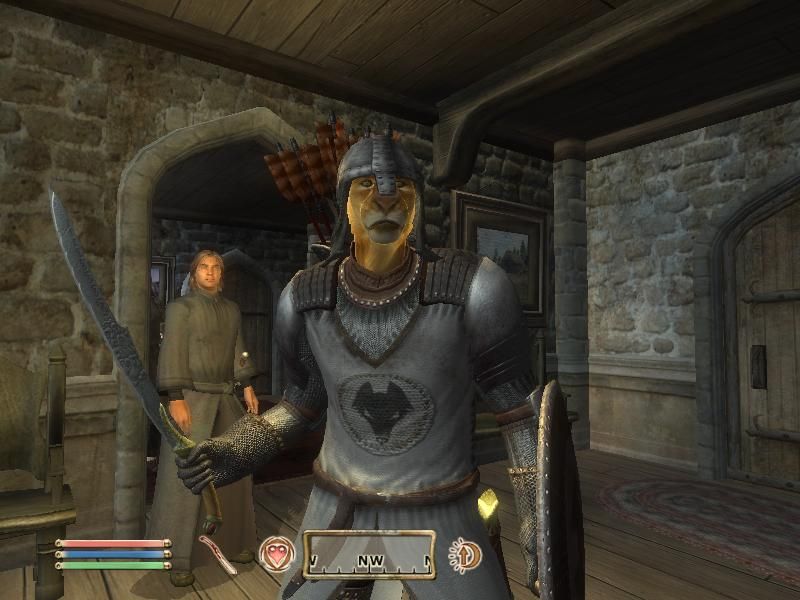
All of these well-crafted systems would be fun even if the game only looked 'okay.' What makes Oblivion so easy to lose yourself in, though, is the visual quality and audio presence the designers have lovingly applied to the entire experience. NPCs look at you with expressive eyes and delicate features. Enemy creatures attack with movement appropriate to their style of combat, and light winds stir the grasses around you while you sit and stare up at the beautiful sky. Tamriel is a gorgeous world, and the visual experience completes the powerful force pulling you into the gameworld. There are a lot of 'wow' moments, but what I enjoyed most about the graphical presentation is that after a time you just stop noticing it. Everything looks just right, and makes it easy to slip into your alternate persona.
There's just so much right about this game, it makes me actually a little sad. The strong statements made by the developers are entirely admirable: a harsh and open world where the player is empowered. Those same statements will put off a lot of gamers because we are just not taught to expect much of ourselves when we game. The power, beauty, and depth of this gameworld should be experienced by as many people as possible, and because of the bad lessons taught by other games there are a lot of people that are going to say 'that's not for me'. Oblivion is a game that forces you to make decisions with real consequences, a game that plays out those consequences on the world, and teaches you as the player to think fast and play for keeps. It's real life, packaged into a fantasy format and with a handy quest journal that I constantly find myself missing as I do chores around the house. It does what other games are afraid to do: it respects you. The finest compliment for a game that allows you to fill a role is to find yourself actually believing the role, and Bethesda has given you every tool you need to go off and be your very own hero. In an escapist niche of an escapist hobby, there's not much more you can ask for than that.
A truly great game. I've been playing an awful lot since it came out a few days ago. I think the reviewer was spot on when he said that the player is given respect in the game. Theres no other way to describe it.
Oh, and this wouldn't be a game review without some tips!
Go find Dorian's house in the Tolas district of Imperial City. Kill him, and you can take an unlimited supply of money off of him. As much as your willing to take at 8gp per button press.
Big ones, small ones, some as big as yer 'ead!
Give 'em a twist, a flick o' the wrist...
Before buying the game, see if there is a demo available. Right now the game has a decent amount of bugs, and it has problems running on alot of systems, including xbox360s. Some people with cutting edge hardware are having low fps issues whilesome people with lower end video cards are running fine. The xbox360 is having harddrive cache problems, ruining saved games, while alot of people on PCs are crashing to desktop.
f 99cc632d35dd16ee09edf8a56b38a&showforum=23
I'm enjoying the game, but it is frustrating. however, I would advise others to wait for a patch, unless you can't restrain yourselves.
Here is the technical board for those interested:
http://www.elderscrolls.com/forums/index.php?s=9d
Before you buy, check the forums(which are completely negative with people convined no one ever, anywhere, has gotten the game to work, ignore thoses posts). Look for stuff on your video card. What runs Doom3 in High may only run Oblivion on Low, and what runs Doom3 on med may not even run it(or it may). My ATI 9800 Pro was nothing to it, barely ran, slowly, and very low framerate. I should have bought a 360 and the game on 360 but I want to be avail for plugins. Now I'm sli geforce 6800gs w/ 1gb ram and it runs high quality, but just barely, and slows down sometimes. But, it's incredibly beautiful, and very worth it. I think the 360 version will do plugins with the hard drive though, but I'm not sure, and I'm not much of a console gamer to begin with.
So, check your stuff out, but it's completely worth it. It requires Shader 3, so half life w/ HDR doesn't mean Oblivion w/ HDR. It's an intensive game, well worth it, but intensive. Your once top of the line comp is obsoleted by this next generation game.
And I hear GeForce FX series support is bad, ultra-low quality, etc... So 6000/7000 series, ATI 9500 or up to run, but my 9800 Pro was low quality, so be prepared.
But definately worth it. Man, pushes the limits of gaming.
The dumb "level matching" feature between your level and the enemies you encounter. It seems like a decent idea on paper but in practice it results in some bafflingly stupid situations. You'll run across bandits that are geared to the teeth with rare magical stuff, despite the fact you killed them 5-10 levels ago and all they dropped was leather. You never get the feeling that you "found" something, because in the corner of your brain you'll know that with your most recent level you triggered a loot upgrade and the game dutifully dispensed some +1 trinket to you.
Fights never get easier, or harder, as you level. Everything becomes more powerful as you become more powerful, ensuring you come out of a fight exactly the way you did in earlier levels. Good for balance, extremely poor decision for conveying to the player that they are getting stronger.
Thankfully there are mods out that fix this. It truly is a spectacular game, the current pinnacle of the genre. The downside is that this perfection only causes the poorly made decisions to sting stronger.
One thing Zonk didn't mention is that as you go through the initial dungeon, your character is "classless". At the end, the game suggests in a clever fashion what class might be well-suited for you based on your actions up to that point. I've only played through the starting dungeon once, but it guessed closely enough that I went ahead and took its suggestion. You can choose a different class or create a custom class, though, just like in Morrowind.
Another thing Zonk didn't mention is that the official forums are rife with reports of crash bugs. While the gameplay is relatively low on bugs, the game itself is prone to dropping some people to the desktop, apparently dependent on other unrelated software they may have installed, such as third-party codec collections or certain printer drivers (though in some cases, it's nigh impossible to track down the problem). One hopes that Bethesda is diligently working to resolve these issues, but they've been notably silent on the situation so far.
From
The following are examples of unexpected behavior discovered during early testing:
One character was given a rake and the goal "rake leaves"; another was given a broom and the goal "sweep paths," and this worked smoothly. Then they swapped the items, so that the raker was given a broom and the sweeper was given the rake. In the end, one of them killed the other so he could get the proper item.
Another test had an on-duty NPC guard become hungry. The guard went into the forest to hunt for food. The other guards also left to arrest the truant guard, leaving the town unprotected. The villager NPCs then looted all of the shops, due to the lack of law enforcement.
In another test a minotaur was given a task of protecting a unicorn. However, the minotaur repeatedly tried to kill the unicorn because he was set to be an aggressive creature.
In one Dark Brotherhood quest, the player can meet up with a shady merchant who sells skooma, an in-game drug. During testing, the NPC would be dead when the player got to him. The reason was that NPCs from the local skooma den were trying to get their fix, didn't have any money, and so were killing the merchant to get it.
While testing to confirm that the physics models for a magical item known as the "Skull of Corruption," which creates an evil copy of the character/monster it is used on, were working properly, a tester dropped the item on the ground. An NPC immediately picked it up and used it on the player character, creating a copy of him that proceeded to kill every NPC in sight.
"Unless you have a high-end rig, you're probably going to want to go with the 360 version."
I disagree...you overlooked one of the greatest parts of the Oblivion experience...the mods. These are user created changes to the game that enhance, alter, add to, or "fix" the game as it came out of the box.
Already there are over 100 mods available that do things from altering the leveling of the npcs, adding battles to the arena, and changing the UI to be less "console'ish"
That is one of the great reasons for going for the PC. The 360 will only have official patches or updates and will miss out on this entire wonderful area of the game.
Was that night on the marge of Lake LaBarge I cremated Sam McGee...
Basically, there are two scenarios -
1) Outdoor combat - These creatures/monsters are by default the same level as your person. That is, after you hit level 20 the likelihood of finding a troll (lvl 12 or so) out in the wilderness is 0. Therefore, after a certain point in the game you no longer find ANY low to mid-game creatures other than basic rats and crabs which do not progress.
- There is a modder who has reintroduced all varieties of npcs to the game in outdoor regions, and made multiples spawn. Which means, you have a larger range of critters you will encounter now. This should have been in the game in the first place.
2) Indoor combat - These, so far, are all scaled to your level. So if you go in a dungeon, it is always going to be your same level. This begs the question, what if I go in a dungeon, find it too hard, can I come back later and try that dungeon and clear it out? No, if you come back, the monsters have accordingly been scaled to your level again. So, the dungeons are static, but the critters are always dynamic for dungeons. This means that you are "supposed" to get better skillz in the game to take down those creatures, instead of levelling.
- There is no point to levelling then, because the traditional view of "What is a level?" means your character grows stronger, gains new abilities, etc. You may gain new abilities, but since the enemy strength always will be the same as your own, there is no notion of advancement, it is entirely constant.
- There are mods to improve indoor and outdoor combat indirectly, which modify the armor that npcs wear. This means that non-monster types will not be wearing the most uber gear. However, the top tiered enemies in other monster groups will always level with you, and chances are they do not wear armor. What the equipment mods do do though is make sure that there aren't poor villages equipped with the phat loot that should have been impossible for them to get. You go to a village in the north, you expect people to be wearing fur armor, etc. Instead they are wearing heavy daedric (enchanted plate) armor, yea that is cool.
For those of you that haven't played oblivion yet, level scaling is a balancing mechanism where the game world adapts to your character's level. The enemies are replaced by more powerful ones as you level up. Bears instead of wolves for instance, or mob characters that level up and get better equipment when you do.
This has many players asking, "So what's the point in advancing my character?".
The idea of level scaling the monsters is generally a good idea for a game of Oblivion's size, but in this case the balancing is way off. The problem is that the level scaling can get coupled with some odd bugs, which can easily make your life miserable.
For instance, at the beginning of the game, if you follow the main plotline, you will get to Kvatch which has been overrun by demons. If you postpone this quest and return when you're level, say, 10 or 15, you will have the unpleasant surprise of seeing that all your NPC allies get owned in the first 30 seconds of the battle, leaving you with 6, 7 or more enemies to handle. Enemies which are of course as powerful as you are, because of the level scaling.
The immediate result of this will be a swift death on your part, or a prolonged one, depending on how many health potions you have. If, by some Godly miracle, you manage to retreat and run for it, the stated policy would be to try and bait one enemy at a time, fight him for some obscene amounts of time, heal and spend a fortune on repairing your equipment (if you want to save a lot of money, the Armorer skill is your friend) and then do it all over again.
In my experieince with the game, the balancing issues with the level scaling system created some embarrassing moments. I couldn't actually believe that they were happening. Situations in which I, Dragonheart, Champion of the Imperial Arena, the greatest fighter in history, having defeated the previous Grand Champion and all gladiators in-between, with a Light Raiment of Valor as armor, is almost killed by a wolf in the forest.
This happened when I was level 6. You wonder how I got to be Champion of the Arena at level 6? Well, let's just say that the Arena is not all that it's cranked up to be because of the balancing.
Let's say, for the sake of argument, that the monster level scaling isn't an issue. That it makes the game challenging long after you're done with the main quest, which is true. But the same principle applies to the loot and equipment that you find or steal, which is scaled according to your level. You've defeated a mighty Minotaur? Very good, you can sell his weapon and armor without remorse, because it won't be any better than yours.
You managed to lockpick a "5 tumbler" lock, which rates "Very Hard" on the difficulty scale while being level 2? Congratulations, you've found 20 septims and a carrot.
Basically, even if you do manage to pull of an incredible feat in the game, like breaking a "5 tumbler" lockpick, you'll never get something spectacular as a reward, or at least something that would justify the effort.
So this leads back to the grueling question: So what's the point in advancing your character?. Why keep improving your character? Why explore the world, all the dungeons, catacombs and forts? For what? So that when you buy a new weapon or a set of armor, everyone else would automatically get something that's equally good? To level up and see that all the enemies are suddenly just as good you?
I've seen a number of people asking how a single-player RPG can be as compelling or as fun as an MMO, and wanted to take a second to address that. I played WoW -- my first MMO -- for over 9 months, levelling my priest to 60 and various alts to mid-40s. I played every instance in the game (at the time), and had some epics. All told, I had a relatively enjoyable experience. But there were a number of factors that pushed me away from WoW, and whose absences I consider to be very compelling advantages for single player RPGs.
:) )
1) The time commitment became unreasonable. I got married, and found myself unable (and unwilling) to devote 3+ contiguous hours per night on raids. (I felt that it was more important for me to spend time with my wife.) Single player RPGs, on the other hand, provide instant-action, and allow you to save the game, turn the computer off, and come back to it at a more convenient time.
2) MMOs become quite reptitious. After 6+ months at level 60, in WoW, having run {Scholo,Strat,ZG,MC,etc.} for the umpteenth time, the game becomes a little long in the tooth. Moddable RPGs, on the other hand, can be enhanced with new scenarios that keep things fresh and entertaining. And, if the single player game becomes boring, it tends to be a lot easier to "walk away" from; after all, you're only "out" the cost of the boxed game -- you don't have a "built up" investment in months' worth of online play that keeps sucking you back into playing.
3) Guild drama, in an MMO, can become annoying. Having to deal with people whining about small things (loot, class roles [feral druids, shadow priests *gasp*], and so forth) can be amusing in small doses, but it can also eat away at you. The only drama in single player games is created by you. (Or, conversely, your spouse, if she sees you playing when you should be cleaning the dishes.
4) MMOs tend to offer worse (possibly less immersive) story lines than single player RPGs. Some single player RPGs, including Planescape: Torment, Baldur's Gate 2, and Star Wars: Knights of the Old Republic, have fantastic stories which will leave you feeling happy and satisfied by the end.
5) There are a slew of other issues in MMOs that don't usually affect single player RPGs, such as prolonged server downtimes, long queue times, class imbalances, "griefers", and so on. These issues can build up over time and ultimately serve to turn people off.
"ome people with cutting edge hardware are having low fps issues whilesome people with lower end video cards are running fine."
As someone who actually has Oblivion and a pretty high end system, including a 7800 GTX, I can also tell you why: because us with high-end bastards pull the graphics details sliders to the max, while those low-end guys know how to be sane and tweak it.
Yeah, I've had performance problems too, because of too much grass. "Auugh! The game stutters on my high-end system! It must be buggy!" Not so. It was just that my settings made it draw half a million grass sprites, with transparency anti-aliasing at that, 16x aniso, and v-sync. Turning grass off made the game play smooth as silk even at maximum visual settings otherwise, and as an added bonus, it also made alchemy plants easier to spot.
And the funny thing is, I could swear that it actually looks better this way. All the flowers and rocks and mushrooms and fallen logs, actually look better and more diverse than a fairly uniform sea of grass.
So basically, the hint is: even if you have a top-end system, do take the time to experiment with the quality settings. Most games nowadays allow for detail levels that would need at least top-end SLI, the latest Athlon 64 FX and 2-4 GB RAM. But just because it's there, doesn't mean you _must_ use it. Unless you actually have that kind of overkill hardware, well, settle for something more suitable to what you actually have. Chances are it won't look that much worse anyway.
A polar bear is a cartesian bear after a coordinate transform.