Slashdot Mirror


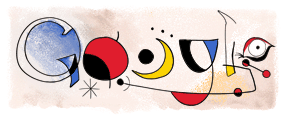
Google Violates Miro's Copyright?

Anonymous Coward writes "In a homage to Joan Miro on his birthday, Google changed its logo as to spell out the word "Google" in Miro's style. Google has a history of changing its logo in order to commemorate events and holidays of particular significance. In this case, the homage was not well received by the Miro family or the Artists Rights Society which represents them, as reported by the Mercury News. According to Theodore Feder, president of the ARS, "There are underlying copyrights to the works of Miro, and they are putting it up without having the rights". The ARS demanded that Google removed the logo, and Google complied, though not without adding that it did not believe it was in violation of copyright. The ARS has raised similar complaints regarding Google's tribute to Salvador Dali in 2002. "It's a distortion of the original works and in that respect it violates the moral rights of the artist," Feder said." It seems to me that the art world has a glorious history of incorporating prior art into modern creations. It's amusing to me that ARS doesn't understand that.
2 of 651 comments (clear)

  1. Moral Rights by TubeSteak · · Score: 5, Informative
    "It's a distortion of the original works and in that respect it violates the moral rights of the artist,"
    That struck me as a very European viewpoint. However, I went to google and found out that the U.S.A. has similar thoughts (and laws) on the matter.

    I can't vouch for this particular article, but similar information shows up on other sites. http://www.carolinaarts.com/902fenno.html
    Many European countries have long recognized artists' personal or "moral" rights in their works of art. Among these rights are the rights of "integrity" (the right to prevent distortion or mutilation of an author's work) and "attribution" (the right of the author to be recognized as the author). These "moral" rights (termed "droit moral" in Europe) spring from a belief that an artist in the process of creation injects his or her spirit into the work. Moral rights are intended to protect the honor and reputation of the artist.

    In 1990, Congress enacted the "Visual Artists' Rights Act" (the "Act") to provide protection for artists' moral rights in selected categories of works of art in the United States. The Act is limited in scope, protecting only works of "visual art" that are created on or after June 1, 1991. [Insert what is and isn't protected]

    Subject to "fair use" rights and other limitations, the Act provides the author of a work of visual art the right to:

    • Prevent any intentional distortion, mutilation, or other modification of that work which would be prejudicial to his or her honor or reputation;
    • Prevent any intentional or grossly negligent destruction of a work of recognized stature;
    • Claim authorship of the work;
    • Prevent the use of his or her name as the author of any work of visual art that (s)he did not create; and
    • Prevent the use of his or her name as the author of the work of visual art in the event of a distortion, mutilation, or other modification of the work that would be prejudicial to his or her honor or reputation.
    ...
    Since moral rights are intended to protect the honor and reputation of the artist, the Act only protects the rights for the lifetime of the artist. ...
    --
    [Fuck Beta]
    o0t!
  2. Re:This is what I think about ARS by Alystair · · Score: 5, Informative

    You know it's personal when they submit an email address in the content of a slashdot article ;)