 Slashdot Mirror
Google Violates Miro's Copyright?
Anonymous Coward writes "In a homage to Joan Miro on his birthday, Google changed its logo as to spell out the word "Google" in Miro's style. Google has a history of changing its logo in order to commemorate events and holidays of particular significance. In this case, the homage was not well received by the Miro family or the Artists Rights Society which represents them, as reported by the Mercury News. According to Theodore Feder, president of the ARS, "There are underlying copyrights to the works of Miro, and they are putting it up without having the rights". The ARS demanded that Google removed the logo, and Google complied, though not without adding that it did not believe it was in violation of copyright. The ARS has raised similar complaints regarding Google's tribute to Salvador Dali in 2002. "It's a distortion of the original works and in that respect it violates the moral rights of the artist," Feder said." It seems to me that the art world has a glorious history of incorporating prior art into modern creations. It's amusing to me that ARS doesn't understand that.
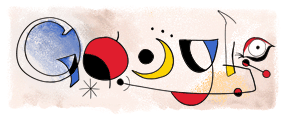
I doubt any of the original artists would have a problem with it. It seems that it is family's that are interested in the financial gain from complaining to Google about it. This tiny excerpt from the article explains it all: "In September, the Authors Guild sued Google for reproducing works..." Come on! The Google symbol in the likeness of an artist is honoring them. It would only help increase the value's of their works, and peoples awareness of them. They just see Google as a big money pit they can take from.
Well, it seems that after some 50 years or so, we wont be able to use any shape, image, saying, metaphor or the like without consulting an intellectual property expert and acquiring appropriate rights, the way things going.
Read radical news here
It seems to me that the art world has a glorious history of incorporating prior art into modern creations. It's amusing to me that ARS doesn't understand that.
It's not that they don't understand, it's more that they're trying very hard to make everybody else forget that fact. They, as well as certain **AAs, behave like rabid dogs protecting their food, so that they have grounds to claim money for the use of this or that piece of art whenever possible and not be contested.
"A door is what a dog is perpetually on the wrong side of" - Ogden Nash
How many people wouldn't have encountered Miro's work if they hadn't seen it on Google's site? Now how many of those people wouldn't have known who's work it was had ARS not filed a complaint with Google. While their complaint seems semi-valid (though, personally, I doubt it would have held up in court), it seems that in effect this ends up being a big PR move. We now have lots of people who weren't familiar with Miro's work, who now recognize it because of the complaint.
This guy's the limit!
Moral rights in copyrighted works are pretty slim in the US if existent at all. We're supposed to have them as a condition to signing a treaty, but for the most part we really don't. Anything that comes up looking like moral rights ends up being weasled through the Lanham Act rather than copyright law.
What?
i see the point that's trying to be made BUT have to make a quick counter point.
google did not just happen to make a logo that looked like miro's style and use it. your comment implies to me that(though exagerated) every idea, shape, color, etc will be taken and one would have to dig deep to make sure that your 'fresh' idea is not too similar to an old one.
instead good DID look at miro's work and made an effort to emulate that work in their logo, though they were giving homage the made an effort to copy. btw i also think that this is ok as long as there is no financial reward from this copy, as it is pay homage! thank you google for being aware and respectful of art and artist.
maybe the ARS should joint the RIAA and MPAA to complete the axis of evil!
this is nothing more than selfishness at work!(ok, maybe some greed!)
paying respect to a dead artist is perfectly acceptable and should be encouraged! this has been happening for 'EVER' and many many many of the most famous artists are only famous now because their work has been emulated and now integrated into modern culture.
no exploitation is happening here, just good ol' respect!
"Lighten up Francis!"
The stupid ARS should be happy Miro got all that attention. What exactly do they expect? I guess we can add ARS to the same list as RIAA and MPAA - self-defeating, money-grubbing idiots.
"No matter where you go, there you are." -- Buckaroo Banzai
I don't think anybody should have to ask permission to use elements of a dead artist's work which are over 65 years old. Miro's contribution to popular culture is pervasive. There is no basis for restricting wholesale reproduction of his works outside of the obscene length of time we allow for copyright in the West. Much less should we be allowed to restrict the use of simple elements and basic tributes of extremely common, influential, and well publicized art.
they created their own, in a style that was influenced by him.
imagine if Manet had been able to copyright French Impressionism, or Picasso cubism, or Renoir portraits.
You shit out a picture and you and your family own it or anything like it for enternity? Bullshit. One more reason I don't feel bad about copy-right infringement. They cry that no art will be produced without pay...I say this is a blatant lie. There are countless artists out there struggling to be seen. Many produce their works with no expectation of payment.
Blar.
While I agree with the above post, IMHO, Google should have the courtesy of asking permission from the controlling body.
Why? Why should they need to ask permission to use the style of a dead artist in their logo?
Miro, like him or not, contributed something to our shared culture. We ALL have the right (morally, not necessarily legally) to make use of that contribution. In this case Google did a tribute to him, which makes the complaints all the more offensive, but I would say the same thing if they had created their "normal" logo, purely out of commercial self-interest, from his style.
Miro family: Get out of the shadow of your one famous ancestor and do something with your lives. The modern world doesn't need de facto aristocracies. Make a name for yourselves, or fade into oblivion. Don't expect society to let you rest on the long-dead laurels of a relative who did accomplish something.
Theodore Feder and the Artists Rights Society: You spout non-stop self-aggrandizing BS about how much your members contribute to our culture, then deny us access to that same culture. You disgust me as the worst kind of hypocrits. Just cease to exist.
1. Google puts up company logo in the artistic style of Joan Miro to honor him.
2. Miros and ARS family tells Google to take it down as it is violating copyrights.
3. The net says "WTF?"
4. Profits from publicity? (NOT)
Shouldn't it be:
1. Google puts up company logo in the artistic style of Joan Miro to honor him.
2. Web surfers Google "Joan Miro".
3. More people find they like his art and buy some.
4. Profit goes to his family and everyone's happy.
Sounds like they are being penny-wise and pound-foolish.
If "disco" means "I learn" in Latin, does "discothèque" mean "I learn technology"?
Admittedly, I was never much into the arts as a kid. But last week I noticed the Google logo and was interested in what or who Google was celebrating.
I clicked on the link and learned all about Joan Miro and his art. After that initial click I become more interested and did some additional research above and beyond what Google offered.
If Google lifted actual elements of Miro's work, then yeah, I'd say it could be a copyright problem. But it's likely a problem that could be easily solved completely in private and without public beratement.
I'd be surprised if the recognition of Miro on Google doesn't result in substaintial financial gains for Miro's license holders, and I'd be shocked if the Miro family approved the public berating of Google by what appears to be a politically inept ARS president, Theodore Feder.
Indeed. In addition - could the Google logo be considered a parody? IIRC, you can make parodies without infringing on copyrights. Weird Al does this a lot, though I get the impression that he does ask first out of courtesy. I think the paridy factor is the whole reason Coolio is unable to take action against Weird Al for Amish Paradase (a parody of Gangsta's Paradise that Weird Al claims he got permission from the record company to do, but Coolio claims he never gave permission).
Quidquid latine dictum sit, altum sonatur.
Just to follow up on my own point, Google being barred from doing a Miró-like logo is the same as if, not only were you not allowed to draw an unuathorized Charlie Brown, Linus or Snoopy, but you couldn't even sketch an anonymous character in a "Peanuts-esque" style. Taking that to an extreme, future sitcom writers could get sued for writing scripts that veered too close to "Seinfeldian" humor. Fast food joints could get hauled into court for having processed meat chunks that were too "McNuggetty." Future presidents could be impeached for aping an authoritarian swagger that was too "Bushist."
Hmm, objection withdrawn, Your Honor.
There are two kinds of people: 1) those who start arrays with one and 1) those who start them with zero.
. . .google did not just happen to make a logo that looked like miro's style and use it.
"Style" is not something that can be copyrighted. Only works can be copyrighted.
See ragtime, blues, jazz, boogie woogie, rock & roll, etc., as opposed to Maple Leaf Rag, Sweet Home Chicago, Take Five, Roll 'em Pete and Purple Haze.
The former are styles, the latter are works. You can copyright Take Five. You cannot copyright 5/4 time.
In fact, the Google logo was their own creative work that they own the copyright on. It was just in emulation of Miro's style, not a copy of one of his works.
The claim of any "moral" rights is so assinine I almost don't know what to say about it. The law does not recognize "moral" rights. It grants a monopoly on copying and may impose monetary recompense against losses incured by such copying. Without the law the artist has absolutely no rights whatsoever, except maybe to be a dickhead.
And I wonder just what sort of monetary losses the Miro heirs feel they have suffered by Google making an original work in tribute to Miro?
KFG
Copyright is not a moral right. Copyright is not a natural right. Copyright is not a human right.
Copyright is a capitalist construct that was created to provide an incentive to
create artistic works.
If you had super powers, would you use them for good, or for awesome?
I'm...speechless.
Let's get this straight.
*The* most popular search engine in the world, with billions of hits per day, puts *your* work on its front page.
Billions of people who've never heard of you before will now find out about you.
And you say...
"TAKE IT DOWN AT ONCE!!"
I've seen stupid, but then there's *STTTTTTTTTTTTTTTTTTUPID*.
A dream where I don't have to wait until 65 years after the death of the artist in order to pay him or her a tribute without having to first ask the family permission.
I mean, sheesh -- this boils down to one simple effect: unless the artist died a long time before I was born, then I can't pay tribute to anybody by imitating the style of their work. All the artists that are alive when I'm alive: forget it. Unless they died when I was 10 and I live to at least 75, they're off-limits. I can't base my work on anyone else's, even stylistically, or on a general idea. The whole current generation of art is essentially off-limits to me in any kind of derivative fashion, even if I'm adding in a little of my own creativity. Nope, it's derivative, so prohibited, without getting permission.
It'll be a pretty depressing world if I have to someday say to my child: sorry, no, you can't draw that picture like that, because somebody already did something like that, and they've only been dead for 50 years, not the requisite 65+. We might get in trouble with their family if you publically display that artwork, and I can't afford the legal hassle of a copyright dispute case.
That's the world the ARS is advocating.
And I expect a call from the lawyers of the family of Martin Luther King, Jr. for the title of this post, complaining that I've violated his "moral right" to the idea of having a dream and expressing it with that turn of phrase.
I wouldn't say it's a parody, but rather a homage. That said, unless they incorporated his art directly, I don't see how copyright applies. You can't copyright a style. If Google's logo was incorporating art that wasn't Google's, they either need to license it or make a case for "fair use."
--JoeProgram Intellivision!
copying other artists' styles is such a common practice in art that it's more noteworthy to see an original style than to see a copied (albeit altered) style.
Agreed whole-heartedly! As a visual artist, myself, it is nigh impossible to create something that isn't influenced by established styles. In fact, that was part of my education at Pratt Institute in NYC - learning the styles and accomplishments of Miro and countless others, and incorporating some of their ideas in clever, new executions. Likely, this sort of thing is more subtle than Google's outright references, but that could easily be argued as a subjective perception.
If somebody made a visual reference or "quotation" of my work, I would be flattered, to say the least. I guess Google's main mistake was verbally attributing the inspiration for the restyled logo to Joan Miro. But in my opinion as an artist, this was a best-intentioned and visually witty tribute.
Artistic styles cannot be copyrighted or patented. In limited cases, people can get design patents or trademarks, but I seriously doubt that that would apply here. Furthermore, it's not like Miro was the only person to have drawn in that style.
ARS and the Miro family seem particularly stupid in this case because Google probably gives them a lot more exposure for free than they have received in a long time.
In other words, the organization that owns the Olympics logo would have had a legitimate complaint, while the ARS most emphatically does not.
"[Regarding the 'cloud,'] ownership was what made America different than Russia." -- Woz
Miro died in 1983, after a lifetime spent capitalizing handsomely (and well-deservedly) on his art. Under the original US copyright laws, he and his "estate" would have had until 2000 to benefit exclusively from the right to reproduce his works. That limited time was certainly more than sufficient to to promote the progress of science and useful arts.
Even though artists like Miro would produce their art regardless of protections or capitalization, driven by their "muse" that compels them to communicate in their medium as much as the rest of us are compelled to communicate by talking and handwaving. And like lawyers are compelled to communicate through C&D letters and invoices.
Popular art like Miro's has always quickly become part of the folk vocabulary of its culture. An early effect of that acceptance is usually enough saleability that the artist can make money quickly, supporting more art. In the centuries since the Constitution recognized a limited monopoly compromise with freedom for practical operation of a free society in an scarcity economy, the time required for adequate compensation has shrunk vastly, with reproduction and compensation technology and techniques far beyond most could then imagine. Recognition of the contribution of the people who codify such art into our folk culture has been completely eclipsed by concessions to the experts who codify art from "high" through "pop" through "commercial" and protect all its product franchises in perpetuity.
--
make install -not war
You can't copyright a style.
Furthermore, don't you think "Miro Style" is not just an extension of pre-existing styles?
This is how society works. One generation building on the work of the past.
That said, Google is not in the art business, nor is that their permanent logo. It should be viewed as an event of limited importance at best. If it truly was an homage then they should just say thanks and go on their fucking way.
Instead they're "fancy" artists [or in this case the family of] who think they invented art all by their lonesome.
Tom
Someday, I'll have a real sig.
They did this on MLK day, with an image of Dr. King that is frankly absurd. I posted about it and put together a similar McDonalds logo at the time:
http://iheartteriyaki.blogspot.com/2006/01/on-icon s-and-logos.html
What's totally hilarious about this is what ultimately the google logo thing brings more attention to the artist's work. You go to google one day, the logo looks funky, and you wonder why. So you click the logo and are now finding out all about Miro, etc.
Not only is this not any obvious violation of copyright law, but IT HELPS THEM. It's free freaking advertising for the artist and presumably could lead to better returns on sales of the art, etc. Whiners.
This sig has been temporarily disconnected or is no longer in service
The difference is that Weird Al clearly made a parody while this logo doesn't have anything funny about it.
Justice is the sheep getting arrested while an impartial judge declares the vote void.
I dont understand why this comment has been modded down.
Moderation is not about agreeing with soemones statements, it is about qualifying them in the context of the article.
The view that Google should have asked permission is justified.
The view that Google should be able to use the style of the artist freely is also justified.
Both type of comments deserve positive moderation!!!!
Repeat after me: We are all individuals
I don't know. If I woke up one morning to find the unique artistic style of a deceased relative being adopted by a company like Google I might be a little upset. Here is why:
Maybe I'm concerned that some of the huge numbers of people who visit Google may believe that in some way my relative approved of Google, or that if they were dead before Google arrived, that the estate approves of Google and regards them as something harmonious with the values my relative held dear.
It matters _not_ one single iota whether or not Google approves of my relative. They may well do so and regard such a logo treatment as a token of their respect and admiration. That is not the point.
The point is that such a relationship is purely one way. It could be that my relative would _not_ have approved of a large American corporation that colludes with repressive regimes in order to make a profit.
In fact my relative may have taken the exact opposite stance against such corporations in their life and as such the risk of someone mistaking the situation goes beyond that of a mild inconvenience and becomes something that must be withdrawn immediately. Even if that means calling the lawyers. That's what the estate does - ensuring the values and worth of the individual is not compromised as that in itself would compromise their work.
Of course it's difficult to suggest such a position to the groupthink of a community like Slashdot - but it is a perfectly sound position to have.
Just a thought.
Having looked at The Escape Ladder, Nocturne, and The Beautiful Bird..., I don't see where they "incorporated images" directly from any of these paintings. Certainly the style is the same, but that is the purpose of the tribute.
The sad part is I'd never heard of Miro before and usually enjoy learning from the little sporadic tidbits Google provides. It would be a shame if Google decided to stop including artists because ARS is over-protective. I could understand their point if Google was trying to profit from using Miro's art in any way, but it just seems to be a fun way to raise awareness.
Does anyone else find it ironic that you can't buy advertising on Google's front-page and people who get some free publicity on one of the most-visited pages on the 'net are complaining.
So I'm guessing that they trademarked his name, so that even when his art goes out of copyright, you won't be able to sell it under the Escher name, because it will still be trademarked (they don't expire).
Sure you can. 'This is a copy of a work by M C Escher' is a statement of fact.
"We returned the General to El Salvador, or maybe Guatemala, it's difficult to tell from 10,000 feet"
Comment removed based on user account deletion
Before seeing the Miro-ized logo (and clicking on it), I had no idea who Joan Miro was, although I recognized the style of painting from the logo. *Because* of the logo, I took 15 minutes out of my day and looked up some of his other work...
The next day I read an article about ARS telling google to take the logo down (or else), and I find that I suddenly care a lot less about who Joan Miro is or what particular works he might have created.
It's one thing to get upset when another artist uses your work to their benifit. I can see talk of copyright violation over that. It's another thing when someone creates a small homage to an artist, replete with a link to a vast repository of articles about said artist, which will be viewed by at least 60% of all people who use a search engine, and start crying foul.
It's an extremely disappointing and myopic reaction to what amounts to free advertising. I even took another 15 minutes out of my day to tell that to ARS.
Just my opinion...
"Murphy was an optimist" - O'Toole's commentary on Murphy's Law