 Slashdot Mirror
Google Violates Miro's Copyright?
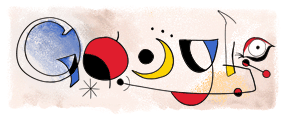
Anonymous Coward writes "In a homage to Joan Miro on his birthday, Google changed its logo as to spell out the word "Google" in Miro's style. Google has a history of changing its logo in order to commemorate events and holidays of particular significance. In this case, the homage was not well received by the Miro family or the Artists Rights Society which represents them, as reported by the Mercury News. According to Theodore Feder, president of the ARS, "There are underlying copyrights to the works of Miro, and they are putting it up without having the rights". The ARS demanded that Google removed the logo, and Google complied, though not without adding that it did not believe it was in violation of copyright. The ARS has raised similar complaints regarding Google's tribute to Salvador Dali in 2002. "It's a distortion of the original works and in that respect it violates the moral rights of the artist," Feder said." It seems to me that the art world has a glorious history of incorporating prior art into modern creations. It's amusing to me that ARS doesn't understand that.
The artists, or their shareholders.
Either way, they can kiss my ARS.
Since I had never heard of the artist until Google used an interpretation of her art as its logo, this seems like it would be a good thing for artists. I have never understood the knee jerk reaction to anything that could possibly be explotive. Its just free publicity in this case, and you would think the family would see that.
http://bgcommonsense.blogspot.com
This sounds like complete crap. Such an logo will increase peoples knowledge about the artist, and thus increase the popularity of the artist, and make images more worth. I doubt anyone would tear down their Miro paintings and put up a print of the google logo instead...
The copyright holders should see that google links this to a search on the artist, which probably generates more knowledge about the artist, and more interest for his works. I'd guess there where firms that would pay millions to have their style on the google logo, and a link from the logo to a search of their company name...
Assembling etherkillers for fun an profit
But kudos to ARS for reminding us that Miró is dead and all the money made from his works goes to some greedy people who have contributed nothing. Miró himself donated many of his works in the hope that he would not be forgotten, but apparently ARS sees no value in keeping that spirit alive. They'd rather have people forget about him than allow anyone to use his "copyrighted" (by them) style for free.
"I love my job, but I hate talking to people like you" (Freddie Mercury)
In case anyone is curious, the letter can be found here.
The obvious conclusion is that Google knows which IP holders not to mess with, and which ones it can probably mess with.
Everybody's a libertarian 'till their neighbour's becomes a crack house.
Well, the art world like everyone else is trying to make a living off their trade. In this case, like most others of its ilk, it's a family who never contributed one ounce of effort who are trying to make a buck off of a dead relative.
That is the nature of capitalism.
If my understanding is correct, parodies, especially disrespectful parodies, are very well protected from problems with copyright infringement.
Any strange "modern" art (Is it still called that?) just has to be an open invitation to all sorts of vile parody.
Miro, Miro on the wall,
who's the dumbest paint of all?
I doubt that Google could get away with slapping a bitmap representation of a copyrighted font or something very close to a copyrighted font on its front page, any particular reason why an artist should be any different? He only died 23 years ago too; there's no room for confusion as to the length of copyright on his works.
All of the out and out WHORING of this fantasy called "intellectual property" is done by the family members and rarely if ever done by the real artists (tools like Metallica as the exception here)
Look at Yoko Ono, she is wringing the Jhon Lennon Rock dry getting every last drop of blood out of it, and this is the Modus Operandi of almost every single artists family that recieves the goldmine that was their parent's or Spouses. One of the biggest to do this was the wife of Martin Luther King Jr. She demanded money from every photo of him or fil clip of him shwon anywhere, now that she is gone the feeding frenzy will probably go into overtime with the family.
This is why copyrights need a solid HARD limit that aftera short X years of the death of the creator all of it goes into public domain and free tomatoes get passed out to the public to pelt the family that was whoring the creativity of the artist or person...
Ok that last part is probably not going to fly but it would be a detterent.
ARS = spoiled brats that really need to have it all taken away from them and made to sit in a corner until they can come out and play with everyone else in society nicely.
Do not look at laser with remaining good eye.
One glaring question is whether Google actually used Miro's images in its logo. Since Miro didn't ever paint a Google logo, the only issue is one of style. Style is trademarkable, not copyrightable; but copying other artists' styles is such a common practice in art that it's more noteworthy to see an original style than to see a copied (albeit altered) style.
Now, if the logo uses portions of Miro's work, then the portions used are likely too insignificant to count as an actual copyright infringement.
Also, Miro died in 1983. I'm not sure of the specific works involved, though his _Carbide Lamp_ looks vaguely similar, and _Catalan Landscape_ (though with a different color scheme). However, the eye is not drawn or colored as Miro would have done, and the lines all seem straighter and more angular than Miro usually used.
While I'm no art critic, the fact that I cannot tell that the style is supposed to be similar without someone pointing it first is rather indicative.
Next, someone's going to claim copyright on Platonic forms and charge people for using them in lectures or sculptures. Hold on while I copyright individual pixels.
Well, it's actually a good argument. The question is the reach of moral rights in the US, but aside from that take a look at Monty Python for example. Their works were put on TV in the US after being chopped to pieces, edited, censored, etc. So, sure it put their skits in front of millions of people; however, what it put in front of those people was NOT something they created, but a bastardization of it. So then instead of a million more fans, they've got a million people that think Monty Python is something that it isn't.
So, Miro is saying that Google has created the impression that he created the logo for them and perhaps that is not something he would have done and doesn't want his name associated with it. IF such moral rights exist in the US, then he might stand a chance. US courts have not been very receptive to the idea in the past, even with the VARA in existence.
What?
If copyrights worked they way they used to, those works would've been out of copyright, for more than 35 years. But, with the latest copyright extensions, I believe his works are protected for 70 years after his death, which would put that at, oh, the end of 2053.
--JoeProgram Intellivision!
Don't blame capitalism for this. (Capitalism has enough on its head.) This absurdity is based on ye olde principle of hereditary property and privilege, which easily pre-dates the whole mercantile economic system that capitalism is based on. And capitalism would work just fine (arguably much better) without it.
http://alternatives.rzero.com/
.....to assert the artist's "moral rights"....
How does anybody in our relativism wracked society decide what what "morals" are and that artists or anybody else for that matter has such a thing as "moral" rights? Exactly WHO decides what is moral? We have lgislatures and courts decide what's LEGAL, that's all.
All theory is gray
Once a big fan of google, this type of behavior is bugging me. There may or may not be a copyright violation here (depending on specific similarities of the expressions), but there is certainly a disrespect of the moral rights of the artist. Let's say a google made a "tribute" to tiger woods by making the google words out of him, or paid a tribute to U2 by playing "one" when you went to the site. Do you think this would be ok? Miro's a big deal, though perhaps not to the ignorant masses. Google appropriates good will from Miro at Google's discretion, not necessarily the other way around (i.e. think Miro on Enron's homepage and you understand why the family might be pissed). I think should set up a porn site, perhaps www.oogle.com, and use the same fonts and colors as google (as a tribute to their fantastic business savy) and see if google gets pissed off. Take of your rosy googles and think about what's going on her folks.
Sigh.
"Moral rights" is a technical term in law, referring to certain post-sale rights an IP creator may have no matter who actually owns the work. Typically moral rights include the right of attribution, the right of anonymity, and the right to prevent modification. Fair use allows me to create my own parody of Miró, but it would not allow me to physically alter a Miró work, and moral rights specifically forbid the latter.
In Europe, moral rights are part of copyright. In the US, moral rights are something of a hodgepodge. They are not part of copyright, however, and are not transferable, and do not extend past death.
Ironically when I checked out the ARS website the first thing I see is Warhol's Venus. Apparently Warhol's estate is represented by ARS. Fortunately for him Botticelli was not
First off, Dali and Miro are both DEAD. They don't give a flying fuck one way or the other. It is an utter absurdity for them to asume some kind of a mantle of "assumed artistic intention", when the artist is dead as a herring. Does their hagiographic activity have rights in perpetuity? Will we have to deal with these soul sucking tourdes for the next 5,000 years? 500 years? 50 years?
I would argue that these jackasses have No Rights. I would argue that an artist has control over his work and images of his as long as he is alive. When he dies, his inheritors own the work, but they do not own the rights over images of the work, BECAUSE THEY DIDN'T MAKE THE STUFF, and they have fewer rights over the work for that reason.
This reminds me of the parasites who run the John Cage estate who sued a musician who put a few minutes of silence on his record in homage to John Cage... Cage has been dead for a while, and 4'33" was composed over 50 years ago. Much the same is going here with Miro and Picasso.
I detest this world of Intellectual Property where coporate parasites and lawyers earn more by merchandising the dead than the artists did in the first place. When I die, I am going to set my work free in my will.
RS
Shoes for Industry. Shoes for the Dead.
some guy with a paintbrush is more culturally significant today than google? Art is great and all, but painters havent exactly defined a culture for a couple hundred years now.
This isn't about copyrights, it's about moral rights.
:-)
I doubt they're saying an art style is copyrighted, but I do believe they're using their rights to preserve "work integrity". The Berne Convention says:
Independently of the author's economic rights, and even after the transfer of the said rights, the author shall have the right to claim authorship of the work and to object to any distortion, mutilation or other modification of, or other derogatory action in relation to, the said work, which would be prejudicial to his honor or reputation.
I do believe this feels pretty nutty though, so don't believe I'm thinking this sounds like great news and intelligence at work on a high level.
Beware: In C++, your friends can see your privates!
It doesn't matter (and the parody argument wouldn't hold water anyway). A copyright gives you protection for a specific piece of work -- a script, a character, a painting, a piece of code, etc. If Google copied elements of specific paintings, the Miro family's attorneys *might* have a case. However, if they use ownership of a "style" of work as the basis of their argument, Google will likely win if they were to take this to trial.
Holders of copyrights have used that to stake ownership claims to which they are not entitled. This is not because of the law. Most people, upon receiving a cease and desist letter, will comply with the terms either immediately or after some correspondence. They either can't be bothered with going to court or are afraid of the consequences. A copyright holder can take advantage of this, by having a lawyer send out a threatening letter accusing the "offender" of some copyright violation. When the "offender" backs down, the holder gains ownership not through endorsement of the law, but through simple bullying.
This one's old, but the site below reviews a book called "The Legend of Rah and the Muggles." The book was written by Nancy K. Stouffer, who decided to sue J.K. Rowlings for the use of the word "muggle" and for supposedly taking similar storytelling elements of writing, too. Hah! Read it and cringe along with the reviewer. The part about the treatment of burns by the book's characters gave me goosebumps (you have to read it to believe it). http://www.magespace.net/mugrev.html