 Slashdot Mirror
EU Craft Successfully Hits The Moon
An anonymous reader writes "SMART-1 has hit the Moon , just as planned and — even better — the impact threw out a bright infrared that was seen by the Canada-France-Hawaii Telescope in Hawaii. There's an animation of the images grabbed by the telescope. Scientists now hope to analyse the chemistry of the rock ejected by the crash. If only you could dump old cars in such a useful way."
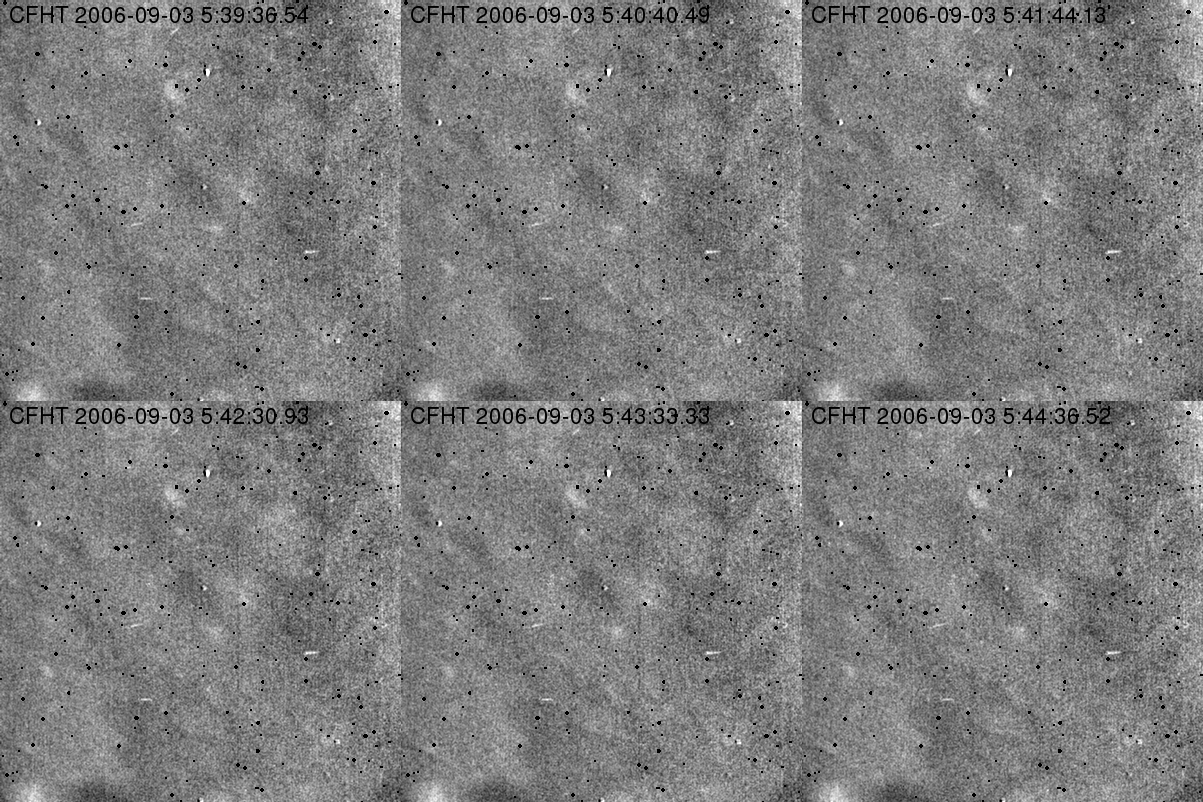
Humanity has been crashing probes into the Moon for decades. Luna 2 was the first to impact, way back in the 50s.
It's much easier if you use an elastic band to simulate gravity.
thank God the internet isn't a human right.
Here's the BBC story on this event. What I found particularly nice about this report was that in a "mainstream" news outlet there was no dumbing-down of the technology, such as the ion drive.
I am officially gone from
...except that gravity force is weaker with increasing distance, while an elastic string force behaves the opposite way... No model is perfect though and I appreciate your suggestion!
Please, it's a European Space Agency operatoin, not European Union.
Shouldnt reply to AC but anyway...
The purpose of the experiment was
1) To try the ION-engine
2) To get dust from the moon in the atmosphere for analysis
I think (1) justified it. The satellite had already done a good job (collecting information) for several years. Instead of letting it remain in the universe with all the other debris we put there, scientists decided to do something useful while scrapping it.
Luna 1 was intended to crash into the Moon but failed. The Soviet scientists then renamed their little probe "Mechta", meaning "The Dream". The dream being the dream of exporting the rest of space.
thank God the internet isn't a human right.
I'm back from the computational astrobiology summer school in Honolulu and we were lectured by Karen Meech who was on the scientific comity for Deep Impact and in charge of all Earth based observations. Despite the catchy depiction of the mission as a space demolition derby its a perfectly valid way to study stuff out there.
/., people love to smash stuff. The science is hard to understand for the average tax payer but the impact isn't and Nasa is really outreach oriented. Next week a lot of people will talk about the recent smash at work, many more than those who talk about the holy quest from dark matter. Some of those will feel nostalgic and bring their kids star gazing and a new generation of astronomers will be on its way. Missions that are easy to understand keep the public interest high. One smash a year keeps the budget cut away?
... and we should build all new spacecrafts to be usefull when we smash them when they run out of fuel. To be usefull all the material should have its emission lines outside of Earth transparency window or at least outsides of windows for interesting stuff like organics. We should of course also launch a bunch of impactors will the sole goal of being smashed.
By smaching stuff hard enough they can vaporize matter and use Earth based spectrometers to get a really detailed description of the content. For those not into astronomy, when you split the light from a neon light, you see distinct rays, not a continuous spectrum. You can identify the gas in the tube by just looking at its rays, argon lights are different from neon and so on. When you vaporize any kind of matter you get a spectrum. You can tell whats in the sample by looking at emission or absorbsion rays depending on wether your sample is the light source or a filter. There is a catch, from Earth you can only tell the elements (and sometimes molecules) that have rays in the transparency windows of our atmosphere,
The good side of the Deep Impact kind of missions is that you can study an object on the "cheap". You just send something to be smashed and the science package is already on earth. No need to build a high price mass spectrometer and to find a way to land it without crashing. In the case of Deep Impact, you don't even need to accelerate the impactor, the comet already has all the momentum required to cause vaporization when it hits something on its path. Since Deep Impact was such a success, they figured that smashing old spacecraft was a good way to "recycle" them and rest assured that the space demolition derby is not about to end.
Another good point about smashing stuff is that is sounds cool. Just look at the comments here on
On a deeper philosophical ground I realize now that hackers should learn from this effort to present to the public an over simplistic view of what you do. Most of us can't explain to our parents what we do. This is because we try to stay accurate and I think that this is wrong. No one will start coding based on just your job description so a little inaccuracy should be allowed. As Kim Binsted told us, we should always have an elevator pitch version of what we do that anyone can understand; thats how you build contacts and how budgets are allocated.
Back to smashing stuff, I think that this is the best way we have to quickly respond to opportunities: a close-by asteroid, an unexpected comet, an alien spaceship,
By the way did you know that they are studying comets and asteroids as the putative primary vector of water and amino acids to Earth? Contrary to the Miller theory, the young earth might not have been such an efficient amino acids synthesizer. On the otherhand we keep finding those in carbonacous meteorites. We have an observation that the formation of chucks of rocks in space for an unknown reason creates the building blocks for life as a byproduct. Don't you think that we should smash a lot more stuff to learn more about it? I do, let the space demolition derby go on!
The ion engine is good for efficiency, but very bad for any human exploration. It takes years to get the spacecraft up to speed (and SMART-1 didn't have any fuel for landing). The Moon is only a few days travel using chemical rockets, so I don't think Orion could get much use from it. Sending payloads in advance may be worth doing, especially when going to Mars and beyond.
Moon orbit is no different from earth orbit; all you have to do is fire an engine to slow down and you will crash into it. Although hitting exactly the right spot - as well is getting into the right orbit to begin with - is rocket science, crashing into it in priciple decidedly is not; gravity will do that for you if you give it a chance.
Your stone and string example is completely irrelevant; unless you do it very far away from the surfice of the earth, of course!
This page: http://www.cfht.hawaii.edu/News/Smart1/ says that the camera's resolution was 0.3 seconds of arc, which equals about 500 meters, per pixel.
I don't see any kind of change in the surface before/after - does anyone yet know if maybe it ricocheted back up again? 15 seconds/frame probably wouldn't show anything further...
"It's time to take life by the cans." ~ Bender ("Bendin' in the Wind", ep. 3-13)
> Instead of letting it remain in the universe with all the other debris
You're missing something. Due to the gravity disturbances of the earth and the sun, the orbit decays naturally. So it was bound to end up crashing on the moon. They had used up all but a few grams of the xenon gas, and the last maneuvres were done using the hydrazine thrusters (used for pointing and gyro offloading). They just set a favorable time and place of impact. Hmm, the "just" is maybe a bit misplaced; they did a great job.
"It's too bad that stupidity isn't painful." - Anton LaVey