 Slashdot Mirror
Amazon Using Patent Reform to Strengthen 1-Click
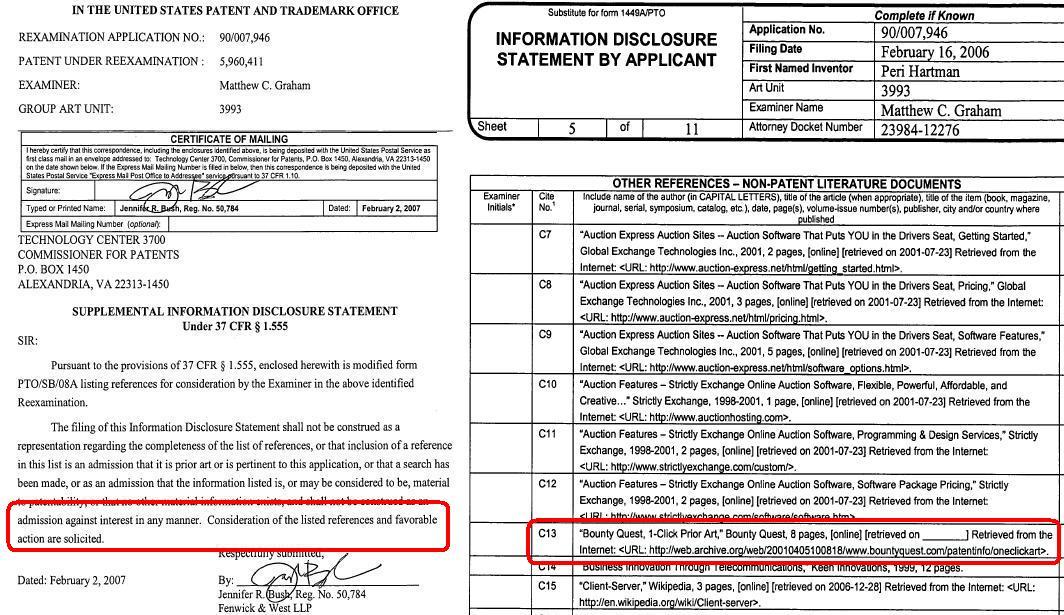
theodp writes "As some predicted, lawyers for Amazon.com have recently submitted 1-Click prior art solicited by Tim O'Reilly under the auspices of Jeff Bezos' patent reform effort to the USPTO, soliciting a 'favorable action' that would help bulletproof the patent. Last June, an Amazon lobbyist referred to deficiencies with the same prior art as he tried to convince Congress that 1-Click was novel, prompting Rep. Howard Berman to call BS."
Amazon seems to have made an error in its patent claim. When I try to use amazon.com's one-click system to make a purchase, I hear and feel two clicks.
Don't buy from Amazon. Is it really that hard to understand?
"Encyclopedia" is to "Wikipedia" what "Library" is to "Some people at a bus stop"
Thank God they are not patenting online shopping. List of things they can also patent
1) One click see all specification(Rather make it Zero click also)
2) Hover and buy
3) Pay by credit card
4) Get it delivered at home
Why is US Government blind all these malpractices.
Which of the 6 links is TFA?
*mindblown*
Why does it matter? You weren't planning on reading it, were you?
The Summary is wrong
Misener (who gets called out by Berman) is not an Amazon Lobbyist
Mr. Misener = Vice President for Global Public Policy, Amazon.com
Mr. Smith = Chairman of the Subcommittee on Courts, the Internet, and Intellectual Property & Rep from Texas
Mr. Berman = Rep from California
Mr. Issa = Rep from California
(this seems like a good spot to start}
And, Mr. Misener, one last question for you. This goes to the 1-Click patent for which Amazon.com is becoming famous. And of course it's under review by PTO. But--I know your answer, but could not Amazon.com be accused of being a troll for patenting the 1-Click?
Page 79 PREV PAGE TOP OF DOC
Mr. MISENER. Oh, we have for about 6 years now. But it's inaccurate, and here are the reasons why. First of all, there's been a lot of complaint about whether or not it was an innovation. And truly it's not innovative only in hindsight. At the time it was a radical departure from the shopping cart model which was ubiquitous on the Web. But more to the point, we have exercised this patent only against a competitor who at the time we exercised it had publicly announced their intention to crush our business. This was not some scheme to hit up small users of 1-Click or similar technologies, it was really to get at a competitor who had not invested anything in developing this technology and had, again, avowed to crush us.
Mr. SMITH. Okay. Thank you, Mr. Misener. And thank you all.
Mr. Berman, do you have any additional questions? Mr. Berman is recognized.
Mr. BERMAN. Thank you.
Paul Barton David, one of Amazon.com's founding programmers, called the 1-Click patent an extremely obvious technology. And Tim O'Reilly, who's been involved in shaping Internet trends, describes the 1-Click patent as an attempt to----
Mr. SMITH. Mr. Misener, we did not coordinate our questions here.
Mr. BERMAN [continuing]. Has not gotten up to speed on the state of the art in computer science. It's been a raging controversy, and I have no idea whether it's valid or not--because I'm a lawyer. But the controversy itself was one of the issues that got at least a few of us 5 or 6 years ago thinking about some issues of reform.
Page 80 PREV PAGE TOP OF DOC
Let's talk about in your testimony you state last year for $40 million we settle with Soverain, owner of a host of broad e-commerce patents, nearly two dozen of which were purchased for less than a million dollars. We settled for 40 million. Did you believe these patents to be invalid because they were too broad?
Mr. MISENER.We still believe them to be invalid.
Mr. BERMAN. Because they were too broad?
Mr. MISENER.In part because they were too broad.
Mr. BERMAN. Did you attempt to initiate a reexamination?
Mr. MISENER.Yes, we did. And it was not going to be completed in time to be relevant to the case.
Mr. BERMAN. Do you consider this company a patent troll because they purchased the patents for less than a million dollars, which presumably didn't represent the value of the patents?
Mr. MISENER.I've shied away as defining them as a troll or not. We were----
Mr. BERMAN. Nobody has shied away from calling you a troll over one claim.
Page 81 PREV PAGE TOP OF DOC
Mr. MISENER.That's true. We worked, by the way, with Mr. O'Reilly; we came and met with Members of Congress 6 years ago because we agreed that there were areas to improve the patent system
[Fuck Beta]
o0t!
Just because they are not using it to go after anyone yet, does not mean that they won't in the future. In the end, their legal department funds, matched with this patent, can shut down any small company competitor with a threat of a patent suit. /.ites are pissed because we recognize this as a threat to innovation by the little guys.
Development notes at http://devscribbles.blogspot.com
Billions of dollars trade hands in Internet commerce annually. A very small percentage of which is one-click.
Undoubtedly, the "One Click" patent is ridiculous because it fails the test of being "obvious", but the issue
is -- if "One Click" wasn't patented would it be as commonly used as many believe?
Amazon has touted the one click patent to the ire of the world, but its important to remember that most Amazon
purchases are *not made through one-click*. Why does Amazon fight so hard to keep "One Click", then?
The answer is two words: "Stock Price". Remember that Amazon went for years and years as an unprofitable company
with a lot of expectation of future profit. Throughout those years they touted their ultra-efficient infrastructure
and their patented IP (including "One Click") as justifications for their high P/E ratio.
The battle for "One Click" is less of a battle for vital, core-business IP and more of a battle for the public
perception that Amazon has a "secret sauce".
Let 'em keep it if they want it. IMHO "One Click" is as much a 'security nightmare waiting to happen' as it is a
revenue booster. I see it as Amazon's Active-X. But even if it never turns into a security risk, its tough to
claim that Amazon's deathgrip on "One Click" is stifling internet commerce, which grows by leaps and bounds
annually.
------ The best brain training is now totally free : )
Polling the top 10 books from amazon.com and comparing them to buy.com's prices gives me 3 prices within 1 cent of each other, 3 prices better at buy.com, 3 prices better at amazon.com, and one book that isn't listed at buy.com (however, this book is from the 90s and isn't even in stock at Amazon).
Polling the top 10 books from buy.com and comparing them to Amazon's prices gives me 6 within 1 cent of each other, and 4 better prices at buy.com.
This leaves Buy.com with a lead in the number of cheaper books. Free shipping for purchases over $25 on Amazon (not Buy.com) and no cost shipping if you are an Amazon prime member. OK, now I know you're on crack, a shill for Amazon, or both. Buy.com has had free shipping on $25 orders for as long as I can remember.
As for the "no cost shipping if you are an Amazon prime member", that's not true: You're paying monthly/yearly membership fees to be an Amazon Prime member, so you are paying for that "free" shipping - you're just paying in advance. Customer Service at Amazon is year after year rated very high by independent surveys (*much* higher than Buy.com) I've actually never had a single problem with either of them, so from my perspective Buy.com is indeed "as good or better". I also was referencing sites other than Buy.com in that sentence, and I'm sure there ARE other sites that are definitely better for customer service (small shops with that personal touch, etc.) What are the reasons you say Buy.com is better for books????
Price - No, Selection - No, Customer Service - No.... what? Price: Yes, by a 7:3 margin, if you don't count the books identical in price.
Selection: Debatable - Amazon lists just about every book ever published (many they have never stocked), but have an older inventory than Buy.com.
Customer Service: Debatable - They are pretty comparable from my point of view.