 Slashdot Mirror
USPTO Examiner Rejected 1-Click Claims As "Obvious"
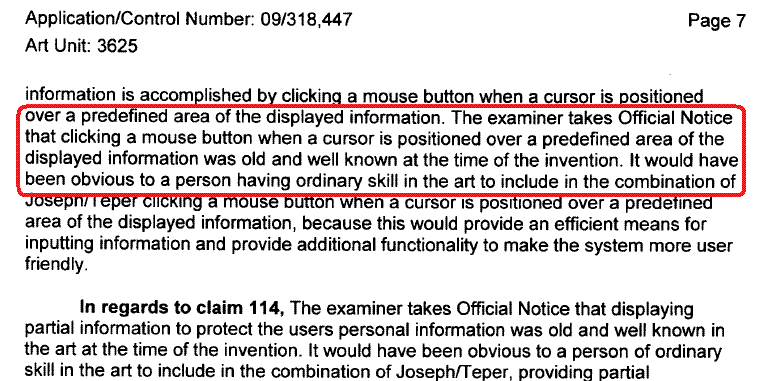
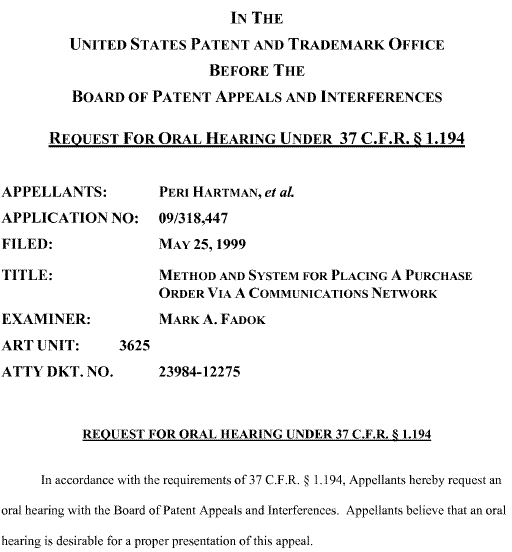
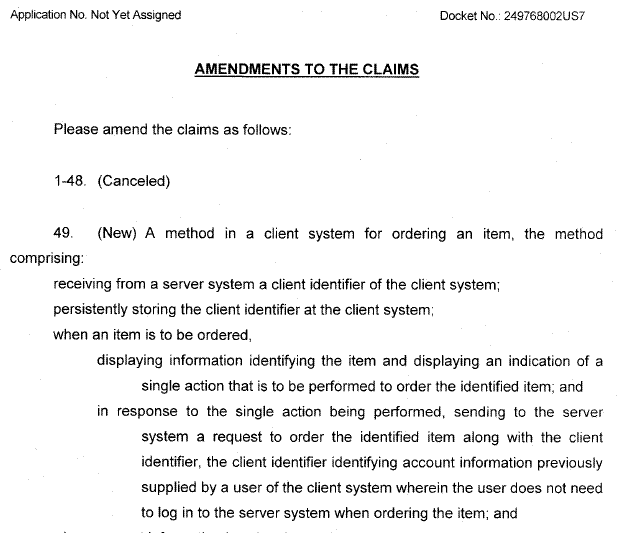
theodp writes "Faced with a duly unimpressed USPTO examiner who rejected its new 1-Click patent claims as 'obvious' and 'old and well known,' Amazon has taken the unusual step of requesting an Oral Appeal to plead its case. And in what might be interpreted by some as an old-fashioned stalling tactic, the e-tailer has also canceled and refiled its 1-Click claims in a continuation application. As it touted the novelty of 1-Click to Congress last spring, Amazon kept the examiner's rejection under its hat, insisting that 'still no [1-Click] prior art has surfaced.' The Judiciary Committee hearing this testimony included Rick Boucher (VA) and Howard Berman (CA), both recipients of campaign contributions from a PAC funded by 1-Click inventor Jeff Bezos, other Amazon execs, and their families."
Probably 99% of patents where computers do work that could be done tediously and manually should be shot down.
'still no [1-Click] prior art has surfaced.'
How can something surface when you're actively trying to drown it?
The theory of relativity doesn't work right in Arkansas.
Back in '95 or '96. We all thought it was so plainly obvious. In fact, the key thing that makes one-click shopping possible, the browser cookie, was put into the browser specifically for the purpose of associating a browser/session with stored data on the back end (payment/shipping details, purchase list.) The reason nobody did it is because engineers thought it was a BAD IDEA. Forcing people to enter their credit card and billing address details was a form of SECURITY. Being able to purchase things with one click was just too easy. Someone could come up to your computer and ring up a bunch of charges. Keeping payment details for thousands of customers on your computer was deemed too large a risk. It wasn't until the Marketeers at Amazon thought this was a good idea that it came about.
However, I think the fact that the cookie support was already in the browser is proof that the claims of the patent were obvious.
"No prior art" is being waved about as being the only significant aspect, and they are hoping no-one realizes the patent was rejected due to being obvious (or, not non-obvious).
As prior art is the usual counter-argument to patents, since it can be clearly proven to someone without expertise in the field, it seems unusual that one has actually been rejected due to being obvious. And since people are so used to hearing about prior art being the significant factor, it may sway a few people.
If something is SO obvious that any moron can come up with it, it deserves no patent.
Patents exist so investition in research and development can be reimbused. If you have no expense for research and development, you deserve no patent.
We used to have a Bill of Rights. Now, with the rights gone, all we have left is the bill.
Expect more applications to get section 103 "obviousness" rejections, in the wake of KSR v. Teleflex.
This post expresses my opinion, not that of my employer. And yes, IAAL.
Nothing Mentioned here is out of the ordinary. All applications are rejected at least once...if it is not rejected your council has done something terribly wrong and drawn narrow-scope claims that will not yield any protection or competitive advantage. Cancellation and continuation are standard strategy as well. It would be more interesting to find that they were given a divisional; implying validity.
/. community riding on the back of an old ski-lift ticket system as prior art.
I thought the one-click patent was brought to its knees by the
-A
One-click has been around as long as bartenders have been extending credit to known customers, but I suppose you can't see prior art rising when its obscured by a head of foam.
Davis http://davis.foulger.net
In much the same way that script kiddies and east european phishers all know how to hack PCs. All of corporate America knows how to hack congress.
Most hacks require only simple tools: PACs, straight contibutions, that important meeting with the lobbyist that needed to be in the lobby of a Hawian hotel.
Some hacks require more subtle tools: "Where was I gonna site that factory - remind me?", "You know if you ever get tired of congress and want a real job.", "I have absolutly no control over the editors of my newspaper/TV station if they print bad things about you thats tough."
It happens so regularly it doesnt even raise eyebrows anymore. So Bezos will probably lose his patents until congress changes the law so he can get them back.
Wouldnt it be much more efficient and simpler to introduce a "pay per vote" system. Represenitives could auction of votes on e-bay, and, the house seat themselves could be auctioned by the higest bidder. (This is a varation on tax farming which served to Ottoman empire well for 600 years).
The sad thing is that while all this malarky is going on Wolfowitz and Bolten are lecturing the rest of the world about the evils of corruption.
Old COBOL programmers never die. They just code in C.
Corporations have never determined the direction of the patent system. Corporations are legally and ethically bound to pursue business practices that are in the interests of shareholders. When the software patent genie was let out of the bottle in the 1980s, software companies had absolutely no option except to pursue their own patents vigorously.
Amazon has never done the wrong thing by pursuing the "one-click" patent. Patents, especially software patents, are interpreted very narrowly. What sounds to a layman as a "patent on online sales" (for example) turns out to be much more specific in print, and more importantly has been interpreted very narrowly by Federal courts. You can't patent the process of online sales, but you can patent a detail of it. When a court sets out to determine the validity of such a detail, it doesn't examine it in the context of "is it a logical implementation of a larger, obvious system." The court sets out to determine whether it is a detail that someone else has used. Basically, as the law has been interpreted for the past two decades, whether something has already been patented is the greatest determining factor on whether it can be patented. That isn't how a layperson reads the law, and in fact it is probably contrary to the intent of the law. But that's how it is.
The US Supreme Court has indicated an interest in changing the interpretation of software and process patents so that courts must interpret patents and patent applications in a way that sounds more in the spirit of the law. I don't think most conventional companies oppose this, because the expense and uncertainty involved in patent applications, cross-licensing, and God forbid, litigation, is considerable. Patent holding firms are probably distressed about it, but I think most people perceive patent holding companies as an aberration.
The fact that Amazon has its "one-click" patent means that Amazon was doing the right thing as far as the system is concerned. It also means that the system is counterintuitive and, a majority of people probably think, out of whack with the original intent of US patent law.
This is Slashdot, where you can be praised to the stars one week and subject to "Two Minute Hate" the next. As far as contributions go, the conventional "wisdom" is that they always corrupt, no exceptions. Therefore, we should only elect people who have enough money to afford the election. Wait, no, we should never allow people to contribute to campaigns. No, wait, wait, we should only allow campaign contributions from the "right" people. Hm, well, we should all be taxed to pay for anyone and everyone who wants to run for office. Um, that is, not *everyone* or *anyone*, only the ones who "qualify" to run.
Anyway, Boucher is now one of the "bad guys" because he took money from the current "bad guys". Next week we will be at war with Eastasia again...
By the taping of my glasses, something geeky this way passes
Get your head out of your ass for a moment.
Just because something is legal and possible does NOT make it 'right'. If it was found that it was legal to kill people by some method, does that make it right for everyone to kill everyone they can by that method? Too extreme? How about a corporation that takes advantage of the tax system to pay as almost no taxes, so that everyone else has to pay their share? How about police that run reds lights in their cars because it's legal for them to, even when they don't have the need? How about a teacher that hands out religious pamphlets right outside the school grounds? How about someone standing outside a playground and screaming at the children?
I bet I just hit on the sensibilities of most of the people that read this. There's plenty of examples of things that are totally legal, but not 'right' in any way.
Amazon may be within their rights to attempt to patent this, but that does not mean they are 'doing the right thing' in any way shape or form. Amazon should be considering their customers in this. If it angers your customers, it's probably not a good idea. Since any global online retailer's goal is to have the whole world as customers, they should be thinking about everyone.
"If you make people think they're thinking, they'll love you; But if you really make them think, they'll hate you." - DM
Machines are different because you have to not only design and build them but also develop mass production processes, and that takes time and money. Business methods have to succeed or fail on their own merits, or we don't have capitalism anymore.