 Slashdot Mirror
USPTO Examiner Rejected 1-Click Claims As "Obvious"
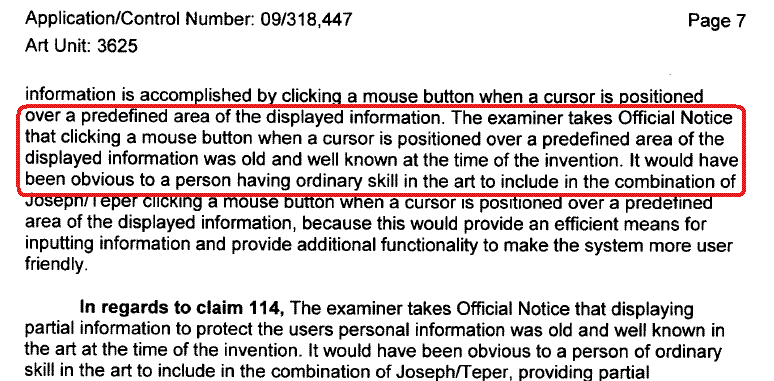
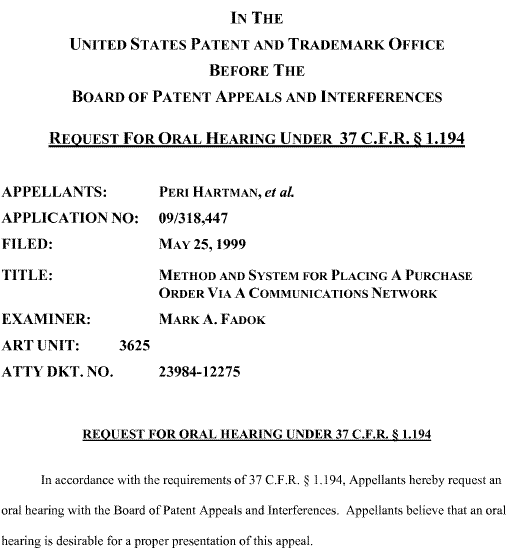
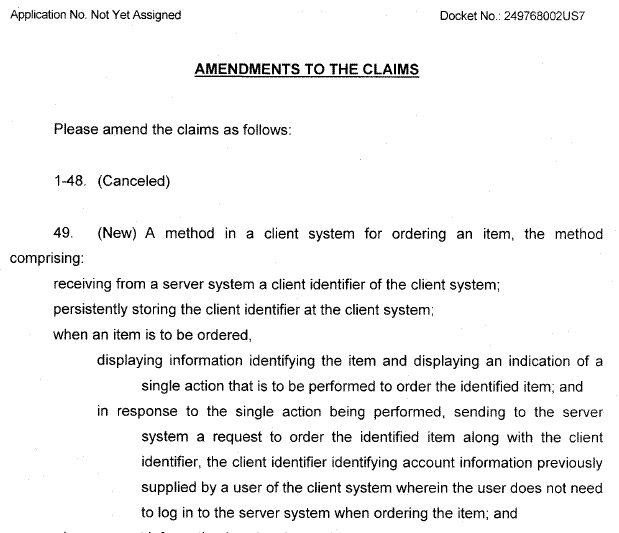
theodp writes "Faced with a duly unimpressed USPTO examiner who rejected its new 1-Click patent claims as 'obvious' and 'old and well known,' Amazon has taken the unusual step of requesting an Oral Appeal to plead its case. And in what might be interpreted by some as an old-fashioned stalling tactic, the e-tailer has also canceled and refiled its 1-Click claims in a continuation application. As it touted the novelty of 1-Click to Congress last spring, Amazon kept the examiner's rejection under its hat, insisting that 'still no [1-Click] prior art has surfaced.' The Judiciary Committee hearing this testimony included Rick Boucher (VA) and Howard Berman (CA), both recipients of campaign contributions from a PAC funded by 1-Click inventor Jeff Bezos, other Amazon execs, and their families."
http://en.wikipedia.org/wiki/Stellar_Crisis .. this game is from 1993, and you can buy in-game things with only one click.
DONE
No, all software patents should be shot down. Patents should only be given to inventions which operate in the physical world — mechanical devices, tools, electronic equipment, and so on. Patenting software is (more or less) patenting algorithms, and therefore to patenting mathematics; on the other hand, research works much better if information is shared freely. Also, software is already covered by copyright, so protecting it with patents also is overkill. Also... well, there are many reasons why software patents are a terrible idea. Everybody with an interest more than casual in the subject whould get familiar with the arguments given in http://www.nosoftwarepatents.com/.
There was a company (And still is) that had a patent on using the "*" and "#" key on your phone, but, only when calling Directory Assistance. Called "Metro One" (NASDAQ:INFO if they aren't delisted).
Now, if Obvious was somehow forgotten in the world of telephony, I don't know what is in the rest of the world. But they had the patent based on "business process". How is using the * key different for a person calling 411 vs calling the local Energy company, or their own PBX? I don't know.
But, they actually won a lawsuit after a competitor in the "411" business allowed their own customers to use the * and # keys on the DTMF phones (and DTMF tones were designed to allow for systems to interpret them for custom needs, with no specified control... so.. yea...) And they won!
This is another case of very very very very very bad Patent law.
No, all software patents should be shot down. Patents should only be given to inventions which operate in the physical world.
Software can operate in the physical world. That's why the USPTO started allowing software patents in 1981. Anyways, I like the europeean take on software patents, which says that "any invention which makes a non-obvious "technical contribution" or solves a "technical problem" in a non-obvious way is patentable even if a computer program is used in the invention." http://en.wikipedia.org/wiki/Software_patent#In_Eu rope
I just don't see anyone can be against that.
You just got troll'd!
Level of abstraction? Okay, explain how you're a walrus.
Software patents make as much sense as mechanical patents because both cover how to change something in one state to something that might be more useful in a different state. The usefulness of the patent is up for debate as it would be in any new industry, as is the innovation. The debatable questions are whether the innovation that goes into creating something that is novel in software deserves a patent, and whether allowing patents in software is good for society. Once those questions are sufficiently answered there will always be the secondary questions of a particular patent's worthiness, but it will be far easier to answer.
B) Eliminate all the stupid users. This is frowned upon by society.