 Slashdot Mirror
Massive Cave Found on Mars
mrcgran writes "Space.com is reporting a very deep hole found on Mars: 'The geological oddity measures some 330 feet (100 meters) across and is located on an otherwise bright dusty lava plain to the northeast of Arsia Mons, one of the four giant Tharsis volcanoes on the red planet. The Mars Reconnaissance Orbiter (MRO) used its High Resolution Imaging Science Experiment (HiRISE) instrument to draw a bead on the apparent deep hole — a feature that may cause more scientists to ponder about potential subsurface biology on Mars. Because the spot lacks a raised rim or tossed out material called ejecta, researchers have ruled out the pit being an impact crater. No walls or other details can be seen inside the hole, and so any possible walls might be perfectly vertical and extremely dark or — more likely — overhanging.' The original image and its cutout at full resolution can be found in the HiRISE site."
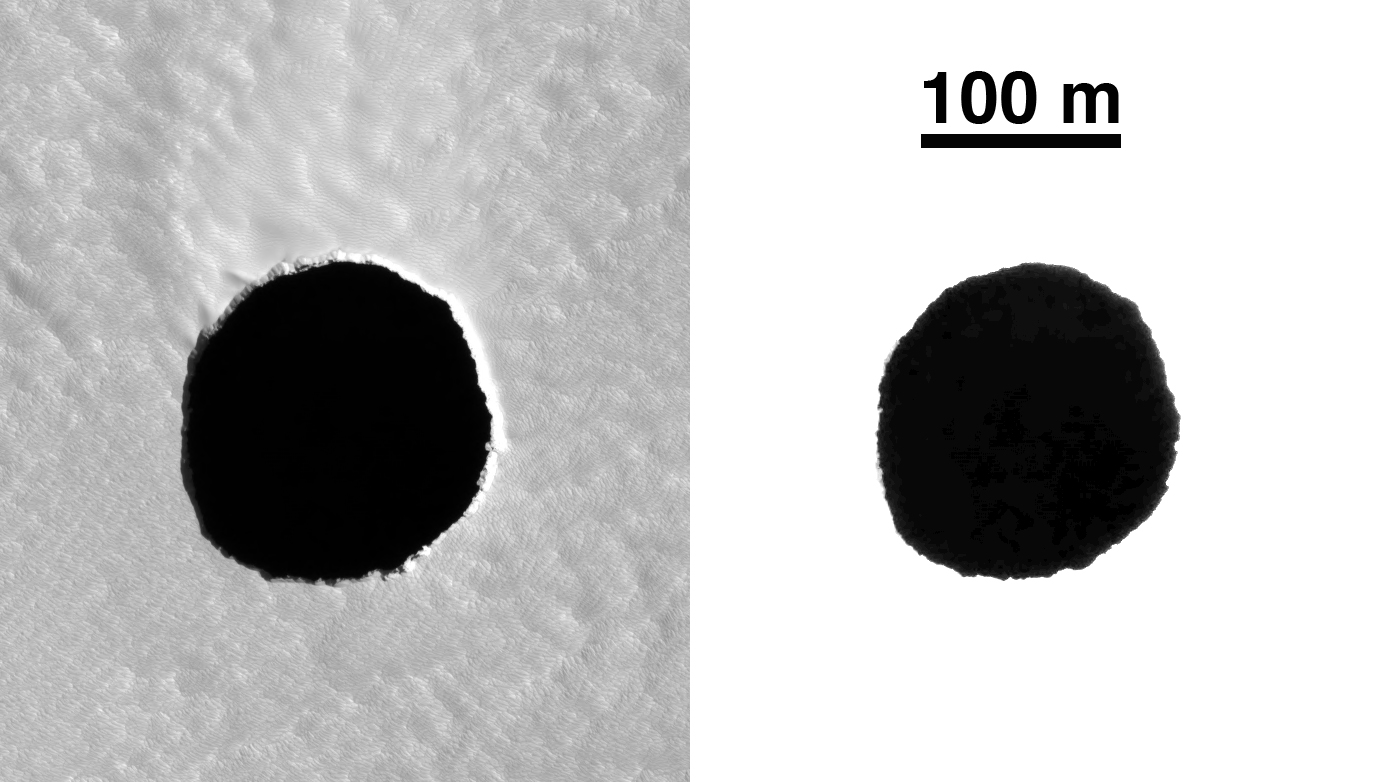
If you read the preprint (PDF), you'd note that luckily, one of the caves actually was imaged with the floor sunlit, giving the authors the ability to calculate the depth of that particular cave. This was covered on May 23rd on the Planetary Society blog.
Or a piece of grit on the scanner scope.
See, the thing about grit is, it's black, and the thing about scanner-scopes,,,
Oh, say does that Star-Spangled Banner entwine / The myrtle of Venus with Bacchus's vine?
The truth is in there!
Y'know, if the UAC would follow a few simply rules of planetary colonization, they wouldn't have such problems.
1) When your life depends on the structural integrity of your base/space station, keep it well lit. Dark corners and unlit passageways invite unobserved problems and make excellent hiding places for demonic hordes.
2) Emergency lighting is your friend. Self-contained lights that can run off batteries for days have existed since the 20th century. USE THEM.
3) Teach your space marines how to use a pistol and flashlight at the same time. Television actors pretending to be cops can do it, so can they.
4) Keep hidden compartments, passageways, and crawlspaces to a minimum. This will drastically reduce construction and maintenance costs by keeping the design simple, and make it far easier for a lone marine to save all of humanity.
5) Develop lockdown procedures. They're useful in the event of a sudden loss of pressure to prevent your entire base from leaking air out a single fracture. They can also come in handy when your absurd experiments fail and you find yourself surrounded by blood-thirsty monsters. Seal all the doors. Combine this with #4 so that they can't simply bypass the doors by crawling through unnecessarily large ventilation shafts or open ceilings.
120 characters for a sig? That's bloody useless.
Given the fact that it's on the side of a volcano, and the fact that it's in the middle of a lava field, the most likely answer is that it opens into a lava tube. Most likely a small meteorite hit the center of the circle and caused a circular fracture that fell into the underlying tube.
Life, the Universe, and Everything... in my image.
You are being MICROattacked, from various angles, in a SOFT manner.
Lots of things form caves. Limestone caverns are caused by acidic water leeching through the soil and eating away at the substrate. We know that parts of Mars were once covered with seas as acidic as acid mine ponds, so that seems a reasonable possibility.
There are also lava tubes all over the planet, although that would be one monstrous lava tube.
Nothing says 'welcome to the neighborhood' like a gunny sack full of dead squirrels.
He starts the article with an anecdote mentioning how he once mentioned the planet 'yoo-RAY-nus' to someone only to be corrected. After checking the dictionary (he doesn't mention which one), he learned that the correct pronunciation was 'YOO-rih-nus'.
This essay is reprinted in 1988 in the anthology "The Relativity of Wrong", Pinnacle Books, ISBN 1-55817-169-X
The thin Martian atmosphere makes an Earthly parachute as much use as an anvil. Come to think of it, that would be funny to watch.
Blank until
Contrary to popular belief, the sandstorms on Mars are nothing like ours on Earth. To put it simply, the winds are not strong enough to create the storms like ours. The popular media will talk about windspeeds, but fail to mention or account for the much lower pressure on Mars. The lower the atmospheric pressure the faster the wind must blow to exert a similar pressure. What we see in Martian dist storms are very small/fine particles, not the "grains of sand" you see at the beach or in your local sandbox. They are more along the lines of flour. Hmm wait this is slashdot. They are more like the powdered sugar on the top of your Krispy Kremes. To fill that big of a hole with that fine of stuff would take on helluva long time. Especially after accounting for blowing back out or other wind currents not taking it in there in the first place.
My Suburban burns less gasoline than your Prius.