 Slashdot Mirror
Massive Cave Found on Mars
mrcgran writes "Space.com is reporting a very deep hole found on Mars: 'The geological oddity measures some 330 feet (100 meters) across and is located on an otherwise bright dusty lava plain to the northeast of Arsia Mons, one of the four giant Tharsis volcanoes on the red planet. The Mars Reconnaissance Orbiter (MRO) used its High Resolution Imaging Science Experiment (HiRISE) instrument to draw a bead on the apparent deep hole — a feature that may cause more scientists to ponder about potential subsurface biology on Mars. Because the spot lacks a raised rim or tossed out material called ejecta, researchers have ruled out the pit being an impact crater. No walls or other details can be seen inside the hole, and so any possible walls might be perfectly vertical and extremely dark or — more likely — overhanging.' The original image and its cutout at full resolution can be found in the HiRISE site."
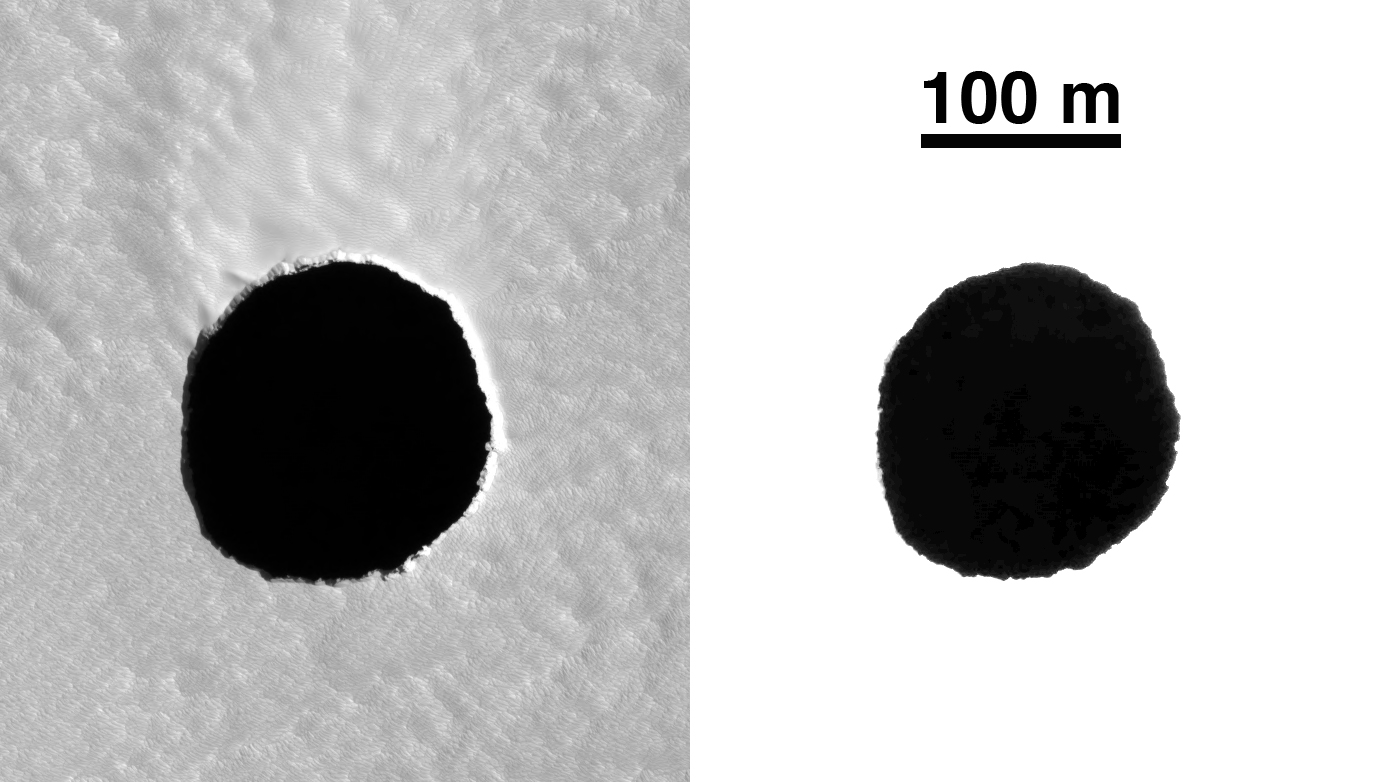
That's no cave! It a giant pool of Purity.
:-)
Seriously though, the absolute absence of albedo in the visible spectrum is stunning. I wonder if there are multi-spectral images of this site? I expect this location will be of intense study in the future as there is little more than a complete absence of something to stir the human imagination.
However, I have to disagree with the analysis in that you can see shallow walls at the very edges of the crater if you stretch the image some and examine the profiles. It also appears to match the brightness of the elevation changes from one rim of the hole to the other which should give some idea for how tall the lip of the hole is to where the "blackness" starts presuming they know the angle of the sun and lat and long. Depending upon how far up the sun can get in the sky at a different season, there may be a possibility of seeing further into the hole, presuming of course it is not a giant pool of Purity....
Visit Jonesblog and say hello.
What would you call an atmosphere where the planet in hollow and the ecosystem exists inside the crust?
Has anyone coined a term?
Maybe it's an "intmosphere" and the hole is the entrance.
There is so much to know about Mars that we don't.
No light is reflected back, which is kind of spooky. What can be inferred about the depth? How deep would it have to be for the HiRES camera stop sensing the light that is reflected?
It's nice and round, that's unusual. There is no crater ejecta so I'm guessing nothing hit it. I'm not a geologist, but aren't giant round holes in otherwise homogeneous flat terrain a bit uncommon?
Is there any radar in orbit with enough resolution to bounce a signal down one of these? I'm just so full of questions and awe.
I'll be checking unmanned spaceflight for theories to these questions. Awesome site.
The article says that the lack of ejected material rules out an impact, but it certainly does not rule out an impact into the roof of a dome (likely a lava-formed dome given the material)... whether from space or from a volcano (any within several miles?). There'd be little to no kick-back of debris if it simply punhced through.
It could be a structural collapse, but it's awfuly round.
So that leaves wind(?) , water(which would be a story) but a big river at 330 feet across, X ? , Y? , Z ?
Not wind, because the surface appears to be fairly flat, and I'm not aware of wind ever punching a hole straight down into the surface like that (at least not without other nearby protrusions to force the wind into some sort of vortex). Not a surface river, because there are no flow indications on the surface. Possibly a subterranean river or something which has eroded the material from the surface, leaving behind a thin crust on top. An impact would then break through the surface and not scatter ejecta around. But what exactly caused the erosion of the subsurface material?
Martian atmosphere is about 1% of the density we prefer (~1 Bar).
To increase the pressure to a survivable few 100 mBar would require several kilometers...
"The likes of Facebook and WhatsApp are free to those whose privacy is of zero value."
"The hole is almost perfectly circular, over 1,000 feet across and 400 feet deep. It was formed as a limestone cave system during the last ice age when sea levels were much lower. As the ocean began to rise again the caves flooded, and the roof collapsed."
http://en.wikipedia.org/wiki/Great_Blue_Hole
People will pass up steak once a week, for crap every day.
At this point, as far as I can tell, there are a huge number of possibilities and no information to distinguish between them.
It's a small world and it smells funny; I'd buy another if it wasn't for the money; Take back what I paid (SoM)
My first though was that it looked like a cenote. They are built from limestone though so it would have to be by a different mechanism. My other thought was it might be a lava tube or a volcanic neck where the magma settled back out. I'm surprised that it hasn't been filled in by millennia of blowing sand so it must be rather young or constantly kept clear somehow. Maybe it is an alien portal and the hollow earth people got it right but for the wrong planet.
It is by the juice of the coffee bean that thoughts acquire speed, the teeth acquire stains. The stains become a warning
If you want to see how those highlights appear to show a wall on the top side of the hole, I adjusted the levels on the photo and posted it at: http://www.flickr.com/photos/8731461@N05/
The black part is not pure black, actually. There appears to be some structure inside the hole.
I ran the HiRISE cut-out image through photoshop (using a stark black-white striped image gradient) and some structure appears to come out in the black region. It's way down on one side of the color spectrum, but I'm able to see about 4 layers of gradient in the black. Perhaps a professional image analysis could bring out more.
With my limited imaging experience (undergrad astrophysics) it doesn't seem to me like the data that comes out is merely random instrument noise. It looks sort of like broad hilly terrain variations of a scale size similar to those outside the hole.
Here is the original image from HiRISE site.
And here is the enhanced color version that I got by using a high contrast color gradient in photoshop.
That stuff at the bottom looks like lumpy ground a lot like what's outside of the hole.
I bet a high fidelity image enhancement of the original data could bring out a lot more detail though. There's probably already someone doing a paper on it as we speak.
-b
Privacy Statement: We value your privacy! It is very valuable. That's why we try to sell it whenever we can.