 Slashdot Mirror
BioShock Review
BioShock, the moody drama-driven FPS for the Xbox 360 and PC, was released last month to rave reviews from the major gaming news sites. Since then the internet has been ablaze with outcry about the game's high rating scores. It's hard to understand why. The work of Ken Levine and Irrational Games on the spiritual successor to System Shock 2 is sublime. It's incredibly atmospheric, the game's story is well written and compellingly told, and the first-person shooter gameplay is a respectable, tightly crafted experience. It's a really, really good game. I'll tell you now: it's a 5/5. So why all the angst? Why the backlash? Read on for my review of BioShock, and a few comments on the dangers of 'merely' being a good game.
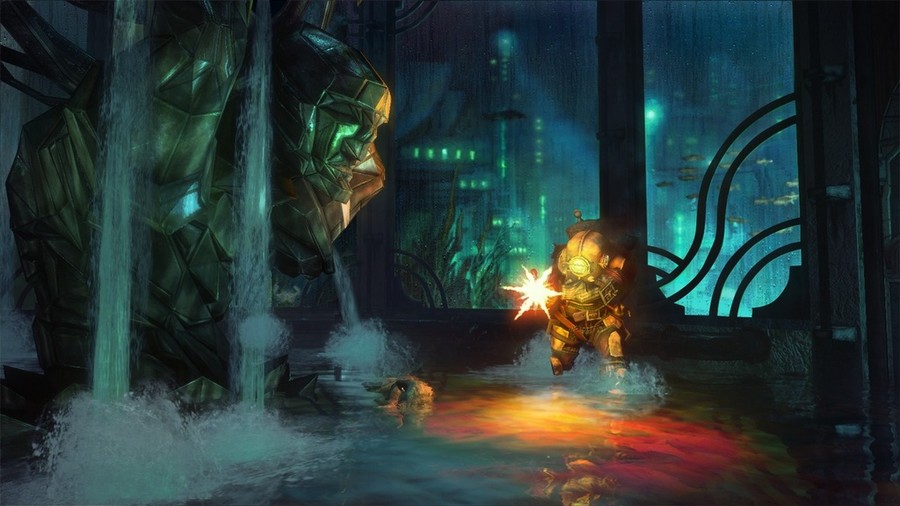
The setting is gripping, but it's also the least of the player's worries. It can frighten, but the remaining citizens of Rapture - they can kill. And they'll kill cheerfully, too, all the while singing songs and muttering enthusiastically to themselves. These people are lumped together under the generic term 'Splicer', implying their extreme genetic modification. From low-powered thugs in masks through to fire-tossing, teleporting madmen, their strength when wielding a pipe is far outweighed by the impact they can leave on your nerves. Far more threatening than this group of variously-powered miscreants are the iconic monsters of the title: the Big Daddies. Acting as patrons for their ADAM-hording Little Sister companions, these creatures are just as tough as you've been lead to believe. While much of a given level involves stalking from room to room dealing with the slicer infestation, the most memorable moments you'll have probably come from one-on-one combat with the diving-suit clad behemoths. And they are completely memorable. Even taken out of context the Big Daddy is one of the creepiest enemies ever to grace a videogame. Everything, from their low groans, to their thudding footsteps, to their cries of rage when they attack, gets across to you that when you face down a Daddy it's 'for real.' Game on. I particularly like how, as they become more and more damaged, steam escapes the Daddy's suit. The implication seems to be that there's something deeply wrong under that helmet.
You're driven through the narrative by the whims of your mostly-unseen benefactor Atlas, who plays the part of the down-to-earth everyman paired with Ryan's soulless venture capitalist. He provides a great deal of information about Rapture's background ... but hints all throughout the game indicate Atlas may be more than he appears. The subtext of 'shades of grey' is laid on throughout the game. Though Ryan is clearly a madman you're given hints of his original intentions, which seem quite benign. Likewise (as has been highly publicized), the ghoulish Little Sisters can be either slain or saved as you desire. Nothing is as it initially appears in Rapture. This moral ambiguity never seems forced, but probably isn't everything the BioShock team hoped it could be. It's very enjoyable to have options, but you're not even making as dramatic a choice as the good and evil options in Knights of the Old Republic. Whether you're a sinner or a saint, you're going to end up at roughly the same place in the end. The great writing and characterization throughout the game stands up much better than any moral overtones.
That's extremely similar to System Shock 2, of course. In keeping with the spirit of that game, your ability to customize your avatar is expansive. There are actually four tracks of powerups to choose from: plasmids, physical tonics, engineering tonics, and combat tonics. While it might sound like you will be engineering a carefully constructed 'build', I found during the course of play that a particular style just emerged based on what I found most useful. Engineering tonics were the upgrades that most appealed to me, and so I made an effort to gain slots in that area. There are far more tonics than slots available, so even as you bump up your character's potential you'll never find yourself wanting for powers. Making use of these powers in the 'emergent gameplay' style is also equally effortless. While it sounds like work from the outside, when you're playing through the game encounters happen so quickly that you rarely have time to realize that you're doing cool stuff before it happens. That was another reason I particularly enjoyed engineering; emergent gameplay can even happen when you're not around. I regularly returned to an encampment I'd made out of hacked turrets to find that they'd been clearing the stage without me. All I had to do at that point was loot the corpses.
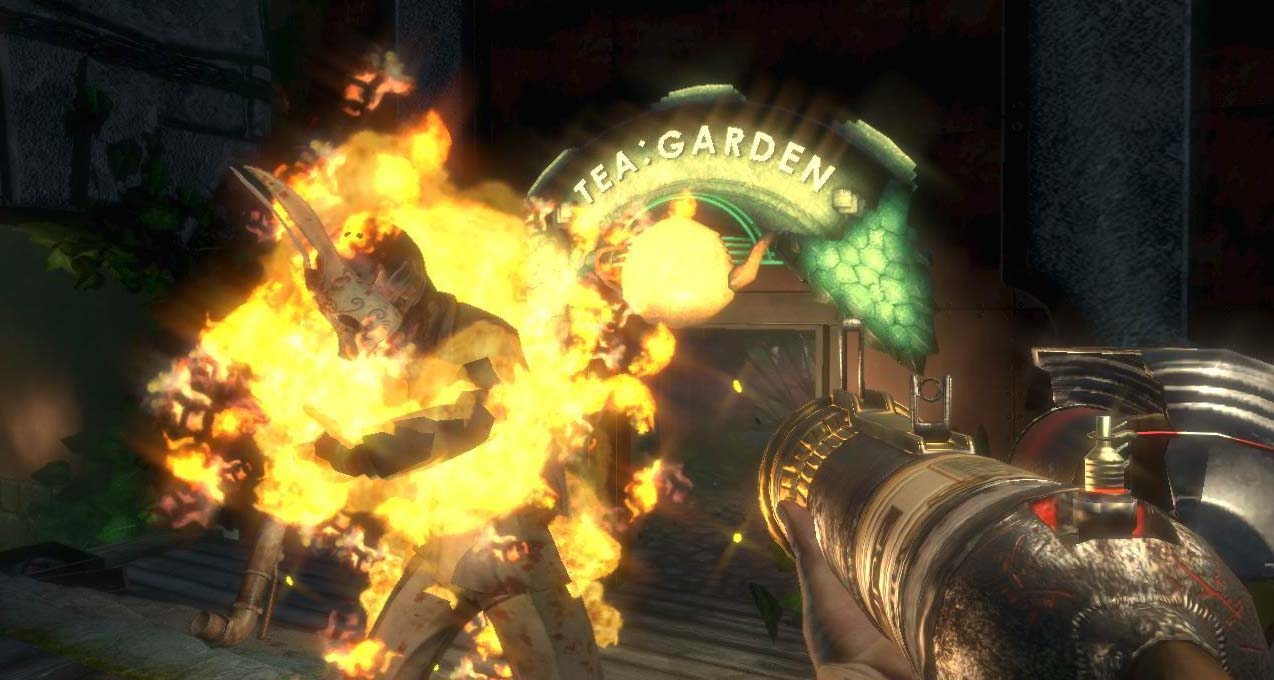
From a graphical and audio perspective, BioShock is a work of art. Rendered by the Xbox 360, the world of Rapture is awe-inspiring to behold. Everything looks so good, it's hard to point out any one thing in specific that stands above the rest. After playing the game, the best thing to do is try to pull out moments that stick with you: water as it slides over bare rock, the endless wood paneling of nicer spaces, disturbing altars lit only by an open flame, the obvious fury of a Big Daddy wreathed in flames. The sound design is the same way, with a combination of eerie vocal performances blending into a background of music that could really have come from the 40s. Every movement, every gesture in BioShock has an associated sound. From the 'clunk' of entering the hacking menu to the squeal of radio static when activating the Security Bullseye Plasmid, the sound experience in BioShock is equal to the task of rendering a world from the rich images on the screen.
All of these elements probably seem very familiar to veteran gamers, and they very well should. You've probably played a handful of games that had many elements similar to BioShock before. What sets this game apart and above other offerings, though, is the way the title brings it all together. There's almost nothing out of place here. There's no "but the story could have been better" or "the weapons didn't feel right", or "the enemies got boring" to mar the experience of playing this through for the first time. Is it the best game that will be released this year? Possibly. It's certainly the best FPS to be released since Valve's Episode One hit last year.
So where has all the hate come from? Why are there so many posts and protestations on message boards, all claiming that BioShock 'isn't all it was promised to be'? Even Zero Punctuation's analysis of the game (which you should really seriously check out because it's hilarious) takes some cheap shots at the game's purported low difficulty level. It's all for laughs, of course, but it shows up in the review because it's a common complaint among players. The issue is that the restoration capsules scattered throughout the game, which allow you to respawn right after your death, apparently remove the 'challenge' from the game. Others have said in response, "just don't play it that way, that's why there is a quicksave option." That also seems like a strange argument, because it's essentially telling someone they're 'playing wrong'. I don't really think anyone can play a game incorrectly.
Instead, look at it from the designer's point of view. What happens when you die in an FPS, normally? You reload from your last save. Why bother? Why not just respawn and get right back into the fight, ala the spirit world of Prey? Commenters then complain that it's easy because injured enemies on the level still have reduced health. By the same token, any resources you have expended in the fight up to that point (medkits, ammunition) are also still gone. To my mind, the vita-chambers are only there to make your play experience as seamless as possible, not to make it 'easy'. Ultimately, BioShock can be as hard as you want it to be. The variable difficulty rating along with several save options and the vita-chambers means that you can play through the game in a multitude of ways, with several 'steps' between simply easy, medium, and hard. BioShock is not a brief game, either, clocking in probably around 20-25 hours for most players. Anything that ensures you will move through the game as quickly as possible would (I think) be appreciated.
The real problem, I think, is that hype has made game players disappointed with games as they're actually delivered. When a game is unexpectedly good, we all marvel over the 'sleeper hit.' There comes a point in a game's marketing, though, when more hype is just too much. The result is that when the game is finally delivered, there's almost no way for the real product to match up with player expectations. After Halo 3 launches later this month, odds are there will be a lot of people in forums nitpicking the slightest flaw or perceived imperfection. The lesson, I think, is that as gamers we need to learn to manage our expectations. I'm really looking forward to Mass Effect, for example, but I don't think it's going to change my life. Really, what can we expect out of a game other than a few hours of enjoyment we might not otherwise have had? Just getting that much out of a game, I think, is a big win for the publisher, the developer, and (of course) the player.
- Title: BioShock
- Developer/Publisher: Irrational Games (2K Boston/2K Australia) / 2K
- System:360 (PC)
- Genre: RPG/ FPS Hybrid
- Score: 5/5 - This game is a classic title. It transcends genre, is certain to be a part of many serious gamers' collections, and is definitely worth purchasing.
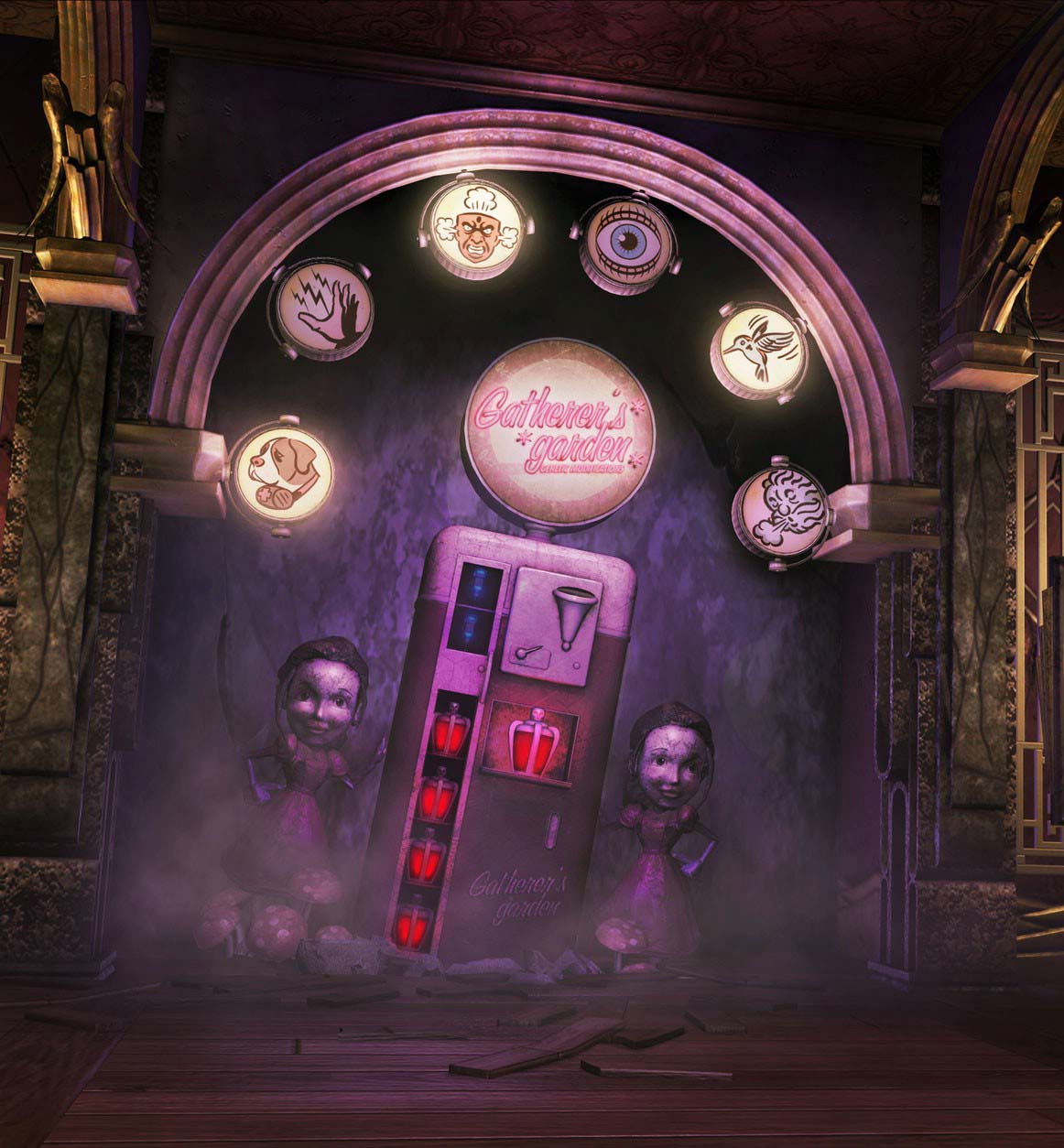
The setting is gripping, but it's also the least of the player's worries. It can frighten, but the remaining citizens of Rapture - they can kill. And they'll kill cheerfully, too, all the while singing songs and muttering enthusiastically to themselves. These people are lumped together under the generic term 'Splicer', implying their extreme genetic modification. From low-powered thugs in masks through to fire-tossing, teleporting madmen, their strength when wielding a pipe is far outweighed by the impact they can leave on your nerves. Far more threatening than this group of variously-powered miscreants are the iconic monsters of the title: the Big Daddies. Acting as patrons for their ADAM-hording Little Sister companions, these creatures are just as tough as you've been lead to believe. While much of a given level involves stalking from room to room dealing with the slicer infestation, the most memorable moments you'll have probably come from one-on-one combat with the diving-suit clad behemoths. And they are completely memorable. Even taken out of context the Big Daddy is one of the creepiest enemies ever to grace a videogame. Everything, from their low groans, to their thudding footsteps, to their cries of rage when they attack, gets across to you that when you face down a Daddy it's 'for real.' Game on. I particularly like how, as they become more and more damaged, steam escapes the Daddy's suit. The implication seems to be that there's something deeply wrong under that helmet.
You're driven through the narrative by the whims of your mostly-unseen benefactor Atlas, who plays the part of the down-to-earth everyman paired with Ryan's soulless venture capitalist. He provides a great deal of information about Rapture's background ... but hints all throughout the game indicate Atlas may be more than he appears. The subtext of 'shades of grey' is laid on throughout the game. Though Ryan is clearly a madman you're given hints of his original intentions, which seem quite benign. Likewise (as has been highly publicized), the ghoulish Little Sisters can be either slain or saved as you desire. Nothing is as it initially appears in Rapture. This moral ambiguity never seems forced, but probably isn't everything the BioShock team hoped it could be. It's very enjoyable to have options, but you're not even making as dramatic a choice as the good and evil options in Knights of the Old Republic. Whether you're a sinner or a saint, you're going to end up at roughly the same place in the end. The great writing and characterization throughout the game stands up much better than any moral overtones.
That's extremely similar to System Shock 2, of course. In keeping with the spirit of that game, your ability to customize your avatar is expansive. There are actually four tracks of powerups to choose from: plasmids, physical tonics, engineering tonics, and combat tonics. While it might sound like you will be engineering a carefully constructed 'build', I found during the course of play that a particular style just emerged based on what I found most useful. Engineering tonics were the upgrades that most appealed to me, and so I made an effort to gain slots in that area. There are far more tonics than slots available, so even as you bump up your character's potential you'll never find yourself wanting for powers. Making use of these powers in the 'emergent gameplay' style is also equally effortless. While it sounds like work from the outside, when you're playing through the game encounters happen so quickly that you rarely have time to realize that you're doing cool stuff before it happens. That was another reason I particularly enjoyed engineering; emergent gameplay can even happen when you're not around. I regularly returned to an encampment I'd made out of hacked turrets to find that they'd been clearing the stage without me. All I had to do at that point was loot the corpses.
From a graphical and audio perspective, BioShock is a work of art. Rendered by the Xbox 360, the world of Rapture is awe-inspiring to behold. Everything looks so good, it's hard to point out any one thing in specific that stands above the rest. After playing the game, the best thing to do is try to pull out moments that stick with you: water as it slides over bare rock, the endless wood paneling of nicer spaces, disturbing altars lit only by an open flame, the obvious fury of a Big Daddy wreathed in flames. The sound design is the same way, with a combination of eerie vocal performances blending into a background of music that could really have come from the 40s. Every movement, every gesture in BioShock has an associated sound. From the 'clunk' of entering the hacking menu to the squeal of radio static when activating the Security Bullseye Plasmid, the sound experience in BioShock is equal to the task of rendering a world from the rich images on the screen.
All of these elements probably seem very familiar to veteran gamers, and they very well should. You've probably played a handful of games that had many elements similar to BioShock before. What sets this game apart and above other offerings, though, is the way the title brings it all together. There's almost nothing out of place here. There's no "but the story could have been better" or "the weapons didn't feel right", or "the enemies got boring" to mar the experience of playing this through for the first time. Is it the best game that will be released this year? Possibly. It's certainly the best FPS to be released since Valve's Episode One hit last year.
So where has all the hate come from? Why are there so many posts and protestations on message boards, all claiming that BioShock 'isn't all it was promised to be'? Even Zero Punctuation's analysis of the game (which you should really seriously check out because it's hilarious) takes some cheap shots at the game's purported low difficulty level. It's all for laughs, of course, but it shows up in the review because it's a common complaint among players. The issue is that the restoration capsules scattered throughout the game, which allow you to respawn right after your death, apparently remove the 'challenge' from the game. Others have said in response, "just don't play it that way, that's why there is a quicksave option." That also seems like a strange argument, because it's essentially telling someone they're 'playing wrong'. I don't really think anyone can play a game incorrectly.
Instead, look at it from the designer's point of view. What happens when you die in an FPS, normally? You reload from your last save. Why bother? Why not just respawn and get right back into the fight, ala the spirit world of Prey? Commenters then complain that it's easy because injured enemies on the level still have reduced health. By the same token, any resources you have expended in the fight up to that point (medkits, ammunition) are also still gone. To my mind, the vita-chambers are only there to make your play experience as seamless as possible, not to make it 'easy'. Ultimately, BioShock can be as hard as you want it to be. The variable difficulty rating along with several save options and the vita-chambers means that you can play through the game in a multitude of ways, with several 'steps' between simply easy, medium, and hard. BioShock is not a brief game, either, clocking in probably around 20-25 hours for most players. Anything that ensures you will move through the game as quickly as possible would (I think) be appreciated.

The real problem, I think, is that hype has made game players disappointed with games as they're actually delivered. When a game is unexpectedly good, we all marvel over the 'sleeper hit.' There comes a point in a game's marketing, though, when more hype is just too much. The result is that when the game is finally delivered, there's almost no way for the real product to match up with player expectations. After Halo 3 launches later this month, odds are there will be a lot of people in forums nitpicking the slightest flaw or perceived imperfection. The lesson, I think, is that as gamers we need to learn to manage our expectations. I'm really looking forward to Mass Effect, for example, but I don't think it's going to change my life. Really, what can we expect out of a game other than a few hours of enjoyment we might not otherwise have had? Just getting that much out of a game, I think, is a big win for the publisher, the developer, and (of course) the player.
Why no mention of the copy protection or the limited number of times it can be installed?
Bioshock was definitely overhyped in my opinion. The atmosphere and art direction were good, no doubt. But gameplay was nothing new from other first person shooters. In fact, I'd say it was even more limited than System Shock 2 or Thief. Stealth as an option? Not really. You pretty much had to fight your way through the game. There were no conversations with decisions to make (ala Fallout). Just recorded conversations you could pick up through the game much like the goofy notes found in No One Lives Forever. There was very little interaction in the game other than combat. No vehicles. Not much in the way of object interaction, either.
Also a much hyped feature was the ability to create your own items like ammo. Well... not really. It was just a collect-the-crap thing that allowed you to sort of unlock extra ammo. It wasn't on the level of, say, the spellbuilder in the Elder Scrolls series.
Finally, there were a lot of plot discrepancies and things that pulled me out of the storyline. Like if I were a plane crash survivor, discovering this underwater city, why would I just inject myself with a syringe I found on a table? There are a lot of things like that which caused the game to simply fall back into the vanilla FPS genre. I find it comparable to Heretic / Hexen, with modern graphics.
The work they did was definitely polished but it's disappointing because there is SO MUCH MORE they could've done with the storyline and gameplay.
Hence the outstanding success and praise of games like Gears of War. Granted, GoW had its own following of hype before the release, but nothing like how Mass Effect and Halo 3 are at the moment.
With GoW, gamers all around expected it to be a good game, but never quite had that "OMG! I'LL DIE IF I DON'T GET THIS!" feeling until after it was released and everyone realized how well made it was.
Yet, with Halo 3, we have the popularity of the series plus the teaser of a multiplayer beta pumping steroids into every fanboy's wet dreams. You made a great point in predicting how critical people will be with the game, but that's to be expected. We're human, we live in our minds and hope for the absolute best.
BioShock is an amazing game, even if it is considered easy to most gamers.
Making the low difficulty level is purposely done to help entice new FPS users. Also, so you don't end up with a controller lodged in your television.
I use sudo in my everyday conversations so I can gain root access.
If the worst thing that can be said about a game is that it is too much like System Shock 2, then that means it is an excellent game. Complaining about that seems to be like saying, "Man, I wish this candy weren't so delicious."
...but is it art?
Frankly it wasn't over-hyped to me. I mean, yeah, there was a lot of hype, but for me the game was sold as soon as it was announced. I was a huge fan of System Shock when it was first released and while I had issues with System Shock 2 initially it was a really great game as well. Deus Ex just continued the winning streak for this loose group of games. Bioshock, though, is where they dropped the ball.
First off is the fact that it all feels dumbed down for a console audience looking for fast, simple gameplay with a few nods to complexity and story thrown in. There's no inventory so everything is just thrown up on your screen like any other shooter. No stats, because everything is handled through the plasmids. In fact, just about everything that would normally be mapped to a sub-screen is now handled in a very limited fashion by wall-mounted consoles (e.g. gun upgrades, plasmids, invention, etc.).
The game is far more linear and yes, the Vita-Chambers do make it too easy. From a console/FPS point of view getting back in the action might be desired, but this isn't a deathmatch here. Dying should feel like it has some consequence. SS and SS2 both had regen machines, but they never felt cheap or easy because there was only one per level and you had to go out and find it and activate it first. As a result dying was a concern. Until you activated the regen there was real tension and once you did, it meant that you weren't totally out of it and back to your last save, but you'd still have to trek across the entire level through hordes of enemies and with very little ammunition. Not just pop out of the chamber and go back to shooting the same enemy.
It's not a terrible game. The graphics are pretty (albeit, on a PC running at Maximum settings, not that much better than what we've gotten used to in recent years) and the setting and theme are novel and interesting even though the art direction seems to have stolen a page from Fallout more often than not. It's just that it was heavily hyped and arrived to glowing reviews when really it's more of a 7/10 sort of game. It's a low point for the series where they tried to transition into a simpler console audience and treated the PC version as the port rather than the other way around. I guess if this is the first game in the series you've ever played it might seem great, but if you've been along since the start then you'll know that it's just no match for it's deeper forebears.
I think gaming is finally starting to suffer from the same thing. To the typical new gamer Bioshock may seem like a wonderful, revolutionary game, but to be honest other than the graphics there is nothing in the game that I haven't in a dozen games over the last 15 years I've been playing then on the PC. It's not a bad game, but it's no 10 out of 10, at least not from where I'm sitting.
P
I see the game as a 4/5 it is not perfect or particularly pushing any boundaries.
AI
Non existent the see you they chase you, you are behind them or over a certain distance they have no idea you are there.
Plasmids
At this time there is no reason to really ever use anything other then the electrical plasmid and sometimes the telekinesis plasmid. This system should have been genre changing see level and monster design for more info. The telekinesis plasmid should be as great and as effective as the physics gun in HL II but ends up being a poor imitation. If I pick up a table or a metal object why is it not an effective bullet shield?
Level Design
You would think that the level design would force and encourage the use of other plasmids some levels the ice or fire would be more effective, then just using the electrical one. This would have been a great way to encourage the use of other plasmids. Physics puzzles for bonuses anyone? HLII used physics puzzles effectively, and so far no one has done it. Bioshock has the mechanic to do it but strangely did not.
Monster Design
For the most part there are 5 monster types in the game that just gain more power or a few abilities to make them more difficult. This would have been the easiest way to make the plasmid system way more effective some monsters have different resists. Why are there only 2 variants of Big Daddies? There is no technique or skill needed to kill them they are just damage tanks, put enough damage into them and they die. Why do they not have different weaknesses on different levels? Why does level design not encourage anything more then a run and gun to kill them?
What was done right
Great looking game, with a great story arch. The game feels very non-linear (while it is.) Sound and VO is excellent. The over all art direction is unparalleled in FPS's. Oh and a blast to play! Which is the most important. Do not get me wrong Bioshock is a great game, but they set out to change the way FPS's are done with the plasmid system and just did not fully realize the implications of this feature set.
---In a time of Chimpanzees I was a Monkey.
Don't have anything to add to this, just thought you might be interested in seeing just how much of a self-righteous jackass you are.
It is inconvenient to have to pay for airline tickets just to travel to another part of the country.Nobody's complaining that it's inconvenient to have to pay for a game in order to legally own it. A better analogy would be that it's inconvenient to be strip-searched every time you want to travel to another part of the country. After all, some number of people smuggle drugs by jamming them up their arse, and drugs are bad, so it's quite reasonable to strip-search everybody and stick your gloved hand up their arse just in case they happen to be trying to smuggle drugs. Every single time they travel on a plane.
Now Joe, he enjoys being anally violated, so it's not an inconvenience for him. You don't like it? Well, tough, because Joe's okay with it, and your opinion is unimportant in the grander scheme of things. Of course, if this happened, then people would stop smuggling drugs on airplanes, so they'd have to incorporate not just an automatic breath tester in your car, but also an automatic invasive drug search, just in case you're trying to smuggle some drugs to your friends place. Then people would stop driving if they're smuggling drugs, so they'd have to add it to your bicycle as well. Then have cops to search you when you're walking down the street, just in case.
Is it that hard to understand that there's different people in the world who are okay with different levels of inconvenience? Having to enter a serial number when I install a game doesn't bother me too much -- I don't like it, and I think it's a pointless inconvenience, but I'm okay with it. Having to enter the serial number every single time I start the game would bother me, and I'd try to find a crack for it, or failing that, not bother with it. For some, having to have a CD in the drive to play the game is too much inconvenience, so they find a workaround.
Having to have the CD in your drive isn't an inconvenience to you. Fine. Will it be inconvenient to have to be connected to the internet every single time you want to play the game, because it verifies you're authorised to play the game each time you run it? Will it be inconvenient that you have to wait for it to download 2 gigs of data every time you play the game, because it removes itself from your drive after you've finished playing it? Will it be inconvenient when their auth servers are down so you can't play the game when you want, or will you be fine with that because it "helps stop piracy"? Will you still think it's fine and dandy when you're only able to play the game on overpriced "certified" PCs which are tightly controlled and prevent you from running any software not signed by one of the manufactures which has purchased, or will you be happy because consoles are already like that?
Just because you're happy with the current measures doesn't mean that anyone who isn't happy doesn't matter. People need to voice their opinions on these things, or else the manufacturers will have no idea when they've gone too far. Every anti-piracy measure is going to piss off some number of legitimate customers, and they need to be able to weigh that against the benefit it provides to them in terms of increased sales. Furthermore, the fact that people who legitimately buy games do feel inconvenienced enough by the copy protection mechanisms that they go out looking for cracks should be a concern to publishers. These people may have otherwise never considered pirating a game, but since they have to go looking for cracks for it anyway, they might end up discovering that it's actually easier to pirate it in the first place rather than go to the store and buy it.
...and I'm here to ask you a question.
Is a man not deserving of enjoying a good PC game without being thought a shallow tool?
No, says the gaming industry. Only the crap sells.
No, says Roger Ebert, no game can be art.
No, says half the posters in this thread, you're a lackey of SecuROM.
I rejected these answers. Instead, I came up with something different. I chose... HAPPINESS.
HAPPINESS. A state where we enjoy good games when they come along, which is rare. Where the gamer is not bound by an understandable but crippling nostalgia for old LGS games. Where great design is not belittled to death.
And with the sweat of your brow, HAPPINESS can become your state as well.
So for those still seeking out the gaming utopia you seem so fondly to desire, would you kindly go jump in the ocean, or better yet, make a better game.