 Slashdot Mirror
BioShock Review
BioShock, the moody drama-driven FPS for the Xbox 360 and PC, was released last month to rave reviews from the major gaming news sites. Since then the internet has been ablaze with outcry about the game's high rating scores. It's hard to understand why. The work of Ken Levine and Irrational Games on the spiritual successor to System Shock 2 is sublime. It's incredibly atmospheric, the game's story is well written and compellingly told, and the first-person shooter gameplay is a respectable, tightly crafted experience. It's a really, really good game. I'll tell you now: it's a 5/5. So why all the angst? Why the backlash? Read on for my review of BioShock, and a few comments on the dangers of 'merely' being a good game.
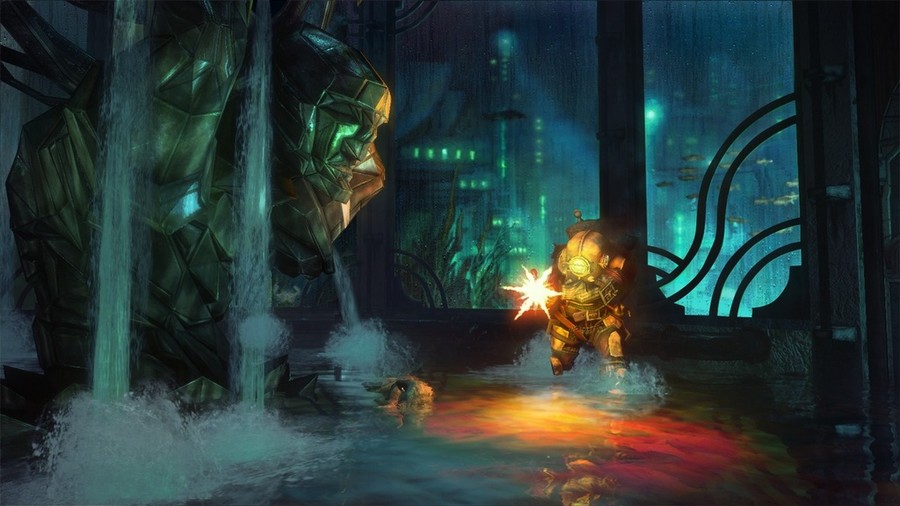
The setting is gripping, but it's also the least of the player's worries. It can frighten, but the remaining citizens of Rapture - they can kill. And they'll kill cheerfully, too, all the while singing songs and muttering enthusiastically to themselves. These people are lumped together under the generic term 'Splicer', implying their extreme genetic modification. From low-powered thugs in masks through to fire-tossing, teleporting madmen, their strength when wielding a pipe is far outweighed by the impact they can leave on your nerves. Far more threatening than this group of variously-powered miscreants are the iconic monsters of the title: the Big Daddies. Acting as patrons for their ADAM-hording Little Sister companions, these creatures are just as tough as you've been lead to believe. While much of a given level involves stalking from room to room dealing with the slicer infestation, the most memorable moments you'll have probably come from one-on-one combat with the diving-suit clad behemoths. And they are completely memorable. Even taken out of context the Big Daddy is one of the creepiest enemies ever to grace a videogame. Everything, from their low groans, to their thudding footsteps, to their cries of rage when they attack, gets across to you that when you face down a Daddy it's 'for real.' Game on. I particularly like how, as they become more and more damaged, steam escapes the Daddy's suit. The implication seems to be that there's something deeply wrong under that helmet.
You're driven through the narrative by the whims of your mostly-unseen benefactor Atlas, who plays the part of the down-to-earth everyman paired with Ryan's soulless venture capitalist. He provides a great deal of information about Rapture's background ... but hints all throughout the game indicate Atlas may be more than he appears. The subtext of 'shades of grey' is laid on throughout the game. Though Ryan is clearly a madman you're given hints of his original intentions, which seem quite benign. Likewise (as has been highly publicized), the ghoulish Little Sisters can be either slain or saved as you desire. Nothing is as it initially appears in Rapture. This moral ambiguity never seems forced, but probably isn't everything the BioShock team hoped it could be. It's very enjoyable to have options, but you're not even making as dramatic a choice as the good and evil options in Knights of the Old Republic. Whether you're a sinner or a saint, you're going to end up at roughly the same place in the end. The great writing and characterization throughout the game stands up much better than any moral overtones.
That's extremely similar to System Shock 2, of course. In keeping with the spirit of that game, your ability to customize your avatar is expansive. There are actually four tracks of powerups to choose from: plasmids, physical tonics, engineering tonics, and combat tonics. While it might sound like you will be engineering a carefully constructed 'build', I found during the course of play that a particular style just emerged based on what I found most useful. Engineering tonics were the upgrades that most appealed to me, and so I made an effort to gain slots in that area. There are far more tonics than slots available, so even as you bump up your character's potential you'll never find yourself wanting for powers. Making use of these powers in the 'emergent gameplay' style is also equally effortless. While it sounds like work from the outside, when you're playing through the game encounters happen so quickly that you rarely have time to realize that you're doing cool stuff before it happens. That was another reason I particularly enjoyed engineering; emergent gameplay can even happen when you're not around. I regularly returned to an encampment I'd made out of hacked turrets to find that they'd been clearing the stage without me. All I had to do at that point was loot the corpses.
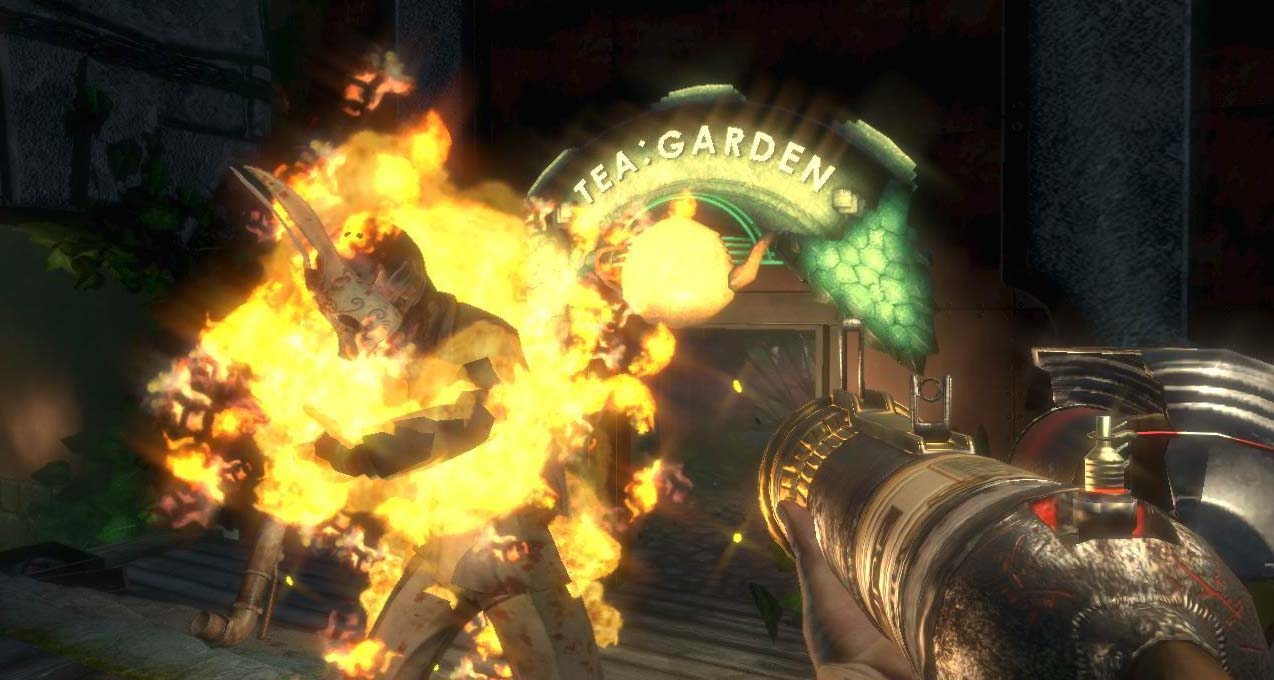
From a graphical and audio perspective, BioShock is a work of art. Rendered by the Xbox 360, the world of Rapture is awe-inspiring to behold. Everything looks so good, it's hard to point out any one thing in specific that stands above the rest. After playing the game, the best thing to do is try to pull out moments that stick with you: water as it slides over bare rock, the endless wood paneling of nicer spaces, disturbing altars lit only by an open flame, the obvious fury of a Big Daddy wreathed in flames. The sound design is the same way, with a combination of eerie vocal performances blending into a background of music that could really have come from the 40s. Every movement, every gesture in BioShock has an associated sound. From the 'clunk' of entering the hacking menu to the squeal of radio static when activating the Security Bullseye Plasmid, the sound experience in BioShock is equal to the task of rendering a world from the rich images on the screen.
All of these elements probably seem very familiar to veteran gamers, and they very well should. You've probably played a handful of games that had many elements similar to BioShock before. What sets this game apart and above other offerings, though, is the way the title brings it all together. There's almost nothing out of place here. There's no "but the story could have been better" or "the weapons didn't feel right", or "the enemies got boring" to mar the experience of playing this through for the first time. Is it the best game that will be released this year? Possibly. It's certainly the best FPS to be released since Valve's Episode One hit last year.
So where has all the hate come from? Why are there so many posts and protestations on message boards, all claiming that BioShock 'isn't all it was promised to be'? Even Zero Punctuation's analysis of the game (which you should really seriously check out because it's hilarious) takes some cheap shots at the game's purported low difficulty level. It's all for laughs, of course, but it shows up in the review because it's a common complaint among players. The issue is that the restoration capsules scattered throughout the game, which allow you to respawn right after your death, apparently remove the 'challenge' from the game. Others have said in response, "just don't play it that way, that's why there is a quicksave option." That also seems like a strange argument, because it's essentially telling someone they're 'playing wrong'. I don't really think anyone can play a game incorrectly.
Instead, look at it from the designer's point of view. What happens when you die in an FPS, normally? You reload from your last save. Why bother? Why not just respawn and get right back into the fight, ala the spirit world of Prey? Commenters then complain that it's easy because injured enemies on the level still have reduced health. By the same token, any resources you have expended in the fight up to that point (medkits, ammunition) are also still gone. To my mind, the vita-chambers are only there to make your play experience as seamless as possible, not to make it 'easy'. Ultimately, BioShock can be as hard as you want it to be. The variable difficulty rating along with several save options and the vita-chambers means that you can play through the game in a multitude of ways, with several 'steps' between simply easy, medium, and hard. BioShock is not a brief game, either, clocking in probably around 20-25 hours for most players. Anything that ensures you will move through the game as quickly as possible would (I think) be appreciated.
The real problem, I think, is that hype has made game players disappointed with games as they're actually delivered. When a game is unexpectedly good, we all marvel over the 'sleeper hit.' There comes a point in a game's marketing, though, when more hype is just too much. The result is that when the game is finally delivered, there's almost no way for the real product to match up with player expectations. After Halo 3 launches later this month, odds are there will be a lot of people in forums nitpicking the slightest flaw or perceived imperfection. The lesson, I think, is that as gamers we need to learn to manage our expectations. I'm really looking forward to Mass Effect, for example, but I don't think it's going to change my life. Really, what can we expect out of a game other than a few hours of enjoyment we might not otherwise have had? Just getting that much out of a game, I think, is a big win for the publisher, the developer, and (of course) the player.
- Title: BioShock
- Developer/Publisher: Irrational Games (2K Boston/2K Australia) / 2K
- System:360 (PC)
- Genre: RPG/ FPS Hybrid
- Score: 5/5 - This game is a classic title. It transcends genre, is certain to be a part of many serious gamers' collections, and is definitely worth purchasing.
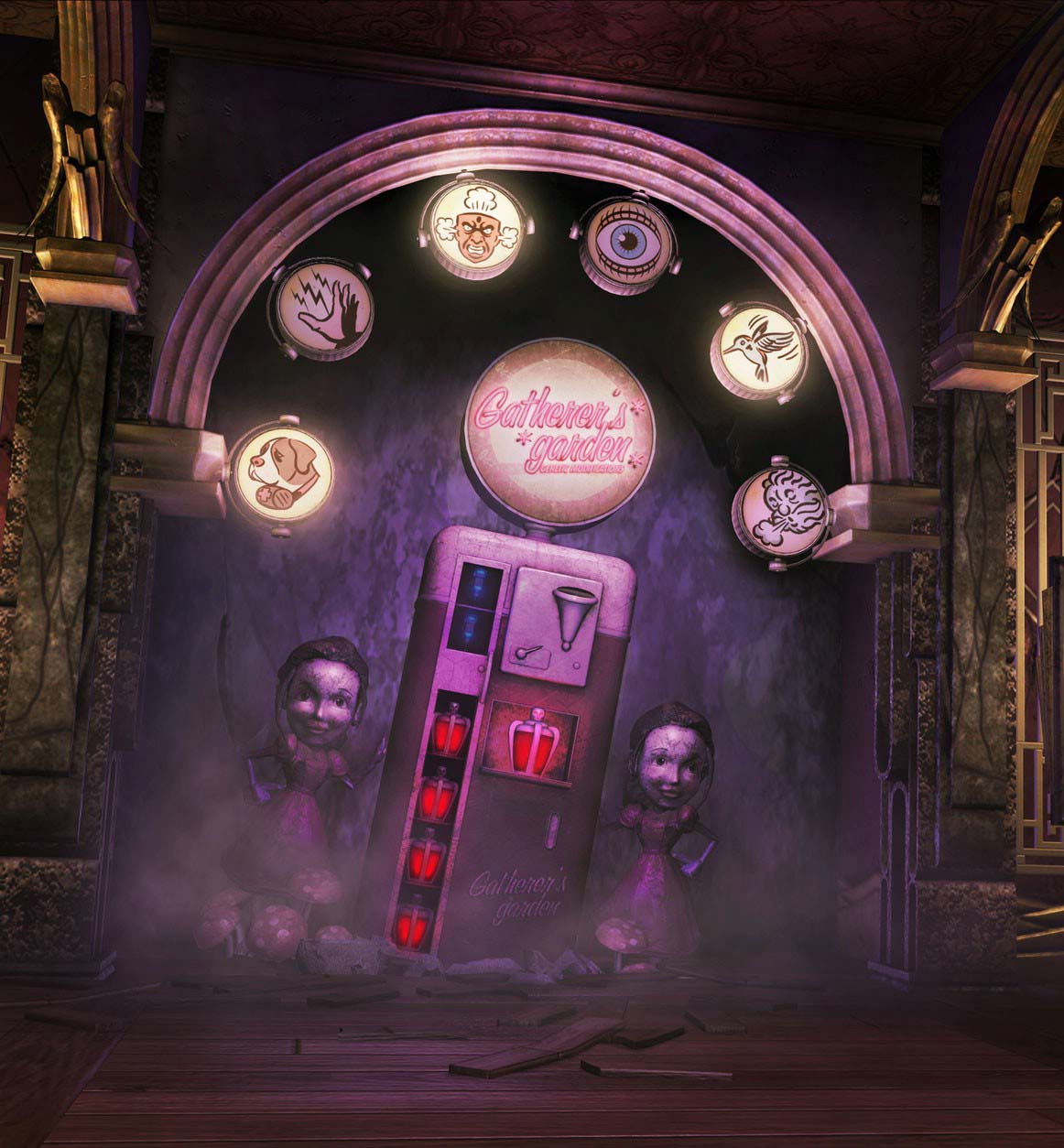
The setting is gripping, but it's also the least of the player's worries. It can frighten, but the remaining citizens of Rapture - they can kill. And they'll kill cheerfully, too, all the while singing songs and muttering enthusiastically to themselves. These people are lumped together under the generic term 'Splicer', implying their extreme genetic modification. From low-powered thugs in masks through to fire-tossing, teleporting madmen, their strength when wielding a pipe is far outweighed by the impact they can leave on your nerves. Far more threatening than this group of variously-powered miscreants are the iconic monsters of the title: the Big Daddies. Acting as patrons for their ADAM-hording Little Sister companions, these creatures are just as tough as you've been lead to believe. While much of a given level involves stalking from room to room dealing with the slicer infestation, the most memorable moments you'll have probably come from one-on-one combat with the diving-suit clad behemoths. And they are completely memorable. Even taken out of context the Big Daddy is one of the creepiest enemies ever to grace a videogame. Everything, from their low groans, to their thudding footsteps, to their cries of rage when they attack, gets across to you that when you face down a Daddy it's 'for real.' Game on. I particularly like how, as they become more and more damaged, steam escapes the Daddy's suit. The implication seems to be that there's something deeply wrong under that helmet.
You're driven through the narrative by the whims of your mostly-unseen benefactor Atlas, who plays the part of the down-to-earth everyman paired with Ryan's soulless venture capitalist. He provides a great deal of information about Rapture's background ... but hints all throughout the game indicate Atlas may be more than he appears. The subtext of 'shades of grey' is laid on throughout the game. Though Ryan is clearly a madman you're given hints of his original intentions, which seem quite benign. Likewise (as has been highly publicized), the ghoulish Little Sisters can be either slain or saved as you desire. Nothing is as it initially appears in Rapture. This moral ambiguity never seems forced, but probably isn't everything the BioShock team hoped it could be. It's very enjoyable to have options, but you're not even making as dramatic a choice as the good and evil options in Knights of the Old Republic. Whether you're a sinner or a saint, you're going to end up at roughly the same place in the end. The great writing and characterization throughout the game stands up much better than any moral overtones.
That's extremely similar to System Shock 2, of course. In keeping with the spirit of that game, your ability to customize your avatar is expansive. There are actually four tracks of powerups to choose from: plasmids, physical tonics, engineering tonics, and combat tonics. While it might sound like you will be engineering a carefully constructed 'build', I found during the course of play that a particular style just emerged based on what I found most useful. Engineering tonics were the upgrades that most appealed to me, and so I made an effort to gain slots in that area. There are far more tonics than slots available, so even as you bump up your character's potential you'll never find yourself wanting for powers. Making use of these powers in the 'emergent gameplay' style is also equally effortless. While it sounds like work from the outside, when you're playing through the game encounters happen so quickly that you rarely have time to realize that you're doing cool stuff before it happens. That was another reason I particularly enjoyed engineering; emergent gameplay can even happen when you're not around. I regularly returned to an encampment I'd made out of hacked turrets to find that they'd been clearing the stage without me. All I had to do at that point was loot the corpses.
From a graphical and audio perspective, BioShock is a work of art. Rendered by the Xbox 360, the world of Rapture is awe-inspiring to behold. Everything looks so good, it's hard to point out any one thing in specific that stands above the rest. After playing the game, the best thing to do is try to pull out moments that stick with you: water as it slides over bare rock, the endless wood paneling of nicer spaces, disturbing altars lit only by an open flame, the obvious fury of a Big Daddy wreathed in flames. The sound design is the same way, with a combination of eerie vocal performances blending into a background of music that could really have come from the 40s. Every movement, every gesture in BioShock has an associated sound. From the 'clunk' of entering the hacking menu to the squeal of radio static when activating the Security Bullseye Plasmid, the sound experience in BioShock is equal to the task of rendering a world from the rich images on the screen.
All of these elements probably seem very familiar to veteran gamers, and they very well should. You've probably played a handful of games that had many elements similar to BioShock before. What sets this game apart and above other offerings, though, is the way the title brings it all together. There's almost nothing out of place here. There's no "but the story could have been better" or "the weapons didn't feel right", or "the enemies got boring" to mar the experience of playing this through for the first time. Is it the best game that will be released this year? Possibly. It's certainly the best FPS to be released since Valve's Episode One hit last year.
So where has all the hate come from? Why are there so many posts and protestations on message boards, all claiming that BioShock 'isn't all it was promised to be'? Even Zero Punctuation's analysis of the game (which you should really seriously check out because it's hilarious) takes some cheap shots at the game's purported low difficulty level. It's all for laughs, of course, but it shows up in the review because it's a common complaint among players. The issue is that the restoration capsules scattered throughout the game, which allow you to respawn right after your death, apparently remove the 'challenge' from the game. Others have said in response, "just don't play it that way, that's why there is a quicksave option." That also seems like a strange argument, because it's essentially telling someone they're 'playing wrong'. I don't really think anyone can play a game incorrectly.
Instead, look at it from the designer's point of view. What happens when you die in an FPS, normally? You reload from your last save. Why bother? Why not just respawn and get right back into the fight, ala the spirit world of Prey? Commenters then complain that it's easy because injured enemies on the level still have reduced health. By the same token, any resources you have expended in the fight up to that point (medkits, ammunition) are also still gone. To my mind, the vita-chambers are only there to make your play experience as seamless as possible, not to make it 'easy'. Ultimately, BioShock can be as hard as you want it to be. The variable difficulty rating along with several save options and the vita-chambers means that you can play through the game in a multitude of ways, with several 'steps' between simply easy, medium, and hard. BioShock is not a brief game, either, clocking in probably around 20-25 hours for most players. Anything that ensures you will move through the game as quickly as possible would (I think) be appreciated.

The real problem, I think, is that hype has made game players disappointed with games as they're actually delivered. When a game is unexpectedly good, we all marvel over the 'sleeper hit.' There comes a point in a game's marketing, though, when more hype is just too much. The result is that when the game is finally delivered, there's almost no way for the real product to match up with player expectations. After Halo 3 launches later this month, odds are there will be a lot of people in forums nitpicking the slightest flaw or perceived imperfection. The lesson, I think, is that as gamers we need to learn to manage our expectations. I'm really looking forward to Mass Effect, for example, but I don't think it's going to change my life. Really, what can we expect out of a game other than a few hours of enjoyment we might not otherwise have had? Just getting that much out of a game, I think, is a big win for the publisher, the developer, and (of course) the player.
The main reason that people are so irritated with the game, in my opinion, is spite for casual gamers. Casual gamers want games to be more like movies. What I mean by that is that they want constant forward motion, and they don't want to have to think too much. A lot of these people consider any sort of challenge work. If this game were made of the PC only, for serious gamers, there wouldn't be all these concessions. It's sad to see potential lost because companies want to make more money off lowest common denominator consumers. Same reason why most movies and all other popular art is bad. It's made to appeal to people with 8th grade educations, seriously. If thing weren't so simplistic all the idiots of the world would label things boring and they wouldn't sell. Something that people don't talk about is that people with a 100 IQ, which is what the average is, are pretty god damn dumb, then think about the other huge segment below 100. And we wonder why democracy doesn't work better.
This was a very well thought out and tight conclusion to your post. Unfortunately it points out exactly why you should NOT have a problem with protected titles.
Don't you think that the game companies themselves feel exactly the way you do, in that they are "really fed up with the pirates consistently getting the better product than the legit customers" as well? They are, and this is why they are making it increasingly difficult to pirate their games. So a real question is; Why are you opposed to anything that might slow or even stop the piracy of the games that you enjoy, if you are opposed to software piracy?
I really do think the question is why I should ever have to worry about a product I bought suddenly deciding I cannot install it.I know, I know. Everyone hates car analogies. Well, I'm gonna use one with two different examples. Automobiles that made you fasten your seatbelt before they would start. Automobiles that make you pass a breathilizer test before you can start the car. Why should anyone have to worry about a product they bought suddenly deciding that it is not going to do what it is supposed to? If the owner of that product is attempting to use it in a manner that has been arbitrarily decided to be "bad" or against the proscribed usage of that product (driving without a seatbelt or driving with a blood alcohol level above a certain amount). Now, it *IS* possible that the owner of a car restricting usage based on seatbelts might have that car in an area that did not have seatbelt laws. So, they *could* wish to drive without a seatbelt, regardless of how utterly careless and idiotic this may be, and this would violate no statutes and not get them into legal trouble. This relates to the number of installs a game might be limited to. Sure, there *could* be a legitimate reason for installing (without uninstalling) the game you buy a number of times exceeding what the company who made the game thinks is a good number. However, the game company has decided that this is the anti-piracy policy they are going to follow. It dictated that they needed to pick a number of installs to draw the line at (regardless of their decision to rescind this restriction later).
Don't even go there trying to attack cars that attempt to determine if you are too drunk to drive.
What if you lost your serials to the Battlefield 1942 install discs? Then, this product you purchased will no longer install. Gee. You spent money on a product that now decides you cannot play it, because you fail to jump through the proper hoop. If you want to be able to uninstall and reinstall, you have to keep track of more than just game discs. It's a restriction, and not one that will lift a few months down the road. You just happen to accept that restriction.
And you are thankful for cracks? So, although you condemn piracy, you encourage (and endorse) it? I'm sorry. In the end, you prove yourself to be a hypocrite.
"I love deadlines. I love the whooshing sound they make as they fly by." -D. Adams