 Slashdot Mirror
How Computers Transformed Baby Boomers
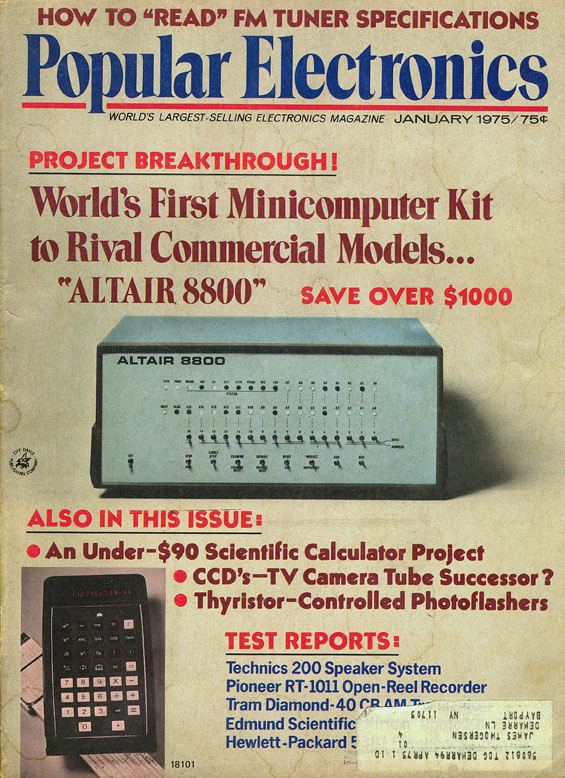
theodp writes "Newsweek's Steven Levy takes a look at how the baby boomer generation formed our tech landscape. Many of the realities boomers grew up with are today's metaphors, including cut-and-paste, the origin of which the 56-year-old Levy had to explain to 20-something Google employees. Levy cites two texts as crucial in pushing the boomers' vision toward power-to-the-people computing — Ted Nelson's Computer Lib/Dream Machines, which inspired Mitch Kapor, and the January 1975 Popular Electronics, which got Bill Gates jazzed. You kids might want to check out Dad's bookshelf — used copies of Computer Lib are going for $130-$225 at Amazon."
I had no idea that CL/DM was selling for so much. I just checked my shelf, I bought a copy for $18.95 in 1992 at the local university bookstore - the sticker's still on it.
I wonder why it's so expensive? The book is terrible, virtually unreadable. Ted Nelson is a nutcase by all reports. Look at the repeated failures of his Xanadu idea.
I guess I should probably sell it; it has no value to me and $150-200 would be pretty nice.
Did baby boomers use scrolls, too?
The shareholder is always right.
I had the same thought while reading that article.
Where does Steven Levy think transistors came from? Or electricity, or math?
What I'm listening to now on Pandora...
Apparently the Boomers were responsible for everything, including all technology! Nevermind that your parents don't know the first thing about computers.
...and it works spectacularly well.
The modern version works like this: you need a photocopier, your source material, a pair of scissors, and a stick of solid glue. Photocopy all your source materials. Cut them up. Stick them onto a blank piece of paper in the order you want. Photocopy. All the seams miraculously vanish, and you end up with an extremely professional-looking end result.
It's a great deal easier than scanning and using a DTP package, it's faster, and it can also produce better results depending on your photocopier and scanner. I wouldn't use it for anything that needed to be stored for long periods of time --- your template is fragile and will fall apart if stored --- but for quickly putting together posters, exam questions (I inherited the technique from my father, who was a teacher), simple fliers, news clipping collections etc, it's first rate.
Don't get glue on the photocopier plate. It'll never come off.
I don't know, after the cyborg revolution the computers will need something to feed on, and what better than old people, the same people who invented computers to begin with?
Monstar L
Many 19th century inventions invented by 19th century inventors. Film at 11.
Don't think of it as a flame---it's more like an argument that does 3d6 fire damage
Railroads and electricity made much bigger changes in people's lives. Before railroads, most people spent their lives within 50 miles of their birthplace. Before electricity, it was, well, dark at night almost everywhere. Huge amounts of effort went into activities like basic cooking and cleaning clothes.
The changes between 1850 and 1900 were far, far greater than those between 1950 and 2000. In communications, in 1950 we had radio, television, teletype, and telephones. Even newspaper delivery via broadcast radio fax, although that never really caught on. Most important info was getting to its destination fast. Most of the communication things you can do today, you could do in 1950, but more expensively.
Steven Levy deserves a lot of credit for his book Hackers, which was the first place to publicly discuss "the hacker ethic." He really "got" a lot of the things that journalists today still don't get. You can disagree with a lot of what he says, and his "ethic" list is a little goofy, but as a "third" generation hacker (someone who grew up hacking on an Apple ][e), I found his interpretation of what was going on in the golden age deeply insightful. IMO, "computer journalism" has never really produced someone like him again -- today it's all David Pogue type "gadget reviewers" who really don't get what was, and still is, revolutionary about computing and the people involved in it.
Protect your liberties. Donate to the ACLU
And hop in the DeLorean... we're going back to 1975 to make sure Popular Electronics never prints that issue...
you had me at #!
If only there was a way to harness the boomers' power of nostalgia and put it to good use. Like banks of boomers chasing after 12" GI Joes, or copies of "The Big Chill" on treadmills running generators.
Well, I can't speak to 20-something google employees, but when I acquired a 1930's Underwood typewriter a couple of years ago, the 12 year old son of a friend looked at it and asked what it was. I asked him what it looked like, and he replied that it looked something like a keyboard. He didn't know what a typewriter was.
Admittedly the kid is not the sharpest knife in the drawer, but I suspect that he's reasonably representative of his peer group.
Now that I think about it, the second graders might do better than a 12 year old. They're not heading into that teen recalcitrant thing and their imagination hasn't been spiked yet.
[17] Leary, T., White, C., Wood, P. R., Bhabha, W. D., and Wirth, N. Lambda calculus considered harmful. In Proceedings
I feel it should be pointed out that there are Boomers and then there are Boomers. Many of the most influential Baby Boomers for personal computers were born more or less in the mid fifties. They were barely teenagers when Woodstock happened and they became eligible for the draft just around the time America left Vietnam. To call them Baby Boomers isn't exactly wrong, (some demographers call them Generation Jones, but it's all bullshit anyway) but to lump them in with those "damned self-important idealists" as some of the other posters are doing is unfair, since by the time these guys came of age, the idealism had already begun to go the other way.
"Never attribute to malice that which can be adequately explained by stupidity." -- Hanlon's Razor
The 'Facebook' generation is calling the 'Boomer' generation self-absorbed? Honestly, is there anything more self-centered than MySpace and Facebook?