 Slashdot Mirror
IBM Patents Checking a Box
theodp writes "What do you call it when you drag a pointer over a checkbox to select or deselect it depending on its original state? Answer: US Patent 7,278,116. On Tuesday, the USPTO awarded IBM a patent for Mode Switching for Ad Hoc Checkbox Selection, aka Making an 'X'. Isn't this essentially the same concept as the older Lotus Notes selection model that IBM was recently asked to reintroduce?"
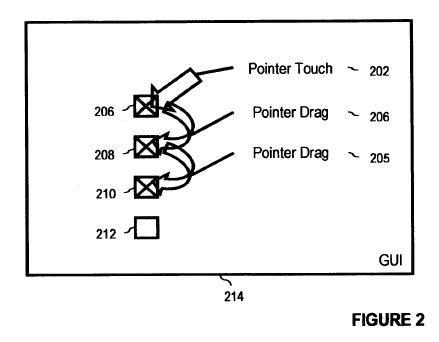
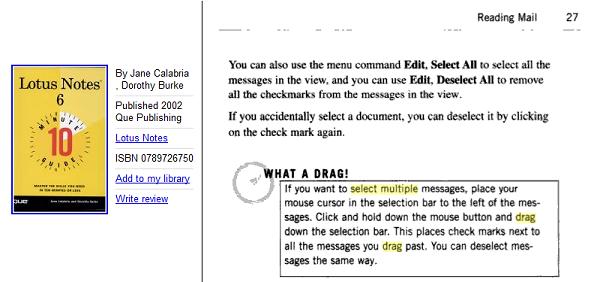
First of all, it's not just "checking a box." It's clicking to toggle a checkmark, and dragging across a bunch of other checkboxes to toggle them all on (or off, depending on the state of the first one you clicked).
Second of all, I have mixed feelings about this.
On the one hand, it really bothers me in a cosmic sense that there was a patent granted for something so patently stupid. (Pun slightly intended.) I'm sorry, but this falls squarely in the realm of obvious to me. I mean, really, are programmers expected to patent every single frickin' thing they do out of fear that someone else might? Because that's the world we're living in, and I'd really like for it to change.
On the other hand, I'm sorry, but the Lotus Notes selection model is one of the most frustratingly stupid things I've ever encountered in my life. Almost every other piece of software follows the old click-first-item, shift-click-last-item model. (Or ctrl-click individual items.) It's been in use since... Well, as long as I can remember using a GUI, and I'm really hard-pressed to think of any other way that selections work. Except for Lotus Notes, where they use this asinine system of selecting messages which means that if I have several pages of stuff to select, I have to scroll past each. and. every. one. Frankly, if IBM is the only company that can do this and it prevents any other company that has the bright idea from implementing something like this, then I can almost bring myself to say that this is a good thing.
If IBM can patent the checkbox, what's next? The radio button? The text box? Maybe even the address bar?!?
.sig
What do you call it when I drag the U.S. software patent system behind my car until it is an unrecognizable bloody mess?
Sorry for the graphic imagery, but I'm really getting sick of this crap.
Ceci n'est pas une sig.
I'm patenting my own method of box checking:
1. Cut a hole in the box.
2. Put your check in that box.
3. Make her open the box.
Let's not stir that bag of worms...
Well, I guess I won't be posting anonymously for once.
And while we are ripping on Lotus Notes...
Why in the name of God would they take the F5 key (the key every other application known to man uses to refresh) and assign to to "Logout"?!?!??!!?
WTF?
Ive been using Lotus (against my will) for 3 years now, and still a few times a month I hit F5 because I just KNOW that I should have that email response by now.
FOR THE LOVE OF GOD MAN!!!!!
No, I dont normally invoke the name of God 2 times in an email (Well, I guess thats 3 now). Its just a sign of the wrath Lotus brings out in me.
I have actual prior art on this. This is a common UI design in the audio world. If you click on a mute button and drag across multiple tracks, it mutes all of them just like it would if you drug your finger across the mute buttons on a console. Most DAW software I've used does this---BIAS Deck, MOTU Digital Performer, Apple Logic.... the list is almost endless.
This is another example of a really obvious patent that adds NOTHING to advance the state of the art. The very fact that this patent was awarded is further evidence that every cool new idea that could possibly be patented in software has already been done at least once, and probably more than once, and hence, software patents to not do anything to improve the state of the art and only serve to harm innovation and stifle competition in the marketplace.
Check out my sci-fi/humor trilogy at PatriotsBooks.
There are various tricks to subvert patent expiration, and this is one of them. Instead of patenting a large system, they patent as many small parts of it as possible, spreading the applications over years.
This way, the system as a whole doesn't lose protection until the last patent expires. The mp3 patents are an example of this, as they would have entered the public domain years ago if not for these shenanigans.
The only real solution is to require one patent per system. Make them pick the best and disallow any associated patents.
No one here understands the complexity involved in checking a box. I don't work for IBM and I am not a marketing expert, if you have side questions on my post please contact me at nocengineer@ibm.com with that said:
IBM's patented technology is a boon to the Interweb of Googletoolbars worldwide. This extremely proficient alternative to physically filling out a form with a paper and pen method deserves its right in Patentdumb history. The traditional approach of said former technology via the pen and the paper is an approach that is inefficient and expensive. IMB's modular design of the radio button and check button interface allows users to utilize with maximum proficiency, the power of checking a box.
Thank you
THIS AND OTHER SUBSEQUENT POSTS ARE PATENT PENDING
Infiltrated dot Net
As someone who used Notes, let me just say that God had nothing to do with it's design. You need to look in the other direction.
My sci-fi novel, Ghost Thief, is now available from Amazon.com.
Almost every other piece of software follows the old click-first-item, shift-click-last-item model. (Or ctrl-click individual items.) It's been in use since... Well, as long as I can remember using a GUI, and I'm really hard-pressed to think of any other way that selections work.
I believe, like many other standards in GUIs, this was first introduced as a standard by Apple and documented in the Macintosh User Interface Guidelines in the 80's (although I'm sure someone did it somewhere before that). Later Microsoft began using a similar standard, while XWindows was still using a "select copies, and right-click pastes" into the 90's, at least in twm and many of the common window managers (not sure what Motif did here).
E pluribus unum
I am a patent attorney who tries to get his clients good, valid patents for any technology, including those that are implemented in software.
I really hate to see patents like this being granted, because they are so obviously stupid, and bring the whole system into disrepute.
If this were a granted European patent, it would have any number of oppositions filed against it. (An opposition is a cheap and effective challenges to a granted patent). IMO, no proper patent system should be without a workable system of opposition!
This is a horrible mess, and I wish that there were a way of extracting it from the US patent system in a way that will save IBM the ignominy of having such an obviously bad patent granted in its name.
A
It is because they picked that key before F5 meant refresh for everybody else, and they don't want to change it and confuse all the experienced Notes users just because some newfangled (read: after 1990 or so) products do it differently.
You'll probably feel equally angry when you try out Notes 8 and realize that CTRL+tab doesn't take you between tabs because they decided to update themselves to use the same shortcut keys Eclipse uses for that operation, but you can't be angry at BOTH decisions and maintain internal rational consistency.
Oh, say does that Star-Spangled Banner entwine / The myrtle of Venus with Bacchus's vine?
IBM Guy: Hey man, you know I have an patent?
Party Dude: Really? What does it pertain to?
IBM Guy: The "check box".
Party Dude: The check box? Is that a new microchip technology.
IBM Dude: No man... it's the box, that, you check... on forms 'n shit
Party Dude: Really? That's not that novel...
IBM Dude: Check it... you are on a computer and if you want to indicate that an item needs to be checked... you click on this little box, and, it totally gets checked-off... Way cool, cutting edge shit...
Party Dude: Cool man. Need to get away, um, I mean some beer. Check you later.
~ In Trust, We Trust ~
I spent the better part of last year working at a client site that used Lotus Notes for e-mail, and thus, so did I, at least for their corporate stuff. I found it incredibly frustrating to use and frequently wished I could use something with a more satisfying user experience. Say, pine or elm.
One of my lifelong best friends worked as a developer for IBM at the time, so naturally the next time I saw him I bitched at him about how much I hated Notes and asked how he could stand it. His reply? "Oh, I wouldn't know about that. We use Outlook."
I'm sure there must be some (maybe even most) departments of IBM that use Notes, but man. To foist that dog food on the world and not even eat it yourself? That's the devil right there.
I'm puzzled at this patent, but no more than I am about Notes in general.
If you don't like IBM's actions, phone your representative for patent law reform as it's the government's own fault for the sad state in which patent law exists today.
09 F9 11 02 9D 74 E3 5B D8 41 56 C5 63 56 88 C0
Kids have been drag-selecting check-buttons for years. The de-selection mode of it wasn't done because even the de-selection of even one such button was not implemented for anyone without an elevator key.
Oh, say does that Star-Spangled Banner entwine / The myrtle of Venus with Bacchus's vine?
While independent claims 1, 6, and 11 do cover multiple checkboxes, they not require dragging do toggle the state of multiple checkboxes. That is covered in later dependent claims. Effectively IBM has just been granted a patent on the basic GUI checkbox which was implemented by Apple in the Lisa Office System in January 1983. Xerox probably used checkboxes before that, but I'm not certain. It seems likely that Claims 1, 6, and 11 can be invalidated by prior art, should someone be willing to invest the time and effort to do so. The dependent claims might have a better chance of being upheld.
This is a common UI design in the audio world.
Ah-hah! But this is On A Computer! Completely original!
Next up they'll patent the same thing, but On The Internet! Genius!
The enemies of Democracy are
That being said, let's see what IBM really patented. First, for the time being, discount everything before the "claims." Claims protect what the patentee considers his/her invention. There are 15 claims of the '116 patent ("We" usually refer to patents by their last three digits). Claims 1, 6, and 11 appear to be the independent claims. These are, arguably, the broadest claims in that the claimed subject matter is much broader than claims 2-5, 7-10, and 12-15.
Claim 1 recites:
A method for control of checkbox status, the method comprising:
Now, we come to the crux of the matter. What do these three limitations mean? Honestly, I have no idea. This is when we have to go back and read everything before the claims. Do these three limitations mean merely "checking a box"? Somehow, I don't think so. There seems to be a lot more going on here. For example, what does it mean to "detect[] a mode selection event"? That doesn't sound like merely "checking a box." That sounds like a bit more.
The other independent claims recite a similar limitations. For example, claim 6 recites "means for detecting a mode selection event." What does this mean? I don't know, I haven't read the rest of the patent's specification. Again, however, this seems to be a bit more than "checking a box." I live it up to another reader to figure out what this limitation means.
The lesson to take away here is that the patent stories on Slashdot are sensationalism at its finest. I read Slashdot, and often, I find the stories very interesting. However, the patent summaries are atrocious and are nothing short of informative, if not misleading.
If you think you have prior art that would invalidate this patent, then please, submit it. I invite you to read about the reexamination procedures at the USPTO. You can find them here.
The views expressed herein are in no way associated with any private entity or government organization
The reality is that IBM has a huge patent portfolio. You can't urinate on a computer without violating one of their patents. Why do they need junk patents like this one? If IBM is truly doing this defensively, they should be be phoning their representatives instead of filing such dubious patents. Instead of trying to change the system, they are taking advantage of the brokenness, and that's wrong.
IBM should drop this patent or release it into the commons or something. It should never have been granted, and profiting from wrong is still wrong.
Check out my sci-fi/humor trilogy at PatriotsBooks.
Photoshop does the same thing. Click the eye to toggle vis of a layer and you can drag to do more than one.
Damn! I just finished preparing my patent for "Usage of Computer as Human Waste Receptical", and you're telling me that there's prior art?
The M.Y.O.B Accounting software I use in my business has had this feature for years. When reconciling your checking account, for example, just click on a cleared check and drag across all the others in sequence that have also cleared, and they all get checked.
Nothing to see here, folks. Move along.
F5 Logoff - its origins:
Remember, Notes has been around since 1973 ('PLATO Notes'), so there are some quirks in there which might seem illogical until you examine its history. I first came across Notes in 1987 before it was ever released by Lotus. Back then it was known as DEC Notes and was widely (internationally) used within Digital Equipment Corporation on their VAX network, but never commercially released.
A DEC Notes user would logon to their VAX host using a 'dumb' VT terminal. To logout, a user could use a menu option or the command line, in which case their process was gracefully terminated by the host, alternatively they could hit the shortcut F5 key. On the back of your terminal was a DB25pin male RS232 port - on hitting the F5 key, the voltage on pin#20 (DTR - data terminal ready) would drop to 3 volts. The modem (DCE) to which you were connected would respond by dropping its carrier signal which would hang up your phone line (no Hayes commands either). At the far end of the phone line, the host modem would respond to carrier loss by dropping the voltage on its pin#6 (DSR - data set ready), and the comm port on the host VAX would respond by killing the user's process. This was the standard of the time.
When Ray and the guys took their idea to Lotus, pc networking and client/server architecture was just evolving. In the absence of any standard they simply carried over the tradition of F5 logout from the DEC environment. Up till then, the nearest thing to 'groupware' was internet newsgroups or bulletin board services (typically a host/terminal topology) - at the time, F5 was a well-considered choice for a logout shortcut
Soonafter, Windows emerged and some ignoramous up in Redmond decided to assign F5 as refresh.
I think Erwin Schrödinger beat you on the prior art. He invented "checking a box" in 1935.
Have you ever considered piracy? You'd make a wonderful Dread Pirate Roberts.
Haven't gynaecologists been checking boxes for years?
Nope. Just send your check to me and I'll make sure it gets to IBM.