 Slashdot Mirror
Amazon Sneaks One-Click Past the Patent System
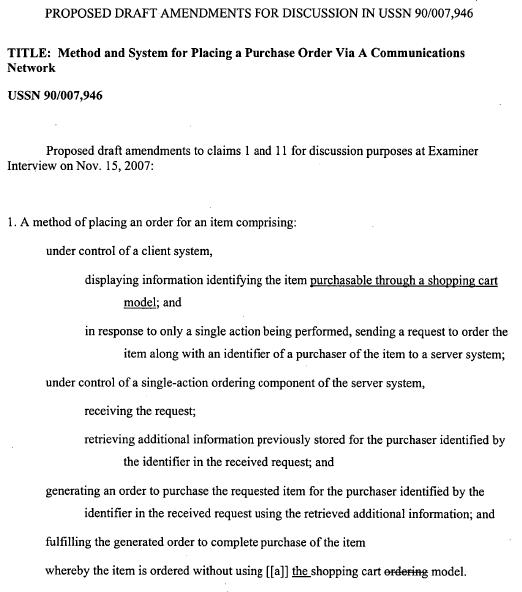
theodp writes "By changing the word 'a' to 'the' and adding the phrase 'purchasable through a shopping cart model,' lawyers for Amazon.com have apparently managed to reinstate two of CEO Jeff Bezos' 1-Click Patent claims that were rejected a month earlier. 'Patent Owner's Rep was informed that the proposed addition to the claims appear to place the claims in condition of patentability,' writes the USPTO in its Ex Parte Reexamination Interview Summary of the 11-15 conference call that was held with five representatives of the USPTO and patent reformer Amazon."

The present system of patents is totally broken. It appears to exist for the promotion of lawsuits and legal fees rather than achieving true innovation.
Of course, if you have a shopping-cart ordering model, then it's not a one-click buy.
...
Let's break that down with some specifics:
1. A method of placing an order for an item comprising;
1) a web browser
2) a web page about an item
3) where pushing "buy now" causes the web browser to send a "buy this item now" message to a web server
4) a web server
5) receives te request
6) looks up the purchaser's credit card number
7) creates an order for that purchaser in the order processing system which
8) Processes the order
9) all without a shopping cart
I suggest that the only potentially novel thing here is #3. And, I suggest that #3 is obvious -- the only reason that nobody was doing it before hand was that nobody had previously considered the problem of reducing the number of clicks it takes to get somebody to buy something.
Is this really news? The ex-parte re-exam with the prior art uncovered by the New Zealand man invalidated all claims except those that mentioned a shopping cart; this was reported weeks ago.
Back then, the PTO said that were Amazon to amend the rejected claims to include a shopping-cart limitation, which was not found in the newly uncovered prior art, those claims would probably be admissible.
The "news" appears to be that Amazon did what the PTO suggested it to do...
So I'd like to make an argument here, and see if I actually get any constructive responses: I really don't think that it was obvious or anticipated by any prior or *at the time that it was filed.* It was filed on September 12, 1997. How many people on here remember the state of internet commerce back in 1997? This idea was pretty innovative at that time. (Now that it's been used for 10 years, it's pretty obvious.)
Vending machines are one click shopping models. Put your money in, then click the button for the item you want. Amazon includes the "putting your money in" step when you sign up for an account; there's no reason you couldn't put $1,000 in a vending machine and come back whenever you wanted something and get a "one click" shopping experience. Patenting an existing business model just by doing it on the Internet is silly, otherwise every single type of financial transaction (or any other action really, including talking, writing, imaging, video, audio, etc.) could be patented simply because it was done over the Internet for the first time.
Second, as early as 1990 "pay-as-you-go" services like AOL and Compuserve already had content that could be purchased simply by clicking on them. They may have even had software downloads that could be purchased directly in forums, but I can't remember.
If your e-commerce site leaves out any one of those 9 clauses, you're not infringing. For example, if you're using a shopping cart ordering model, you're not infringing (look at part 9 there, you have to have a shopping cart ordering model to be within its bounds).
If Amazon wanted to be a bully, they could easily sue people. They can definitely afford lawyers. Microsoft doesn't even need to say which patents it thinks Linux infringes on in order to threaten people and win (see Suse and Linspire). Additionally, would you trust your business model to the whims of a jury who can't tell a shopping cart with a "Checkout" button apart from a "One click Purchase" button, or some random judge in Delaware or Texas of similar technical ignorance? I'm not slamming the states, just the fact that those states are used for incorporation for a reason; they're very friendly to big corporations.