 Slashdot Mirror
USPTO Reaffirms 1-Click Claims 'Old And Obvious'
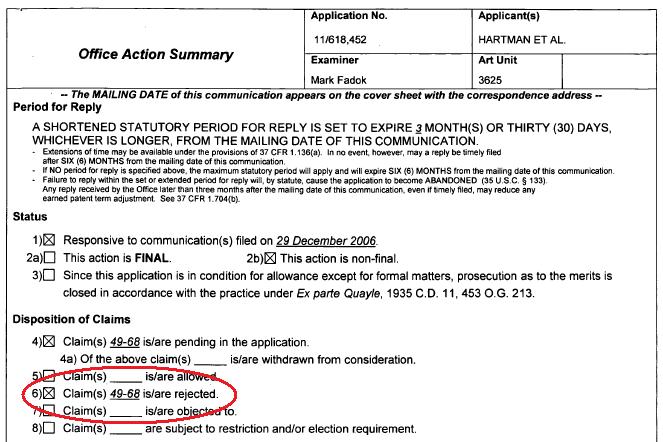
theodp writes "After USPTO Examiner Mark A. Fadok rejected Amazon CEO Jeff Bezos' 1-Click Patent claims as 'old and obvious,' Amazon canceled and refiled its 1-Click claims in a continuation application as it requested an Oral Appeal, a move that smacked of a good old-fashioned stalling tactic. But the move may have backfired, as Fadok has just completed his review of the continuation app and concluded that all of the refiled 1-Click claims should be rejected, providing explanations of why the Board of Patent Appeals was wrong to reverse his earlier decision after listening to Amazon's lawyers in September. In October, USPTO Examiner Matthew C. Graham rejected most of the 1-Click claims as part of the reexam requested by LOTR actor Peter Calveley, a decision that attorneys for Amazon are currently trying to work around with some creative wordsmithing. Can't see how all of this means 'less work for the overworked Patent and Trademark Office.'"
Three words: Mod Parent Up. This behavior, and the backlash to big box stores, have been pretty obvious to the observer since the advent of the supermarket. As an aside though, Jeff Bezo is probably paying his employees fairly and paying a whackload of taxes to boot.
Disclaimer: As a Canucklehead I know extremely little about American corporate law other than someone will eventually get screwed when a CEO siphons off a billion dollars of company money to buy ridiculous crap.
Well, I've had to write code that hits AWS, and I'm not *that* impressed with it. It's a set of Web Services. The documentation isn't particularly good, and the interfaces aren't particularly good. It's decently usable.
But I also fail to see how this is "utterly ridiculous" as a patent. (Here we go again.) The relevant criterion is "non-obviousness". When Bezos told his programmers to implement "one-click", their first implementation took two clicks: buy, then confirm. So he told them to go do it again. It's gotten a little better since 1999, but at that time, that was the thinking of programmers: you have to confirm everything.
(Look at the GNOME trash can, even today, for example: it asks you to confirm emptying it, even though the whole point of the trash can itself *is* the confirmation step. Yes, it's confirming my confirmation.)
Of course, anybody who's read any user interaction books by Alan Cooper knows that confirmation dialogs are stupid, and don't (in general) work. Users build the habit that "operation + confirm" *is* the operation, so the one time in a dozen they don't want to do it, they do anyway, out of habit. This is why Undo was invented -- which is what One-Click allows, in fact. But in 1999, most people still hadn't really understood why Undo was better than Confirm (and many people still don't), and they sure hadn't figured it out with respect to online shopping.
Finally, if Amazon's programmers are so smart, and if one-click is so obvious, then why did Amazon's own programmers have trouble understanding that something called "one-click" is supposed to take
"Theories have four stages of acceptance: i) this is worthless nonsense; ii) this is an interesting, but perverse, point of view; iii) this is true, but quite unimportant; iv) I always said so." -- J.B.S. Haldane, 1963
This is one reason you haven't received a dime of my money. Hasn't hurt me a bit, because EVERYTHING you sell can be acquired from other places, and from what I've seen, often at better prices.
I know this is going against the grain, but the one-click patent wasn't obvious to me. When I first enabled it on my amazon account and I clicked the link I *didn't expect the transaction to be complete*. I'm a pretty bright software engineer working at a startup, and I honestly didn't comprehend how it worked until I saw it. I assumed that it would be one click followed by a confirmation.
On reflection, I realized that it was because when looking at how to do an e-commerce system no matter how short you try to make the checkout process you want to include a confirmation. It would be dangerous not to do so. The innovation seems to be that you can order with one-click and then, to make it not dangerous, you can cancel within an hour or so. I don't know whether it's patent-worthy, but it's at least clever to allow error correction after the fact instead of forcing a check before.
Given the importance that Amazon places upon this particular patent, how many times can Amazon keep going back to the USPTO to get their patent reviewed? At some point, is the patent just ruled invalid, or can they keep this in limbo forever?
The higher the technology, the sharper that two-edged sword.