 Slashdot Mirror
The Dungeons and Dragons Fourth Edition Preview Books
It's a big year for tabletop gamers. In just a few months the first books for the Fourth Edition of Dungeons and Dragons (D&D) will be released by publisher Wizards of the Coast (WotC). The last major update to the game rules was released in 1999, and sparked interest in D&D not seen since the early 80s. To attempt to answer some of the biggest questions about this newest edition, WotC has learned from mistakes made in 99', and is previewing their game updates with a pair of softcover books. Called "Races and Classes" and "Worlds and Monsters", the two titles cover everything from character creation to the new default world's pantheon. More importantly, it includes a large amount of commentary from the designers about why things are going to be as they are. In short: they're must-haves for hardcore D&D fans. Read on for my impressions of these highly entertaining (and vastly overpriced) chapbooks.
Races and Classes
Compiled and Edited by Michele Carter
95 pages
Published by Wizards of the Coast
Rating: 9
ISBN: 9780786948017
From a player's perspective, "Races and Classes" is definitely the more important of these two books. Acting as a stand-in for the upcoming Player's Handbook (due out in June of this year), it shows off the player races and character classes Dungeons and Dragons players will be able to choose for their first Player Characters (PCs). The book is broken up into five sections, with two devoted to the titular character aspects. The other three outline the process of rethinking the game's core. Each section is broken up into a series of short essays on specific subtopics. Each race and class gets at least one essay, with some requiring three or more to fully explore.
As a veteran DM of the 3.0/3.5 era, their choices for which races and classes to include are at the same time surprising and reassuring. Their picks have definitely shaken up the status quo, bucking traditions that date back to the late 80's. The Gnomish race, for example, won't be in the first Player's Handbook. Half-Orcs, one of the favorite races of the current edition, won't be addressed until the Forgotten Realms sourcebook in the Fall.
Instead, standbys like the Elf, Dwarf, and Hafling have been refined and polished to clarify their place in the world. Haflings in particular have been given a fictive solidness they previously lacked: they're now a nomadic boat-people, tending to the waters in the same way the Elves tend to forests or Dwarves to hills and mountains. New additions to the racial roster fill in gaps that have been patched previously in non-core supplements. The Dragonborn race, a reptilian species, is the most obvious of these. Previous 'dragon-ish' races have fit into campaign worlds roughly compared to the core races. Tieflings (half-demons) are another example of this trend. A popular player race in 3.0/3.5, it was challenging to play a Tiefling because of restrictions at character creation.
The process of making and growing a character seems to be the element they examine most closely in the commentary sections of the book. One subheading says it all: "Expanding the Sweet Spot". 3.0/3.5, it has often been noted, follows a power curve that starts somewhat underpowered and eventually reaches a point where players are too powerful to be seriously challenged. Though there's a lot of debate on this point, personal experience suggests the sweet spot for D&D 3.5 is about 5th level to 14th. Though many campaigns will never make it that far, it's frustrating to deal with mechanical weaknesses like that over the lifespan of a game. Fourth edition is a valiant attempt to rectify that by making all levels viable for play.
For a player, viability essentially boils down to "fun". At any given moment, is the player having fun at the gaming table? The Classes they've chosen for core inclusion speak directly to the need for fun. While the Core Four (Fighter, Cleric, Rogue, Wizard) are there, they've also included a number of fun tweaks for additional classes. In 3.5 hybrid classes were rough to play; why would you want to play a Paladin (a weak fighter bolted to a weak cleric) when you could play one of the core four and do something well? Fourth edition solves this issue by looking at the roles behind the classes rather than at class particulars. The Rogue, for example, is the classic Striker. He uses stealth and guile to cause spikes of high damage at opportune times. But that's not the only interpretation you can have of that role; the Warlock (another fourth edition core class) is also a Striker, but he relies on Damage over Time spells and arcane blasts to do his job. The Cleric is the classic Leader, keeping his allies up and in the fight by tapping into a spiritual power. The Warlord does the same through discipline and sheer force of will; the same role, but with a different interpretation.
The real advance is that each class role should always have something interesting to do in a fight, because every role is defined. If you're a Defender, and you're not interposing yourself between the bad guys and the party, you're doing it wrong. That great start is expanded by the inclusion of 'powers'. Previously the domain of spellcasters only, powers are going to be a staple for every class. Instead of the Fighter being forced to dully repeat "I hit it" over and over again, every class will have unique moves and attacks that support their role in the party. And if the Warlock (with powers labeled things like hurl through hell or iron chains of misery) are a good representation, each class should be a lot of fun to play.
I've been reading information about fourth edition greedily since last year on the D&D Insider site, and I thought I had a handle on what this game was going to be like. The class book, though, has been an eye opening experience. The designers just 'get it'. Everything that gets in the way of having fun needs to be excised. This book illustrates that, fundamentally, the WotC designers understand that. In 3.5 Fighters have too few options and Wizards have too many. Fixed. In 3.5 race didn't fundamentally matter, and on top of that each race was fairly poorly defined in the core books. Fixed. In 3.5 class roles were a challenge to understand for new and old players alike. Fixed.
Reading this text read like an answer to every player frustration I've experienced in the past 9 years. The game they describe in the pages of "Races and Classes" sounds like an intrinsically different experience than Dungeons and Dragons 3.5. For some people it's not going to be what they're looking for. For me personally, it's everything I could have hoped for and more. It's always been easy to have fun roleplaying; if they can make character creation fun? If they can make combat purely fun? That's an innovation worth rebooting the system for.
My only complaint with this book is the price. For more on that, please read on.
Worlds and Monsters
Compiled and Edited by Jennifer Clarke Wilkes
95 pages
Published by Wizards of the Coast
Rating: 7
ISBN: 9780786948024
Whereas the "Races and Classes" book speaks directly to the core of the new D&D, "Worlds and Monsters" primarily deals with the frippery and window dressing associated with the new core world. The loosely defined core setting that has always existed in previous editions of the game is going to become more codified in fourth edition. This text talks a bit about that world, and the decisions that went into that choice. It also runs through some of the most well-known monsters in Dungeons and Dragons, explaining how they've been adapted for the new version of the game.
For Dungeon Masters, this is far and away the more fascinating book. This stand-in for the DMG speaks directly to the storytelling core of the game, and hints at the kinds of high-adventure tales we'll be able to craft later this year. The game world sounds quite interesting, both for its specificity and its vagueness. Races, for example, are quite specifically outlined. Tieflings, Dragonborn, Elves ... all have specific creation stories that PCs can share as a common background. Racial traits stemming from historical events will add a lot of texture to character portrayals. At the same time, much of the world is being left deliberately vague. This setting is described just enough to hang plot hooks on, but not enough so that as a DM you'll have to deal with backstory cruft.
The world they describe sounds quite interesting, too. They're calling the core concept "Points of Light". Adventurers are heroes living in a world mostly covered by the darkness of wilderness and the unknown. Small cities and villages dot the landscape, providing shelter and a bright spot in this darkness. The wilderness hides numerous ruins, leftovers from the rise and fall of ancient civilizations. The last great human empire fell about a hundred years ago, in the setting, and the result is something akin to the historical dark ages. Layered on top of this ruin-strewn landscape is a faerie realm, accessible via special holes in the world. Monsters live in the deep woods, and dark magics are hidden underground. It sounds like a great place to adventure.
The monsters section of the book clarifies a number of things about what D&D combat will be like in fourth edition, and speaks again to their goal of 'fun all the time'. 3.5 combat was balanced around the concept of a party fighting one creature of an appropriate level. It turns out? That tends to get kind of boring. Fourth edition combat, instead, is balanced around an equal number of opponents for the players. Having the concept of 'slots', where monsters oppose players on equal footing, and roles (not unlike PC roles) ensures that fights will be actually challenging. 3.5 fights tend to be either bloodbaths or total routs, with little room in-between for contesting the outcome.
That concept of roles has been applied to monsters quite deliberately. Balancing a monster party with Defenders, Skirmishers, Controllers, and Leaders will result in a mixed bag of interesting critters. Monster races that tended toward the generic have even been given a degree of specificity. Instead of Gnolls just being Orcs with Hyena masks on, they'll now apparently fight with pack tactics and cowardly tricks. Giving flavour to the opposition seems to be the basic idea: off-the-rack encounters will no longer feel so rote.
Again, the game they're describing sounds like a lot of fun. My frustration with this text was high on the price side, though. While the "Races and Classes" book speaks directly to the core of the new D&D game, and is a great book to throw at someone still griping about the lack of Gnomes, "Worlds and Monsters" seems like it's mostly a lot of set dressing. Set dressing which (I can only assume) will be reiterated in more detail in the core books. Did I enjoy reading it? Of course. It's interesting stuff. But twenty dollars for set dressing is hard to swallow, especially when we're going to have to repurchase that information in the DMG for another thirty bucks.
At a cost of forty dollars for the pair, it's hard to say if the extremely interesting content is worth the price of admission. In podcasts and commentaries WotC has said how they enjoy the 'DVD extras' model, where consumers pay a premium for 'behind-the-scenes' info. If you really enjoy that kind of content, or just can't wait the next four months for the core books, these will be easy buys for you. The ideal would have been if purchasing these books represented preorders for the core books. Pay $40 now, buy the core books for only $20 each? Anything to make this investment last past May? Instead, we're left with the reality that nothing in these books can't wait until June.
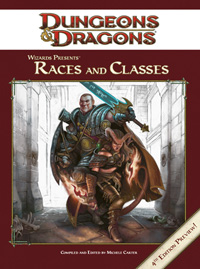
Compiled and Edited by Michele Carter
95 pages
Published by Wizards of the Coast
Rating: 9
ISBN: 9780786948017
From a player's perspective, "Races and Classes" is definitely the more important of these two books. Acting as a stand-in for the upcoming Player's Handbook (due out in June of this year), it shows off the player races and character classes Dungeons and Dragons players will be able to choose for their first Player Characters (PCs). The book is broken up into five sections, with two devoted to the titular character aspects. The other three outline the process of rethinking the game's core. Each section is broken up into a series of short essays on specific subtopics. Each race and class gets at least one essay, with some requiring three or more to fully explore.
As a veteran DM of the 3.0/3.5 era, their choices for which races and classes to include are at the same time surprising and reassuring. Their picks have definitely shaken up the status quo, bucking traditions that date back to the late 80's. The Gnomish race, for example, won't be in the first Player's Handbook. Half-Orcs, one of the favorite races of the current edition, won't be addressed until the Forgotten Realms sourcebook in the Fall.
Instead, standbys like the Elf, Dwarf, and Hafling have been refined and polished to clarify their place in the world. Haflings in particular have been given a fictive solidness they previously lacked: they're now a nomadic boat-people, tending to the waters in the same way the Elves tend to forests or Dwarves to hills and mountains. New additions to the racial roster fill in gaps that have been patched previously in non-core supplements. The Dragonborn race, a reptilian species, is the most obvious of these. Previous 'dragon-ish' races have fit into campaign worlds roughly compared to the core races. Tieflings (half-demons) are another example of this trend. A popular player race in 3.0/3.5, it was challenging to play a Tiefling because of restrictions at character creation.
The process of making and growing a character seems to be the element they examine most closely in the commentary sections of the book. One subheading says it all: "Expanding the Sweet Spot". 3.0/3.5, it has often been noted, follows a power curve that starts somewhat underpowered and eventually reaches a point where players are too powerful to be seriously challenged. Though there's a lot of debate on this point, personal experience suggests the sweet spot for D&D 3.5 is about 5th level to 14th. Though many campaigns will never make it that far, it's frustrating to deal with mechanical weaknesses like that over the lifespan of a game. Fourth edition is a valiant attempt to rectify that by making all levels viable for play.
For a player, viability essentially boils down to "fun". At any given moment, is the player having fun at the gaming table? The Classes they've chosen for core inclusion speak directly to the need for fun. While the Core Four (Fighter, Cleric, Rogue, Wizard) are there, they've also included a number of fun tweaks for additional classes. In 3.5 hybrid classes were rough to play; why would you want to play a Paladin (a weak fighter bolted to a weak cleric) when you could play one of the core four and do something well? Fourth edition solves this issue by looking at the roles behind the classes rather than at class particulars. The Rogue, for example, is the classic Striker. He uses stealth and guile to cause spikes of high damage at opportune times. But that's not the only interpretation you can have of that role; the Warlock (another fourth edition core class) is also a Striker, but he relies on Damage over Time spells and arcane blasts to do his job. The Cleric is the classic Leader, keeping his allies up and in the fight by tapping into a spiritual power. The Warlord does the same through discipline and sheer force of will; the same role, but with a different interpretation.
The real advance is that each class role should always have something interesting to do in a fight, because every role is defined. If you're a Defender, and you're not interposing yourself between the bad guys and the party, you're doing it wrong. That great start is expanded by the inclusion of 'powers'. Previously the domain of spellcasters only, powers are going to be a staple for every class. Instead of the Fighter being forced to dully repeat "I hit it" over and over again, every class will have unique moves and attacks that support their role in the party. And if the Warlock (with powers labeled things like hurl through hell or iron chains of misery) are a good representation, each class should be a lot of fun to play.
I've been reading information about fourth edition greedily since last year on the D&D Insider site, and I thought I had a handle on what this game was going to be like. The class book, though, has been an eye opening experience. The designers just 'get it'. Everything that gets in the way of having fun needs to be excised. This book illustrates that, fundamentally, the WotC designers understand that. In 3.5 Fighters have too few options and Wizards have too many. Fixed. In 3.5 race didn't fundamentally matter, and on top of that each race was fairly poorly defined in the core books. Fixed. In 3.5 class roles were a challenge to understand for new and old players alike. Fixed.
Reading this text read like an answer to every player frustration I've experienced in the past 9 years. The game they describe in the pages of "Races and Classes" sounds like an intrinsically different experience than Dungeons and Dragons 3.5. For some people it's not going to be what they're looking for. For me personally, it's everything I could have hoped for and more. It's always been easy to have fun roleplaying; if they can make character creation fun? If they can make combat purely fun? That's an innovation worth rebooting the system for.
My only complaint with this book is the price. For more on that, please read on.
Worlds and Monsters
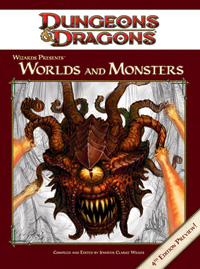
Compiled and Edited by Jennifer Clarke Wilkes
95 pages
Published by Wizards of the Coast
Rating: 7
ISBN: 9780786948024
Whereas the "Races and Classes" book speaks directly to the core of the new D&D, "Worlds and Monsters" primarily deals with the frippery and window dressing associated with the new core world. The loosely defined core setting that has always existed in previous editions of the game is going to become more codified in fourth edition. This text talks a bit about that world, and the decisions that went into that choice. It also runs through some of the most well-known monsters in Dungeons and Dragons, explaining how they've been adapted for the new version of the game.
For Dungeon Masters, this is far and away the more fascinating book. This stand-in for the DMG speaks directly to the storytelling core of the game, and hints at the kinds of high-adventure tales we'll be able to craft later this year. The game world sounds quite interesting, both for its specificity and its vagueness. Races, for example, are quite specifically outlined. Tieflings, Dragonborn, Elves ... all have specific creation stories that PCs can share as a common background. Racial traits stemming from historical events will add a lot of texture to character portrayals. At the same time, much of the world is being left deliberately vague. This setting is described just enough to hang plot hooks on, but not enough so that as a DM you'll have to deal with backstory cruft.
The world they describe sounds quite interesting, too. They're calling the core concept "Points of Light". Adventurers are heroes living in a world mostly covered by the darkness of wilderness and the unknown. Small cities and villages dot the landscape, providing shelter and a bright spot in this darkness. The wilderness hides numerous ruins, leftovers from the rise and fall of ancient civilizations. The last great human empire fell about a hundred years ago, in the setting, and the result is something akin to the historical dark ages. Layered on top of this ruin-strewn landscape is a faerie realm, accessible via special holes in the world. Monsters live in the deep woods, and dark magics are hidden underground. It sounds like a great place to adventure.
The monsters section of the book clarifies a number of things about what D&D combat will be like in fourth edition, and speaks again to their goal of 'fun all the time'. 3.5 combat was balanced around the concept of a party fighting one creature of an appropriate level. It turns out? That tends to get kind of boring. Fourth edition combat, instead, is balanced around an equal number of opponents for the players. Having the concept of 'slots', where monsters oppose players on equal footing, and roles (not unlike PC roles) ensures that fights will be actually challenging. 3.5 fights tend to be either bloodbaths or total routs, with little room in-between for contesting the outcome.
That concept of roles has been applied to monsters quite deliberately. Balancing a monster party with Defenders, Skirmishers, Controllers, and Leaders will result in a mixed bag of interesting critters. Monster races that tended toward the generic have even been given a degree of specificity. Instead of Gnolls just being Orcs with Hyena masks on, they'll now apparently fight with pack tactics and cowardly tricks. Giving flavour to the opposition seems to be the basic idea: off-the-rack encounters will no longer feel so rote.
Again, the game they're describing sounds like a lot of fun. My frustration with this text was high on the price side, though. While the "Races and Classes" book speaks directly to the core of the new D&D game, and is a great book to throw at someone still griping about the lack of Gnomes, "Worlds and Monsters" seems like it's mostly a lot of set dressing. Set dressing which (I can only assume) will be reiterated in more detail in the core books. Did I enjoy reading it? Of course. It's interesting stuff. But twenty dollars for set dressing is hard to swallow, especially when we're going to have to repurchase that information in the DMG for another thirty bucks.
At a cost of forty dollars for the pair, it's hard to say if the extremely interesting content is worth the price of admission. In podcasts and commentaries WotC has said how they enjoy the 'DVD extras' model, where consumers pay a premium for 'behind-the-scenes' info. If you really enjoy that kind of content, or just can't wait the next four months for the core books, these will be easy buys for you. The ideal would have been if purchasing these books represented preorders for the core books. Pay $40 now, buy the core books for only $20 each? Anything to make this investment last past May? Instead, we're left with the reality that nothing in these books can't wait until June.
http://www.wizards.com/default.asp?x=dnd/welcome&dcmp=ILC-DND062006FP
My humor is probably your flamebait
... who feels like they may have simplified the most interesting parts clear out of the game, filled the gaps liberally with WoW, and ended up with a game that, admittedly, has a much lower barrier to entry but is also not particularly interesting?
I mean, you can make Monopoly a lot easier to play and simpler to learn if you ditch hotel and house building, the rent for each property is the same, and instead of rolling the dice to move you move one space each time on your turn, but would it be fun?
3/3.5E's not perfect by a long shot to me either, but what we've seen of 4E so far is honestly just not interesting to me.
I used to play D&D (and AD&D) a lot when I was in junior high (I'm a crusty old 38 years now). I had a lot of fun. Occasionally I browse through the computer games at the box store and see things that look D&D-ish. But, I think I really would like to have something that feels like the old "pen-and-graph-paper" game rather than the most awesome 3d graphics.
Is there a computer game out there that can give me that nostalgic experience? Or will I have to buy the books and get a group of like-minded geeks together for old times sake?
Want D&D to run smoothly again?
1: The keywords here are "simple" and "straightforward". The current grapple rules are painful, many conditions make no sense (can a construct be nauseated? the answer may surprise you), and what exactly does polymorph do these days? You don't know. No one knows. It's been errata'd like eight times. If a rule takes longer than two or three sentences to explain, people have already stopped caring.
2: Fix stacking and inherited bonuses. The days of sixteen different kinds of bonus all adding up to push a character WAY off the random number generator have to end; at the same time, feats that provide an advantage so small you frequently forget about it also must end. Feats and abilities need to provide meaningful options without turning rolls into "no lose" situations.
3: Get rid of gold = power. The 3.5 conceit of assuming characters of level X would have Y gp worth of Magical Stuff ruined a lot of flavor and a lot of system. Let the GM handle the distribution of magic items, and let the PCs spend their gold the way it was intended: on ale and whores.
4: Fix the phrase "level appropriate ability" firmly in mind. At every level, every character should gain new abilities appropriate to that level. Every one. It's WAY too easy in 3.5 to fall off the level appropriate ability train for life.
5: Want to playtest? Recruit the twinkiest, most outrageous powergamers you can find. They're the ones that spot inane bullshit like Balor mining, chain-binding djinni, and the truly stupid amount of awesome that 3.5 clerics and druids bring to the table.
Since based on what I've heard so far, not one of these is actually happening (with the possible exception of #1), I am not optimistic.
"I have spread my dreams under your feet, Tread softly, because you tread on my dreams." - W. B. Yeats.
D&D --> Diku/CircleMUD --> Everquest --> World of Warcraft --> D&D
Adventurer 1: I spend my reward on new spells and potions how about you?
Adventurer 2: I spend mine on ale and whores...So you know cure disease?
I don't care the version, you won't lose some of the best "non-battle conversation"
Ask not what you can do for your country. Ask what your country did to you
Uh... no. Paladins are competent, with a few useful abilities and a lot of bad ones. You can make them good, but it takes a lot of effort to get there. Their spellcasting has a few gems, but is overall lackluster, and the only thing their turning attempts are good for is burning for Divine feats.
Clerics and Druids, hands down, are the "most powerful" core classes, with probably an edge to druids, because making a good one requires almost no effort.
Overall, it's a reasonably good review that is, in my view, overly optimistic about how 4th ed will turn out. He's definitely right about combats: "3.5 fights tend to be either bloodbaths or total routs, with little room in-between for contesting the outcome." is exactly how a lot of fights turn out, particularly when players discover the joys of Save-or-Die. Part of the problem with the "four encounters per day" balance idea was that the fourth was the only one that was actually challenging, because it's the only time the players would be getting low on resources.
"I have spread my dreams under your feet, Tread softly, because you tread on my dreams." - W. B. Yeats.
What happened to "Ask The Designers of D&D Fourth Edition" that was posted back in January? Are we ever going to see a follow-up to this? Did they not like all the questions? Guess I shouldn't hold my breath...
Paladins are probably the most powerful class in DnD!
Wait, are we both talking about 3.5 D&D? If so, I think you're the only person I've ever heard say it's the most powerful class. The common opinion among everybody I've talked to is that paladin is one of the worst-designed classes in the PHB, and possibly the weakest, although some people will argue that monks are weaker.
No, seriously -- if you think paladins are that great, I'd be interested in hearing why. From what I can see, the class basically just stops growing after 5th level. Remove disease a few times per weak is pitiful compared to the cleric who can do it several times per day; their signature ability, smite evil, is usable on only a few attacks per day, and the bonus to damage is miniscule compared to how much high-level spells can do; and their spellcasting can't hold a candle to any of the full spellcasters. The only other thing they get is minor improvements to their mount; the mount is almost as useful as the party's fighter when you first get one, but later on they're nothing but an extra target on the battlefield.
If you want a holy warrior type character, paladin 4 / cleric 16 is objectively just a better build. You'll have a 16 BAB, which is still enough for four attacks, plus a much better will save and a better fort save due to the way multiclassing saves works, plus you'll be able to cast 8th level cleric spells. The only things you lose are a few hit points, a few uses of smite evil & remove disease, and a rather weak mount. Of course, spending a couple of your fourth level spell slots on Divine Power will bump your BAB up to 20 and give you effectively a d10 hit die, anyway, not to mention +6 to strength.
Heck, just ditch those paladin levels, and the only things you lose are a few class abilities that are easily emulated by other spells; in exchange you can turn undead better and get game-breaking 9th level spells.
Even compared to other melee classes, the paladin lacks the mobility & damage potential of a bow ranger, a TWF/UMD rogue, or a raging barbarian. Even the fighter is more versatile with all of his fights, but mind you, I'm not making the case that fighter is actually a good class, either.
Karma: Terrifying (mostly affected by atrocities you've committed)
"why would you want to play a Paladin (a weak fighter bolted to a weak cleric) when you could play one of the core four and do something well?"
Because you're ROLE-PLAYING. Aren't you? You aren't just rolling dice and putting the business end of a sword into randomly-generated monsters to acquire their gold and +2 swords (+4 vs. randomly-generated monsters), are you?
In short: they're must-haves for hardcore D&D fans.
I'll bet there isn't anything worth justifying the price of the new books in there if you look at it honestly.
Called "Races and Classes" and "Worlds and Monsters", the two titles cover everything from character creation to the new default world's pantheon.
They've done that dozens of times. Races and Classes was originally called Player's Manual back when I was a kid. The pantheon book was Deities and Demigods, or optionally Greyhawk. It's been done and done and done.
This is what WotC does. Take it out, polish it, change things just enough to be incompatible with the last version, and resell. Expensively. Look at Magic the Gathering for another example. Each expansion came out with something that would absolutely devastate the previous versions - to stay current you HAD to keep buying it. And for tournament play you weren't allowed to use older sets either. That's why they called MtG Cardboard Crack.
This is just the latest round of "buy this update we need another injection of cash" from WotC. I'll pass.
Weaselmancer
rediculous.
Why do some people think that you can only RP if you pick a sub-optimal character?
If it's for-profit but free, you're not the customer -- you're the product (e.g., the Slashdot Beta's "audience").
Is it the best of the AD&D-inspired RPGs? I don't know, but I don't like what I've read so far. Besiders it will be hard to beat Hackmaster.
Seeing the price of the books, what I would recommend to a beginner is the following: Go to a used book store and buy a set of the excellent hardcover AD&D books by Gary Gygax. Why play immitations when you can play the real thing? I can buy them locally in excellent condition for $10 each. For the DMG, PH, MM1&2 and Unearthed Arcana you will pay $50, but you'll walk away with something substantial, historical and cannonical. You'll also learn about the real spirit of AD&D, which has since been emasculated by various marketeers who tried to cash in on the game (by targeting 11-year-olds). Also, the binding is built to last for decades, unlike the modern glue crap.
Many people are realizing the value of the AD&D, and several game cons are now hosting AD&D tables.
Did they bring back weapon speed factors and "vs. armor type" modifiers? And are there crude b/w drawings of bare-chested female monsters?
You see? You see? Your stupid minds! Stupid! Stupid!
Here are my concerns with 4e:
1. WotC has not responded to the "Ask the developers questions" that have been posted for over a month.... Not a single question.
2. WotC claims to still be playtesting and running into some major issues (War-Forged Palidins are nigh invincable). However, they are preparing to mass produce the books in order to ready for launch in June.
3. WotC wants ~$14.00 subsciption fee to continue to get online updates and erratas.
...a. It will also allow for "virtual tabletop" but from what I have seen, there are open source "virtual tabletop" systems that CURRENTLY offer more flexability... and are FREE!!!
.
4. 4e will introduce "level specific" items. The playtesting reports indicate that at 11th level, a NON-combative character (wizard) is ASSUMED to have +5 bonus to thier armour class....
5. You have to be 11th level BEFORE you can use a ring!!!! You need to be level 21 before you can use a second ring
6. WotC seems to be creating a "digital devide".... The virtual tabletop will contain/replace miniatures... But they want us to buy miniatures as well. To my knowledge, these are mutually exclusive in the 4e gaming environment.
7. Supposedly, WotC will be releasing a NEW Dungeon Master Guide and Players Handbook ONCE A YEAR!!! (however, maybe these will elminiate the need for online errata's???? Not a good deal either way, IMHO)
8. If this is a preview, why do we have to pay for it??? And, to the author, how is that "valuable"?
9. Now we need a new tag for "Hack and Slash-vertisement"
P.S. Please don't use the Gandalf quote of "There are many magic rings in this world, Bilbo Baggins, and none of them should be used lightly." to justify the level dependent rings... unless Bilbo was 11th level or higher at the time. ; )