 Slashdot Mirror
Mark Zuckerberg, Inventor
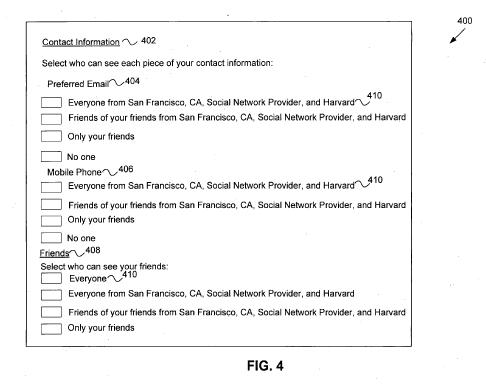
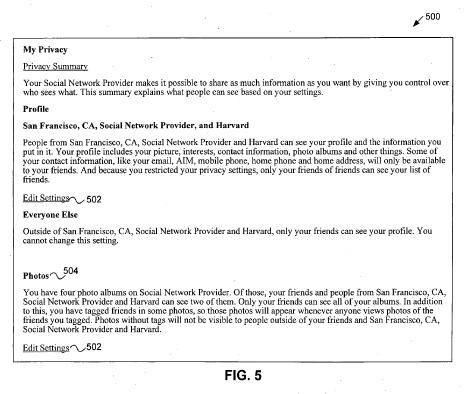
theodp writes "Move over, Thomas Edison. Here comes Mark Zuckerberg, inventor extraordinaire. Zuck's still waiting for that elusive first patent to be issued, but take a gander at the Facebook founder's patent application for Dynamically Generating a Privacy Summary to get an idea of what's in the works. After you check boxes on a form to indicate that 'Everyone from San Francisco, CA, Social Network Provider, and Harvard' can see your profile, Zuckerberg's 'invention' will miraculously display: 'People from San Francisco, CA, Social Network Provider, and Harvard can see your profile.' How dare Rolling Stone question his inventiveness!"
Some deserve it. But I don't read this site for editorials, I read it for some of the scientists and engineers that will comment after the fact.
But this kind of initial submission makes it hard to even read the front page.
I don't really understand the view that because someone succeeded they must be smart. This isn't necessarily true at all. Success is often a matter of luck or timing that had nothing to do with skill.
For example, Apple didn't succeed with their Newton handheld but Palm computing did with their Pilot. Most people agree its a case of market timing, even though the Newton was unarguably a more powerful device all-round.
Whether Mark stole an idea or not should be argued on its own merits, whether he succeeded in the resulting application of that theft or not.
People (with money) steal ideas all the time and then hire people to implement it for them leaving true inventors empty handed. Ask the inventor of the Yo-yo how his patent fights against big companies have been for example.
No matter what you were told in school, market forces are NOT fair. They may determine several things, but determining who DESERVES credit or compensation is not one of them.
- Michael T. Babcock (Yes, I blog)
Seriously, hate the game, i.e. the patent system. It makes a lot of sense for companies to patent everything they possibly can, if only for defensive purposes. If the patent is accepted, cool, you have another patent to sit on. If it's not accepted, oh well, you lost some time and money. There's no real reason not to try to patent any little thought that passes through your mind, no matter how stupid or banal.
There are probably other reasons to hate this guy. Being even somewhat responsible for Facebook is probably enough. But filing for frivolous patents is just the way you do business these days, so nothing to get excited about there. It's just an indication that (in case you haven't figured it out) the patent system is in serious need of reform.
> I don't really understand the view that because someone succeeded they must be smart. This isn't
> necessarily true at all. Success is often a matter of luck or timing that had nothing to do with skill.
It has everything to do with skill. It just not necessarily the skill you have, so it might look like magic to you instead. Could I have invented Facebook, for example? Technically, sure. There's nothing difficult about it; I would probably have even done a better job with the implementation. Why didn't I? Because I don't need it and I can't imagine why it would be useful, and so wouldn't have ever thought of it as a sellable idea. In fact, I still can't understand what all those social networking sites are for. It's not an idea that has any meaning to my generation. Yes, I tried it. I have a MySpace profile. I puttered around the site for a few days and just couldn't figure out what the big fuss was about. It took some serious amount of cultural knowledge to see that this idea would sell. I don't know why it sells, but that's why I'm not the Facebook owner. It is not about luck or timing here. It's about knowing things I do not.
There are 3 facts about success.
1 - it about WHO you know and WHO knows you. Having the right network will make you a CEO.
2 - it's all about timing. I dont care how innovative your idea or product is, if it's not the right time for it, it will fail.
3 - Dumb luck. Many successes confound everyone. Twitter for example, what an inane idea, yet people are taking to it like flies.
Being a genius, inventor, or guru means NOTHING. Look at Tesla. he actually invented radio, AC power, and 90% of what we use today. Problem is other turds like Marconi used Tesla's ideas (and patents) to beat him to the patent office. Yet History still shows incorrectly as Marconi as the inventor of radio, even though congress and other bodies overturned the claims and gave it to Tesla. He died a pauper alone in his apartment. Tesla was as smart as Einstein if not smarter. He had bad timing and was did not have the right network.
Do not look at laser with remaining good eye.
...'cause the prior art on this won't already be ridiculous...
Seriously though - this whole situation is bonkers. Can we just start making people take IQ tests of some sort before being allowed to apply for a patent? Sort of the intellectual equivalent of "must be this tall to ride this ride". Or maybe they just need to add a new department to the USPTO that performs a "Is this completely f***ing retarded" test on all IT patent applications before the rest of the office even sees them.
You are using English. Please learn the difference between loose and lose; they're, there, and their; your and you're.
I think a lot of the success of Facebook is attributable to the fact that it was college-only at first. It was a walled garden, which was a huge draw for people who wanted the social networking features without dealing with insane 14-year-olds and 50-year-old perverts. By the time Facebook opened up to both groups, however, college students were too heavily invested in it to be bothered to switch. And there wasn't much else to switch to, really.
I really miss the old days of Facebook, when you updated your profile all the time and joined/created all kinds of crazy groups for goofs. It was a lot of fun back then. Now my entire family has added me as a friend and all my exes reload my profile all day waiting to see if, by chance, I've become a miserable hermit. I can't post a picture without mentally making sure it's ok for my entire extended family and all future potential connections (bosses, etc.)
Pet Rocks. Everybody Loves Raymond. Cabbage Patch Kids. Tila Tequila. George W. Bush. Perhaps in hindsight you can explain them, but that is meaningless. Does your explanation provide any predictive power, or does it just fit itself to observed facts?
Sometimes, the only thing that makes a product popular is the fact that it is popular. It's the network effect. Most of the time, when people are free to do what they choose, they choose to imitate other people. Things become popular just because random fluctuations in popularity lead to a runaway feedback loop of imitation.
But Lumpy was talking about luck in general terms. Sometimes people know the right people, have the timing right, even have a good idea, but they still don't get the break. On the other hand, luck can trump everything else. Think of the inventions that were found while looking for something completely different.
- None can love freedom heartily, but good men; the rest love not freedom, but license. -- John Milton
Yet Zuckerberg is the 24-year old BILLIONAIRE and Greenspan isn't.
Billionaire? Really? Is all that money on a piece of paper, or in his bank account?
Until Facebook has (at the very least) an IPO, Zuckerberg isn't a billionaire, he just owns part of an entity that some people believe to be worth billions.
Hollow words will burn and hollow men will burn.
Ok. So How about this for a non-self-important, non-jealous, non-douchey response:
Disclaimer: I happen to know many of Mark's friends, as well as having gone to school @ Stanford when Facebook made it's break-through in the beta stages. I've been a member for ages, and seen pretty much everything. I almost tried to work there, but when I interviewed I knew it wasn't the place for me.
Now to go on. Zuck, and Facebook by extension, really do think they know better than their users and everyone else. Their opt-out marketing ploys and from-the-first-day terrible privacy and retention policy's (go to the picture bucket for something you deleted. see it still? yeah, me too.) show their true colors as a data aggregation service.
They managed to create a token service that in exchange for hundreds of dollars of personal information (ie. your contact info is generally accepted as being worth $5. For browsing habits, preferences, etc. go up an order of magnitude), they give you shiny trinkets and a simplified website.
Zuck and many of his friends are more concerned with how they're going to cash out than any social good that they could bring from the service. Time and time again they demonstrate how little they are concerned by the preferences of their users, and believe that huge privacy and datamining fau paux's can be made up for by a well-worded apology (no doubt, written by their writing staff).
Do me a favor, and don't defend him. He doesn't deserve his success, and although he's been lucky, I expect the luck to run out before they sell out for their desired Billions.
In fact, how about this:
I'll put a $5k bounty on a very well written, adaptable Facebook scraper that can transfer all personal information and friends from their platform, to OpenSocial or a platform of my choosing.
Watch Facebook's bottom line once a altruistic company comes along with the same service.
**AA: a bunch of mindless jerks who'll be the first against the wall when the revolution comes