 Slashdot Mirror
IBM Granted "Paper-or-Plastic?" Patent
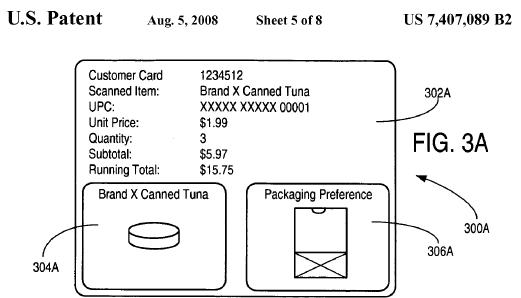
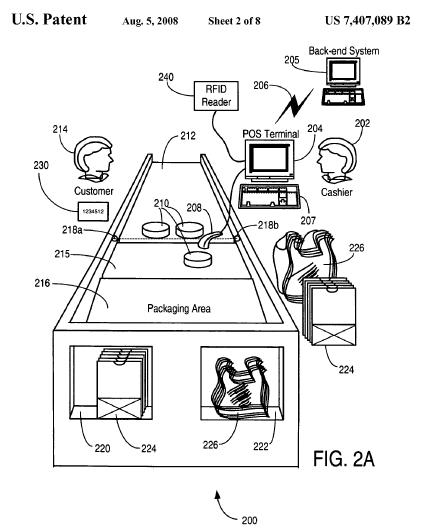
theodp writes "On Tuesday, IBM was granted US Patent No. 7,407,089 for storing a preference for paper or plastic grocery bags on customer cards and displaying a picture of said preference after a card is scanned. The invention, Big Blue explains, eliminates the 'unnecessary inconvenience for both the customer and the cashier' that results when 'Paper or Plastic?' must be asked. The patent claims also cover affixing a cute sticker of a paper or plastic bag to a customer card to indicate packaging preferences. So does this pass the 'significant technical content' test, IBM'ers?"

How about we also solve the "debit or credit" problem I have to deal with each time I visit the mini-mart?
Answering paper or plastic isn't as inconvenient as having to carry around an identification card for every store I shop at. Why don't they just combine all the cards into a single ID. Yeah, and while they're at it, pulling that one card out of my pocket sounds inconvenient too, so why not just permanently affix it to my right hand or forehead. I'm so lucky that everyone wants to help me. /sarcasm off
In Denmark, where "no-nonsense" is a lifestyle, you pay +/- 1$ for each bag you want. (Makes you think twice about double-bagging!). In Belgium, you buy a reusable bag from the store. If it wears out or tears, you can trade it in for free. In the US, you guys are patenting your dependency on foreign oil.
10 ?"Hello World" life was simple then
In Seattle Washington, our City Counsel just voted a 20 cent per bag (paper or plastic) tax. Indeed, the city also outlawed the sale of water in plastic single-use bottles in or on all city owned property. I believe that more and more municipalities are headed this direction.
But it's still an asinine patent that is a perfect example of one of the many problems with our patent system.
If you want news from today, you have to come back tomorrow.
The common one you get from people is either they get into the water and damager wild life, or they don't bio-degrade.
correct.
If its damage, then if you take care to dispose, how is it an issue?
if they're not biodegradable, then how do you dispose of the millions of bags that are thrown in the trash every day? where do you put them?
If its bio-degrade, I dont get that either. They arent the largest things around. Is it a significant issue?
you under-estimate the number of plastic bags thrown away each day. They aren't only used in supermarkets for your groceries. Practically every store uses them (clothing, electronics, books, everything). There is also plastic packaging. Plastic bags ARE a HUGE problem.
the really amazing thing here is that those bags seem to know where they are, so they don't decompose when they're not buried in a dump!
MP3 Search Engine
China has just implemented this policy as well, you must pay 0.2 RMB if you want a plastic bag. Stores which still give plastic bags for free will be fined, or worse, shut down.
All in the name of environment.
The cost saved has never been passed to customers. Worse yet, stores have been taking in even more profits, selling at amazing high price all kinds of shopping bags.
The cost is totally transfered to customers. There are other side affects too, as a result. People used to put their garbage in those plastic bags, tied them up before throwing them in the common garbage bin. Now, they just dump the garbage directly in, bringing flies and other insects, and having very stinky neighborhood.
We used to use those as garbage bags as well, and as we are only two, we don't have much garbage. The smallish grocery store bags are just perfect for daily garbage. Now we have to buy those larger black bags, which we can't fill in one day. Since we don't like stinky overnight garbage in house, we throw away a half empty bag, which is a waste. So, for our family of two, this policy does not seem to do any good to environment. Unless we are willing to keep garbage overnight, of course.
The so-called experts on the panel who decided this policy (in closed door, as all other policies in China) admitted they didn't consider any of the social and cost issues before they passed it. As if this is new to any one.
I think the biodegradable plastic bags sound like the better choice and much more preferable then a 20 cent tax per bag (although it might end up costing more then 20 cents per bag, at least its actually doing something rather then just punishing people)
Your recommendation appears based on the notion that not using plastic bags is punishing someone. I don't see how alternative approaches can ever be considered punishment, given that convenience of any type involves a trade-off, and the negative connotations of the term are more appropriate for bumperstickers and negative campaign ads than for reasoned discussion.
By offering plastic bags, the tradeoff is mostly the wasteful use of resources vs. the customer being able to carry home their purchases. With plastic rings for 6-packs of aluminum cans, the tradeoff includes an even more wasteful use of resources, threats to the marine environment, and the collective cost borne by the rest of society vs. marketing effectiveness (6-packs on sale!) on the part of the retailer, and easy-to-carry benefits on the part of the consumer.
My own opinion is that anything that encourages environmental responsibility and awareness of the true costs involved by all parties is A Good Thing. If that requires a minor incovenience or a similarly minor change of habit and routine on the part of everyone involved, so be it. If it involves a surcharge, then the surcharge will remind people that they have to take into account what the realities are when they make their purchasing decisions and force them responsible for their actions. At the moment, we don't see $20 Environmentally Destructive Surcharge sticker on computer motherboards, but if it comes to that, I'm sure we'd all benefit from it.
You can, of course, seek or encourage compromise solutions. However, the plastic bag problem is relatively simple to fix, so I don't see any need to pursue half-hearted or partially-effective schemes at the periphery when something more fundamental needs addressing. Namely, resources of all types have their limits, we're too wasteful as a society, we're only too happy to remain ignorant of the consequences, and everything has a cost that someone, somewhere pays.
The irony here is that instead of taking the opportunity to use the plastic bag issue as a symbolic Step in the Right Direction and moving on with what we've learned, we're busy arguing over whether consumers are being punished.
Won't someone please think of the consumers! ;-)
In Belgium we have proper beer. So grocery stores try not to annoy us by selling bland liquids like Budweiser.
"I have downloaded hundreds and hundreds of records, why would I care if somebody downloads ours?" Robin Pecknold
Even the oil companies admit they can't get the new oil to market in less than five to ten years.
So, should we not pursue alternative energy also? It takes time to bring to market also. Heck, even educating and convincing consumers to change their habits takes time. We should not pursue your plan by that logic also. Conservation is a good thing, but it won't replace long term production, unless we just stop growing. We have to get our energy from somewhere.
And 5 years is too long? Pfft! What, are you six? Is that forever to you? Who cares if it takes 50 years...think of the grandchildren! But, seriously, have you heard of the futures market, it speculatively bid on things that are, like, in the future. Part of the reason why oil is so high is because the speculation is that there won't be enough oil in the future to meet demand, thanks for that gift, pal.
The fastest easiest way to add more oil to the market is to cut back on usage.
What? huh? Who cares how much oil you are "adding to the market" if you are not using it! That's like saying, "Hey, everybody! We could add more food to the market if we add just stop eating! Hooray!" Please do not mistake me, I am not against conservation. Clearly in my last analogy, there are some people (not everybody) who could go with less food. They would have more personal wealth and there would be more food available for others, but this will not keep feeding people indefinitely. The world's population today could not have lived on the food supply of ages past, even if everybody was on strict rations.
One last thing: Sometimes I wonder; "Is that someone's signature? Or do they type that at the end of each post?"
Plastic bags are NOT a problem. Stop buying into it and read up.
1) The degrade a lot faster then paper bags.
2) Bags made in the US are not from oil(You didn't make this point, but it always crops up)
3) A lot of people use plastic bags as garbage bags. Getting rid of plastic grocery bags means more people are buying 'regular' trash bags; which are far worse in every respect.
Charging a fee hurts the poor. Yes, 1 dollar can mean the difference between eating and not eating.
How about we do it another way? a 20 cent discount for every reusable bag a customer uses?
A large portion of people would switch very quickly. Of course we still have the garbage bag issue.
The Kruger Dunning explains most post on
One easy solution: Get twelve bags.
"The likes of Facebook and WhatsApp are free to those whose privacy is of zero value."